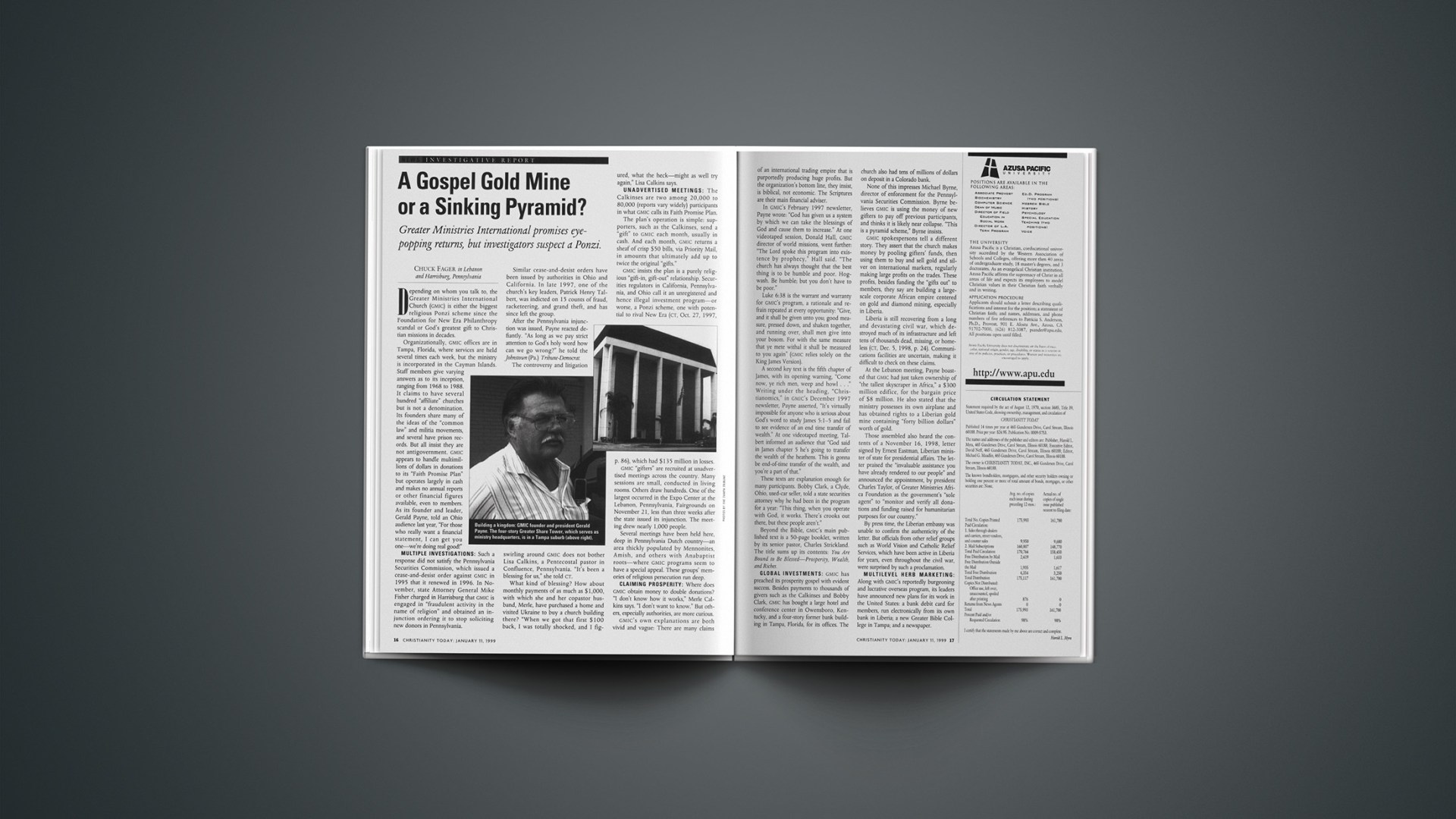

Depending on whom you talk to, the Greater Ministries International Church (GMIC) is either the biggest religious Ponzi scheme since the Foundation for New Era Philanthropy scandal or God’s greatest gift to Christian missions in decades.
Organizationally, GMIC offices are in Tampa, Florida, where services are held several times each week, but the ministry is incorporated in the Cayman Islands. Staff members give varying answers as to its inception, ranging from 1968 to 1988. It claims to have several hundred “affiliate” churches but is not a denomination. Its founders share many of the ideas of the “common law” and militia movements, and several have prison records. But all insist they are not antigovernment. GMIC appears to handle multimillions of dollars in donations to its “Faith Promise Plan” but operates largely in cash and makes no annual reports or other financial figures available, even to members. As its founder and leader, Gerald Payne, told an Ohio audience last year, “For those who really want a financial statement, I can get you one—we’re doing real good!”
MULTIPLE INVESTIGATIONS:
Such a response did not satisfy the Pennsylvania Securities Commission, which issued a cease-and-desist order against GMIC in 1995 that it renewed in 1996. In November, state Attorney General Mike Fisher charged in Harrisburg that GMIC is engaged in “fraudulent activity in the name of religion” and obtained an injunction ordering it to stop soliciting new donors in Pennsylvania.
Similar cease-and-desist orders have been issued by authorities in Ohio and California. In late 1997, one of the church’s key leaders, Patrick Henry Talbert, was indicted on 15 counts of fraud, racketeering, and grand theft, and has since left the group.
After the Pennsylvania injunction was issued, Payne reacted defiantly. “As long as we pay strict attention to God’s holy word how can we go wrong?” he told the Johnstown (Pa.) Tribune-Democrat.
The controversy and litigation swirling around GMIC does not bother Lisa Calkins, a Pentecostal pastor in Confluence, Pennsylvania. “It’s been a blessing for us,” she told CT.
What kind of blessing? How about monthly payments of as much as $1,000, with which she and her copastor husband, Merle, have purchased a home and visited Ukraine to buy a church building there? “When we got that first $100 back, I was totally shocked, and I figured, what the heck—might as well try again,” Lisa Calkins says.
UNADVERTISED MEETINGS:
The Calkinses are two among 20,000 to 80,000 (reports vary widely) participants in what GMIC calls its Faith Promise Plan.
The plan’s operation is simple: supporters, such as the Calkinses, send a “gift” to GMIC each month, usually in cash. And each month, GMIC returns a sheaf of crisp $50 bills, via Priority Mail, in amounts that ultimately add up to twice the original “gifts.”
GMIC insists the plan is a purely religious “gift-in, gift-out” relationship. Securities regulators in California, Pennsylvania, and Ohio call it an unregistered and hence illegal investment program—or worse, a Ponzi scheme, one with potential to rival New Era (CT, Oct. 27, 1997, p. 86), which had $135 million in losses.
GMIC “gifters” are recruited at unadvertised meetings across the country. Many sessions are small, conducted in living rooms. Others draw hundreds. One of the largest occurred in the Expo Center at the Lebanon, Pennsylvania, Fairgrounds on November 21, less than three weeks after the state issued its injunction. The meeting drew nearly 1,000 people.
Several meetings have been held here, deep in Pennsylvania Dutch country—an area thickly populated by Mennonites, Amish, and others with Anabaptist roots—where GMIC programs seem to have a special appeal. These groups’ memories of religious persecution run deep.
CLAIMING PROSPERITY:
Where does GMIC obtain money to double donations? “I don’t know how it works,” Merle Calkins says. “I don’t want to know.” But others, especially authorities, are more curious.
GMIC’s own explanations are both vivid and vague: There are many claims of an international trading empire that is purportedly producing huge profits. But the organization’s bottom line, they insist, is biblical, not economic. The Scriptures are their main financial adviser.
In GMIC’s February 1997 newsletter, Payne wrote: “God has given us a system by which we can take the blessings of God and cause them to increase.” At one videotaped session, Donald Hall, GMIC director of world missions, went further: “The Lord spoke this program into existence by prophecy,” Hall said. “The church has always thought that the best thing is to be humble and poor. Hogwash. Be humble; but you don’t have to be poor.”
Luke 6:38 is the warrant and warranty for GMIC’s program, a rationale and refrain repeated at every opportunity: “Give, and it shall be given unto you; good measure, pressed down, and shaken together, and running over, shall men give into your bosom. For with the same measure that ye mete withal it shall be measured to you again” (GMIC relies solely on the King James Version).
A second key text is the fifth chapter of James, with its opening warning, “Come now, ye rich men, weep and howl … ” Writing under the heading, “Christianomics,” in GMIC’s December 1997 newsletter, Payne asserted, “It’s virtually impossible for anyone who is serious about God’s word to study James 5:1-5 and fail to see evidence of an end time transfer of wealth.” At one videotaped meeting, Talbert informed an audience that “God said in James chapter 5 he’s going to transfer the wealth of the heathens. This is gonna be end-of-time transfer of the wealth, and you’re a part of that.”
These texts are explanation enough for many participants. Bobby Clark, a Clyde, Ohio, used-car seller, told a state securities attorney why he had been in the program for a year: “This thing, when you operate with God, it works. There’s crooks out there, but these people aren’t.”
Beyond the Bible, GMIC’s main published text is a 50-page booklet, written by its senior pastor, Charles Strickland. The title sums up its contents: You Are Bound to Be Blessed—Prosperity, Wealth, and Riches.
GLOBAL INVESTMENTS:
GMIC has preached its prosperity gospel with evident success. Besides payments to thousands of givers such as the Calkinses and Bobby Clark, GMIC has bought a large hotel and conference center in Owensboro, Kentucky, and a four-story former bank building in Tampa, Florida, for its offices. The church also had tens of millions of dollars on deposit in a Colorado bank.
None of this impresses Michael Byrne, director of enforcement for the Pennsylvania Securities Commission. Byrne believes GMIC is using the money of new gifters to pay off previous participants, and thinks it is likely near collapse. “This is a pyramid scheme,” Byrne insists.
GMIC spokespersons tell a different story. They assert that the church makes money by pooling gifters’ funds, then using them to buy and sell gold and silver on international markets, regularly making large profits on the trades. These profits, besides funding the “gifts out” to members, they say are building a large-scale corporate African empire centered on gold and diamond mining, especially in Liberia.
Liberia is still recovering from a long and devastating civil war, which destroyed much of its infrastructure and left tens of thousands dead, missing, or homeless (CT, Dec. 5, 1998, p. 24). Communications facilities are uncertain, making it difficult to check on these claims.
At the Lebanon meeting, Payne boasted that GMIC had just taken ownership of “the tallest skyscraper in Africa,” a $300 million edifice, for the bargain price of $8 million. He also stated that the ministry possesses its own airplane and has obtained rights to a Liberian gold mine containing “forty billion dollars” worth of gold.
Those assembled also heard the contents of a November 16, 1998, letter signed by Ernest Eastman, Liberian minister of state for presidential affairs. The letter praised the “invaluable assistance you have already rendered to our people” and announced the appointment, by president Charles Taylor, of Greater Ministries Africa Foundation as the government’s “sole agent” to “monitor and verify all donations and funding raised for humanitarian purposes for our country.”
By press time, the Liberian embassy was unable to confirm the authenticity of the letter. But officials from other relief groups such as World Vision and Catholic Relief Services, which have been active in Liberia for years, even throughout the civil war, were surprised by such a proclamation.
MULTILEVEL HERB MARKETING:
Along with GMIC’s reportedly burgeoning and lucrative overseas program, its leaders have announced new plans for its work in the United States: a bank debit card for members, run electronically from its own bank in Liberia; a new Greater Bible College in Tampa; and a newspaper.
One of the most aggressively promoted initiatives announced at the meeting involved the introduction of a line of “Greater Life” herbal remedies and food supplements, through a new Greater ministry, the Health Benevolence Christian Fellowship.
Nontraditional medicine has been a keen interest of Payne and his wife, Betty, and an herbal research center has been part of GMIC’s Tampa headquarters complex since 1995. Payne described his hopes for cancer treatment at the center in a deposition: “We actually pull the cancer right out of your stomach,” Payne said. “We never cut the cancer because if you cut it, it spreads through the body and you’re finished.”
The centerpiece of the “Greater Life” line is a nutritional supplement called “Beta 1, 3rd Glucan,” and the Health Benevolence Christian Fellowship is a multilevel plan for its distribution. Program literature insists that the supplement, described as a powerful immune system booster derived from baker’s yeast, is not for sale, but rather is to be distributed solely as “gifts” by the fellowship. The goal is to help believers survive the predicted series of “end-time plagues.”
To receive such “gifts,” however, participants agree to send the program regular donations. Those who send at least $50 monthly can become “fellowship builders.” In addition, for each pair of new donor-recruits signed up, a fellowship builder qualifies for increasing levels of bonus “charity blessings.” These can be redeemed for more supplements, or cash.
ESTABLISHING A NATION:
Greater Life supplements were the newest venture on display at the meeting, but not the ministry’s most ambitious project. That distinction belongs to GMIC’s plan to establish its own country, to be called Greaterlands. This will be, according to its literature, “an Ecclesiastical Domain, i.e., similar to the Vatican.”
The benefits of such statehood are expected to be enormous: “We will become an embassy and our ministers and missionaries may become immune from unwarranted prosecution, and Greaterlands will rule under God’s law in our own courts.” For a $10,000 donation, early supporters are promised a Greaterlands passport, driver’s license, business domicile, and one square foot of land dedicated in their name. Prospective donors are also assured, “You can hold more than one citizenship.”
Payne told listeners after the Lebanon meeting that he is negotiating with the Liberian government to locate Greaterlands on the coast not far from its capital city of Monrovia.
FINANCIAL SETBACKS:
Despite the lengthy list of initiatives, the tone of GMIC’s November 21 meeting was not all upbeat. As Hall explained, in the past several months, “Satan has hindered us. But he cannot stop us.”
One set of hindrances is the spate of cease-and-desist orders, and the Pennsylvania injunction, which the meeting seemed in part designed to test. A sheet headlined “Churches Under Siege” was distributed to all attenders as they entered the hall, along with a second flier describing GMIC’s 1997 legal victory in Florida, where an appeals court had ruled that its gifting program, in its latest incarnation, did not constitute an investment plan.
Besides ongoing legal challenges, the ministry suffered a serious financial setback in July when Best Bank of Boulder, Colorado, failed. The Federal Deposit Insurance Corporation has sued the bank’s president and chairperson for $300 million, alleging massive fraud. GMIC was a major depositor in the bank. GMIC lost more than $20 million in uninsured deposits, though the organization hopes to recover some of the funds.
BIG-TIME LOSSES:
Because of the huge loss, by September the stream of Priority Mail envelopes stuffed with $50 bills all but stopped arriving in gifters’ mailboxes. In the wake of missed payments, many GMIC gifters have felt financially pinched.
Michael E. Miller, part-owner of a personal-care home in Confluence, Pennsylvania, felt especially hard hit. Miller had heard about the gifting program in 1996 from his pastor, Merle Calkins. He attended a meeting where he heard the enthusiastic testimony of an acquaintance who had “maxed out his credit cards and put everything he had into the gifting program,” and learned of others who had done likewise.
Soon, Miller followed their example, holding meetings himself to line up new recruits, selling property, refinancing his home, borrowing heavily, then putting all the proceeds into the program. He even drove to Tampa once to make sure $40,000 of his money arrived at GMIC offices in time for a monthly closing date.
Miller says he put in a total of $98,000. Soon he too received the Priority Mail envelopes full of new $50 bills, along with printed account statements that he could not decipher.
In the summer of 1998, an expected payment of $13,000 did not show up. Miller contacted Payne and informed him he wanted his $98,000 returned. “I was told many times I could get my money back anytime,” he now says. Payne reportedly offered to send him only $18,000 and Miller would then be out of the program.
Miller eventually received $13,000, but no more. He says he has had to sell more property to keep up with his bills, and he has been ostracized by other gifters in his area for speaking out. Miller says GMIC never informed him about the 1995 cease-and-desist order. “If I had known about this order, I would never have invested in Greater,” he says. “I was deceived.”
CT made numerous unsuccessful attempts to talk to Payne. However, videotapes of meetings show Payne and Hall repeatedly assuring audiences that “nobody has ever lost a dime” in GMIC. Miller is one of only two participants to go on record with formal statements to the contrary.
The other is June Smith, a retired businesswoman from Lancaster, Pennsylvania. She told investigators last spring that she put $261,500 into the program, expecting to receive twice as much in return. However, her affidavit states that she received only $129,265—less than half of what she invested—before being “prayed out” of the program. After she protested, Smith testified to Pennsylvania investigators: “Greater placed a curse on my family.”
UNEASY DONORS:
Neither Miller nor Smith has any direct recourse for their claimed losses. Despite what Miller may have been told about receiving his original deposits back, the GMIC gift form, which each donor is required to sign, states that funds deposited are “donations,” and “there are no guarantees implied and the only promise involved is the promise God gives in His word.”
The tapes also show Payne and Hall warning that they have little patience for the querulous. “We don’t want anybody in the program that is a continual doubter,” Payne told an Ohio audience. “If I catch you doubting, guess what happens? You come out. If you doubt, you come out. I don’t care if you’ve got about six million, seven million—don’t make any difference.”
At the Lebanon meeting, Hall repeated the theme: “God has let this [trouble] happen to us in the last five months to shake out all the investors, and all the doubters, and all the unbelievers.”
In the face of such warnings, Michael Byrne of the Pennsylvania Securities Commission complains that it is hard to find people ready to come forward to tell stories in public similar to those of Miller and Smith. But at the Lebanon meeting, it was clear that many such stories had recently filled the phone lines to GMIC offices.
“Some of you are in a financial strain because of Greater Ministries,” Hall told the standing-room-only crowd. “But trust in God, and God will take you through.” He prayed loudly for God to “loose a financial miracle” on those who needed it most.
“A man called me on my cell phone,” Hall acknowledged, “and asked, ‘Why didn’t I get any money this month?’ I told him, ‘You’re one of 80,000 that need it!’ ” (A GMIC spokesperson later told CT that 20,000 is a more realistic figure.) “Brother Gerald,” Hall added sadly, “gets calls all day and night.”
But the interruption in payments, Hall assured the group, is only temporary. “If you’ll hang on and buckle your seat belts,” he declared, “God will give you back seven times more than you gave.” The new $40 billion Liberian gold mine would soon deliver them all, he promised. “We’re going to have more credibility than ever before.”
After the meeting, small groups clustered around the GMIC staff, some holding sheets of paper they had been sent instead of payments. The papers, headed “Storehouse #1, Gold/Silver Receipt,” announced that future payments would be made in the form of IOUs that could be redeemed 30 days after issue for gold, silver, or cash. GMIC staffer David Whitfield also announced that future gift payments would be made through the ministry’s Liberian bank, making use of the new debit card the group would soon issue, with which cash could be withdrawn from many automatic teller machines.
PERSECUTION CLAIM:
Will GMIC get its payments back on track? Or will the cries of “Ponzi” prove prophetic? The ministry’s legal troubles are mounting: Responding to rumblings about a federal subpoena demanding to see GMIC records, Payne adamantly responded at the Lebanon session, “In a pig’s fanny.” He then boasted of going through GMIC offices and “purging the computers” so federal authorities could not hack into them.
Pennsylvania state agents in the crowd did not like what they saw. On December 2, state Attorney General Fisher went back to court in Harrisburg, seeking a sweeping contempt order against GMIC, Payne, and Hall. Fisher called for the surrender of all GMIC records of gifts to or from Pennsylvanians since the November injunction, and refunds of all gifts made in the state since then. He also asked for fines of up to $2,000 per day for noncompliance and an arrest warrant for Payne if he did not cooperate. A contempt of court hearing is set for January 20.
The latest Pennsylvania action sets up a confrontation in court over the limits of freedom of religion. At press time, CT learned that GMIC had retained a new general counsel, Al Cunningham of Redding, California. He told CT he has specialized in religious freedom since a controversial 1981 Nebraska church school licensing case when a pastor spent several months in jail for refusing to submit his church school to state licensing laws.
GMIC attorneys have made religious freedom the basis of their defense in hearings both in Pennsylvania and Ohio. “It’s really very inappropriate for a state to come in and tell religious groups how they should believe and how they should raise money,” says Paul B. Johnson, one of the GMIC attorneys.
Another advocate, Susan Gellman, insists that GMIC’s understanding of what is promised in Luke 6:38 is not within a court’s jurisdiction. “The state’s arguments that this is not, in fact, a gift,” she said in an Ohio hearing, “rely on its rejection of all these witnesses’ beliefs, their religious beliefs.” But, she declared, tribunals and courts “are simply precluded from weighing the merits of those beliefs” by the Constitution.
The Ohio hearing officer was not moved by these assertions, concluding that “Constitutional arguments are often used to cloak impermissible conduct.” Similar arguments carried no weight in Pennsylvania.
In a flier distributed at the Lebanon meeting, GMIC alleged, “Silently, but methodically, local, state, and federal agencies are crossing the line between church, state, and in so doing violate freedom of religion.” Mark Stewart, a Pennsylvania deputy attorney general, retorts, “Individuals’ religious beliefs do not excuse them from complying with otherwise valid laws.”
Thus far, securities agencies in Ohio and Pennsylvania, along with a Pennsylvania judge, have agreed with Stewart. It seems certain that there will be more court fights over GMIC’s programs.
In the coming months, this high-stakes conflict will be played out in lofty courtroom language and in the bank accounts of thousands of ordinary Christians.
Copyright © 1999 Christianity Today. Click for reprint information.