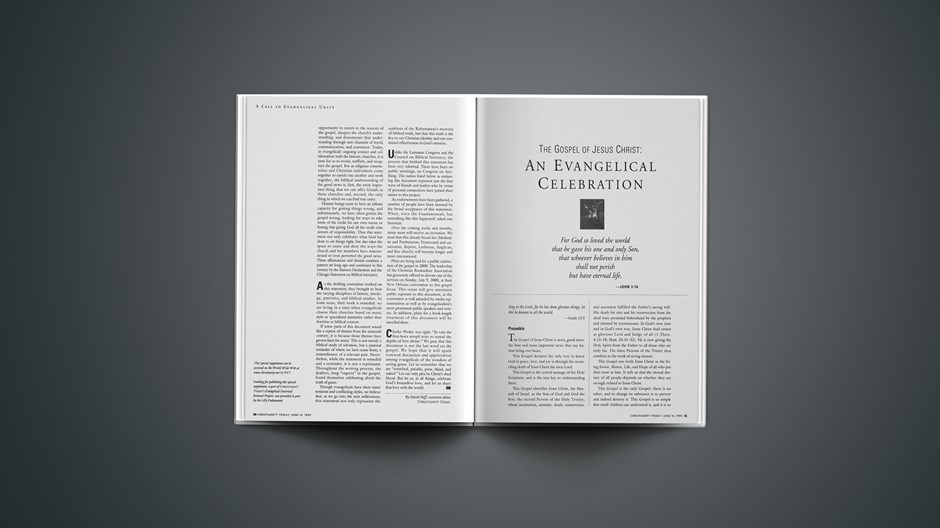
No one should be an accidental evangelical—or a merely cultural one. Unfortunately, few evangelicals can actually articulate the gospel. They can lead people to Christ and help them pray the sinner's prayer, but when it comes to setting forth just how Jesus saves, most of us flounder.
Last year, two evangelical theologians had a bright idea. Wouldn't it be wonderful, they said, if evangelicals could achieve a broad consensus on the gospel and join in a common statement? These theologians felt the pinch of recent tense discussions over how to define the doctrine of justification, a key element of the gospel. They saw the need for a reference document for those engaged in interchurch dialog, for theological students, for pastors, for parachurch ministries, for itinerant evangelists, and for the rest of us. Those two theologians recruited some top Christian leaders and scholars (along with two representatives of Christianity Today). Now, almost a year later, the fruits of their passion appear below.
Of the making of many statements, there is no end. In the history of evangelical Protestantism, issues and opportunities have called forth declarations on various topics. The Lausanne Covenant (1974) is the most famous and influential, with the Chicago Statement on Biblical Inerrancy (1978) running a close second.
Curiously, those who bear the name evangelical (a term that means "of or relating to the gospel") have never put forth a large-scale defining document about the gospel. That is because the gospel itself has not been at the center of modern disputes. In the decades when many evangelical institutions were being founded (from the National Association of Evangelicals and Youth for Christ in the early forties through Fuller Seminary and the Billy Graham Evangelistic Association and up to Christianity Today in 1956), most Protestants agreed (at least formally) on justification, though they were at odds over a multitude of other issues.
As modern evangelicalism emerged from its isolation and engaged American culture as it then was, evangelical leaders paid attention to safeguarding the authority of the Bible and the propositional nature of truth in order to counter the existentialist, liberal, and neo-orthodox tendencies in the theological world of that day.
Today, classic theological liberalism is no longer the church's main threat. As we enter a post-Christian world, one driven by consumer culture and the entertainment industry, we face more basic challenges, such as the radical devaluation of human life. In this context, we find ourselves standing with Catholic and Orthodox believers on key social issues. In deed, through collaboration with Catholic and Orthodox activists in the prolife movement, many evangelicals have discovered a genuine appreciation for and developed friendships with them. This deeper friendship has required that Protestants know their Protestantism (and that Catholics know their Catholicism and the Orthodox, their Orthodoxy).
Providence gave the first evangelicals a gift: at the time of the Reformation, the renewal of classical learning provided an opportunity to return to the sources of the gospel, sharpen the church's understanding, and disseminate that understanding through new channels of travel, communication, and commerce. Today, in evangelicals' ongoing contact and collaboration with the historic churches, it is time for us to revisit, reaffirm, and recapture the gospel. For as religious communities and Christian individuals come together to enrich one another and work together, the biblical understanding of the good news is, first, the most important thing that we can offer friends in these churches and, second, the only thing in which we can find true unity.
Human beings seem to have an infinite capacity for getting things wrong, and unfortunately, we have often gotten the gospel wrong, looking for ways to take some of the credit for our own rescue or fearing that giving God all the credit robs sinners of responsibility. Thus this statement not only celebrates what God has done to set things right, but also takes the space to name and deny the ways the church and her members have misconstrued or even perverted the good news. These affirmations and denials continue a pattern set long ago and continued in this century by the Barmen Declaration and the Chicago Statement on Biblical Inerrancy.
As the drafting committee worked on this statement, they brought to bear the varying disciplines of history, theology, patristics, and biblical studies. In some sense, their work is remedial: we are living in a time when evangelicals choose their churches based on music style or specialized ministries rather than doctrine or biblical content. If some parts of this document sound like a reprise of themes from the sixteenth century, it is because those themes have grown faint for many. This is not merely a biblical study of salvation, but a pastoral reminder of where we have come from, a remembrance of a relevant past. Nevertheless, while the statement is remedial and a reminder, it is not a reprimand. Through out the writing process, the drafters, long "experts" in the gospel, found themselves celebrating afresh the truth of grace.
Article continues below
Though evangelicals have their inner tensions and conflicting styles, we believe that, as we go into the next millennium, this statement not only represents the synthesis of the Reformation's recovery of biblical truth, but that this truth is the key to our Christian identity and our continued effectiveness in God's mission.
Unlike the Lausanne Congress and the Council on Biblical Inerrancy, the process that birthed this statement has been very informal. There have been no public meetings, no Congress on Anything. The names listed below as endorsing this document represent just the first wave of friends and leaders who by virtue of personal connections have joined their names to this project.
As endorsements have been gathered, a number of people have been stunned by the broad acceptance of this statement. When, since the Fundamentals, has something like this happened? asked one historian.
Over the coming weeks and months, many more will receive an invitation. We trust that this already broad list (Methodist and Presbyterian, Pentecostal and cessationist, Baptist, Lutheran, Anglican, and free church) will become longer and more international. Plans are being laid for a public celebration of the gospel in 2000. The leadership of the Christian Booksellers Association has graciously offered to devote one of the services on Sunday, July 9, 2000, at their New Orleans convention to this gospel focus. This venue will give maximum public exposure to this document, as the convention is well attended by media representatives as well as by evangelicalism's most prominent public speakers and writers. In addition, plans for a book-length treatment of this document will be unveiled there.
Charles Wesley was right: "In vain the first-born seraph tries to sound the depths of love divine." We pray that this document is not the last word on the gospel. We hope that it will spark renewed discussion and appreciation among evangelicals of the wonders of saving grace. Let us remember that we are "wretched, pitiable, poor, blind, and naked." Let our only plea be Christ's shed blood. But let us, in all things, celebrate God's boundless love, and let us share that love with the world.
Funding for publishing this special supplement, a part of Christianity Today's Evangelical Doctrinal Renewal Project, was provided in part by the Lilly Endowment.


















 While we pray for peace, we need moral clarity about this war.
 As my doubts about his teachings grew, so did a secret fascination with Jesus.
 The founder of Concerned Women for America was credited by President Ronald Reagan with “changing the face of American politics.”






