It may be that there will be no salvation
for the human spirit
from the more and more painful burdens
of social injustice
until the ominous tendency in human history
has resulted in the perfect tragedy.
—Reinhold Niebuhr
When Eric Harris, 18, and Dylan Klebold, 17, taunted, tormented, and massacred 12 of their peers and a teacher (while seriously wounding 23 others) at Columbine High School on April 20 of this year, Niebuhr’s prophetic insights about the banal and heroic aspects of human nature were fulfilled. The “ominous tendency in human history” and the “salvation for the human spirit” came together for a brief, but life-altering, interlude at Columbine High. It bears the mark of the perfect tragedy.
Some have even called it a watershed. William Kristol in The Weekly Standard (May 10, 1999) noted that as politicians “stumped on behalf of their favorite ‘solutions’’’ in the wake of the Columbine tragedy, “the speeches rang even hollower than usual.” Nancy Gibbs wrote in Time: “With each passing day of shock and grief you could almost hear the church bells tolling in the background, calling the country to a different debate, a careful conversation in which even Presidents and anchormen behave as though they are in the presence of something bigger than they are.”
What is the “something bigger"?
The tragedy has been dissected into many parts: gun-control issues; uncensored access to dangerous information on the Internet; the violent media culture; the cliquish school culture; the need for parental oversight; the separation of church and state. All of these contribute to, but do not alone account for, that “something bigger.”
I traveled to Littleton with the hope of answering the question that has haunted Presidents and anchormen—and us all: What is the meaning of that day at Columbine High School when (as one local pastor describes it) insanity fell like a meteor?
I arrived in Littleton on a steamy July afternoon. I stopped at my hotel only briefly, anxious to run the errand I had to complete before I could move forward with this assignment.
It took 20 minutes to get from my hotel to Columbine High School. It was west on 470, north on Wadsworth, east on Coal Mine Avenue, north on Pierce—and there it was, on the left. I immediately recognized those curved two-story glass windows of the cafeteria and library. Rachel Scott and Danny Rohrbough died outside those windows.
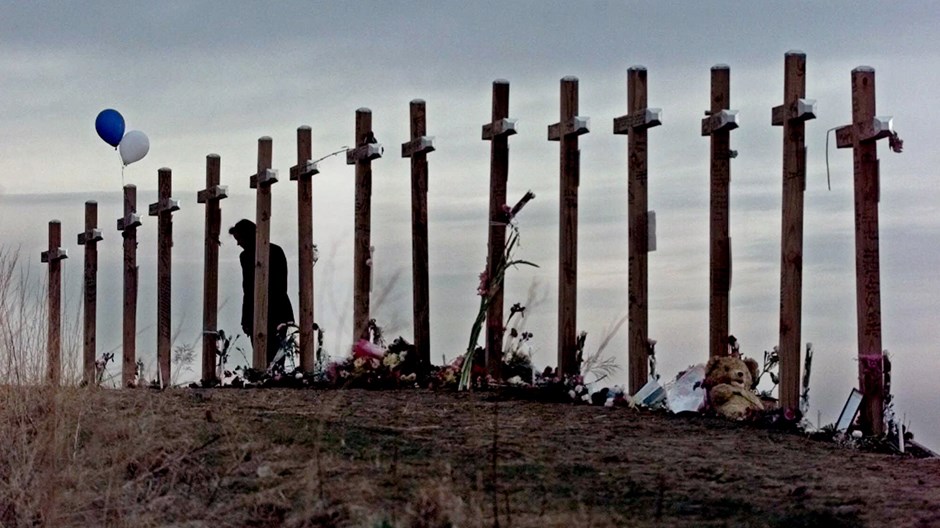
Barricades prohibited me from turning into the school’s parking lot, so I drove another 20 feet and pulled into Clement Park, which shares the school’s northern perimeter. Driving around the outer boundary, I came to Rebel Hill, where the 15 memorial crosses had been placed shortly after the shootings. (They were quickly reduced to 13 when a victim’s father tore down the killers’ crosses.) It was a steep hike from the parking lot to the pinnacle of the hill. I thought of Greg Zanis, the carpenter from Illinois, lugging those crosses all that way.
Three teenage girls were sitting atop the hill. “Father God, you hear their breaking hearts,” one said. “You hear them mourning.”
Bear Creek Junior baseball teams were playing on the field below this hill, directly behind the school. I made my way down. “Make contact, big guy,” one dad shouted to his young son as he stepped into the batter’s box.
I moved closer to the school, walking past a volleyball game where it was “two serving and five,” and a picnic where Paul McCartney’s “Band on the Run” animated a rousing game of Hula-Hoop Kiss (“the longer the hula, the longer the kiss”). The skies were blue; the air, fresh. The clouds hung gracefully over the Rockies. Balloons, bubbles, and barbecue created the impression that everything was as it should be in this perfect world.
Yet, not a hundred yards from the Hula-Hoop Kiss event sat a police officer, parked in the school parking lot to turn away gawkers and trespassers. I had heard some locals complain that tourists had made Columbine one of their vacation stops, just like the Rocky Mountain National Park or the Chatfield Arboretum. But I saw us more as pilgrims trying to come to terms with what happened here.
I went onto school property through a small opening in the barricade. There, under a tree, was another makeshift memorial with 13 American flags and all manner of ribbons, flowers, stuffed animals, and balloons.
“You’re not supposed to be on school property,” said the woman in the police cruiser, leaning out her window.
“Could I leave a note at the memorial?”
“It’s not a memorial. But go ahead, and then please leave.”
I scribbled a note, tucked it under a sprig of dried flowers, and returned to Clement Park.
It struck me how the people here went along as though things were normal and that the events of that school, right next to the park, were all a bad dream. What else could they do? It wouldn’t help anything to declare a moratorium on Little League Baseball or weekend barbecues.
Article continues below
The first clue pointing toward that “something bigger” that transpired at Columbine High School emerged during my visit with John and Doreen Tomlin, whose son John, 16, was killed in the library.
The Tomlins didn’t have their family devotions on April 20, a day that unfolded in slow motion as they waited to hear news from John, a sophomore at Columbine. The first they knew something was wrong was when their son Pat, who is home-schooled, caught news on his portable television that “there was trouble at Columbine.” Doreen’s first instinct was to call her sister in Wisconsin and ask her to pray.
“Within 15 minutes the story just kept getting worse,” she recalls. “I called my sister three times within a half an hour.” Parents were told to go to the Leawood Elementary School, near the high school, to get word of the whereabouts of their children. There, lists were being posted of kids who had been accounted for, and kids were being sent there by bus.
“That was difficult in itself, because you were stuck in traffic, and sirens were going off, and there were helicopters and ambulances. It didn’t seem real,” says Doreen. “Cell phones were going off constantly.”
“The students would pass on a stage at Leawood,” she says. “We were looking for John, and he was never showing up. I was getting envious of parents finding their kids and screaming out their names. I thought, If only I could cry out John’s name.
“I remember [at one point] sitting in the back of the room. There were still busloads of kids going across the stage, and I just didn’t get up anymore. I had no enthusiasm to jump and look for him. I think the Lord was settling it in my heart that John was probably dead.”
“When the buses stopped, things didn’t look good,” adds John’s father, also named John. “I said, ‘Doreen, if they ask us to get up and go into a different room, it’s not a good sign.’ Then they asked us to get up and go into a different room.”
“They said there was another bus,” says Doreen. “We were all clinging to that hope that one more bus would be there.”
Article continues below
“I don’t know why they did that,” says John, “because there was no other bus. After we came out of that room they had us fill out descriptions of our kids.”
When the sheriff told them that most of the kids who died were in the library, Doreen felt sick. “John always goes to the library. I felt like I was going to pass out. I said, ‘I’ve got to go home to be with my other children.’ When I came home, kids from his youth group and the youth pastor were there. I said, ‘I do believe John’s dead.’
“I went up to the shower and prayed with every part of my being. I said, ‘Lord, thank you for the 16 years I’ve had with John. Let this glorify your name. Let his death not be in vain. Let us not become bitter. Fill us with the Holy Spirit. Let it not ruin our marriage.’ I prayed this with every part of me that could call out to him, and I pictured a fountain—when I prayed, ‘Fill us with the Holy Spirit’—it was gushing with water, gushing and gushing.”
The Tomlins eventually went back to their devotional reading, Spurgeon’s writings, dated April 20. The morning reading included: “Child of God, cease to fear dying. Living near the cross of Calvary you may think of death with pleasure. … It is sweet to die in the Lord. … We are not far from home—a moment will bring us there. … When the eyes close on earth, they open in heaven.”
The evening reading said: “There never was a day when Christianity seemed to tremble more than now.”
The Tomlins buried John in their native Wisconsin. After they returned, the girl who was with John under the table in the library came over to see them. She had hidden at first under a table next to John, she told them, but didn’t feel comfortable there and asked John if she could come under the table with him. “She was very traumatized,” says Doreen. “She’d seen kids die; she saw John die and others lying in blood. She still had five bullets in her. She said that [during the shooting] she was talking, and John put his hand over his mouth, saying, ‘Shhhh.’ She said they held hands, and they saw the legs coming toward their table, and she knew by hearing their voices who they were, and she said that they were evil and wicked. She said that if it weren’t for John she wouldn’t be alive. I wondered why she said that. She didn’t elaborate. She said that John was totally calm through the whole thing. I just know the Lord’s presence was there with him.”
Article continues below
The Lord’s presence was with him. This sentiment emerged time and again from my visits with parents, students, pastors, and others intimately connected to that day at Columbine High. The students remained calm before, during, and after the rampage, even after some were gravely wounded; others heroically used their bodies to shield friends and relatives; and several carried the wounded to safety. At the same time, these witnesses attest that there was an equally unmistakable presence of evil.
Shirley Hickman, a Spanish teacher at Columbine, said, “You have to go into the spiritual element because, in human terms, none of it makes sense. These were two suburban boys from two-parent families with plenty of money, part-time jobs; they were good students, intelligent and respected by faculty for their computer skills. But when you think that they walked into school and murdered 13 people, you have to look at the power of Satan.”
Kacey Ruegsegger, 17, had transferred to Columbine High School that year as a junior, and on a fluke, ended up in the library during fifth-period lunch on the day of the shootings. She said, “There was like—I don’t know if I can explain it very well—but like a spiritual battle you could feel going on. As soon as the killers came in you could feel evil in the room. Yet, I also felt God’s presence, or maybe it was just angels, also with me in the room.”
The shooting started around 11:20 a.m. that Tuesday, April 20. According to Darrell Scott, Rachel’s father, the opening shots were targeted at Mark Taylor, a Christian who was witnessing to two Mormon classmates at the time. He was hit through the left thigh and fell crumpled on the grass. Rachel Scott (17), a junior, was eating lunch with Richard Castaldo when she was shot in the arm, thigh, and chest. Castaldo was hit through his left arm, right arm, through the lungs, kidneys, and vertebrae. The exact sequence of events is still sketchy, but by one account told to Rachel’s older sister, Dana, after wounding Rachel and Richard, the gunmen shot Danny Rohrbough and his friends Lance Kirkland and Sean Graves. Kirkland lay on the ground and cried, “Help me.” A figure approached him and said, “Sure, I’ll help you.” It was Dylan Klebold, who then shot Kirkland in the face.
Article continues below
Rachel Scott was on the ground crying. There are conflicting reports about what happened next, but friends told the Scott family that the killer walked up and pulled Rachel’s head up by her hair. Says Dana: “They confronted her with the question, ‘Do you believe in God?’ and she said yes, and they took a gun to her temple and killed her.”
The gunmen then started shooting through the cafeteria windows hoping to detonate bombs. They entered the cafeteria, tossing homemade bombs into the air and shooting randomly.
The gunmen made their way upstairs. They encountered teacher Dave Sanders, who was shepherding students out of the school, and shot him through the back.
By the time the gunmen had entered the library, Patti Nielson, the teacher on hall duty, had already warned everyone to get under the tables. Kacey Ruegsegger recounts: “They shot as they came in and made their way down [to the windows]. The first one they shot was Kyle [Velasquez]. They were laughing and saying how much fun it was and, ‘We’re going to blow up this library,’ and, ‘Today is your day to die.’ I remember one of them dropping his trench coat [on the floor next to me], and he set a gun on the table [in front of me]. The next thing I remember happening was he bent down right next to the chair I was sitting behind, and I saw him shoot Steven [Curnow]. I was the next one shot. I made a moaning noise, and he told me to quit my bitching. I thought I was going to be shot again, so I leaned over in the cubicle pretending to be dead.” Kacey had been shot with a 12-gauge shotgun at close range, blowing a three-inch hole in her shoulder and shattering the bone as well as her thumb.
Would it have been less horrific if they hadn’t been laughing and taunting their victims?
Joshua Lapp, a 16-year-old sophomore at Columbine, recalls: “They walked in and shot twice behind the librarian’s desk, which was right in front of us. I probably could have reached out and touched their legs if I had wanted to—which, obviously, I didn’t. That’s when they said, ‘All the jocks stand up!’
“Nobody stood up. Then they said, ‘If you’re wearing a hat or have a sports emblem on your shirt, you’re dead.’ That Saturday I got my hair cut, otherwise I would have been wearing my hat.
Article continues below
“They walked in the section by the windows first. There were a few times girls would ask them, ‘What are you doing?’ And they answered, ‘We’ve always wanted to do this. This is payback. This is what you deserve.’
“The only things that broke the silence were the bombs and the gunshots and them taunting people, like what they did to Isaiah [Shoels] before they killed him. One of them said, ‘Hey look, there’s that little nigger.’ I knew that it was [Isaiah] when they said that because he’s short. They shot three times. The other one said, ‘Is he dead?’ There was a pause and he said, ‘Yeah, he’s dead.’
“The only time I can remember that they talked to each other was when one would say, ‘I’m out; give me a clip.’ And they would say things to people before they would shoot them, like what they did with Cassie [Bernall]. They just walked up to her and said, ‘Do you believe in God?’ And there was a pause and she said, ‘Yes.’ She didn’t sound timid. It was a firm response. She said ‘Yes’ and then they said, ‘Why?’ and then they shot her.
“When they got over to Val [Schnurr], as they got close they were shooting, shooting, shooting, and I remember hearing, ‘Oh my God, oh my God.’ They asked her, ‘Do you believe in God?’ And there was another ‘Yes,’ and then they asked why, and they shot again. She was shot in the side.”
By the time the rampage ended, ten students lay dead in the library, with others too injured to move. Harris and Klebold eventually returned to the library where they ended their own lives. (Klebold died from a gunshot wound to the left temple, and he was right-handed, so there is some speculation that perhaps Harris killed him.)
Josh and Kacey and the others made a break for it when the killers temporarily withdrew. Josh recounts: “I don’t remember any of the helicopters or police cars. All I heard was shooting and bombs going off. I thought I was going to have to run forever.”
To assimilate these stories, I returned to Clement Park and sat at a picnic table that looked out at the school. I saw an Asian man and his two young children wander to the edge of the school property in an attempt to get nearer the school. He was turned back, but, underdeterred, he led his sons past the tennis courts behind the school, determined to find another point of entry. I was tempted to follow him but decided to return to Rebel Hill. I looked out over the school and caught sight of a footpath that wended closer to the building, so I followed it. I was surprised to find an opened gate leading to the southwest side of the school—the “hot spot,” some called it, on the day of the shooting. Two men walked toward me from the other direction. One asked, “Is that the hill where the crosses were placed?” nodding toward Rebel Hill. I told him it was, but that the original crosses were back in Illinois, with the carpenter.
Article continues below
I told him about the cross controversy: how Greg Zanis, while vacationing in Florida with his family, had received a phone call a few days after the shooting from a friend who had been contacted by students from Littleton. Through a convoluted set of inquiries, they had gotten in touch with Zanis’s homespun ministry, Crosses for Losses, and had requested 15 memorial crosses for those who died in the massacre. Zanis left Florida immediately, worked all night building the crosses in Illinois, and drove with his son the next day, crosses in tow, to Littleton.
“My son didn’t want me to put up the killers’ crosses. He said, ‘Don’t do it, Dad. You’re going to get in trouble.’ But I wanted to honor the request. I wanted to do it because [the killers] had parents. It’s not so simple.
“I went around the back of the hill and staked it out with a string and a tape measure, five feet apart, and dug the first hole. When my son carried up the first cross, people [sitting on the hill] grabbed the shovels and started digging. When the crosses started coming up the hill, I asked each one to be put in by a different person. I wanted Mr. Sanders to be in the middle and I wanted the killers to be in the teeth of it. On Eric Harris’s and Dylan Klebold’s, I asked that the lettering be put in Greeklike script, to disassociate them from Christ. I believe they were nonbelievers of the Lord.
“We were trying to make this sacred ground.”
The image of the crosses loomed over the site of the massacre, and the regrets of a grieving nation were somehow captured in that scene. Over 125,000 people climbed the hill in silence over the next few days, to walk past the crosses, lay flowers, leave notes, or write something. In a letter to Zanis, one woman described how she and her husband stood in torrential rain for two hours to reach the top of the hill (normally a three-minute hike) to view the crosses. She wrote that as they waited in line, not one person ahead of them left, and hundreds more fell in behind them. Despite the rain and the throngs of people, she said, “the crowd was so hushed and reverent. Your beautiful cross memorial has helped so many with forgiveness and healing.”
Article continues below
But not Brian Rohrbough, whose son, Dan, died outside the cafeteria. The presence of the killers’ crosses was an affront to Rohrbough, and he posted signs on their crosses that read: “Murderers burn in hell.”
Rohrbough and some relatives later took matters into their own hands. With CNN filming, he said, “We don’t build a monument to Adolf Hitler and put it in a Holocaust museum—and it’s not going to happen here.” They tore down the crosses and “cut them into pieces and threw them in the dumpster.”
Zanis—who by then had returned to Illinois—was outraged. “We put them up for closure, not for people to find a target. They were defiling my crosses.”
He immediately drove back to Col o ra do and, in the middle of the night to elude the media, snuck up Rebel Hill. “I yanked them all down real quick. In 45 seconds they were lying on the ground. I carried them down two and three at a time. I was gone in about four minutes. I was angry because it got to be so controversial.”
The original crosses remain in the possession of Zanis, who has been traveling and displaying them at various youth events, I told my fellow pilgrim. Then, changing the subject, I expressed surprise at being permitted to get this close to the school. He said, “Well, now you see the trouble spot of the world.”
He was from Ridgewood, New Jersey, and was emotional for a New Jerseyite (I can say that; I used to live there). “Everything happens for a reason,” he said. “It’s people. It’s always people.”
We parted and I walked closer to the school. A few bundles of kitschy accoutrements adorned a chain-link fence: photo I.D.s, poems, candles, teddy bears, flowers, ribbons, pictures of Jesus, baseballs. The school stood beyond it, windows still boarded. A dumpster impeded my view, but I tried to calculate where Dan Rohrbough would have fallen.
He had been Brian’s only child.
“Dan’s picture [of him dead on the sidewalk outside the school] was in the newspaper the next morning,” says Rohrbough. He was dead there for 26 hours or thereabouts before they picked up his body.” No one had informed Dan’s parents that their child was numbered among the dead before they saw the picture.
Article continues below
There are no crosses on Rebel Hill now (13 trees have since been planted). I thought of Paul’s reference to “the offense of the cross” (Gal. 5:11). The “offense,” in Galatians, was that the cross of Christ brought both Jews and Gentiles under God’s judgment and into God’s blessing on equal terms. It was the great equalizer, which offended the Jews who felt they had special standing before God. The cross bore the weight of God’s wrath against sin, and it made the way for a new relationship with God, whose love surpassed that same sin.
The cross scandalized the Jews (and Jewish followers of Jesus) in Paul’s day. And, it scandalized some at the memorial on Rebel Hill.
“It’s a dangerous symbol to use for vicious murderers,” says Brian Rohr bough. “You don’t cheapen what Christ did for us by honoring murderers [with crosses]. It’s a visual symbol of what repentance is about. The only thing apparently [the killers] regretted is that they didn’t kill more. So I’m very much offended by people who try to paint them as victims or who put up crosses for them. They are not victims. They were never victims.”
Zanis counters: “Any cross that I put up shows that Greg Zanis cares for them, and that the Lord loves them and he’s there for them. These crosses are not put up for dead people. They’re put up so your sister won’t go to hell, so she’ll wake up and say, ‘Hey, I could die this very minute. Somebody could aim a gun in my face and I’d be dead.’ Children know so little about Christ. We need to lead them back.”
A young woman approached me and asked, “Have you been to see the crosses?” referring to a new set of 13 crosses that had been placed in a nearby cemetery. “It’s really quite moving,” she said.
She was from Albuquerque and was visiting a friend who lived next to the cemetery. This friend had kept tabs on the Columbine funerals that took place there. “Dylan Klebold is supposed to be buried in that cemetery, in an unmarked grave.”
Storm clouds were forming over the mountains, so I decided to scramble out to the cemetery before the rains started.
Article continues below
The 13 crosses formed a semicircle in a grassy median between entrance and exit driveways. Rachel Scott and Corey DePooter were buried side by side within the semicircle of the crosses. Like the original 15 that had been planted on Rebel Hill, these crosses, also built by Greg Zanis, were covered with messages. “Danny, my precious angel, I miss you so much. You will be forever in my heart until we meet again in heaven,” wrote Sue Petrone to her son, Danny Rohrbough. “Rachel … I can’t wait to do everything we planned in heaven,” wrote Rachel Scott’s friend Lauren. A person named Kami wrote to coach Dave Sanders: “Coach, I will always remember Monday night open gym [and] the last words I got to share with you. I will play with 110 percent this year at basketball.” On Kelly Fleming’s cross, her mother wrote, “I’m sorry I wasn’t there to save and protect you from all that evil. I know you are with God now and have found the light you were always searching for. I love and you miss you so much, my little Kelly.” A sheet of paper on Daniel Mauser’s cross noted that he lived 5,778 days; someone left The Phantom Menace tickets at Steven Curnow’s cross for the May 30, 8:00 p.m. showing.
I wandered around the cemetery, driven by the notion that Dylan Klebold might be buried there in an unmarked grave. In fact, I came across a fresh grave that had no marking—not even the temporary flower holder like those that adorned Rachel’s and Corey’s graves. But it was clearly a grave; its recently laid blankets of sod had a not-yet-integrated-into-the-lawn look. I found a small piece of paper stuck in the sod. It was the remnant of a note. The only words that were legible were: sample, memory, family.
As I stood over that strange grave—not knowing whether it belonged to Dylan Klebold—I wondered, Is the cross big enough for even this lost son’s crimes?
A responsive recitation of Psalm 130 served as part of the Invitation to Worship at Klebold’s funeral, conducted by the Reverend Don Marxhausen, pastor of Saint Philip’s Lutheran Church in Littleton. “Out of the depths I cry to you, O Lord. Lord, hear my voice! Let your ears be attentive to the voice of my supplications. If you, O Lord, should mark iniquities, Lord, who could stand?” Marxhausen’s message was based upon 2 Samuel 18:2833, in which King David learns of the death of his son Absalom after his treachery: “The king was overcome with emotion. He went up to his room over the gateway and burst into tears. And as he went, he cried, ‘O my son Absalom! My son, my son Absalom! If only I could have died instead of you! O Absalom, my son, my son.’”
Article continues below
“Who knows why sometimes our sons and daughters do well or do wrong?” Pastor Marxhausen asked rhetorically in his homily. “Who knows why we ourselves do good and sometimes do wrong?
“One of the old prayers of the church for confession reads: ‘O God, Our heavenly Father, I confess unto Thee that I have grievously sinned against Thee in many ways; not only by outward transgressions but also by secret thoughts and desires which I cannot fully understand, but which are known unto Thee.’
“Who would have known?” he asked.
Indeed, as Marxhausen explained to me, Tom and Sue Klebold never saw this coming. He told me about a video the Klebolds showed him, shot on prom night—the Saturday before the Tuesday shootings. An awkward and flustered Dylan, pulling his cuffs, straightening his tie, was receiving his boutonniere. He said into the camera: “Dad, we’re going to laugh about this in 20 years.”
“It’s not easy to define evil,” says Marxhausen. “For me, evil is radical disconnectedness. If we are created in the image of God, we’re created to have relationships. Wholeness is connectedness; evil would be the opposite—relationships broken apart. In one sense, the final word [of sanity] before the shooting started was when the boys told a friend of theirs [in the school parking lot], ‘Go away and don’t come back.’ From that point on, it was chaos and evil. Fingers and arms were shot off of people they knew. That had to be the total destruction of connectedness.
“The hardest thing for me sitting with this family—they are very nice people—is to turn off that switch in my head and not pursue the why? and just listen to how they’re processing what has happened to them. Before I did the [funeral] service, I asked, ‘Who wants to say something about Dylan?’ There was a family who poured out their tears, saying they just couldn’t believe it was Dylan because of how much they loved him. There was a family who told stories about Dylan being at their house wrestling with their kids. Then the parents: the father asked, ‘How can this happen? We didn’t even have a gun in our house. We have a BB gun to take care of woodpeckers.’ His mother was saying, ‘How can he be anti-Semitic? We do Seder in the house and he reads the questions.’
Article continues below
“This is my theory,” says Marxhausen. “First part: Rage builds up over the years of being different and outcast and shamed. One of the stories about these two boys took place the year before with a certifiable senior bully. He started throwing ketchup packages at them in the dining hall, and he and his friends would say, ‘Why don’t you fags kiss? You guys are such sweethearts.’ This guy was an all-state wrestler in the heavyweight division.
“Second part: These kids had a tremendous capacity to hide their anxiety. Their parents were not privy to it. Number three: Evil occurs incrementally. Fourth part: You get a plan. So you take some rage, some evil, and a plan, and somewhere they crossed over and got lost. The Book of Job doesn’t give any answers as to why evil happens. It’s like trying to make sense out of nonsense. But you still have to be people of faith. Insanity falls on you like a meteor falls on a house. The question is, now what do you do?”
Perhaps the most troubling aspect of this tragic episode was the pleasure these boys seemed to derive from their evil deeds coupled with the fact that they could have been our own sons. How could such evil arise out of young men who had so much going for them?
I have wondered if it would have been less horrific if Eric Harris and Dylan Klebold hadn’t been laughing and taunting their victims. Would it have been more “normal” if they had just moved about the library killing people? They were at the epicenter of evil, totally disconnected from their community, their families, the Author of all that is good. What else, but scorn, could animate them?
C. S. Lewis argues in The Abolition of Man that when young people are reared in an educational environment that jettisons “objective value” (the belief that certain attitudes are really true and others really false”) the result is a system that creates “Men Without Chests": “The head rules the belly through the chest—the seat … of Magnanimity, of emotions organized by trained habit into stable sentiments. The Chest—Magnanimity—Sentiment—these are the indispensable liaison officers between cerebral man and visceral man. It may even be said that it is by this middle element that man is man: for by his intellect he is mere spirit and by his appetite mere animal. … [W]ithout the aid of trained emotions the intellect is powerless against the animal organism,” he says, concluding, “the practical result of [such an] education … must be the destruction of the society which accepts it.”
Article continues below
Perhaps the shock that reverberated nationwide when this happened was the fear that it signaled the rise of a generation of (gender issues aside) “men without chests,” bereft of magnanimity and driven by visceral cravings. The fact that the killers brought God into it, more than once, made this episode more than “just another schoolyard killing.” Perhaps they thought that shooting Cassie Bernall before she could answer why she believed in God, would knock him off his throne. When some were tempted to think that they had, the crosses on Rebel Hill testified otherwise.
But the three-letter response to the killers’ question was enough to turn the tide. It was, to borrow from Martin Luther, “the little word that felled [them].” It rescripted the terms of this event.
First, it challenged prevailing cultural assumptions. When my generation—the baby boomers—came of age, we forged a generational identity that exalted individual freedoms and loss of inhibition and ridiculed institutional authority. The cultural mindset became so humanistic and self-referring that Time ran a cover story (April 6, 1966) that asked, “Is God Dead?”
Cassie’s and the others’ confession answered that question. “God,” thanks to Harris and Klebold, is front and center back in the cultural conversation challenging the spirit of the age. William Kristol asserts in the Weekly Standard that “modernity began with Machiavelli” and ended with Harris and Klebold. “Wasn’t it the … killers who were thoroughly modern, who disbelieved in moral absolutes, who denied that any truth bound them? Eric Harris wrote: ‘My belief is that if I say something, it goes. I am the law. … Feel no remorse, no sense of shame.’ There you have it: the culmination, the end, of modernity.” Said Charles Colson, in this magazine: “Littleton brought us face to face with two world-views competing for our allegiance.”
Article continues below
Second, the heroic yes of these young people, with the muzzle of a gun pressed against them, seems to have become a rallying cry for their peers. Just as the baby boomers’ world-view was conceived by a series of defining moments—the assassinations of President Kennedy, Martin Luther King, and Robert Kennedy, as well as the Kent State killings—this event is becoming a defining moment for this generation of teens.
The constancy, speed, shock levels, and moral vacuity of so much of the world teens inhabit have honed them to operate in extremes. The consumer-driv en cultural ethos has aroused a yearning to belong to something bigger and greater than the appetites we serve but can’t satiate. These tendencies were played out negatively in Eric Harris and Dylan Klebold and positively in Cassie Bernall, Rachel Scott, Val Schnurr—who survived being shot for saying yes—John Tomlin, Joshua Lapp, and Craig Scott, along with countless others. The evil that was unleashed at that school—that mocked God—arose from “our kids.”
But so did the heroics.
The slain students were not saints, and their parents resist the notion of putting them on pedestals. “They were normal kids,” says Doreen Tomlin. “John had an attitude with me”; Rachel Scott struggled with smoking; Cassie Bernall contended with her weight and other issues (see “Tough Loved Saved Cassie,” p. 41). But these human elements have made their example all the more accessible and inspiring to a broad spectrum of their peers. “[Cassie’s] interrogation by her murderer recalls Christian persecutions throughout history,” writes David Van Biema in Time (May 31, 1999). But for youngsters, the most important thing, explained Teen Mania attendee Heather Miller, 18, in Time, “is that ‘a lot of martyrs have been older, and you don’t hear about teens.’”
Says Laurie Johnson, youth pastor at Orchard Road Christian Center and Rachel Scott’s mentor: “To have Rachel basically being a martyr, and to think someone 17 years old was among the ranks of the apostle Paul, was amazing. I saw people in my cell group boldly take a stand—people who would normally be too scared to go up and talk to someone and invite them to cell group. I have people in my cell group—16- and 17-year-olds dressed in baggy clothes or preppie clothes—who have every bit the same stuff of these heroes we read about in history. It was the young people, more so than the adults,” she says, “who stood up and said, ‘This is a time to be a witness, to take a stand for God.’”
Article continues below
“Cassie raised the bar for me and my Christianity,” said a member of her youth group.
To date, statistical evidence reflecting a resurgence of teen spirituality since Columbine is elusive. Even before the shooting, however, there was “a massive shift in cultural values and personal behavior" among teens, notes David B. Wolfe in American Demographics (April 1998): “[They] may dye their hair green and pierce their noses to shock their parents. But at the same time millions of them attend church weekly.”
Still, anecdotal evidence abounds for the galvanizing effect this tragedy has had on teens all over the country. John Tomlin’s girlfriend went on a short-term missions trip to Nebraska with John’s brother Pat and was asked to speak to a group of teens about Columbine. “She thought she’d be talking to 20 kids,” says Doreen. “She ended up talking to 300 or 400.” Over a thousand teens from 28 states turned out in August for the Columbine Torchgrab youth rally in Littleton, vowing to pick up the torch of faith dropped by Rachel, Cassie, and others at their deaths. Darrell Scott recalls one youth event where he was speaking, traveling with Greg Zanis who displayed the 13 original memorial crosses, when over a thousand teens fell to their knees before those crosses, and almost as many accepted Christ.
“It is in our hands right now as a young generation,” says Dana Scott. “We’ve been put in this position, and I think God is raising up a generation that is going to do things differently.”
When Darrell Scott travels and speaks at youth conferences, he shares from Rachel’s journal. In one entry, she wrote: “I want heads to turn in the halls when I walk by. I want them to stare at me, watching and wanting the light you put in me. I want you to overflow my cup with your Spirit. … I want you to use me to reach the unreached.”
God answered that prayer, he says. “Columbine was a wound to open up the hearts of the kids in this country. Tens of thousands of young people have given their hearts to the Lord [since Columbine]; we know that from phone calls and letters. Organized Christianity hasn’t been able to do that in decades.”
Article continues below
A year to the day before her death, during Rachel’s sophomore year, she wrote in her journal (April 20, 1998): “I have a heavy heart and this burden upon my back and I don’t know what it is. There is something in me that makes me want to cry and I don’t even know what it is.”
Two weeks later, on May 2, she wrote: “This will be my last year, Lord. I’ve gotten what I can. Thank you.”
Darrell Scott believes his daughter Rachel, along with the others, were chosen by God to be his instruments in this theologically weighted moment.
“She knew it was her last year. She was prepared. I believe this was a spiritual event. God’s powerful enough to have prevented it. He protected my son, who should have been killed. Rachel should be alive—she was outside the building; Craig should be dead—he was in the killing room. You can call it warfare, but God is never out of control of what happens.
“This is true Christianity in its rawest form put to the deepest test,” he says. “What happened there was spiritual,” says John Tomlin. “Satan was there"—as the evening reading for April 20 of their Spurgeon devotion said: “There never was a day when Christianity seemed to tremble more than now.”
Whether the deeds of Eric Harris and Dylan Klebold will be covered by the “offense of the Cross” is beyond human ability to know. Even Brian Rohrbough says, “Everything is in God’s hands and you either trust him or you don’t. His judgments will be absolutely just.” But on April 20, 1999, through their brutal acts, Niebuhr’s “ominous tendencies of human history” converged upon Columbine High School. Evil reared its head, and Cassie paused. Then she said, “Yes.” And “salvation for the human spirit” won the moment. That is why it has the marks of the perfect tragedy. It was the moment when everything went wrong, and the moment when everything was as it was meant to be.















 While we pray for peace, we need moral clarity about this war.
 As my doubts about his teachings grew, so did a secret fascination with Jesus.
 Christians can disciple each other toward action, prayer, and hope.






