Q: The New Testament seems to support divorce for a narrow range of reasons, but does it support remarriage? —K.A.Miller, Wheaton, Illinois
A: There are three New Testament passages that bear most directly on the subject of divorce and remarriage. I suggest that when they are carefully considered, they prove to be both more demanding and less restrictive on the question of divorce and remarriage than evangelicals have often acknowledged.
Luke 16:18 is a very bold, straightforward saying that seems to settle the issue quickly: "Anyone who divorces his wife and marries another commits adultery, and whoever marries a woman divorced from her husband commits adultery" (all quotations from the NRSV). Both divorce and remarriage are just plain wrong—right?
Almost all New Testament scholars agree that this saying is an abbreviation of a saying of Jesus that appears in its fuller form in Matthew 5:3132 in the Sermon on the Mount. After discussing his views contrasted with those in Judaism, Jesus remarks, "It was also said, 'Whoever divorces his wife, let him give her a certificate of divorce.' But I say to you that anyone who divorces his wife, except on the ground of unchastity, causes her to commit adultery; and whoever marries a divorced woman commits adultery."
It is noteworthy that Jesus clearly sees some circumstances that legitimize divorce. A marriage continues to be valid until one party dissolves the marriage through unfaithfulness. This so-called exception clause appears here in Matthew 5 and again in Matthew 19 but does not occur in either Mark or Luke.
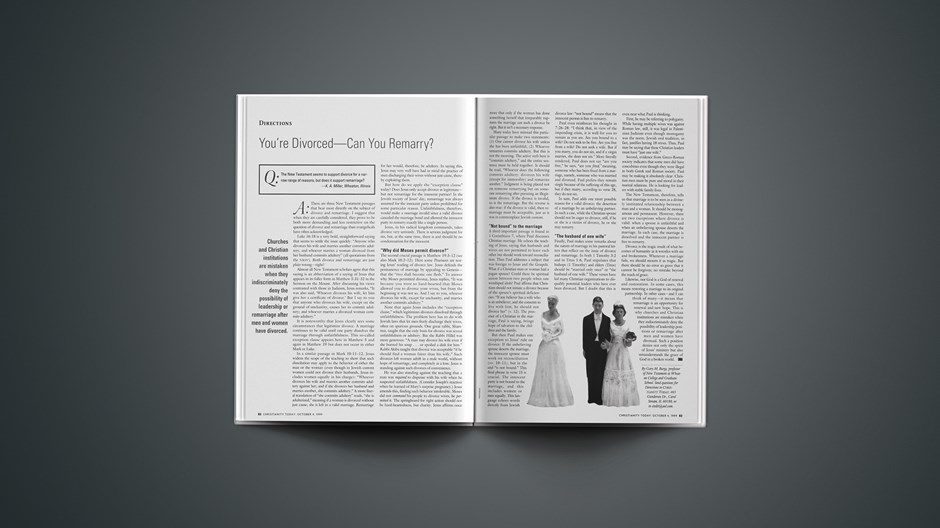
Churches and Christian institutions are mistaken when they indiscriminately deny the possibility of leadership positions or remarriage after men and women have divorced.
In a similar passage in Mark 10:1112, Jesus widens the scope of the teaching to show that such dissolution may apply to the behavior of either the man or the woman (even though in Jewish custom women could not divorce their husbands, Jesus includes women equally in his charge): "Whoever divorces his wife and marries another commits adultery against her; and if she divorces her husband and marries another, she commits adultery." A more literal translation of "she commits adultery" reads, "she is adulterized," meaning if a woman is divorced without just cause, she is left in a valid marriage. Remarriage for her would, therefore, be adultery. In saying this, Jesus may very well have had in mind the practice of men discharging their wives without just cause, thereby exploiting them.
But how do we apply the "exception clause" today? Does Jesus only accept divorce as legitimate—but not remarriage for the innocent partner? In the Jewish society of Jesus' day, remarriage was always assumed for the innocent party unless prohibited for some particular reason. Unfaithfulness, therefore, would make a marriage invalid since a valid divorce canceled the marriage bond and allowed the innocent party to remarry exactly like a single person.
Jesus, in his radical kingdom commands, takes divorce very seriously. There is serious judgment for sin, but, at the same time, there is and should be no condemnation for the innocent.
"Why did Moses permit divorce?" The second crucial passage is Matthew 19:312 (see also Mark 10:212). Here some Pharisees are testing Jesus' reading of divorce law. Jesus defends the permanence of marriage by appealing to Genesis—that the "two shall become one flesh." To answer why Moses permitted divorce, Jesus replies, "It was because you were so hard-hearted that Moses allowed you to divorce your wives, but from the beginning it was not so. And I say to you, whoever divorces his wife, except for unchastity, and marries another commits adultery."
Note that again Jesus includes the "exception clause," which legitimizes divorces dissolved through unfaithfulness. The problem here has to do with Jewish laws that let men freely discharge their wives, often on spurious grounds. One great rabbi, Shammai, taught that the only basis for divorce was sexual unfaithfulness or adultery. But the Rabbi Hillel was more generous: "A man may divorce his wife even if she burned his soup … or spoiled a dish for him." Rabbi Akiba taught that divorce was acceptable "if he should find a woman fairer than his wife." Such divorces left women adrift in a male world, without hope of remarriage, and completely at a loss. Jesus is standing against such divorces of convenience.
He was also standing against the teaching that a man was required to dispense with his wife when he suspected unfaithfulness. (Consider Joseph's reaction when he learned of Mary's surprise pregnancy.) Jesus amends this, finding such behavior intolerable. Moses did not command his people to divorce wives, he permitted it. The springboard for right action should not be hard-heartedness, but charity. Jesus affirms once more that only if the woman has done something herself that irreparably ruptures the marriage can such a divorce be right. But it isn't a necessary response.
Article continues below
Many today have misread this particular passage to make two statements: (1) One cannot divorce his wife unless she has been unfaithful; (2) Whoever remarries commits adultery. But this is not the meaning. The active verb here is "commits adultery," and the entire sentence must be held together. It should be read, "Whoever does the following commits adultery: divorces his wife (except for immorality) and remarries another." Judgment is being placed not on someone remarrying but on someone remarrying after pursuing an illegitimate divorce. If the divorce is invalid, so is the remarriage. But the reverse is also true: if the divorce is valid, then re marriage must be acceptable, just as it was in commonplace Jewish custom.
"Not bound" to the marriage A third important passage is found in 1 Corinthians 7, where Paul discusses Christian marriage. He echoes the teaching of Jesus, saying that husbands and wives are not permitted to leave each other but should work toward reconciliation. Then Paul addresses a subject that was foreign to Jesus and the Gospels. What if a Christian man or woman had a pagan spouse? Could there be spiritual union between two people when one worshiped idols? Paul affirms that Christians should not initiate a divorce because of the spouse's spiritual deficiencies: "If any believer has a wife who is an unbeliever, and she consents to live with him, he should not divorce her" (v. 12). The presence of a Christian in the marriage, Paul is saying, brings hope of salvation to the children and the family.
But then Paul makes one exception to Jesus' rule on divorce: If the unbelieving spouse deserts the marriage, the innocent spouse must work on reconciliation (vv. 1011), but in the end "is not bound." This final phrase in verse 15 is crucial. The innocent party is not bound to the marriage, and this includes women or men equally. This language echoes words directly from Jewish divorce law: "not bound" means that the innocent person is free to remarry.
Paul even reinforces his thought in 7:2628: "I think that, in view of the impending crisis, it is well for you to remain as you are. Are you bound to a wife? Do not seek to be free. Are you free from a wife? Do not seek a wife. But if you marry, you do not sin, and if a virgin marries, she does not sin." More literally rendered, Paul does not say "are you free," he says, "are you freed," meaning, someone who has been freed from a marriage, namely, someone who was married and divorced. Paul prefers they remain single because of the suffering of this age, but if they marry, according to verse 28, they do not sin.
Article continues below
In sum, Paul adds one more possible reason for a valid divorce: the desertion of a marriage by an unbelieving partner. In such a case, while the Christian spouse should not be eager to divorce, still, if he or she is a victim of divorce, he or she may remarry.
"The husband of one wife" Finally, Paul makes some remarks about the nature of marriage in his pastoral letters that reflect on the issue of divorce and remarriage. In both 1 Timothy 3:2 and in Titus 1:6, Paul stipulates that bishops (1 Timothy) and elders (Titus) should be "married only once" or "the husband of one wife." These verses have led many Christian organizations to disqualify potential leaders who have ever been divorced. But I doubt that this is even near what Paul is thinking.
First, he may be referring to polygamy. While having multiple wives was against Roman law, still, it was legal in Palestinian Judaism even though monogamy was the norm. Jewish oral tradition, in fact, justifies having 18 wives. Thus, Paul may be saying that these Christian leaders must have "just one wife."
Second, evidence from Greco-Roman society indicates that some men did have concubines even though they were illegal in both Greek and Roman society. Paul may be making it absolutely clear: Christian men must be pure and moral in their marital relations. He is looking for leaders with stable family lives.
The New Testament, therefore, tells us that marriage is to be seen as a divinely instituted relationship between a man and a woman. It should be monogamous and permanent. However, there are two exceptions where divorce is valid: when a spouse is unfaithful and when an unbelieving spouse deserts the marriage. In each case, the marriage is dissolved and the innocent partner is free to remarry.
Divorce is the tragic result of what be comes of humanity as it wrestles with sin and brokenness. Whenever a marriage fails, we should mourn it as tragic. But there should be no error so grave that it cannot be forgiven; no mistake beyond the reach of grace.
Likewise, our God is a God of renewal and restoration. In some cases, this means restoring a marriage to its original partnership. In other cases—and I can think of many—it means that remarriage is an opportunity for renewal and new hope. This is why churches and Christian institutions are mistaken when they indiscriminately deny the possibility of leadership positions or remarriage after men and women have divorced. Such a position denies not only the spirit of Jesus' ministry but also misunderstands the grace of God in a broken world.
Article continues below
By Gary M. Burge, professor of New Testament at Wheaton College and Graduate School. Send questions for Directions to Christianity Today, 465 Gundersen Dr., Carol Stream, IL 60188; or to cteditor@christianitytoday.com.















 While we pray for peace, we need moral clarity about this war.
 A Christian reconciliation group in Israel and Palestine warned that war would come. Now the war threatens their relevance.españolالعربيةFrançais
 C.S. Lewis recommended discernment over diatribes in exactly the moments we’re most eager to indulge in critique.






