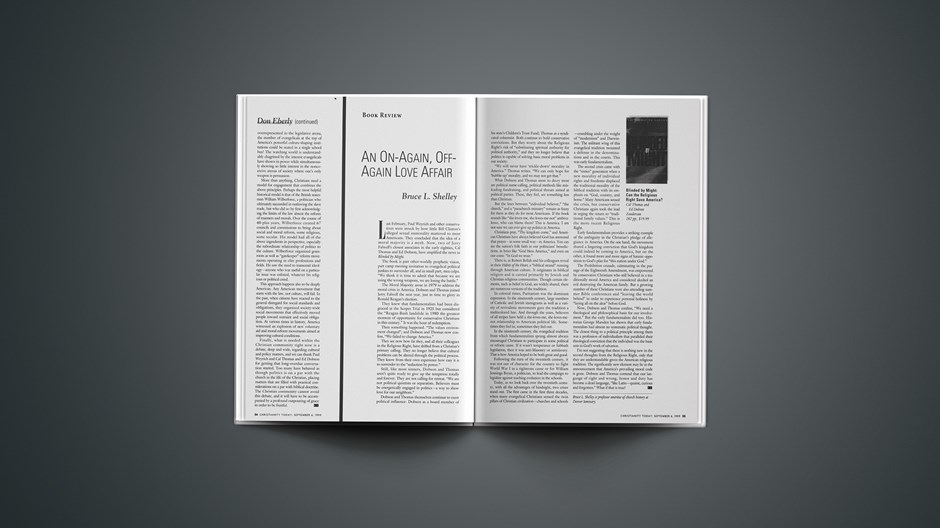
Last February, Paul Weyrich and other conservatives were struck by how little Bill Clinton's alleged sexual immorality mattered to most Americans. They concluded that the idea of a moral majority is a myth. Now, two of Jerry Falwell's closest associates in the early eighties, Cal Thomas and Ed Dobson, have amplified the news in Blinded by Might.
The book is part other-worldly prophetic vision, part camp meeting invitation to evangelical political junkies to surrender all, and in small part, mea culpa. "We think it is time to admit that because we are using the wrong weapons, we are losing the battle."
The Moral Majority arose in 1979 to address the moral crisis in America. Dobson and Thomas joined Jerry Falwell the next year, just in time to glory in Ronald Reagan's election.
They knew that fundamentalists had been disgraced at the Scopes Trial in 1925 but considered the "Reagan-Bush landslide in 1980 the greatest moment of opportunity for conservative Christians in this century." It was the hour of redemption.
Then something happened. "The values environment changed"; and Dobson and Thomas now confess, "We failed to change America."
They see now how far they, and all their colleagues in the Religious Right, have drifted from a Christian's primary calling. They no longer believe that cultural problems can be altered through the political process. They know from their own experience how easy it is to surrender to the "seduction by power."
Still, like most sinners, Dobson and Thomas aren't quite ready to give up the temptress totally and forever. They are not calling for retreat. "We are not political quietists or separatists. Believers must be energetically engaged in politics—a way to show love for our neighbors."
Dobson and Thomas themselves continue to exert political influence: Dobson as a board member of his state's Children's Trust Fund; Thomas as a syndicated columnist. Both continue to hold conservative convictions. But they worry about the Religious Right's risk of "substituting spiritual authority for political authority," and they no longer believe that politics is capable of solving basic moral problems in our society.
"We will never have 'trickle-down' morality in America." Thomas writes. "We can only hope for 'bubble-up' morality, and we may not get that."
What Dobson and Thomas seem to decry most are political name-calling, political methods like misleading fundraising, and political threats aimed at political parties. These, they feel, are something less than Christian.
But the lines between "individual believer," "the church," and a "parachurch ministry" remain as fuzzy for them as they do for most Americans. If the book sounds like "she-loves-me, she-loves-me-not" ambivalence, who can blame them? This is America. I am not sure we can ever give up politics in America.
Christians pray, "Thy kingdom come," and Am er i can Christians have always believed God has answered that prayer—in some small way—in America. You can see the nation's folk faith in our politicians' benedictions, in lyrics like "God bless America," and even on our coins: "In God we trust."
There is, as Robert Bellah and his colleagues reveal in their Habits of the Heart, a "biblical strand" running through American culture. It originates in biblical religion and is carried primarily by Jewish and Christian religious communities. Though certain elements, such as belief in God, are widely shared, there are numerous versions of the tradition.
In colonial times, Puritanism was the dominant expression. In the nineteenth century, large numbers of Catholic and Jewish immigrants as well as a variety of revivalistic movements gave the tradition a multicolored hue. And through the years, believers of all stripes have held a she-loves-me, she-loves-me-not relationship to American political life. Some times they feel in; sometimes they feel out.
In the nineteenth century, the evangelical tradition from which fundamentalism sprang almost always encouraged Christians to participate in some political or reform cause. If it wasn't temperance or Sabbath legislation, then it was anti-Masonry or antislavery. That is how America hoped to be both great and good.
Following the turn of the twentieth century, it was not out of character for the country to fight World War I as a righteous cause or for William Jennings Bryan, a politician, to lead the campaign to legislate against teaching evolution in the schools.
Today, as we look back over the twentieth century, with all the advantages of hindsight, two crises stand out. The first came in the first three decades, when many evangelical Christians sensed the twin pillars of Christian civilization—churches and schools —crumbling under the weight of "modernism" and Dar win ism. The militant wing of this evangelical tradition mounted a defense in the denominations and in the courts. This was early fundamentalism.
Article continues below
The second crisis came with the "sixties" generation when a new morality of individual rights and freedoms displaced the traditional morality of the biblical tradition with its emphasis on "God, country, and home." Many Americans sensed the crisis, but conservative Christians again took the lead in urging the return to "traditional family values." This is the more recent Religious Right.
Early fundamentalism provides a striking example of the ambiguity in the Christian's pledge of allegiance in America. On the one hand, the movement shared a lingering conviction that God's kingdom could indeed be coming to America, but on the other, it found more and more signs of Satanic opposition to God's plan for "this nation under God."
The Prohibition crusade, culminating in the passage of the Eighteenth Amendment, was empowered by conservative Christians who still believed in a traditionally moral America and considered alcohol an evil destroying the American family. But a growing number of these Christians were also attending summer Bible conferences and "leaving the world behind" in order to experience personal holiness by "laying all on the altar" before God.
Now, Dobson and Thomas confess, "We need a theological and philosophical basis for our involvement." But the early fundamentalists did too. Historian George Marsden has shown that early fundamentalists had almost no systematic political thought. The closest thing to a political principle among them was a profession of individualism that paralleled their theological conviction that the individual was the basic unit in God's work of salvation.
I'm not suggesting that there is nothing new in the second thoughts from the Religious Right, only that they are understandable given the American religious tradition. The significantly new element may lie in the announcement that America's prevailing moral code is gone. Dobson and Thomas contend that our language of right and wrong, honor and duty has become a dead language, "like Latin—quaint, curious and forgotten." What if that is true?
Bruce L. Shelley is professor emeritus of church history at Denver Seminary.















 While we pray for peace, we need moral clarity about this war.
 A Christian reconciliation group in Israel and Palestine warned that war would come. Now the war threatens their relevance.العربيةFrançais
 The Grammy-winning artist was found dead at her home in Nashville at age 47.






