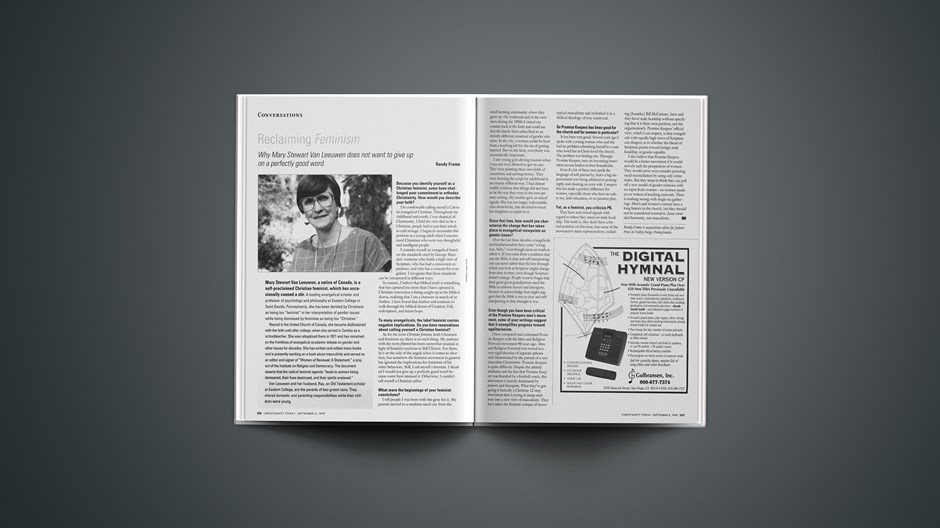
Mary Stewart Van Leeuwen, a native of Canada, is a self-proclaimed Christian feminist, which has occasionally caused a stir. A leading evangelical scholar and professor of psychology and philosophy at Eastern College in Saint Davids, Pennsylvania, she has been derided by Christians as being too "feminist" in her interpretation of gender issues while being dismissed by feminists as being too "Christian."
Reared in the United Church of Canada, she became disillusioned with the faith until after college, when she served in Zambia as a schoolteacher. She was rebaptized there in 1971 and has remained on the frontlines of evangelical academic debate on gender and other issues for decades. She has written and edited many books and is presently working on a book about masculinity and served as an editor and signer of "Women of Renewal: A Statement," a project of the Institute on Religion and Democracy. The document asserts that the radical feminist agenda "leads to women being demeaned, their lives destroyed, and their spirits en slaved."
Van Leeuwen and her husband, Ray, an Old Testament scholar at Eastern College, are the parents of two grown sons. They shared domestic and parenting responsibilities while their children were young.
Because you identify yourself as a Christian feminist, some have challenged your commitment to orthodox Christianity. How would you describe your faith?
I'm comfortable calling myself a Calvinist evangelical Christian. Through out my childhood and youth, I was skeptical of Christianity. I held the view that to be a Christian, people had to put their minds in cold storage. I began to reconsider this position as a young adult when I encountered Christians who were very thoughtful and intelligent people.
I consider myself an evangelical based on the standards cited by George Marsden: someone who holds a high view of Scripture, who has had a conversion experience, and who has a concern for evangelism. I recognize that these standards can be interpreted in different ways.
In essence, I believe that biblical truth is something that has captured me more than I have captured it. Christian conversion is being caught up in the biblical drama, realizing that I am a character in search of an Author. I have found that Author and continue to walk through the biblical drama of Creation, Fall, redemption, and future hope.
To many evangelicals, the label feminist carries negative implications. Do you have reservations about calling yourself a Christian feminist?
As for the term Christian feminist, both Christians and feminists say there is no such thing. My patience with the term feminist has been somewhat strained in light of feminist reactions to Bill Clinton. For them, he's on the side of the angels when it comes to abortion, but somehow the feminist movement in general has ignored the implications for feminism of his other behaviors. Still, I call myself a feminist. I decided I would not give up a perfectly good word be cause some have misused it. Other wise, I couldn't call myself a Christian either.
What were the beginnings of your feminist convictions?
I tell people I was born with the gene for it. My parents moved to a medium-sized city from the small farming community where they grew up. On weekends and in the summers during the 1950s I visited my cousins back at the farm and could see that the family farm subscribed to an entirely different construct of gender relations. In the city, a woman could be fired from a teaching job for the sin of getting married. But on the farm, everybody was economically important.
I saw young girls driving tractors when I was not even allowed to get on one. They were planting their own fields of cucumbers and earning money. They were learning the script for adulthood in an entirely different way. I had almost weekly evidence that things did not have to be the way they were in my own primary setting. My mother gave us mixed signals. She was not happy with middle-class domesticity, but she tried to teach her daughters to aspire to it.
Since that time, how would you characterize the change that has taken place in evangelical viewpoints on gender issues?
Over the last three decades, evangelicals and fundamentalists have come "a long way, baby," even though most are loath to admit it. If you come from a tradition that says the Bible is clear and self-interpreting, you can never admit that the lens through which you look at Scripture might change from time to time, even though Scripture doesn't change. People want to forget that their great-great-grandparents used the Bible to endorse slavery and misogyny, be cause to acknowledge that might suggest that the Bible is not as clear and self-interpreting as they thought it was.
Even though you have been critical of the Promise Keepers men's movement, some of your writings suggest that it exemplifies progress toward egalitarianism.
I have compared and contrasted Promise Keepers with the Men and Religion Forward movement 90 years ago. Men and Religion Forward was rooted in a very rigid doctrine of separate spheres and characterized by the pursuit of a very masculine Christianity. Promise Keepers is quite different. Despite the athletic stadiums and the fact that Promise Keepers was founded by a football coach, this movement is heavily dominated by pastors and therapists. What they've got going is basically a Christian 12-step movement that is trying to jump-start men into a new view of masculinity. They have taken the feminist critique of stereotypical masculinity and reclothed it in a biblical theology of true manhood.
Article continues below
So Promise Keepers has been good for the church and for women in particular?
It has been very good. Several years ago I spoke with a young woman who said she had no problem submitting herself to a man who loved her as Christ loved the church. The problem was finding one. Through Promise Keepers, men are be coming benevolent servant leaders in their households.
Even if a lot of these men speak the language of soft patriarchy, that's a big improvement over being addicted to pornography and cheating on your wife. I suspect this has made a positive difference for women, especially those who have no safety net, little education, or no pension plan.
Yet, as a feminist, you criticize PK.
They have sent mixed signals with regard to where they stand on male headship. The truth is, they don't have a formal position on this issue, but some of the movement's main representatives, including [founder] Bill McCartney, have said they favor male headship without specifying that it is their own position, not the organization's. Promise Keepers' official view, which I can respect, is that evangelicals with equally high views of Scripture can disagree as to whether the thrust of Scripture points toward benign male headship or gender equality.
I also believe that Promise Keepers would be a better movement if it would actively seek the perspectives of women. They would never even consider pursuing racial reconciliation by using only white males. But they seem to think they can pull off a new model of gender relations with no input from women—no women speakers or writers of teaching materials. There is nothing wrong with single-sex gatherings. Men's and women's retreats have a long history in the church, but they should not be considered normative. Jesus modeled humanity, not masculinity.
Randy Frame is acquisitions editor for Judson Press in Valley Forge, Pennsylvania.















 While we pray for peace, we need moral clarity about this war.
 As my doubts about his teachings grew, so did a secret fascination with Jesus.
 Christian artists work at the intersection of music and climate change.






