A grownup once asked Jesus, "Who is my neighbor?" The man didn't ask because he wanted to be a neighbor, but because he wanted to find a loophole around being a neighbor. The man asked that question to "justify himself." Grownups tend do that.
Something else grownups tend to do these days is yank children into the adult world. Whether putting them on schedules as demanding as those of company presidents, dressing them up as beauty queens, leaving them all day under the eye of someone who doesn't love them like a parent, or simply surrendering their souls to the television, many grownups leave children in a disorienting world with nary an adult hand to guide them.
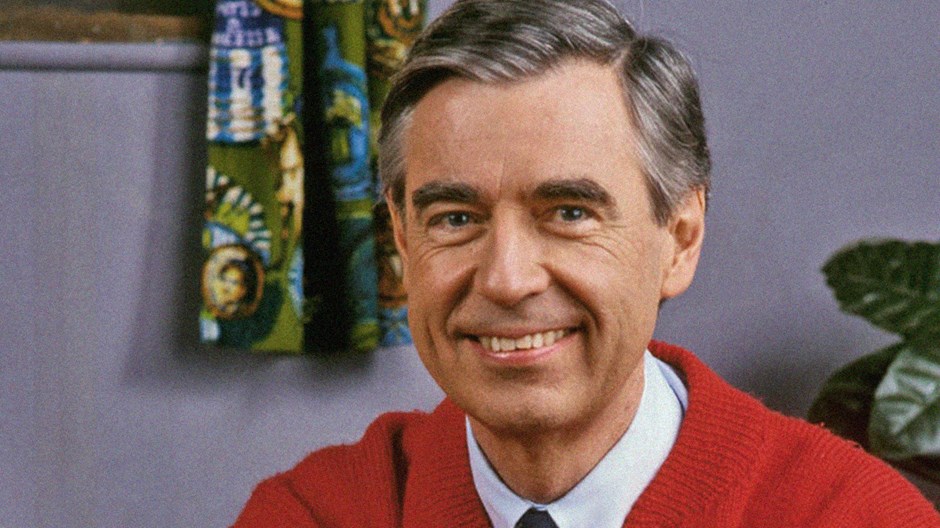
One grownup, however, has been an abiding adult presence for children for over three decades. He calls himself a neighbor. He is a gentleman—spindly and unflappable—who sings songs and animates puppet fantasies. Many grownups scratch their heads at the power this man has over their children. What is the attraction, they think, of a silly man who, every day, walks through the same door of a studio home, all smiles, singing It's a beautiful day in the neighborhood? Every day the man pulls off his sport jacket and dons a cardigan sweater and sits on a bench to remove his shoes, replacing them with canvas tennis shoes, still singing—It's a neighborly day in this beauty wood, a neighborly day for a beauty—would you be mine? Could you be mine?
He is Mister Rogers and his neighborhood friends, young and old, answer that question with a resounding Yes, I'll be your neighbor!—bewildered though they may be about how it could possibly be a beautiful day every day in Mister Rogers' Neighborhood.
Through his daily half-hour children's program, Fred Rogers opens the door to childhood and walks inside, gently navigating his young television neighbors through their sometimes scary world in terms they can understand. They feel safe in his nurturing adult presence. He gives children permission to be children.
But what most people don't realize about Mister Rogers and his Neighborhood is that behind the puppets, the tennis shoes, and the simple songs lies an abiding faith and weighty theology. The Presbyterian Church (U.S.A.) ordained Fred Rogers as "an evangelist to work with children and families through the mass media." He does not bring evangelism in its churchly sense to this calling, and neither does he introduce religious themes in his programs. But his daily neighborhood visits with children sow seeds that awaken something basic in their hearts. It is hidden growth, like the parable of the seeds sown in secret. It is growth, as someone has said, as "silent as light, as subtle as life, and mightier than either." Mister Rogers, in his silent, subtle, mighty way, rescues children from a world that would too soon warp their souls. He summons them to a special place where trust arises and does not disappoint. Hearts come alive, awakened by his unconditional acceptance. "Everybody longs to be loved and longs to know that he or she is capable of loving," he says.
Mister Rogers calls it "loving someone into existence." And Mister Rogers' Neighborhood is his way of answering God's call to "broadcast grace throughout the land."
A tour through the wallet
Every corner of the small, cramped, eclectic room in Pittsburgh that Mister Rogers calls an office is a testimony to the people who have loved him into existence. There is a couch, well-worn, and velveteen chairs next to end tables that look like Grandma's. These are from Latrobe, Pennsylvania, his childhood home. He writes letters and thinks about things like "big" and "little" from that couch—there is no desk. He is flanked by stuffed animals and baseball caps (and sometimes stuffed animals wearing baseball caps) that his many neighbors have given him over the years.
He shows me a sign that he keeps on the table near the door: Freddie, I like you just the way you are. "It was my Grandfather McFeely who said such things as that," he says. "We used to visit him in the country almost every Sunday. He was the kind of person who would say, 'You know, you've made this a special day by being here.'" Above the couch hangs a sign that bears the Greek word for grace; below it, a sign in Hebrew that means "My beloved is mine, and I am his." Near the window, a molted snakeskin dangles from a wooden parrot mobile opposite a framed letter from his good friend, the late Henri Nouwen. A giant crayon leans up against a corner; the book Hello Fish is within arm's reach on the couch; there is a Bible on the end table and a violin case resting against a chair.
Then Mister Rogers starts asking me the questions.
"Do you live right in Chicago?
"How long have you lived there?"
“So you've gotten to know some people really well during that time. My, they're blessed to have you."
Article continues below
He asks about my job and my family. "I love to know about people," he says. I tell him how my children (and their mother) grew up watching his show and how my oldest son wrote him a letter and drew him a picture of Daniel Tiger. "How blessed they are to have you for a mother," he says.
I try to regain control of the interview, but do not succeed. Before we can push on, he is opening his wallet to show me pictures.
"Did you know Henri Nouwen? Here he is with Chris de Vinck," he says. He tells me about the book of essays Chris de Vinck is compiling about Henri Nouwen.
"These are Chris de Vinck's children."
There is a picture of a woman whose husband was sucked into coal slag and suffocated; and there is a picture of her two children.
"This is one of my special friends, Yo-Yo Ma, who is a cellist, and his son," he says. "He's a great man.
"This is Jonathan Kozol—he writes about children."
Then there is a picture of Mother Martha and "some of the kids in the Bronx"; a little boy from his church; and another boy with autism who is fixated on hangers.
"That's Chef Brockett," he says.
"Oh, here is Dr. Orr, that's what I was looking for. And Mrs. Orr. She's still living."
In seminary Mister Rogers studied systematic theology with Dr. William S. Orr. "From then on I took everything he offered; it could have been underwater basket weaving.
"He was a great influence on many of our lives. Not just because he was brilliant," he says. "He was the kind of person who would go out on a winter's day for lunch and come back without his overcoat.
"I studied Greek with him and then I studied New Testament with him. Every Sunday, my wife and I used to go to the nursing home to visit him. One Sunday we had just sung 'A Mighty Fortress Is Our God' and I was full of this one verse. I said, 'Dr. Orr, we just sang this hymn and I've got to ask you about part of it.
"'You know where it says—The prince of darkness grim, we tremble not for him. For, lo, his doom is sure. … one little word will fell him? Dr. Orr, what is that one thing that would wipe out evil?'
"He said, 'Evil simply disintegrates in the presence of forgiveness. When you look with accusing eyes at your neighbor, that is what evil would want, because the more the accuser'—which, of course, is the word Satan in Hebrew—'can spread the accusing spirit, the greater evil spreads.' Dr. Orr said, 'On the other hand, if you can look with the eyes of the Advocate on your neighbor, those are the eyes of Jesus.'
Article continues below
"I've never forgotten that."
The wallet tour ends with a flurry. There are pictures of his wife, his sons, and many other friends he calls neighbors. Then Mister Rogers pulls one last scrap of paper from his wallet. He looks at it and says, "I love this quote, don't you? Calmness is a language which the deaf can hear and the blind can read—Mark Twain.?
"I carry stuff like that with me all the time."
The early years
When Fred Rogers (born in 1928) was growing up in Latrobe, being an only child, he some times would get lonely and feel unsure of himself. Now and then he would hear about things on the news that frightened him and his mother would say, "Look for the helpers; you will always find people who are helping." He played with puppets and created a world where he felt safe. He loved music and appreciated his Grandmother McFeely. She "always supported my musical interests," he says.
His sister, Elaine, was adopted when he was 11. She was "very high-spirited" and people would say, "You know, Freddie is the only one who can make Lainey mind." Lady Elaine Fairchild, who is a feisty puppet in the Neighborhood of Make Believe on Mister Rogers, is named for his sister (and for his assistant).
As a little boy he would sit in church and look up at the pulpit where his first heroes, his pastors, would seem high and lifted up. They said "such wonderful things," he says.
These heroes inspired him. He wanted to be like them. He planned to go to seminary after college. But something happened to change that. He went home from Rollins College (Fla.) for a visit one time and saw his parents' television. He thought it was a wonderful medium and that it could be used to reach many people and do much good. He also thought the show he happened to see that day was "perfectly horrible" and he wanted to do better. He changed his plans and did not go to seminary. He told his parents he wanted to work with television, and they were disappointed. They wanted him to be a minister.
But Mister Rogers was hearing a call, though he wasn't sure how it could be that God wanted him to go into television instead of to seminary. He answered the call and after graduating from college in 1951, he moved to New York and helped other people who also felt called to work in television. One of his favorite performers was a cowboy named Gabby Hayes. He liked talking to people through the television camera. Rogers asked him what he thought about when he looked at the camera and Hayes told him, "Freddie, you just think of one little buckaroo."
Article continues below
Fred Rogers married a girl named Joanne—they had met in college—and stayed in New York for two years. He especially loved hearing Kate Smith sing on her program and was very helpful to everyone whose programs he served. He began winning favor among many people, but he missed his home in Pennsylvania. He wanted to help make good television programs available there. So, in 1953, he left New York and, gathering the support of his friends and neighbors, he helped launch WQED, the first community-supported public television station in the country.
Having learned much during his stint in New York, he decided to make a program that involved singing, like Kate Smith's, and little buckaroos, like Gabby Hayes'. Mister Rogers called it The Children's Corner and he asked Josie Carey, a smiley-faced woman with a high-pitched voice, to help him. Children's Corner producer Dorothy Daniel held a party the night before the new program went on the air for the first time and gave everyone favors. Mister Rogers' favor was a tiger puppet. He thought, "Why don't we cut a hole in the set and I'll put the puppet through? We'll call him Daniel, for Mrs. Daniel."
Josie Carey liked that idea and Dorothy Daniel was pleased to have a puppet named for her. Mister Rogers was good with puppets, since he used to play with them when he was little. So he became Daniel's voice. And the buckaroos watching The Children's Corner liked Daniel Striped Tiger so much that Mister Rogers used him the second day, and the third day. Mister Rogers decided, if he could do Daniel's voice so well, maybe he could do other voices and create other puppet characters. That's when King Friday XIII and X the Owl came along. They joined Daniel Striped Tiger, and all of a sudden Mister Rogers was in charge of more puppets than he had hands.
But he never forgot his heroes who used to stand high up in that special place in church. He thought maybe he could make a program that the church could use to spread its teachings. He couldn't stop working on his television program, so he decided to go to seminary during his lunch breaks (starting in the fall of 1954). That's when he met Dr. Orr and became inspired when he would come to class without a coat during the winter. Dr. Orr was always giving his coat to someone who didn't have one.
Article continues below
It took Mister Rogers eight years to finish his seminary work at Pittsburgh Theological Seminary. The day before he was going to receive his diploma, he received a call from denomination officials telling him that they were very sorry, but they didn't have enough money to help him make the program he hoped to create.
At first he was disappointed, because he thought making a television program for church was the way God wanted him to be a minister. But the day after he received his diploma, someone else called and asked Rogers to come to a new place and make a new program that was about him, Mister Rogers, and not just about puppets.
To make this new program, Rogers and his wife and two sons had to leave Pittsburgh to move to Canada. He didn't want to leave Pittsburgh, but he understood that sometimes, to follow God's plan, you have to do things you don't want to do.
This new program, called MISTEROGERS, was 15 minutes long. This is the first time the man behind the puppets appeared on camera as himself. He remembered his friend Gabby Hayes, and when he looked into the camera he thought about only one little buckaroo. He liked thinking about that.
But by now the puppets had become his companions, and he didn't want the real-life Mister Rogers to take their place. So he divided his new program between time when he talked to his television friends and time when the puppets lived their interesting lives in a fantasy world. He called this puppets' world the Land of Make Believe.
Still longing for his home in Pittsburgh, he returned a year later. Now he knew exactly what kind of ministry God had called him to. He changed the 15-minute MISTEROGERS into a half-hour program and called it Mister Rogers' Neighborhood. He thought his young viewers would get confused hearing two words, but seeing only one. He also added the word neighborhood because he wanted the children to think of the program not as being about him, but about a place—a neighborhood—where they could come and visit.
Mister Rogers' Neighborhood was a local show for two years. But so many children loved visiting the neighborhood that stations all over the country soon wanted their young viewers to have the same opportunity. So in 1968 his program went national, and many children since have grown up with the song It's a beautiful day in the neighborhood echoing in their hearts.
Article continues below
A safe haven
Mister Rogers' Neighborhood is in its thirty-second year of production. In 1971 Mister Rogers created Family Communications Inc. as a nonprofit umbrella organization to produce the show. Over 870 episodes have aired for the 8 million households and childcare centers that tune in each week. It has received every major award in television, including two George Foster Peabody awards, and is the longest-running program on the Public Broadcasting System (PBS). Two years ago Mister Rogers himself was inducted into the Television Hall of Fame by the Academy of Television Arts and Sciences. He has received over 30 honorary doctorates from schools including Yale, Carnegie Mellon, Boston University, and his alma mater, Rollins.
His friends and neighbors who work in the neighborhood don't measure their tenure in years. Most have been there for decades. Mr. McFeely, the "speedy delivery" mailman on the program (named after Rogers' grandfather), is played by David Newell, who answers phones and sets up interviews and has been making real-life speedy deliveries in the offices for over 32 years. Hedda Sharapan is the associate producer, and she started a year before David Newell. Mister Rogers' assistant, Elaine Lynch, started a year before Hedda Sharapan.
Johnny Costa, who Mister Rogers says was "probably one of the finest jazz pianists in the world," had been the music director for nearly three decades when he died in 1996. "I was a real jazzer," Costa once said, and so he wasn't sure if directing music for a children's program was the best way to use his talents. Rogers encouraged him to do all the jazz he wanted for the program. Costa decided that, rather than create singsongy and childlike music, he would improvise with his own style. He played live in the studio for each program. The neighborhood went silent for a moment in his memory after he died. Michael Moricz took over as music director for the 15 new shows a year produced at the time. The company will produce 10 new shows this year.
Since Mister Rogers had studied music in college and theology in seminary, he knew he was going to need help understanding how a child's mind and heart responded to the show's content. He had done his field education in seminary with the well-known child psychologist Margaret McFarland (who cofounded the Arsenal Family and Children's Center with Erik Erikson and Benjamin Spock), so he asked if she would help him develop the show's affective side. She met weekly with Rogers and helped him understand how all of his story ideas might be understood by his young viewers. She died in 1988 and Mister Rogers keeps the tapes of all of their conversations in a box in his office.
Article continues below
Margaret McFarland believed that "As a child is loved, he loves in return." She said that to understand children, we have to understand "powerful human influences" and "strong impulses conceived in love." She called it "part and counterpart," the interplay—positive or negative—between humans and their intimate relationships. The nature of this interplay is critical during a child's early years. Things can go very wrong, she said, if a child does not receive positive messages. "There is no daycare center that replaces the mother," she said. "[If] in the future children are reared in groups, the human personality will become different."
Mister Rogers tries to bring Margaret McFarland's spirit into every program. He wants to make sure his television neighbors understand the loving interplay between him and them. He uses things in his neighborhood, like the trolley, to help make those connections. His television neighbors love it when the trolley—like the one he would ride as a child in Pittsburgh—comes into his studio living room, dinging and tooting on an electric track. It is getting ready to take the viewers into the Neighborhood of Make Believe.
Mister Rogers sets the scene for what his neighborhood viewers are about to see in Make Believe, and then says, "Trolley, to the Neighborhood of Make Believe!" The trolley toots and whistles through a tunnel that leads out of Mister Rogers' studio home into a fantasy world inhabited by puppets, a few humans, and some strange animals (like Bob Dog and the Purple Panda). The trolley comes and goes from Make Believe because Mister Rogers doesn't want his neighbors to get confused about what is real and what is pretend. He never appears in Make Believe: "I think of myself as someone who is sitting with my television friends and listening to what's happening in that other pretend Neighborhood."
On a recent episode, King Friday XIII became enamored with three-cornered hats, like Paul Revere's, and decreed: "I expect everyone to wear a three-cornered one before the day is done. As soon as I hear Fairchild is wearing one, I will be satisfied. That is my kingly word." King Friday rules the Neighborhood of Make Believe, but he is filled with self-doubt and worries that people won't love him unless he comes across as someone who is very important.
Article continues below
Lady Elaine Fairchild doesn't want to wear a three-cornered hat and wears a three-cornered scarf instead.
With the help of some of the sympathetic human characters in Make Believe, King Friday eventually comes to understand that people will still respect him as king even if Lady Elaine doesn't wear a three-cornered hat.
The trolley reappears, dings and toots, and goes back through the tunnel out of Make Believe and into the studio living room. Mister Rogers looks into the camera and says, "Lady Elaine and King Friday were each trying to be the most important. The truth is that everybody has something special inside them and nobody's more important than someone else. Just like you, my television friend." He sings a song—You are my friend, you are special, you are my friend, you're special to me. You are the only one like you. Like you, my friend, I like you—and then gets ready to leave.
He begins changing back into his real-life clothes, replacing his shoes and sweater. "People wear all sorts of things," he says. "But the best part is the part that's on the inside. That's what's really you—the person inside."
He ends the visit with the same song that ends every visit: It's such a good feeling to know you're alive.
"See you next time," he says before walking out the door. "I'll be back." He smiles, waves, and walks out the door of his studio home and off the set until "next time," which always comes, and he dons the canvas shoes and the sweater again, and it is another beautiful day.
A mystical bond
The Journal of Child-Care Administration says three components make Mister Rogers' Neighborhood "developmentally appropriate" for young children: pacing, planning, and tone. "In contrast to the frenetic, loud, image-piled-on-image formats of so many cartoons and other children's shows, the program is carefully paced to accommodate the thought processes and reaction times of preschoolers," the Journal article says. The content is "meticulously planned. … [to] reach children in ways that are sound and tuned in to their lives today," and Mister Rogers "clearly respects his young audience. He uses words they understand, but never talks down to them."
Article continues below
Hedda Sharapan says the show's team must constantly fight the temptation to "pizzazz it up and grab those eyeballs." She says that children "are getting so accustomed to fast-paced stuff coming at them that it's almost like they become hungrier for that and it's harder to calm them down. But we hear all the time that hyperactive children, who will sit for nothing else, will sit for Mister Rogers because he gives them that calming." Margaret McFarland used to say that the difference between Mister Rogers and most television for children is that "it is less a show for children and more [a show about] real communication."
Television is an intimate medium, says Sharapan, and people form "a precious relationship" with it. "The show is kind of a safe haven. One of the [visitors] in the audience, when we were taping a segment with a boy in a wheelchair, said, 'I sense a spirituality.'"
That "spirituality" sets the show apart from some of the more frenzied children's programs. It hints at the grace that Mister Rogers says he wants to broadcast throughout the land. He calls the space between him and that one little buckaroo "holy ground."
"Every time I walk into the studio, I say to myself [as a prayer], 'Let some word that is heard be Yours.' The Holy Spirit translates our best efforts into what needs to be communicated to that person in his or her place of need. The longer I live, the more I know it's true," he says.
Tom Junod wrote about Mister Rogers for the November 1998 Esquire, and at first, like most grownups, he didn't understand Mister Rogers. Junod told about a boy, a teenager, who was severely handicapped with cerebral palsy: "[T]he people entrusted to take care of him [when he was little] took advantage of him and did things to him that made him think he was a very bad boy. … [H]e would get so mad at himself that he would hit himself hard, with his own fists, and tell his mother on the computer he used for a mouth that he didn't want to live anymore, for he was sure that God didn't like what was inside him anymore than he did."
Article continues below
This young man was still watching Mister Rogers' Neighborhood at age 14, and "the boy's mother sometimes thought that Mister Rogers was keeping her son alive."
Then one day Mister Rogers was making a trip to California and decided to pay a visit to the teenager with cerebral palsy. "At first, the boy was made very nervous by the thought that Mister Rogers was visiting him," Junod writes. "He was so nervous, in fact, that when Mister Rogers did visit, he got mad at himself and began hating himself and hitting himself, and his mother had to take him to another room." Mister Rogers waited patiently and when the boy came back, Mister Rogers said, "I would like you to do something for me. Would you do something for me?'" On his computer, the boy answered yes. "I would like you to pray for me. Will you pray for me?"
Tom Junod says that the boy was "thunderstruck" because "nobody had ever asked him for something like that, ever. The boy had always been prayed for. The boy had always been the object of prayer, and now he was being asked to pray for Mister Rogers, and although at first he didn't know if he could do it, he said he would, he said he'd try, and ever since then he keeps Mister Rogers in his prayers and doesn't talk about wanting to die anymore because he figures Mister Rogers is close to God, and if Mister Rogers likes him, that must mean God likes him, too."
Tom Junod asked Mister Rogers how he knew what to say to make the boy feel better. He responded: "Oh, heavens no, Tom! I didn't ask him for his prayers for him; I asked for me. I asked him because I think that anyone who has gone through challenges like that must be very close to God. I asked him because I wanted his intercession."
I saw the same thing for myself the day I visited Mister Rogers. It was Joey's eighth birthday that day. Something did not work right inside Joey and he wasn't able to speak with or relate to people very well. He didn't understand the world around him and stayed locked inside himself—except on the day of his eighth birthday, when his mother and grandparents brought him to visit Mister Rogers. I was doing some research alone in a small room off to the side when I heard a commotion—it was Joey and his family arriving—and then I heard a whoop. Mister Rogers had walked in to greet them and Joey couldn't contain his emotions.
Mister Rogers sat on a chair and Joey climbed into his lap, pressing his head into Mister Rogers' shoulder and not moving for the next 20 minutes. We all took pictures of Joey sitting on Mister Rogers' lap and the only way the family could finally get Joey to say goodbye was when Mr. McFeely—I mean, David Newell—brought Joey a picture of Mister Rogers and a Neighborhood goody bag filled with King Friday, X the Owl, and Daniel Striped Tiger puppets. Then, slowly, his family pulled him away and he couldn't stop waving to Mister Rogers as he finally walked out the door.
Article continues below
Redeeming the media
Mister Rogers says that those in television "are chosen to be servants to help meet deeper needs." Life isn't cheap, he says. "It is the greatest mystery and we all only have one life to live on earth. Through television we can demean or cherish it.
"Life is deep and simple, and what our society gives us is shallow and complicated," he says. At its worst television can be "degrading, reducing important human feelings to the status of caricature or trivia," and even "encouraging pathology," he says.
"Television started out by attempting to bring cultural riches to its viewers, like NBC's Opera Theater. But that was before there were millions and millions of viewers. Then it became a tool for selling. I wish I knew how we could better point to all the riches of our society and how the media—television, radio, computers, magazines—could take an assignment to do our best to make goodness attractive. We're so caught up in glorifying the opposite. It is so unfair for parents to have to be so vigilant. They have so much that they have to do besides being police people."
But Mister Rogers still believes that human beings are God's vessels of mystery and beauty and he refuses to give up hope. "I have seen in my life too many indications of what is wonderful about human beings. I think the accuser would have us be so despairing that we wouldn't do anything. You know the effect of one little candlelight in great darkness. That sounds simple, but it's true.
"The older I get the more impressed I am with simplicity and silence," he says. "I do believe that that's where we can be inspired. Whenever I give a speech now I give a minute of silence for people to think about all those who have helped them to become who they are. Invariably, that's what people will remember—that silence.
Article continues below
"That leads me to a fishing-pole story. "
There was a conference on children and television at the White House, the East Room. The Clintons and the Gores were there. We all sat at this huge rectangular table. Different people were asked to present short thoughts. I guess mine was about seven or eight minutes. But for one of those minutes I gave a minute of silence. And when I was going out of the room I heard this voice say, 'Thank you, Mister Rogers.' I turned. It was one of the military guards, dressed in white and gold.
I said, 'For what?'
He said, 'For that silence.'
I said, 'Who did you think about?'
He said, 'I hadn't thought about him in a long time, but I thought about my grandfather's brother who, just before he died, took me to his basement and gave me his fishing pole. I've loved fishing all my life and that silence reminded me of that today.'
"The words thank you are probably the greatest words in any language."
The eyes of Jesus
I ask Mister Rogers if he thought the Neighborhood could be a metaphor for heaven. "We deal with a lot of gritty stuff on the Neighborhood —death, divorce, the need for childcare, separation," he says. "The Neighborhood is not a Pollyannish state.
"When I think about heaven, it is a state in which we are so greatly loved that there is no fear and doubt and disillusionment and anxiety. It is where people really do look at you with those eyes of Jesus."
But that is what his legions of preschoolers through these decades—many of them now parents themselves—have seen and still see when they turn on his program. When they see Mister Rogers walk through the front door of his studio home, smiling, waving, and singing, they know they are in a safe place and that Mister Rogers will take away their fear and doubt and disillusionment and anxiety. When they hear him say "I like you just the way you are," it is like a still small voice telling them that if Mister Rogers likes them then God must like them, too. They are on holy ground. Mister Rogers looks at them with the eyes of an advocate, not an accuser. This helps them believe they are loved and capable of loving others.
Before that grownup asked Jesus the question about the neighbor, he had first posed a different question. He had asked, "What must I do to inherit eternal life?" Jesus, being wise, asked him what he thought the answer should be. The man said, "To love God and love your neighbor as yourself." Jesus told him, "Do this and you will live." The man thought that he was already doing that—many grownups think they are already doing it. But the man wasn't doing it. He was looking for loopholes. And sometimes the kind of love that grownups show their neighbors is the loophole kind. That is why many do not understand the power behind the Neighbor hood. To understand, one must become like a child.
Article continues below
"The underlying message of the Neighborhood," says Mister Rogers, "is that if somebody cares about you, it's possible that you'll care about others. 'You are special, and so is your neighbor'—that part is essential: that you're not the only special person in the world. The person you happen to be with at the moment is loved, too.
"God, in his great mercy, accepts us exactly as we are. Who could ever stand if God's faithfulness did not endure?"
Before my day with Mister Rogers comes to an end, I ask if I can take his picture. "Oh, let me take your picture," he says. "I love taking pictures of people." I sit on his couch—he wants the illustration of X the Owl and Henrietta Pussycat in the background—and he takes my picture. Tom Junod says that before he said goodbye, Mister Rogers prayed with him. His heart at first felt like a spike, but when Mister Rogers prayed it opened like an umbrella. Mister Rogers gave us something in those moments. In giving, he bid us to receive. And in receiving, we took hold of grace. We became his neighbors.
Mister Rogers wrote something for Chris de Vinck's collection of essays in honor of Henri Nouwen. A neighbor, he wrote, is
someone who has helped you see beyond the obvious. … perhaps a person who, like Henri and many of us, longs for deep friendships and reaches out to others in response to that longing—just as our God reached out to us through Jesus the Christ our Lord.















 While we pray for peace, we need moral clarity about this war.
 As my doubts about his teachings grew, so did a secret fascination with Jesus.
 The Grammy-winning artist was found dead at her home in Nashville at age 47.






