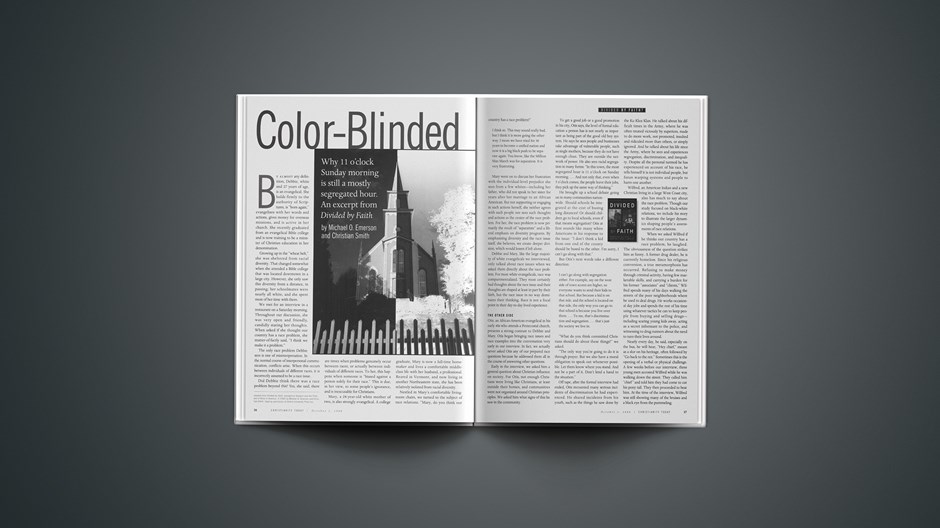
By almost any definition, Debbie, white and 27 years of age, is an evangelical. She holds firmly to the authority of Scriptures, is "born again," evangelizes with her words and actions, gives money for overseas missions, and is active in her church. She recently graduated from an evangelical Bible college and is now training to be a minister of Christian education in her denomination.
Growing up in the "wheat belt," she was sheltered from racial diversity. That changed somewhat when she attended a Bible college that was located downtown in a large city. However, she only saw this diversity from a distance, in passing; her schoolmates were nearly all white, and she spent most of her time with them.
We met for an interview in a restaurant on a Saturday morning. Throughout our discussion, she was very open and friendly, candidly stating her thoughts. When asked if she thought our country has a race problem, she matter-of-factly said, "I think we make it a problem."
The only race problem Debbie sees is one of misinterpretation. In the normal course of interpersonal communication, conflicts arise. When this occurs between individuals of different races, it is incorrectly assumed to be a race issue.
Did Debbie think there was a race problem beyond this? Yes, she said, there are times when problems genuinely occur between races, or actually between individuals of different races. To her, this happens when someone is "biased against a person solely for their race." This is due, in her view, to some people's ignorance, and is inexcusable for Christians.
Mary, a 28-year-old white mother of two, is also strongly evangelical. A college graduate, Mary is now a full-time homemaker and lives a comfortable middle-class life with her husband, a professional. Reared in Vermont, and now living in another Northeastern state, she has been relatively isolated from racial diversity.
Nestled in Mary's comfortable living-room chairs, we turned to the subject of race relations. "Mary, do you think our country has a race problem?"
I think so. This may sound really bad, but I think it is more going the other way. I mean we have tried for 30 years to become a unified nation and now it is a big black push to be separate again. You know, like the Million Man March was for separation. It is very frustrating.
Mary went on to discuss her frustration with the individual-level prejudice she sees from a few whites—including her father, who did not speak to her sister for years after her marriage to an African American. But not supporting or engaging in such actions herself, she neither agrees with such people nor sees such thoughts and actions as the center of the race problem. For her, the race problem is now primarily the result of "separatists" and a liberal emphasis on diversity programs. By emphasizing diversity and the race issue itself, she believes, we create deeper division, which would lessen if left alone.
Debbie and Mary, like the large majority of white evangelicals we interviewed, only talked about race issues when we asked them directly about the race problem. For most white evangelicals, race was compartmentalized. They most certainly had thoughts about the race issue and their thoughts are shaped at least in part by their faith, but the race issue in no way dominates their thinking. Race is not a focal point in their day-to-day lived experience.
The other side
Otis, an African-American evangelical in his early 40s who attends a Pentecostal church, presents a strong contrast to Debbie and Mary. Otis began bringing race issues and race examples into the conversation very early in our interview. In fact, we actually never asked Otis any of our prepared race questions because he addressed them all in the course of answering other questions.
Early in the interview, we asked him a general question about Christian influence on society. For Otis, not enough Christians were living like Christians, at least outside their homes, and communities were not organized around Christian principles. We asked him what signs of this he saw in the community.
To get a good job or a good promotion in his city, Otis says, the level of formal education a person has is not nearly as important as being part of the good old boy system. He says he sees people and businesses take advantage of vulnerable people, such as single mothers, because they do not have enough clout. They are outside the network of power. He also sees racial segregation in many forms: "In this town, the most segregated hour is 11 o'clock on Sunday morning. … And not only that, even when 5 o'clock comes, the people leave their jobs, they pick up the same way of thinking."
He brought up a school debate going on in many communities nationwide. Should schools be integrated at the cost of busing long distances? Or should children go to local schools, even if that means segregation? Otis at first sounds like many white Americans in his response to the issue: "I don't think a kid from one end of the county should be bused to the other. I'm sorry, I can't go along with that."
Article continues below
But Otis's next words take a different direction:
I can't go along with segregation either. For example, say on the west side of town scores are higher, so everyone wants to send their kids to that school. But because a kid is on that side, and the school is located on that side, the only way you can go to that school is because you live over there. … To me, that's discrimination and segregation. … that's just the society we live in.
"What do you think committed Christians should do about these things?" we asked.
"The only way you're going to do it is through prayer. But we also have a moral obligation to speak out whenever possible. Let them know where you stand. And not be a part of it. Don't lend a hand to the situation."
Off tape, after the formal interview had ended, Otis recounted many serious incidents of discrimination he had experienced. He shared incidents from his youth, such as the things he saw done by the Ku Klux Klan. He talked about his difficult times in the Army, where he was often treated viciously by superiors, made to do more work, not promoted, insulted and ridiculed more than others, or simply ignored. And he talked about his life since the Army, where he sees and experiences segregation, discrimination, and inequality. Despite all the personal turmoil he has experienced on account of his race, he tells himself it is not individual people, but Satan warping systems and people to harm one another.
Wilfred, an American Indian and a new Christian living in a large West Coast city, also has much to say about the race problem. Though our study focused on black-white relations, we include his story to illustrate the larger dynamics shaping people's assessments of race relations.
When we asked Wilfred if he thinks our country has a race problem, he laughed. The obviousness of the question strikes him as funny. A former drug dealer, he is currently homeless. Since his religious conversion, a true metamorphosis has occurred. Refusing to make money through criminal activity, having few marketable skills, and carrying a burden for his former "associates" and "clients," Wilfred spends many of his days walking the streets of the poor neighborhoods where he used to deal drugs. He works occasional day jobs and spends the rest of his time using whatever tactics he can to keep people from buying and selling drugs—including scaring young kids away, acting as a secret informant to the police, and witnessing to drug runners about the need to turn their lives around.
Article continues below
Nearly every day, he said, especially on the bus, he will hear, "Hey chief," meant as a slur on his heritage, often followed by "Go back to the rez." Sometimes this is the opening of a verbal or physical challenge. A few weeks before our interview, three young men accosted Wilfred while he was walking down the street. They called him "chief" and told him they had come to cut his pony tail. They then proceeded to beat him. At the time of the interview, Wilfred was still showing many of the bruises and a black eye from the pummeling.
Being attacked by young, poor men, though certainly painful, is almost understandable to him. His other experiences based on race hurt more. More than once, after putting in a day's work, he has been offered alcohol (once in the form of mouthwash) as his pay. Because he is American Indian, he said, people assume that alcohol is more than fair compensation for his day's labor.
Wilfred has also had rough experiences with the police. Walking late at night, he was stopped by the police and told to get in the squad car. He was then taken to an alley, commanded to get out and put his hands on the squad car, and interrogated, complete with racial slurs, about a crime he did not commit. He then suffered a blow to the back of his head and was told to walk away without looking back.
But he sees these isolated events as simply part of a system. To be an American Indian, he said, is to be "on the bottom of the ladder" with blacks. To be an American Indian or an African American means a history of being dealt with harshly, being denied jobs, living in rural or urban ghettos, growing up (as he did) without parents, being poor, being expected to achieve little, and ultimately, he said, accepting and becoming what others expect of you. The race problem is painfully real to him. It is complex, involving actions both by individuals and the larger community. It is people, it is policies, it is our society.
Rigid individualism
The responses of these four people embody much of what we heard from evangelicals on the race issue, with Debbie's and Mary's attitudes most common among whites. Debbie and Mary take a benign view of the race problem. From Debbie's perspective, much of what gets labeled "the race problem" merely represents inevitable disagreements between fallen human beings. For Mary, the race problem would disappear if it were not for separatists dividing the nation.
From the perspectives of Otis and Wilfred, the race problem is very much alive. Permeating most aspects of society like the air they breathe, it may never die.
Article continues below
Why do we find these disparate perspectives?
For most white evangelicals, the race problem is one or more of three main types:
Prejudiced individuals, resulting in bad relationships and sin.
Other groups—usually African Americans—trying to make race problems a group issue from nothing more than individual problems.
Self-interested groups—often African Americans again, but also the media, the government, or liberals—who fabricate problems.
The view that prejudiced individuals are the essence of the race problem of course reflects a focus on the individual as opposed to larger social units. As a Presbyterian man said, "I think our country has a perceived race relations problem. I think that we have individuals still that have race relation problems. I don't think that the country has in its current form a race relation problem."
Individualism and defective personal relationships were constants in evangelicals' assessment of the race problem. We could marshal literally hundreds of quotes substantiating this. For many, the race problem, no matter how big or how small, ultimately came down not to a social issue but to personal defects of some individuals in some groups as they attempted to relate to each other.
Different realities
Because evangelicals distrust basic human propensities (as the result of the doctrine of original sin), they see humans, if they are not rooted in proper interpersonal contexts, as tending to make wrong choices. For evangelicals, relationalism (a strong emphasis on interpersonal relationships) derives from the view that human nature is fallen and that salvation and Christian maturity can only come through a "personal relationship with Christ." It is difficult to overemphasize the significance of this relationship for evangelicals. It is a bedrock, nonnegotiable belief.
As interviewers, we were struck by how racially homogenous the social worlds of most evangelicals are, particularly those of white respondents. Other than an occasional acquaintance, they had few interracial contacts. With a few notable exceptions, none lived in worlds that were not at least 90 percent white in their daily experience. Many commented on this while answering the race questions. It was common for the respondents to speak of being sheltered, unexposed to racial diversity, insulated, in their own small world.
This isolation is important sociologically. Because the vast majority of white evangelicals do not directly witness individual-level prejudice (with the exception of some relatives who used the "N" word occasionally), the race problem simply cannot be as large an issue as some make it to be. Granted it was a problem in the past, and a residue may remain today because original sin remains, but the race problem is not severe in their estimation.
Article continues below
The white evangelicals we interviewed do not want a race problem. They want people to get along and to have equal opportunity. They see these as essential to living out their faith. In short, they yearn for colorblind people. This is the contemporary white American evangelical perspective.
Black evangelicals tend to see the racial world very differently. Ironically, evangelicalism's cultural tools (ideas, habits, skills, and styles) lead people in different social and geographical realities to assess the race problem in divergent and nonreconciliatory ways. This large gulf in understanding is perhaps part of the race problem's core, and most certainly contributes to the entrenchment of the racialized society.
Michael O. Emerson is associate professor of sociology at Rice University. Christian Smith is professor of sociology at the University of North Carolina, Chapel Hill.
Read the
introduction
to Christianity Today's series on evangelicals and racial reconciliation. The series will continue through next week.
Summaries of Christian Smith's books
are available from the University of North Carolina, including other works with Michael Emerson, such as American Evangelicalism: Embattled and Thriving.
Read the Sojourners article, "
Evangelicals and Race
", which argues that white evangelicals are beginning to recognize the need for racial reconciliation.
The 'Jackie Robinson' of Evangelism
| When Howard Jones broke the race barrier on Billy Graham's platform, he faced rejection from both sides. (Feb. 9, 1998)
After the Hugs, What?
| The next step for racial reconciliation will be harder. (Feb. 3, 1997)















 While we pray for peace, we need moral clarity about this war.
 A Christian reconciliation group in Israel and Palestine warned that war would come. Now the war threatens their relevance.العربيةFrançais
 Christian artists work at the intersection of music and climate change.






