During the past decade or so I have occasionally played around with a rather perverse theological fantasy. I have thought of announcing the formation of yet another "neo" movement within evangelicalism—this one I would label "neo-fundamentalism." I hasten to repeat: It is a mere fantasy, and admittedly a perverse one. But there is nonetheless a germ of seriousness for me in the idea.
The thoughts that sparked the fantasy came shortly after current Notre Dame professor George Marsden published his much-acclaimed history of Fuller Seminary titled Reforming Fundamentalism. A person who was quite fond of Fuller told me he liked the Marsden book very much but found the title "embarrassing." This wasn't a word I would have thought to use, so I pressed him for clarification. He explained that he had rejected his fundamentalist upbringing and now looked to Fuller for "a more sophisticated evangelicalism." But to make a big thing about Fuller's connection to a fundamentalist past, he said—well, it was for him "embarrassing." Much better, as he viewed things, to reject fundamentalism altogether than to be associated with any effort to "reform" it.
Prior to this conversation, I hadn't thought much about the Marsden title. But now I began to muse about what it means to "reform" something. It would be very strange, for example, to give the title Reforming Roman Catholicism to a book about the Protestant Reformation. When the sixteenth-century Reformers set out to change things, they broke completely with the Roman church. They were re-forming (re-making, re-establishing) the church as such-a church that, as they saw things, had gotten completely messed up in Catholic hands. When a group within a particular political party, on the other hand, announces that it is working for the reform of their party, they are not trying to create a brand-new entity but rather to renew the existing party from within. They are working on something they see as seriously damaged—but they are also convinced it is worth fixing.
The person who expressed annoyance with Professor Marsden's book title would have been happy, I'm sure, with Reforming Evangelicalism as an alternative. This person saw fundamentalism as a distorted version of the evangelical movement. To attempt a repair job on fundamentalism was, for him, a waste of time. He saw Fuller Seminary as embodying a new kind of evangelicalism—one purged of fundamentalist distortions.
My own criticisms of fundamentalism are probably quite similar to his. But I do have a difficult time seeing the fundamentalists as nothing more than the villains in the story of evangelical reform.
Survival and beyond
I must confess that in my own support for the "neo-evangelical" cause I have often engaged in a bit of fundamentalist-bashing. This is why it was good for my soul to read Joel Carpenter's Revive Us Again: The Reawakening of AmericanFundamentalism, a compelling account and an honest assessment of what happened to American fundamentalism from 1930 to 1950. Professor Carpenter's book picks up the story where George Marsden left off in his much-discussed 1980 book titled Fundamentalism and American Culture: The Shaping of Twentieth-Century Evangelicalism, 1870-1925. Together these two books provide an excellent and authoritative history of the fundamentalist movement.
As the conventional wisdom had it at the time, Protestant fundamentalism was all but dead by the end of the 1920s. The fundamentalists had struggled for several decades against "modernizing" tendencies in old-line Protestantism, and now they had, to all appearances, lost the battle. Their efforts to gain control of denominational seminaries and missionary agencies had failed, and one of their most visible champions, William Jennings Bryan, had suffered a humiliating defeat in the infamous J. T. Scopes "monkey trial" in 1925.
Twenty-five years later, however, the fundamentalist cause was very much alive and well. What happened between 1930 and 1950 to bring about a reversal in fundamentalism's fortunes? This is the story Joel Carpenter tells so well. Like Professor Marsden, he sees fundamentalism as a movement full of "paradoxical tensions." Not the least of these has to do with the fundamentalists' basic understanding of their place in North American culture. The Puritan notion of America as having a special divine appointment among the nations is deeply embedded in the fundamentalists' collective psyche. But the nineteenth-century Darwinian crisis and (not unrelated) the increasing influence of secularism in American public life brought about a strong sense of cultural transition that, as Marsden argued, was not unlike an immigrant experience. In this case the migration was not one of literal geography, but as evangelical Protestants moved into the twentieth century they felt like they 'Were somehow being transported into a strange new land. They were moving from the New Israel to the New Babylon.
Article continues below
The battles against theological modernism during the first thirty years of the twentieth century only served to reinforce this mood of cultural pessimism. Having lost the struggle for control of the old-line denominations, the fundamentalists came to see their role in the larger culture in "remnant" terms: They were the faithful cognitive minority who possessed inside "prophetic" information about the world's inevitable decline toward doom. The only hope for the future was the ushering in of a supernaturally initiated millennial kingdom. In the meantime, the faithful remnant must concentrate on the work of spiritual rescue by means of evangelizing the lost and providing spiritual nurture for the remnant. And that is precisely what the fundamentalists worked at for two decades. And in doing so—as it- turns out-they guaranteed their survival. Indeed, they did more than survive. They prepared the way for a vital evangelicalism that would come to function in recent decades as an influential movement in the Christian world in particular and in the larger American cultural scene in general.
Correcting an overreaction
What does all of this have to do with my perverse theological fantasy about a "neo-fundamentalist" movement? At the heart of this fantasy is the growing recognition that in all of my efforts to prove I have long ago abandoned fundamentalist traits and convictions, I have failed to acknowledge my indebtedness to—and my continuities with—the fundamentalism that nurtured me in my early years.
Joel Carpenter hits home with the criticisms he makes of folks like me. Take the case of Edward John Carnell. As a college student I took glee over the way Dr. Carnell attacked the fundamentalists in his The Case for Orthodox Theology. Characterizing fundamentalism as "orthodoxy gone cultic," he chided the movement for the pettiness of many of its attitudes and legalisms.
There is a certain measure of naivete embodied in these criticisms of fundamentalism, argues Professor Carpenter. All religious movements that are trying to accomplish something important are necessarily "cultic." A movement needs to forge an identity, which means establishing behavioral and cognitive boundaries. This is turn means devising, as Carpenter puts it, "mores and symbols" to live by, and these, by their very nature as human fabrications, reflect the circumstances of their makers." Furthermore, says Carpenter, Carnell and his colleagues failed to acknowledge that in their efforts to improve on what the fundamentalists had done, they were making use of the very subculture they were attempting to alter. While the fundamentalists could certainly be "intellectually lame, provincial, petty, mean-spirited, stultifying and manipulative" they also managed to produce a new generation-people like Carnell—who were not at all attracted to liberalism but who were restless to bring new intellectual and evangelistic energy to the larger vision they had received from their fundamentalist forebears.
Article continues below
Carpenter rightly reminds us that those "who chide a prior generation for not seeing its own foibles and limitations should know that some day their descendents will say the same of them." But he is not content simply to have us tolerate the fundamentalists' shortcomings; he wants us to see their very real strengths: "They were able to create close-knit and supportive fellowships. They had plenty of outlets for inventiveness and entrepreneurial expansion, and they enjoyed life-changing religious experiences that came to them in forms and language they had fashioned." In a day when "fundamentalist" has become a label that gets thrown around with much abandon by the folks who take delight in disparaging strong religious convictions, many of us can be grateful that the fundamentalists taught us some important lessons about what it means to be caught up in passionate witness.
Organizational savvy
Joel Carpenter also points us to the organizational savvy of fundamentalism. Much of his narrative focuses on the intricate subculture the fundamentalists constructed to implement their mission. While the secularizing elites took it for granted that "the old-time religion" was a thing of the past, the fundamentalists were building a complex system of independent organizations-youth ministries, evangelistic teams, Bible institutes, seminaries, missionary agencies, summer Bible conferences, Bible distribution societies, and so on. These organizations were somewhat eclectic theologically; advocates of the "Old Princeton" brand of Presbyterian Calvinism managed to cooperate in various settings with both the more "Bible prophecy" oriented dispensational theologians and the relatively atheological "get the message out" pragmatists. The fundamentalist subculture was surprisingly transdenominational, with participants representing the newer independent "Bible churches" as well as pockets of conservatism within the more established denominational bodies.
Article continues below
During the period when the fundamentalists were building this organizational infrastructure, the old-line Protestant bodies seemed content to maintain the more traditional denominational patterns. Their efforts at creating new interdenominational networks focused primarily on leadership-oriented "council of churches" entities, in contrast to the fundamentalists' less "official" grassroots networks.
In all of this, the liberals were oblivious to the fact that they were being outflanked by the theological opponents they thought they had defeated in earlier battles. Although the process was not very visible for several decades, the fundamentalists were, as Joel Carpenter puts it, helping to affect "a major shift among the basic institutional carriers of American religious life." The results are quite obvious today. Many commentators even insist we are in a "postdenominational" era. While this may be overstated, there can be no doubt that, as Carpenter observes, the old-line "denominations have been losing members, income, and influence while special-purpose, non-denominational religious agencies have grown, multiplied, and taken on increasing importance in shaping and carrying people's religious identity. Carpenter underscores the irony in this situation. Having been forced by the Protestant denominational establishment to move to the margins in order to survive, the fundamentalists promoted ways for Christians to associate with each other that went beyond the denominational structures. In doing so, they guaranteed their own survival by initiating "a trend that has led to the weakening of the most central and powerful corporate expressions of American religion."
Some very healthy evangelical organizations today—many colleges and seminaries, mission and relief agencies, evangelistic associations, youth ministries, radio and television programs—owe their contemporary vitality to the organizational savvy of the earlier fundamentalist movement. This is certainly true of Fuller Seminary, the school over which Edward John Carnell had presided during the time be was formulating the basics of his attack on fundamentalism. The seminary had been founded in 1947 by Charles E. Fuller, an important pioneer in the field of religious broadcasting. While one of the gentler fundamentalist leaders, Dr. Fuller's successes in his international radio ministry—and in the founding of his seminary—are unthinkable apart from the vast organizational infrastructure fundamentalism had created.
Article continues below
A healthy remembering
Sigmund Freud, the founder of psychoanalysis, was fond of telling the story of a pastor who was summoned to the bedside of a dying insurance agent. The man was a professed atheist, but his family was hopeful that he might be open to the Christian message as he faced his own demise. The family members waited outside the room as the pastor and the insurance agent talked together. The conversation went on for a long time, and the family began to nurture the hope that a religious conversion was in process. When the door finally opened and the pastor emerged, however, they discovered that the dying insurance agent had remained in his unconverted state-but the pastor had been sold a new insurance policy!
Freud's primary intention in telling this story was to warn psychoanalysts not to compromise their principles. But it can also be used to illustrate some important questions about the present condition of evangelicalism. In rejecting the very real defects of fundamentalism during the past few decades, evangelicals have begun to take very seriously their responsibilities to the larger culture and with some obvious signs of success. The questions we must face honestly are these: Have we sold a new policy to the culture or has the culture sold us a policy!
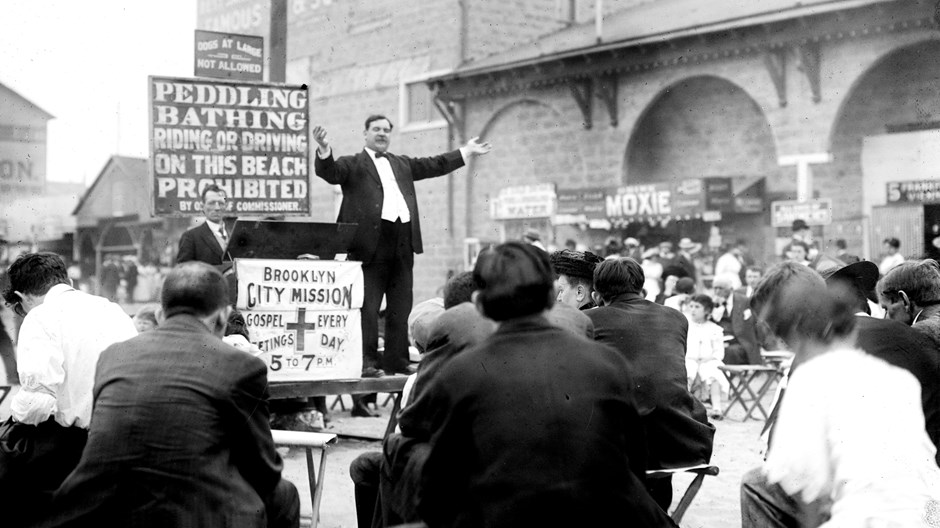
There is no ignoring the fact that we are in a different cultural position from the days when our spiritual forebears spread sawdust on the ground in their revival tents. We certainly have a much friendlier relationship with our surroundings. Some commentators say we have actually become the "mainline" of Protestantism. Evangelicals can be found in positions of leadership in politics, the universities, the entertainment business, and the marketplace. Pentecostal and Holiness congregations, which once stood on the wrong side of the tracks, are now often-flourishing ecclesiastical enterprises occupying the best real estate in town. Yet the question must be asked: Have we lost some important spiritual sensitivities while all of this has been happening?
There is an interesting parallel between the social pilgrimage of evangelicals and that of Roman Catholics in this century. In the course of only one or two generations, American Catholics have gone from being a marginal immigrant community to a significant cultural presence in the United States. A number of commentators have observed that these changes have not been accompanied by a comparable shift in theological self-understanding. Many Catholic laypeople, for example, occupy significant leadership roles in American culture, but they were educated in a religious system that presupposed the need to "keep the faith" as immigrant communities rather than to take up the challenge of exercising power in the structures of the larger culture.
Article continues below
Similar things, I am convinced, can be said about evangelicals—and not only about our upwardly mobile laity but about our upwardly mobile clergy leaders as well. In the past we evangelical Protestants became accustomed to thinking of ourselves as a beleaguered remnant. We devoted much energy to preserving the integrity of our faith in what we saw as a hostile environment. And the kind of theology we heard in sermons and read in magazines was designed to reinforce this sense that we are destined to be a people who are on the margins of cultural life. We don't really belong in this world, we told ourselves. We are on our way to heaven's glory. The most important thing is to make it through by being faithful to the gospel and—as much as possible—without getting contaminated by our sinful surroundings.
We don't usually hear the case being made in such stark terms these days. We have a lot less to feel alienated about than we did in the past. Let me make it clear that I do not think this is necessarily a bad thing. I have expended considerable energy joining my voice with those who have called for an evangelical witness that speaks more credibly to the larger culture without losing the movement's distinctive strengths, and I do not think this effort has been misguided. Indeed, I occasionally complain that some of the defects that led to the marginalized mentality in the past still linger on in the evangelical community.
Unlike those evangelical thinkers who worry that our successes have inevitably weakened us spiritually and theologically, my own inclination is to see the social gains of contemporary evangelicalism as presenting us with new opportunities for faithfulness. And I see many evangelicals responding creatively to these challenges. I talk with seminary students on a daily basis who care deeply about the cause of the gospel. I often hear "megachurch" pastors boldly proclaiming the themes of sin, guilt, and redemption through the blood of Jesus Christ. So, I am not discouraged about the evangelical movement. But I do want us to think carefully about who we are and what God calls us to be.
Article continues below
I am especially impressed these days with the importance of historical mindfulness. The call issued by sociologist Robert Bellah and his colleagues in Habits of the Heart—that churches and synagogues must work hard at being "communities of memory" in a culture fast losing its awareness of the past—is a poignant one for evangelicals.
Indeed, memory loss was one of fundamentalism's biggest defects. The fundamentalist movement often seemed to think that the history of the "real" church jumped from the early church to a quick stop at Martin Luther and then on to the fundamentalist-modernist controversies of the early twentieth century. The Pentecostal and Holiness movements had their own versions of that kind of abbreviated narrative of the Spirit's dealings with the church. Traces of this kind of spiritual and theological amnesia can still be detected in the evangelical movement.
A few years ago I met with a group of pastors from very large "charismatic" churches. Each of their congregations numbered in the thousands—many were conducting four and five services each weekend. I tried to impress on them the importance of theological education for pastors. Several of them made it clear they found what I was saying quite unconvincing. "We're in the business of getting people to come to church," they said; "seminaries are no help at all in telling us how to do that." I responded by admitting that while seminaries could do a better job in helping to promote this cause, we also are concerned about what people learn when we get them into a church. And for this we need pastors who are firmly grounded in biblical teaching, theological reflection, and a clear understanding of the history of God's dealings with the church. None of this seemed very attractive to this group of pastors. One of them did say, however, that there probably is some value in studying the history of past revivals in the Christian community.
The study of the history of revivals is, of course, a worthy project. But I'm also interested in looking at the forces that were at work to make revivals necessary. One obvious factor in bringing about spiritual decline is bad theology. If we fail to engage in the careful study of ideas in Christian history—worthy and unworthy ideas about God and his relationship to human beings—we run the real risk of constantly recycling old heresies.
Article continues below
A Pentecostal friend of mine once shared an interesting account of the ways in which the Assemblies of God have had to deal with various heretical views about faith healing during the twentieth century. A key biblical text for Pentecostalism's understanding of this topic has been Isaiah 53:5 (King James Version): "with his stripes we are healed." The standard Pentecostal interpretation of this verse has been that physical healing is included in the atoning work of Jesus Christ, so that we can expect on occasion miraculous displays of God's healing power in our bodies. This interpretation was an important corrective emphasis for the whole evangelical movement. But at times in the Assemblies of God certain people have taught that physical healing is guaranteed by the atonement, so that Christians can expect miraculous hearings as a normal course of events in their lives. The denomination has regularly warned against this teaching. At other times, though, an even more radical notion has surfaced, namely, that Physical healing is accomplished by the atoning work of Christ, so that if a person thinks she has a cold she is being deceived by Satan—with Chris's stripes she is healed! This teaching has also been rejected as heretical.
This history shows us that there resides in the Assemblies of God a collective wisdom about faith healing; contemporary Pentecostals and charismatics ignore this wisdom at their peril. And these are only a few of the lessons that the study of the Christian history can teach us. If we fail to be historically mindful, we run the risk of constantly recycling old heresies.
I find it necessary for my own spiritual well-being to remember the history of the fundamentalist movement in particular. I was surrounded in my youth by people for whom painful memories of spiritual and theological battles were still very vivid. Many of them had left denominations and had been evicted from church buildings where they had served faithfully. They had seen schools and agencies they loved come under the influence of strange theological teachings. They had experienced the loss of "goods and kindred" because they refused to compromise their convictions.
Article continues below
I certainly entertain no illusion that the stories of their struggles were inerrant in all details. Nor do I deem it healthy to nurture past hurts in such a way that I insist on waging battles that no longer need to be fought. David Hubbard, the late president of Fuller Seminary, had a nice way of making this point. He said we evangelicals should look at the battles fought by previous generations in much the same way that American citizens honor the memories of those who fought in the Revolutionary War. "I can go to Bunker Hill," he said, "and feel patriotic, even though I have no animosity toward the present-day British."
Dr. Hubbard's image is an instructive one. Clearly it is important to remember our spiritual ancestors and to learn from their strengths and their weaknesses. But we do remember them as ancestors, as people who attempted to be faithful under conditions very different from our own context. We contemporary evangelicals must continue to visit our Bunker Hills. But the point of those visits is not to live in the past but to find new ways of engaging the present, knowing that to do so will require us to work together with—and learn important lessons from—Christian fellow travelers who regularly take their own detours, visiting very different shrines.
Excerpted from The Smell of Sawdust: What Evangelicals Can Learn from Their Fundamentalist Heritage, by Richard J. Mouw.













 While we pray for peace, we need moral clarity about this war.
 As my doubts about his teachings grew, so did a secret fascination with Jesus.
 Beyoncé’s right. Whether listening to Cowboy Carter or reading theology, diversity is a good thing.





