A recent web search on the word Celtic identified 976 sites, while a similar search on Jesus Christ located 896. In our local book-and-music megastore, Celtic music is one of the largest categories—well behind rock but gaining rapidly on classical. In the same store, the word Celtic appears frequently among the titles of the spirituality book section.These Celtic spirituality books are generally beautiful, lavishly decorated with a colorful knotwork of intertwined beasts and plants. The contents are organized around the seasons or the Celtic Pagan holy days (Samhain, Beltane, and others). The spiritual content is generic and safe, usually preceded by some warnings about the difference between Celtic spirituality (which is inclusive, and hence good) and Christian religion (which is exclusive, and hence bad). The introduction from one of these books is typical: "This book is for people of lively, questing spirit who want to lay down a personal pattern of spiritual practice but who do not wish to practice this within a specific religious framework. The material within this book springs from the spiritual current of Celtic tradition."Thus Celtic spirituality becomes one more dish on a spiritual smorgasbord, alongside various ancient and exotic traditions. We are used to such a spread in these late-modern times, whose inhabitants (like the Athenians of Paul's day) are always hungry for the latest ideas.The current wave of Celtophilia might be of only marginal interest to the Christian—except that a substantial and rapidly growing Celtic Christian movement also exists within the evangelical Christian community. So the word Celtic occurs with increasing frequency in the books and music of Christian bookstores, as do the rhythms of Celtic idiom in Christian worship. (Witness, for example, the current popularity of the ancient Irish hymn, "Be Thou My Vision," recorded not only by Christian groups but by secular stars like Van Morrison.)To many Christians, hints of a distinctive Celtic source have beckoned like cool water in a desert land. Michael Mitton—director of Anglican Renewal Ministries within the Church of England—writes in Restoring the Woven Cord about discovering the Celtic tradition after a trip to the "Holy Island" of Lindisfarne:
I discovered a burning and evangelical love for the Bible … a depth of spiritual life and stillness … a radical commitment to the poor and to God's creation; and the most attractive expression of charismatic life that I had yet encountered. … I am in no doubt that the Spirit of God is reminding us of the first expression of faith in these isles to give us inspiration for Christian ministry and mission today.
Many Christians, however, rigorously resist any influence from the Celtic tradition. This reaction ranges from guilt by association ("If it's Celtic it must be pagan") to a more scholarly perception that what much of our contemporary spiritual questing finds in the Celtic is a mere projection of our own longings. In a recent work, Ian Bradley admits that his earlier book, The Celtic Way, played "a small part in promoting the present revival." But in a new volume, Celtic Christianity: Making Myths and Chasing Dreams, Bradley tries to strip away the "layers of distortion and fabrication" that color much contemporary Celtic enthusiasm. He quotes favorably from Clifford Langley, a respected London journalist, that it is "time for a backlash against Celtic Christianity":
It is truly the myth whose time has come. But its very convenience, its extraordinary ability to meet so many current needs, should make us suspicious. For it is also, to use an old Celtic expression, phony baloney—a legend still in the process of being invented. … It will be all things to all men and score high in the ballyhoo department. A touch of skepticism would be timely.
My own experience has been that the truth lies (as usual) between these extremes of Celtophobia and Celtophilia. Great riches may be found in the Christian traditions of the people who inhabited the fringes of Britain in the centuries following the collapse of the Roman Empire. But there is also much wishful thinking in the reconstruction of those traditions. As always, the standard should not be whether it is appealing, but whether it is biblical. Given that guide, there is good reason to become a pilgrim—literally or figuratively—to the holy places and people from that distant age. But to do so it is necessary to think carefully about their time—and our own.
QUEST FOR THE HISTORICAL CELTS
Who were the Celts? The name Celtic refers to an ancient European people who shared a family of languages now represented mainly by Gaelic, Irish, and Welsh. That these languages have survived (tenuously) around the Western fringe of the British Isles reveals something of the people's history, and their peculiar relationship to the Roman Empire and to Roman Christianity.In the centuries before Christ, the Celts inhabited a broad band across central Europe, extending into Spain and Turkey. Paul wrote the epistle of Galatians to a group of Celts in Asia Minor.The word Galatia only slightly conceals the word Celt, as does Gaul. They were a warlike people with a highly distinctive style of visual art and a rich mythology and oral culture.The Romans succeeded in conquering the Celtic peoples throughout Europe, and were established in Britain by the time Jesus was born. But the Romans never got as far as Ireland, or the Highlands and outer islands of Scotland, and the pagan Celtic cultures flourished there during the centuries that Romans were in Britain. Conveyed by Roman civilization, sometime during those centuries the gospel came to Britain—at least to the soldiers and the aristocracy. Exactly when is debatable; a durable but quite unsupported legend puts Joseph of Arimathea in Britain, along with the Holy Grail, shortly after the Resurrection.But there were certainly Christians in the south of Britain by the early third century. And, though Roman soldiers never made it to Ireland, the Christian message did. By the fourth century—a generation and more before Patrick—Christians were in pagan Ireland.Then Rome withdrew from Britain. The Romans had been there almost as long as Europeans have been in North America. But the legions were needed to protect the Roman heartland, and by the early fifth century the soldiers were no longer present to hold back the waves of Saxons and Angles who nearly eliminated the Roman (and Christian) culture of England.Although the flame of Christian culture was practically extinguished in what is now England, it burnt brighter and brighter in Ireland, fanned in the fifth century by the tireless preaching of Patrick. For a century and a half Ireland was isolated from the chaos of the collapsing Roman world. During those years it became the center—and the preserver—of much of European Christian culture. Thomas Cahill tells this story brilliantly in How the Irish Saved Civilization. The title may exaggerate a little—but not much. Rooted in these years of Celtic Christian culture's isolation is its uniqueness, its mystery, and its apparently endless appeal to citizens of another chaotic (and perhaps collapsing) civilization, a millennium and a half later.The uniqueness is this: nowhere in the history of Christianity is there so clear an instance of the Christian transformation of a pagan culture with so little influence by the culture that brought the Christian message. For as soon as the Roman culture had carried the gospel to Ireland, the carrier collapsed. Certainly the Celtic Christians were not ignorant of that distant world, and there is no evidence—contrary to some exaggerated claims—that they ever saw themselves as a separate church. (The terms Celtic church and even Celtic Christianity are almost certainly misleading.) Nevertheless, for several generations there was little influence from the rest of European Christianity, and the result was a unique Christian blossoming of a formerly pagan culture.Christian Ireland did not keep its light to itself. It not only welcomed scholars—and manuscripts—from all over Europe, but it sent out missionaries. Columbanus (d. 615), late in the sixth century, wandered across Europe as far as Austria, Switzerland, and Northern Italy, making converts and establishing monasteries as he went. As the consequence of his self-imposed exile from Ireland, Columba (or Colum Cille, c. 521-97) established a monastic community on Iona, a tiny island off the coast of Scotland. Iona became a major center for the Christianization of England and northern Europe. The King of Northumbria, ruler of some of the invaders who had eliminated Rome from Britain, sent to Iona saying he was tired of fighting and wanted to become a Christian. The result was Aidan's establishment of the monastery at Lindisfarne in 635. It is located on an island (a peninsula at low tide) off the northeast coast of England near the Scottish border. Iona and Lindisfarne continued as centers of learning and evangelism until Viking invaders shut them down late in the ninth century. Not surprisingly, much of the current interest in a Celtic perspective on Christian faith centers on these two ancient sites.By the end of the sixth century, the worst of the chaos in Europe was over and the church, under the Bishop of Rome, was establishing order throughout Western Christendom. In 597 Pope Gregory sent Augustine (not the great Augustine of North Africa, but a papal librarian) to England, and he began converting the southern residents of the island to Roman Christianity. The older and much less orderly Celtic Christians accepted, apparently without much resistance, the authority of the larger Roman Catholic world (from which they never seem to have felt fundamentally separated) at the Synod of Whitby in 664. Increasingly, Christianity in Britain became administratively unified as part of Catholic Christianity.
Article continues below
Article continues below
DEMYTHOLOGIZING THE CELTS
That much is fairly well established. The intense interest today in Celtic spirituality is based on the belief that in those centuries of isolation, Celtic Christians developed a culture that was in many respects closer to the early church, and to "true Christianity," than any of the forms of institutionalized Christianity that replaced it. Some consider the "defeat" of Celtic Christians at Whitby a disaster of planetary proportions. Bradley quotes a 1998 speculation from The Plain Truth, the magazine of the Worldwide Church of God: "If the Celts had won at Whitby, our world might be less materialistic and less steeped in consumerism. Our waters might be less polluted, our rain forests and ozone layer might still be intact, and our fellow creatures might be less endangered. Life might be simpler, less frantic, and happier."So the books, conferences, and retreats focusing on a distinctive Celtic Christianity continue to flow. This month in Oxford, for example, a conference—titled "There's Life in the Roots"--focused on Celtic and Anabaptist traditions. The brochure announcing the conference lists what the two traditions have in common, and these qualities can stand as a good list of the appeal that Celtic Christianity exerts today. he movement offers
Article continues below
a rich worship tradition; fosters prayer in everyday language; is 'green' in its stewardship of the earth; affirms women and men equally; is committed to living in community; nurtures radical discipleship; is passionate about peace and justice; has no divide between sacred and secular; engages critically with contemporary culture; is rooted in mission not maintenance.
This is an appealing list. Those with Anabaptist roots can judge how accurate it is of their tradition and practice, and how much it is an ideal. Two factors, however, make it difficult to say with confidence that in living out these values we are indeed walking in the Celtic Christian tradition.First, little direct information exists about the actual practice of the early Celtic Christians. There is evidence instead of a great deal of wishful reconstruction. Bradley's book, subtitled "Making Myths and Chasing Dreams," carefully catalogues five waves of mythmaking about Celtic Christianity. "It is the misty and vague aura surrounding this age that accounts for much of its appeal," Bradley writes. "The absence of hard facts has allowed hagiographers, romanticists and propagandists for various causes to weave myths and spin legends."The first of those waves of legend-spinning dates back to the initial biographies of Celtic Christian heroes like Patrick and Columba. In few cases were these stories written by people with living memories of the characters they described. As a result, the legends diverged more and more from fact. In the case of Patrick, we do have a significant work of his own: his "Confession," a personal creed that establishes not only his essential orthodoxy but his deeply Christian sense of humility. That document became an embarrassment to later writers, who needed a national hero. Indeed, those biographers edited much of the humility from the words of the real Patrick, because (as one scholar put it) "the contrast between the real Patrick and the 'conquering hero' of his late seventh-century biographers … who marches from one territory to another at the head of a band of lay and clerical retainers and pulverizes his opponents, often by a display of 'bigger and better' magic … would have been all too obvious." The same kind of exaggeration accompanies the most influential biographers of Columba, who increasingly becomes a miracle-worker. Thus these early hagiographies, while not simply fictitious, provide a less-than-certain foundation on which to build.The second wave of mythmaking began several centuries later, and was influenced by two factors. One was the need for individual dioceses to establish that they had within their borders the birthplace or relics of a saint, which would lend prestige and attract pilgrims. Another more subtle factor was the fascination of the Norman conquerors with the history of the people they had vanquished. From this period come the legends of the Holy Grail and King Arthur, and a number of other fabulous quest stories about Celtic saints, most of them written in French.A third wave of mythmaking emerged in the turbulent years around the Reformation, and was motivated by the deep need to prove an ancient strain of pre-Roman Scottish Christianity, a kind of original Protestantism, which was now, after many centuries, being recovered.A fourth wave in the nineteenth century drew on Victorian fascination with antiquity, and was well-expressed in William Butler Yeats' celebration of "The Celtic Twilight," which he and other enthusiasts hoped might turn into the dawn of a mystical new paganism.The fifth wave is the current one with (as we have seen) both pagan and Christian elements. Celtic legend is the strongest single source in the current neopagan revival, and ardent neopagans find it difficult to acknowledge that the fullest flowering of Celtic culture was undoubtedly in Celtic Christianity. (An artist friend had a hard time convincing the clerk in a "Celtic Art" shop that the Book of Kells, one of the glories of Celtic art, was actually an illustration of Christian Scriptures.)Equally ardent Christian Celtophiles can be troubled that collections of Celtic prayers and blessings contain large numbers of charms and curses, reflecting a quite unbiblical melange of saint and fairy. In fact, the tangle of sources for contemporary Celtic Christianity is quite as complex and confusing as the knotted networks on the "carpet pages" of the Lindisfarne Gospels or the Book of Kells.In addition to uncertainty about the primary sources, the other factor that shadows current Celtic Christian enthusiasm is the postmodern conviction that we need to find (or create) stories to live by. True, there is a human need for story. But both neopagans and radical feminists alike are quick to say: "It doesn't really matter whether a useful history [dominated either by magic or by matriarchy] really happened. Too fine a concern for fact and truth is a modern, patriarchal hangup anyway. The important thing is to find stories which nourish us now, and the Celtic past, historical or not, is a rich store of such stories." No Christian whose faith is rooted in the reality of the Resurrection can have such a casual attitude toward history.Like historians, most academic theologians are not impressed with claims for the significance of Celtic thought."The idea of Celtic Christianity," one British theologian told me severely after I had presented a paper that said some positive things about the tradition, "is a black hole in which one can find anything one wants." Certainly the plethora of recent books on Celtic spirituality which make no mention of Jesus would seem to confirm that judgment.The contribution of Celtic Christian thinkers to the Western theological tradition is dubious at best. Celtic theology is linked with the fourth-century Augustine's British contemporary, Pelagius. Thanks to Augustine's thoroughgoing critique of Pelagius' idea that sin did not drain all value from human action, Celtic theology is remembered today only through the Pelagian heresy. ("British theology," said Karl Barth, "is incurably Pelagian.")In the ninth century, toward the end of Ireland's ascendancy as a cultural center, the Celtic world produced its most significant philosophical thinker, John Scotus Erigena. But his insistence on speaking of God as "Nature which creates" got him eventually condemned as a pantheist and a heretic, and his books were burned in the thirteenth century.
Article continues below
Article continues below
Article continues below
NOT JUST CHICKEN SOUP FOR THE SOUL
There are ample reasons to be cautious about the Celtic Christian tradition, but it would be a huge mistake to dismiss it as a postmodern fad. Here I speak personally. Exposure to the Celtic perspective on the Christian gospel has been (for both my wife and me) a rich source of recovering basic Christianity. This is not because of any sentimental attachment to the ambience of Scotland, Ireland, or Wales, or any sense of going back to distant ethnic roots.It is rather that some basic Christian insights have been preserved here. Two sorts of sources have helped to convey those insights. The first is a powerful written record of experiencing the triune God.This is nowhere clearer than in that astonishing giant of a hymn called "St. Patrick's Breastplate." The hymn is likely not by Patrick, but it can certainly be traced to the Ireland that he helped influence (most scholars date it to the eighth century). The "breastplate" in the title refers to the hymn's drawing on an ancient—probably pre-Christian—tradition of invoking supernatural help in times of trouble. But here that ancient human response to vulnerability has been gloriously baptized.It begins with an invocation to the Trinity: "I bind unto myself today/the strong name of the Trinity"--and then proceeds, through several verses, to invoke the reality of the whole extended community of creation: the angels and archangels, the saints and patriarchs, even the rocks and the sea. The climax of the hymn (and here both the meter and the tune change) is an appeal to the biblical truth that "all things hold together" in Christ, "without whom nothing was made":
Christ be with me, Christ within me,
Christ behind me, Christ before me,
Christ beside me, Christ to win me,
Christ to comfort and restore me,
Christ beneath me, Christ above me,
Christ in quiet, Christ in danger,
Christ in hearts of all that love me,
Christ in mouth of friend and stranger.
Then the hymn returns to the opening invocation:
I bind unto myself the name,
The strong name of the Trinity,
By invocation of the same,
The three in one, and One in Three,
Of whom all nature has creation;
Eternal Father, Spirit, Word,
Praise to the Lord of my salvation
Salvation is of Christ the Lord.
Two related convictions pervade the great hymn. The first is an exuberant belief in the reality of the Trinity, "The Three in One, the One in Three." The second, in separable from the first, is a sense of the triune God's astonishing closeness.Belief in the Trinity and the closeness of God is not unique to the Celtic Christian culture, of course. Both doctrines are affirmed in Western theology (both Catholic and Protestant). Yet, as many have pointed out, a subtle deism is latent in much Western theology—some trace it to Augustine of northern Africa—which reinforces the oneness and otherness of God rather than God's intrinsic relatedness. Eastern Orthodoxy, with which the Celtic Christian vision often shares intriguing similarities, keeps this insight of the interrelatedness of the Trinity (called the doctrine of perichoresis, or coinherence of the Trinity). Eastern Orthodoxy too has been better at keeping central the abundant witness of Scripture that creation is not so much a process that God began and occasionally intervenes in. Rather, creation involves a relationship in which the whole cosmos is at every point dependent on the self-giving God whose very nature is love involving community and relatedness.This accent on God's immanence in Celtic Christian thought is close to the basic Hebrew vision expressed (for example) in Psalm 65: "You care for the land and water it; you enrich it abundantly. … [T]he valleys are mantled with grain; they shout for joy and sing"; or in Paul's sermons to pagan peoples in Acts 14 (God "provides you with plenty of food and fills your hearts with joy") and Acts 17 (God "is not far from each of us. For in him we live and move and have our being"). For some reason, this sense of God's loving, active presence has been diminished in much of Western Christianity. Yet it survived in the Christian experience of many in the Celtic regions on the fringe of Britain.One of the most important documents in the Celtic renaissance is a remarkable, massive five-volume collection of "hymns and incantations," recently published in a one-volume edition. These hymns were collected in the outer islands of Scotland by Alexander Carmichael, whose work as an "excise man" (tax collector) took him to many remote areas in the nineteenth century. Though Carmichael has been criticized for polishing the form of these carefully recorded bits of oral tradition, no one seriously doubts the general accuracy of his transcriptions. They seem to record, across the centuries, the spirit of ancient Celtic Christianity.Not all of Carmichael's transcriptions are Christian—many reflect a tradition of folk magic. But the vast majority are prayers and blessings that, like "St. Patrick's Breastplate"--to which they bear considerable resemblance—recognize the presence and activity of the triune God in daily life. Most of the material in the many collections of prayers that have been published in the last decade or so, and which are the main source of the current "Celtic Christian" revival, come from Carmichael's work, Carmina Gadelica.Three things characterize this abundance of folk prayers and blessings. First, as we have already noted, is their irrepressible Trinitarianism. The spirit of the whole collection is captured in the first lines of the invocation that opens it:
Article continues below
Article continues below
I am bending my knee
In the eye of the Father who created me,
In the eye of the Son who purchased me,
In the eye of the Spirit who cleansed me,
In friendship and affection.
The remarkable thing here is not only the easy invocation of the Trinity, which is foreign to much evangelical prayer, except—in some traditions—as a kind of liturgical habit. The phrase "in friendship and affection" suggests the second pervasive feature of the praying tradition represented here: the possibility of friendship with God. These prayers are close to the spirit of the one who taught us to pray, "Abba," "Daddy." They suggest it is possible not only to love God, but to like him.The third striking thing about these prayers is the way they pervade and seek to hallow every aspect of life. There are prayers for cooking, eating, milking the cows, starting the fire, weaving cloth, baking bread, rowing a boat.Because they are associated with "rural" activities most of us no longer engage in, we are apt to lose the main point that God is present in every act of our life. That there are no prayers here for rush-hour commutes or committee meetings should not obscure the essential point—easily affirmed, usually forgotten—of God's presence in all our activities. This principle perhaps parallels the Benedictine orare est labore ("to labor is to pray").The second way Celtic Christianity has affected me is in the gift of people who put their faith into practice. When my wife and I were in Britain for a time of study a few years ago, we stumbled, almost by accident, onto the Northumbrian Community. This is a transdenominational (and thoroughly orthodox and evangelical) group of people determined to live the Trinitarian Christian life which once transformed that part of Britain, and Europe. They have a particular affection for the places associated with Aidan and Cuthbert, and the waves of evangelism that spread out from Lindisfarne.This community of faith is deeply aware (as all Christians should be) that we are in a confused period of cultural darkness—as deep as anything in the sixth and seventh centuries. They also recognize that now, as then, groups of local Christians—characterized by "availability, vulnerability and hospitality"--uniquely shine light in the darkness.The liturgies of the Northumbrian Community (published as Celtic Daily Prayer and Celtic Night Prayer) draw on Scripture and on a wealth of old and new material that remind us of the reality the triune God.Other such communities draw on the down-to-earth implications of the Incarnation—that, in the words of Eugene Peterson's translation of John 1:14, "The Word became flesh and blood and moved into the neighborhood." Whether they appeal to the rediscovered resources of these Christ-transformed pagans from the fringe of Britain is not nearly so important as this: in a time of darkness, they experience, enjoy, and share the closeness of the triune God.For the gifts of the rediscovered Celtic tradition, and the books it is producing, we need to be both cautious and thankful. But after the caution, thanksgiving should be the main response: whether or not all these insights can be clearly traced to ancient Celtic sources, they are true.They can be traced to a much more ancient and authoritative source: God's Word in Scripture. For these works can put us in touch with the living God, wellspring of our own life and joy. In these tense and cluttered times we could well learn and live by the sort of daily prayer that Alexander Carmichael recorded in 1866 from Mary McCrae, on the Isle of Harris. She was, he says, "a faithful servant and an admirable worker and danced at her leisure and caroled at her work." She prayed:
Article continues below
Christ with me sleeping
Christ with me waking,
Christ with me watching Every day and night
Each day and night. God with me protecting,
The Lord with me directing,
The Spirit with me strengthening,
For ever and for evermore. Amen.
Amen indeed.
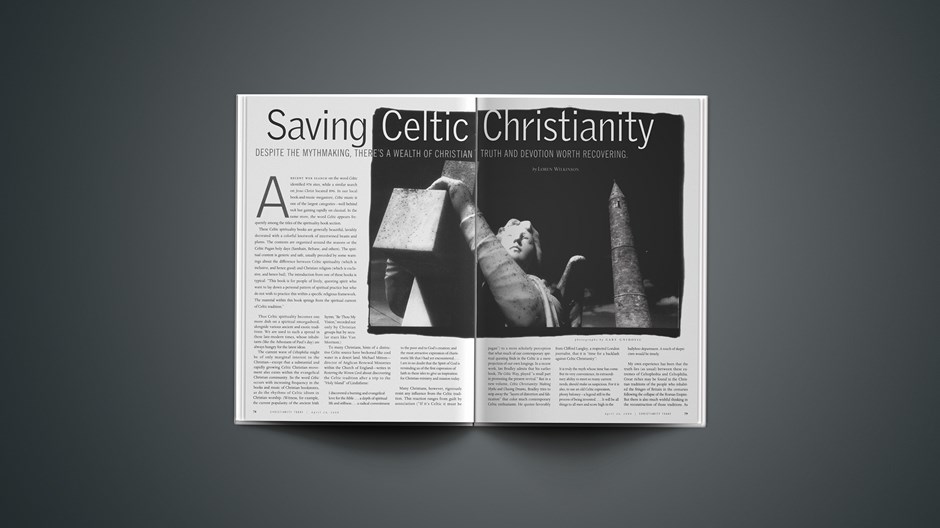
Loren Wilkinsonis professor of interdisciplinary studies and philosophy at Regent College in Vancouver, British Columbia. He and his wife Mary Ruth live on an island off the coast of the mainland. Paternoster Press will publish his book Circles and the Cross this year.Photography by Gary Gnidovic.
Article continues below
Related Elsewhere
See today's related article, "Going Deeper | Books on Celtic Christian spirituality," also by Loren Wilkinson.For more on historical Celtic Christianity and how it matches up to today's version, see issue 60 ("How the Irish Were Saved") of our sister publication, Christian History. Especially of note are the articles "Rooted in the Tradition | Celtic Christianity is not as theologically unique as many have supposed" by Gilbert Márcus and "Modern Myths of the Medieval Past | Much of today's 'Celtic Christianity' is neither Celtic nor Christian" by Donald E. Meek.Other Christianity Today articles about Celtic Christianity include a collection of Celtic prayers and blessings and "Invoking the Celtic Saints | Irish Christian band Iona defies trends, transcends tradition" (Nov. 17, 1997)ChristianityToday.com also looked at the patron saint of Celtic Christianity, Patrick, on (when else?) March 17, 2000.Other Christianity Today articles by Loren Wilkinson include "The Bewitching Charms of Neopaganism | The movement rejects Christianity, but we may discover surprising openings for the gospel" (Nov. 18, 1999) and "How Green Is Easter? | Celebration of Jesus' resurrection is more than being glad about the return of spring" (Apr. 5, 1999).Stuart's Celtic Christianity Page is one of the better collections of links in this subject.















 While we pray for peace, we need moral clarity about this war.
 As my doubts about his teachings grew, so did a secret fascination with Jesus.
 Beyoncé’s right. Whether listening to Cowboy Carter or reading theology, diversity is a good thing.






