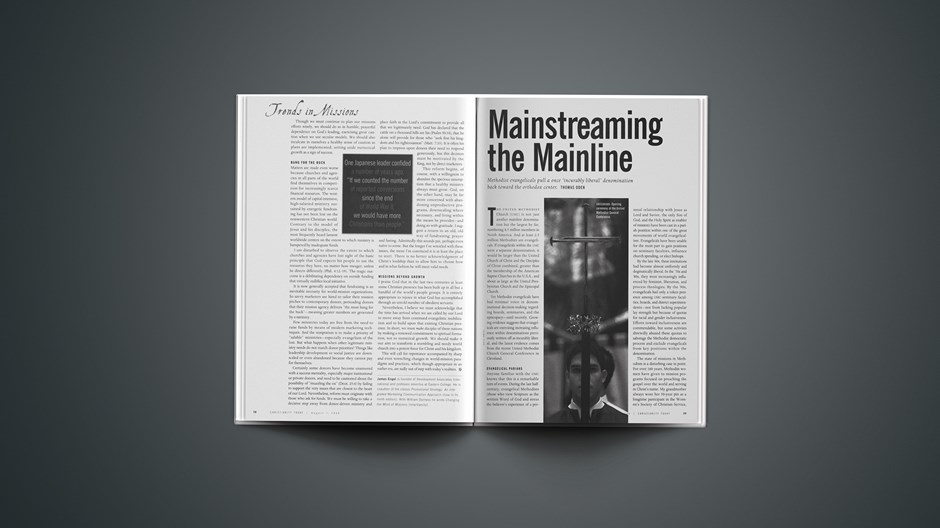
The United Methodist Church (UMC) is not just another main line denomination but the largest by far, numbering 8.5 million members in North America. And at least 2.5 million Methodists are evangelicals. If evangelicals within the UMC were a separate denomination, it would be larger than the United Church of Christ and the Disciples of Christ combined, greater than the membership of the American Baptist Churches in the U.S.A., and about as large as the United Presbyterian Church and the Episcopal Church.Yet Methodist evangelicals have had minimal voice in denominational decision-making regarding boards, seminaries, and the episcopacy—until recently. Growing evidence suggests that evangelicals are exercising increasing influence within denominations previously written off as incurably liberal, and the latest evidence comes from the recent United Methodist Church General Conference in Cleveland.
Evangelical pariahs
Anyone familiar with the UMC knows that this is a remarkable turn of events. During the last half-century, evangelical Methodists (those who view Scripture as the written Word of God and stress the believer's experience of a personal relationship with Jesus as Lord and Savior, the only Son of God, and the Holy Spirit as enabler of mission) have been cast in a pariah position within one of the great movements of world evangelicalism. Evangelicals have been unable for the most part to gain positions on seminary faculties, influence church spending, or elect bishops.By the late '60s, these institutions had become almost uniformly and dogmatically liberal. In the '70s and '80s, they were increasingly influenced by feminist, liberation, and process theologies. By the '90s, evangelicals had only a token presence among UMC seminary faculties, boards, and district superintendents—not from lacking popular lay strength but because of quotas for racial and gender inclusiveness. Efforts toward inclusiveness are commendable, but some activists shrewdly abused these quotas to sabotage the Methodist democratic process and exclude evangelicals from key positions within the denomination.The state of missions in Methodism is a disturbing case in point. For over 160 years, Methodist women have given to mission programs focused on preaching the gospel over the world and serving in Christ's name. My grandmother always wore her 50-year pin as a longtime participant in the Women's Society of Christian Service, as did my mother. Every month these societies would meet and hear of preaching missions and give generously to world missionary efforts.These monies have accumulated in the Board of Global Ministries for 100 years, but since the late '60s the board has been controlled by Methodists with a different vision. The board now casts a cold eye on preaching aimed at conversion and all deliberate ministries of proclamation. It prefers that the mission bureaucracy be a grant-making institution tilted largely toward social action and humanitarian projects.Until recently, evangelicals have not felt a divine vocation to enter the nitty gritty of legislative activism in the church's governance process, or to organize a populist countermovement, or to plan how to elect delegates, bishops, and a fair judiciary. Evangelicals have preferred to get busy with the Great Commission to make disciples all over the world, abandoning political machinations to those perhaps wise as serpents but considerably more harmful than doves.But the curve of evangelical political and strategic intelligence is sharply up, as attested in Cleveland. Legislating within the United Methodist Church is a vast democratic process, with multiple views at the table often largely reflecting the mood of the country. Evangelicals can take heart from what happened in Cleveland. This year's General Conference:
Acted to require evangelism in the curriculum for ministerial ordination.
Obliged clergy candidates, curriculum planners, and lay speakers to follow Wesleyan evangelical doctrinal standards.
Defeated attempts to impose non-Trinitarian language on the liturgy.
Affirmed Jesus as exclusive Lord and Savior of the world, against efforts to legitimize the doctrine of universal salvation as if it were a standard Methodist teaching.
Affirmed that regional Annual Conferences cannot nullify the Book of Discipline. Bishop Melvin Talbert did this in effect when he refused to further press charges against 67 clergy who participated in blessing a same-sex union, appealing to Annual Conference authority over the Discipline.
Resisted persistent challenges to grant legitimacy to homosexual behavior.
It firmly retained language declaring that "homosexuality is incompatible with Christian teaching." It defined "practices incompatible with Christian teaching" as a chargeable offense. Under "duties of the pastor," the conference added a prohibition of performing same-sex unions. While affirming evangelical reparative therapy and transforming ministries to homosexuals, the conference defeated proposals to require the hiring of active homosexuals in church positions. It defeated attempts to require church-sponsored Scout troops to accept homosexually active leaders.In fact, over the last 28 years of constant challenges, the margin of majority votes resisting the legitimization of homosexual behavior has gradually increased in a range from 60 to 70 percent. These majorities were strengthened by some votes of over 70 percent, demonstrating that the once-assertive advocacy of the gay agenda has now dwindled to less than one-third. The vote to uphold the ban on church funds being used to support homosexual advocacy had a strong 74 percent support.For the first time, the UMC seeks observer status in the National Association of Evangelicals and the World Evangelical Fellowship. For the first time, on a 622–275 vote, the conference opposed partial-birth abortion, in contrast to previously adamant prochoice stance. For the first time, the conference supported voluntary prayer in public schools and the International Day of Prayer for the Persecuted Church.
Article continues below
Slow shift coming
These may seem like modest gains, but they are among the first evidences of evangelicals' growing ability to effect basic change in the UMC.This shift has not happened overnight but is the result of decades of work by renewal groups. The Good News movement was founded 33 years ago to bring a more distinctly evangelical emphasis to the denomination.More recently, the Confessing Movement (a broader coalition of evangelicals, orthodox, Wesleyan traditionalists, moderates, prolife, and mission-oriented faithful) was inaugurated in 1994 when a group of 90 church leaders met in Atlanta and drafted an invitation to call church leadership back to classic Christian teaching. The Confessing Movement has subsequently become a vast grassroots movement through a series of national conferences.That growth is reflected in the Confessing Movement's selecting state senator Pat Miller of Indiana as its executive director. She is committed to organizing Confessing members and churches in every state, with half a million people related to this network and its literature and prayer life. Its influence and connectivity stretch into every conference and jurisdiction.In addition to Good News and the Confessing Movement, several renewing movements united as Decision 2000 during the Cleveland conference. That coalition included the Mission Society for United Methodists, Aldersgate Renewal Fellowship, Lifewatch, the Renew Network: An Ecumenical Coalition for Women, Transforming Congregations (encouraging evangelical ministries to homosexuals), and United Methodist Action, the Methodist branch of the Institute for Religion and Democracy.Almost every conference, meanwhile, has half a dozen rapidly growing congregations with evangelical pastors whose gifts are being discerned by their hearers, even if not by their bishops. Most of the rapidly growing congregations larger than 1,000 members now have evangelical and traditional leadership, some effected by charismatic movements, some by serious Bible teaching, some by becoming seeker-oriented churches.In most cases, the correlation is clear: growth is occurring most dramatically in the evangelical wing of Methodism, even if it has little voice in church agencies.I don't want to overstate the case. Most boards and agencies that officially speak for the UMC indeed remain liberal. The official voices most easily heard about United Methodist affairs are often the most utopian and least evangelically grounded voices in the church. And rigorous realism suggests that votes in one General Conference do not prove a trend.Yet most of us involved in confessing and renewing movements have reason to think we can reclaim our institutions. And United Methodist evangelicals have good reason to continue to ask other evangelicals to pray for their efforts to reground the UMC in the gospel.
Article continues below
Thomas Odenteaches theology at Drew University's Theological School in Madison, New Jersey.















 While we pray for peace, we need moral clarity about this war.
 As my doubts about his teachings grew, so did a secret fascination with Jesus.
 Beyoncé’s right. Whether listening to Cowboy Carter or reading theology, diversity is a good thing.






