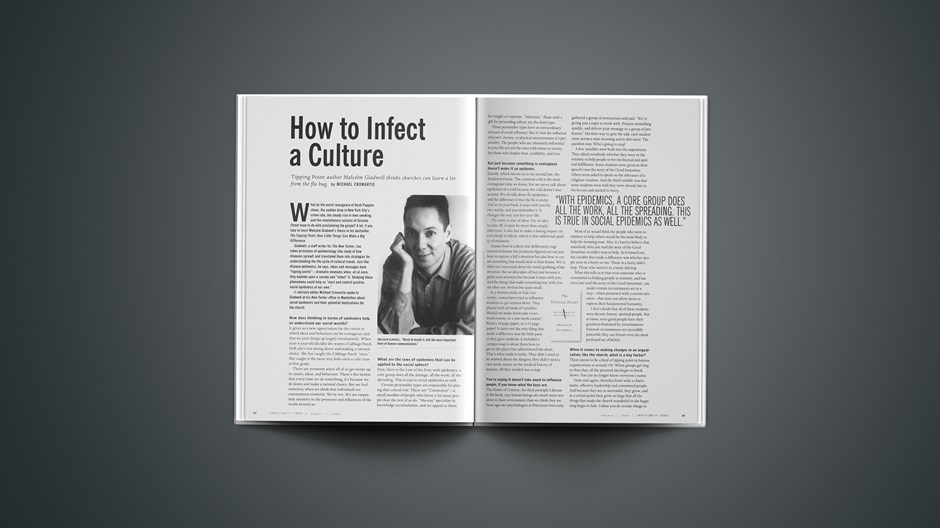
What do the weird resurgence of Hush Puppies shoes, the sudden drop in New York City's crime rate, the steady rise in teen smoking, and the revolutionary success of Sesame Street have to do with proclaiming the gospel? A lot, if you take to heart Malcolm Gladwell's thesis in his bestseller, The Tipping Point: How Little Things Can Make a Big Difference.Gladwell, a staff writer for The New Yorker, has taken principles of epidemiology (the study of how diseases spread) and translated them into strategies for understanding the life cycle of cultural trends. Just like disease epidemics, he says, ideas and messages have "tipping points"—dramatic moments when, all at once, they explode upon a society and "infect" it. Studying these phenomena could help us "start and control positive social epidemics of our own."CT advisory editor Michael Cromartie spoke to Gladwell at his New Yorker office in Manhattan about social epidemics and their potential implications for the church.
How does thinking in terms of epidemics help us understand our social worlds?
It gives us a new appreciation for the extent to which ideas and behaviors can be contagious, and that we pick things up largely involuntarily. When your 6-year-old decides she wants a Cabbage Patch Doll, she's not sitting down and making a rational choice. She has caught the Cabbage Patch "virus." She caught it the same way kids catch a cold virus in first grade.There are moments when all of us get swept up in causes, ideas, and behaviors. There's this notion that every time we do something, it's because we sit down and make a rational choice. But we fool ourselves when we think that individuals are autonomous creatures. We're not. We are exquisitely sensitive to the pressures and influences of the world around us.
What are the laws of epidemics that can be applied to the social sphere?
First, there is the Law of the Few; with epidemics, a core group does all the damage, all the work, all the spreading. This is true in social epidemics as well.Certain personality types are responsible for playing that critical role. There are "Connectors"—a small number of people who know a lot more people than the rest of us do. "Mavens" specialize in knowledge accumulation, and we appeal to them for insight or expertise. "Salesmen," those with a gift for persuading others, are the third type.These personality types have an extraordinary amount of social influence. But it's not the influence of power, money, or physical attractiveness; it's personality. The people who are ultimately influential in your life are not the ones with status or money but those who inspire trust, credibility, and love.
But just because something is contagious doesn't make it an epidemic.
Exactly, which moves us to the second law, the Stickiness Factor. The common cold is the most contagious virus we know, but we never talk about epidemics of a cold because the cold doesn't stay around. We do talk about flu epidemics, and the difference is that the flu is sticky. You're on your back, it stays with you for two weeks, and you remember it. It changes the way you live your life.The same is true of ideas. For an idea to take off, it must be more than simply infectious. It also has to make a lasting impact on everybody it infects, which is that additional quality of stickiness.Sesame Street is a show that deliberately engineered stickiness; the producers figured out not just how to capture a kid's attention but also how to create something that would stick in their brains. We're often too concerned about the initial grabbing of the attention. But an idea takes off not just because it grabs your attention but because it stays with you. And the things that make something stay with you are often not obvious but quite small.In a famous study at Yale University, researchers tried to influence students to get tetanus shots. They played with all kinds of variables: Should we make them take a two-week course, or a one-week course? Read a 10-page paper, or a 15-page paper? It turns out the only thing that made a difference was the little packet they gave students: it included a campus map to show them how to get to the place that administered the shots. That's what made it sticky. They didn't need to be warned about the dangers; they didn't need a two-week course on the medical history of tetanus. All they needed was a map.
You're saying it doesn't take much to influence people, if you know what the keys are.
The Power of Context, the third principle I discuss in the book, says human beings are much more sensitive to their environment than we think they are. Years ago two psychologists at Princeton University gathered a group of seminarians and said, "We're giving you a topic to work with. Prepare something quickly, and deliver your message to a group of professors." On their way to give the talk, each student came across a man moaning and in dire need. The question was: Who's going to stop?A few variables were built into the experiment. They asked everybody whether they were in the ministry to help people or for intellectual and spiritual fulfillment. Some students were given as their speech's text the story of the Good Samaritan. Others were asked to speak on the relevance of a religious vocation. And the third variable was that some students were told they were already late to the lecture and needed to hurry.Most of us would think the people who were in ministry to help others would be the most likely to help the moaning man. Also, it's hard to believe that somebody who just read the story of the Good Samaritan wouldn't stop to help. As it turned out, the variable that made a difference was whether people were in a hurry or not. Those in a hurry didn't stop. Those who weren't in a hurry did stop.What this tells us is that even someone who is committed to helping people in ministry, and has even just read the story of the Good Samaritan, can under certain circumstances act in a way—when presented with a certain situation—that does not allow them to express their fundamental humanity.I don't doubt that all of these students were decent, honest, spiritual people. But at times, even good people have their goodness frustrated by circumstances. External circumstances are incredibly powerful; they can thwart even the most profound set of beliefs.
Article continues below
When it comes to making changes in an organization, like the church, what is a key factor?
There seems to be a kind of tipping point in human organizations at around 150. When groups get larger than that, all the personal ties begin to break down. You can no longer know everyone's name.Time and again, churches form with a charismatic, effective leadership and committed people. And because they are so successful, they grow, and at a certain point they grow so large that all the things that made the church wonderful in the beginning begin to fade. Unless you do certain things to promote the same level of intimacy, closeness, involvement, and humanity in a large group as you have had in a small group, something is lost. And when churches start to exceed that 150 level, they need to break up the group into smaller pieces. One of the things that made the early church so successful was that they created small cells, pockets of community where people had close ties.
This has also been a key to the success of many influential church movements in history. In the book, you mention Methodism.
The genius of early Methodism was in setting up structures, not just churches, with rules that held the group together until people were able to build up a much stronger set of personal bonds and greater attachment to their faith. John Wesley spent his life traveling on horseback, seeding all these groups, visiting one after another, giving them an injection of energy and inspiration. The interesting thing about him is not that he managed to create a religious movement in his lifetime; he was able to create a movement that has lasted hundreds of years after his life.
Article continues below
Your message is hopeful: major social change can begin with just a small group of people.
Absolutely. A message or idea doesn't have to have status, power, and money behind it, but it does have to have the right kind of personalities. These people—Connectors, Mavens, and Salesmen—aren't interested in furthering themselves; they're just doing it because that's who they are. It's as natural as breathing to them.















 While we pray for peace, we need moral clarity about this war.
 We’ve got little information on Jesus’ appearance and personality. But that’s the way God designed it.españolFrançais
 The founder of Concerned Women for America was credited by President Ronald Reagan with “changing the face of American politics.”






