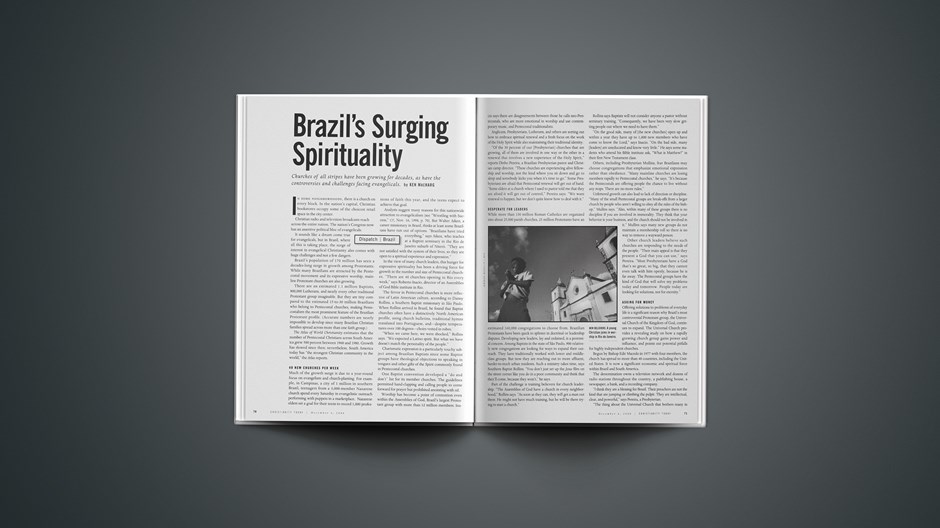
In some neighborhoods of São Paulo, there is a church on every block. In the nation's capital, Christian bookstores advertise their products on expensive billboards in the city center.
Christian radio and television broadcasts reach across the entire nation. The nation's Congress now has an assertive political bloc of evangelicals.
It sounds like a dream come true for evangelicals, but in Brazil, where all this is taking place, the surge of interest in evangelical Christianity also comes with huge challenges and not a few dangers.
Brazil's population of 170 million has seen a decades-long surge in growth among Protestants. While many Brazilians are attracted by the Pentecostal movement and its expressive worship, mainline Protestant churches are also growing.
There are an estimated 1.1 million Baptists, 800,000 Lutherans, and nearly every other traditional Protestant group imaginable. But they are tiny compared to the estimated 15-to-30 million Brazilians who belong to Pentecostal churches, making Pentecostalism the most prominent feature of the Brazilian Protestant profile. (Accurate numbers are nearly impossible to develop since many Brazilian Christian families spread across more than one faith group.)
The Atlas of World Christianity estimates that the number of Pentecostal Christians across South America grew 500 percent between 1960 and 1980. Growth has slowed since then; nevertheless, South America today has "the strongest Christian community in the world," the Atlas reports.
40 new churches per week
Much of the growth surge is due to a year-round focus on evangelism and church-planting. For example, in Campinas, a city of 1 million in southern Brazil, teenagers from a 3,000-member Nazarene church spend every Saturday in evangelistic outreach performing with puppets in a marketplace. The Nazarene teens set a goal for themselves to record 1,000 professions of faith this year, and are well on their way to achieving that goal.
Analysts suggest many reasons for this nationwide attraction to evangelicalism. But Walter Aiken, a career missionary in Brazil, thinks at least some Brazilians have run out of options. "Brazilians have tried everything," says Aiken, who teaches at a Baptist seminary in the Rio de Janeiro suburb of Niteroi. "They are not satisfied with the system of their lives, so they are open to a spiritual experience and expression."
In the view of many church leaders, this hunger for expressive spirituality has been a driving force for growth in the number and size of Pentecostal churches. "There are 40 churches opening in Rio every week," says Roberto Inacio, director of an Assemblies of God Bible institute in Rio.
The fervor in Pentecostal churches is more reflective of Latin American culture, according to Danny Rollins, a Southern Baptist missionary in São Paulo. When Rollins arrived in Brazil, he found that Baptist churches often have a distinctively North American profile, using church bulletins, traditional hymns translated into Portuguese, and—despite temperatures over 100 degrees—choirs vested in robes.
"When we came here, we were shocked," Rollins says. "We expected a Latino spirit. But what we have doesn't match the personality of the people."
Charismatic expression is a particularly touchy subject among Brazilian Baptists since some Baptist groups have theological objections to speaking in tongues and other gifts of the Spirit commonly found in Pentecostal churches.
One Baptist convention developed a "do and don't" list for its member churches. The guidelines permitted hand-clapping and calling people to come forward for prayer but prohibited anointing with oil.
Worship has become a point of contention even within the Assemblies of God, Brazil's largest Protestant group with more than 12 million members. Inacio says there are disagreements between those he calls neo-Pentecostals, who are more emotional in worship and use contemporary music, and Pentecostal traditionalists.
Anglicans, Presbyterians, Lutherans, and others are sorting out how to embrace spiritual renewal and a fresh focus on the work of the Holy Spirit while also maintaining their traditional identity.
"Of the 30 percent of our [Presbyterian] churches that are growing, all of them are involved in one way or the other in a renewal that involves a new experience of the Holy Spirit," reports Dinho Pereira, a Brazilian Presbyterian pastor and Christian camp director. "These churches are experiencing alive fellowship and worship, not the kind where you sit down and go to sleep and somebody kicks you when it's time to go." Some Presbyterians are afraid that Pentecostal renewal will get out of hand. "Some elders at a church where I used to pastor told me that they are afraid it will get out of control," Pereira says. "We want renewal to happen, but we don't quite know how to deal with it."
Desperate for leaders
While more than 130 million Roman Catholics are organized into about 25,000 parish churches, 25 million Protestants have an estimated 160,000 congregations to choose from. Brazilian Protestants have been quick to splinter in doctrinal or leadership disputes. Developing new leaders, lay and ordained, is a perennial concern. Among Baptists in the state of São Paulo, 900 relatively new congregations are looking for ways to expand their outreach. They have traditionally worked with lower and middle-class groups. But now they are reaching out to more affluent, harder-to-reach urban residents. Such a ministry takes time, says Southern Baptist Rollins. "You don't just set up the Jesus film on the street corner like you do in a poor community and think that they'll come, because they won't," he says.
Article continues below
Part of the challenge is training believers for church leadership. "The Assemblies of God have a church in every neighborhood," Rollins says. "As soon as they can, they will get a man out there. He might not have much training, but he will be there trying to start a church."
Rollins says Baptists will not consider anyone a pastor without seminary training. "Consequently, we have been very slow getting people out where we need to have them."
"On the good side, many of [the new churches] open up and within a year they have up to 1,000 new members who have come to know the Lord," says Inacio. "On the bad side, many [leaders] are uneducated and know very little." He says some students who attend his Bible institute ask, "What is Matthew?" in their first New Testament class.
Others, including Presbyterian Allan Mullins, fear Brazilians may choose congregations that emphasize emotional expression rather than obedience. "Many mainline churches are losing members rapidly to Pentecostal churches," says Mullins, who has served in Christian camping in Brazil for 30 years. "It's because the Pentecostals are offering people the chance to live without any stops. There are no more rules."
Unfettered growth can also lead to lack of direction or discipline. "Many of the small Pentecostal groups are break-offs from a larger church by people who aren't willing to obey all the rules of the bishop," Mullins says. "Also, within many of these groups there is no discipline if you are involved in immorality. They think that your behavior is your business, and the church should not be involved in it."
Other church leaders believe such churches are responding to the needs of the people. "Their main appeal is that they present a God that you can use," says Pereira. "Most Presbyterians have a God that's so great, so big, that they cannot even talk with him openly, because he is far away. The Pentecostal groups have the kind of God that will solve my problems today and tomorrow. People today are looking for solutions, not for eternity."
Article continues below
Asking for money
Offering solutions to problems of everyday life is a significant reason why Brazil's most controversial Protestant group, the Universal Church of the Kingdom of God, continues to expand. The Universal Church provides a revealing study on how a rapidly growing church group gains power and influence, and points out potential pitfalls for highly independent churches.
Begun by Bishop Edir Macedo in 1977 with four members, the church has spread to more than 40 countries, including the United States. It is now a significant economic and spiritual force within Brazil and South America.
The denomination owns a television network and dozens of radio stations throughout the country, a publishing house, a newspaper, a bank, and a recording company.
"I think they are a blessing for Brazil. Their preachers are not the kind that are jumping or climbing the pulpit. They are intellectual, clear, and powerful," says Pereira, a Presbyterian.
"The thing about the Universal Church that bothers many in the Presbyterian Church is that they have two things that we always wish we had," he says. "One is thousands of people, and the other is millions of dollars."
The Universal Church's wealth has drawn attention and criticism. "They are distinguished by asking for money," Inacio says. "If you need prayer, you had better take an offering. If you need help, you had better take an offering."
Terry Johnson, a third-generation Assemblies of God missionary in Brazil, is also unsparing in his criticism of the Universal Church. "They are rejected for the most part and considered to be radical. They are basically Pentecostal and charismatic in doctrine and practice, but they take it to the extreme."
While Johnson acknowledges that the Universal Church is dynamic and growing, he questions its theology of "inviting people to come to church but not to Jesus."
In 1997 the Universal Church experienced an enormous public setback when the Brazilian government levied a multimillion dollar assessment against it for avoiding taxes on business income.
But questions of finance and theology are not its only difficulties. In 1995 the Universal Church created a worldwide scandal when Sergio von Helde, a senior pastor of the church, called the likeness of Our Lady of Aparecida, Brazil's highly revered patron saint, a "horrible, disgraceful doll." He told viewers of a São Paulo-based television program, "This image can't do anything for you." Then he broke a ceramic image of the saint on camera, outraging millions of Brazil's Roman Catholics. He was later tried and found guilty of religious discrimination and desecration of a national sacred treasure and sentenced to two years in prison.
Article continues below
Universal Church leaders have come to their own defense, and sometimes in unexpected ways. Church supporter Edna Fernandes, Bishop Macedo's sister, has compared the Universal Church to an omelet.
"The more they beat us, the more we grow," she said in 1995. Other Universal Church members point to miraculous healings and deliverance from evil spirits as principal reasons the Universal Church grows.
Receptive to spirituality
Jose Cabral, a Universal Church pastor, told Charisma magazine, "The fast growth of our church can't be explained by factors such as good administration, marketing, the intelligent use of media, or good training techniques. We consider it a result of the Holy Ghost's activity. It is a miracle."
There is no clear consensus about the Universal Church among evangelicals in Brazil. They ac know l edge the church's robust growth with an estimated 6 million followers worldwide. Nevertheless, they say, the Universal Church's excesses are impossible to ignore and undermine its credibility.
There is another dimension to rapid church growth in Brazil. "People say that Brazil is real receptive to the gospel," says Rollins's wife, Leann. "But what we have found is that they are really just receptive to anything. That's why many people practice several things. They will go to their Catholic Mass on Saturday and their Spiritist meeting on Tuesday. Many of them have been part of a charismatic church, and when you offer them the gospel, they will say yes to that, and they will just add that to the other things they already had."
Brazil is considered the largest Roman Catholic country in the world, but "Brazil is a Spiritist country, not a Catholic country," Presbyterian pastor Pereira says. "If you ask people, they say they are Catholic. But if you really start to analyze, they are Spiritists, but they are ashamed to say that."
Operation World reports that there are over 14,000 Spiritist centers throughout Brazil. Spiritist worship takes two forms, according to Southern Baptist Rollins.
"One is lower Spiritism that came over with the African slaves, involving black magic with what we consider voodoo, casting of spells and witchcraft," Rollins says. "The other, which is popular among the upper-class folks, has a New Age kind of emphasis involving reincarnation, dealing with spirits, and talking with the dead."
Article continues below
Brazilians "are looking for something, and if we don't reach them with the gospel, then somebody is going to reach them with something else," says Leann Rollins.
Assemblies of God missionary Johnson strikes a more optimistic note, saying a genuine spiritual interest is at the core. He sees a difference in people.
He tells stories of his grandfather being harassed when he tried to preach the gospel from street corners. Johnson's grandparents were once stoned by a mob in Vanginha, fours hours outside São Paulo. "Today the neighborhood where they lived is called The Good Shepherd, in honor of my grandfather."
Kenneth D. MacHarg is a journalist based in Miami, Florida.
Christianity Today's sister magazine, Books & Culture, ran an
article on Pentecostalism
, power shifts, and competition in Latin American religion in 1999.
Conversation or Competition | Pentecostals, Roman Catholics in long-standing talks to resolve conflicts, discover some commonalities. (Sept. 7, 1998)
Romancing Pentecostalism | Clark Pinnock's theology of the Holy Spirit builds a bridge between divided communities within evangelicalism. (Nov. 11, 1996)















 While we pray for peace, we need moral clarity about this war.
 We’ve got little information on Jesus’ appearance and personality. But that’s the way God designed it.españolFrançais
 Christian artists work at the intersection of music and climate change.






