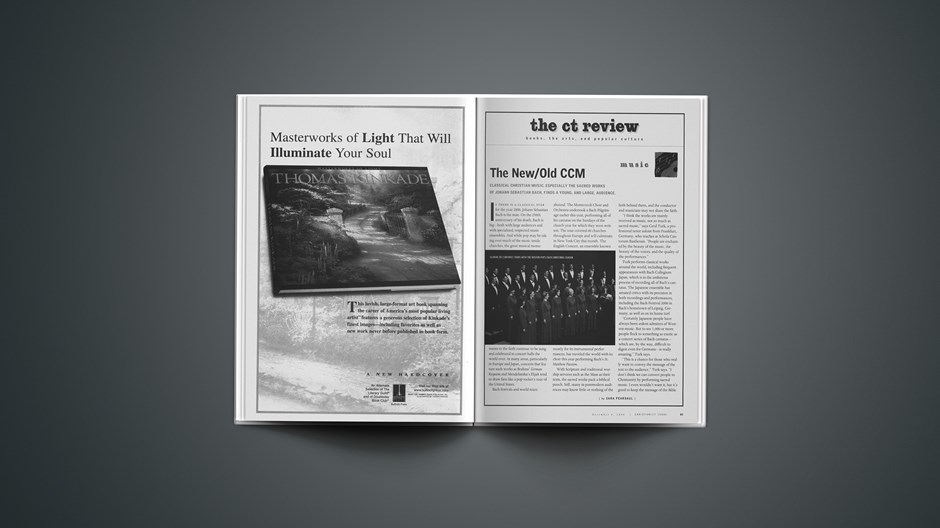
If there is a classical star for the year 2000, Johann Sebastian Bach is the man. On the 250th anniversary of his death, Bach is big—both with large audiences and with specialized, respected music ensembles. And while pop may be taking over much of the music inside churches, the great musical monuments to the faith continue to be sung and celebrated in concert halls the world over. In many areas, particularly in Europe and Japan, concerts that feature such works as Brahms' German Requiem and Mendelssohn's Elijah tend to draw fans like a pop rocker's tour of the United States.
Bach festivals and world tours abound. The Monteverdi Choir and Orchestra undertook a Bach Pilgrimage earlier this year, performing all of his cantatas on the Sundays of the church year for which they were written. The tour covered 60 churches throughout Europe and will culminate in New York City this month. The English Concert, an ensemble known mostly for its instrumental performances, has traveled the world with its choir this year performing Bach's St. Matthew Passion.
With Scripture and traditional worship services such as the Mass as their texts, the sacred works pack a biblical punch. Still, many in postmodern audiences may know little or nothing of the faith behind them, and the conductor and musicians may not share the faith.
"I think the works are mainly received as music, not so much as sacred music," says Gerd Turk, a professional tenor soloist from Frankfurt, Germany, who teaches at Schola Cantorum Basiliensis. "People are enchanted by the beauty of the music, the beauty of the voices, and the quality of the performances."
Turk performs classical works around the world, including frequent appearances with Bach Collegium Japan, which is in the ambitious process of recording all of Bach's cantatas. The Japanese ensemble has amazed critics with its precision in both recordings and performances, including the Bach Festival 2000 in Bach's hometown of Leipzig, Germany, as well as on its home turf.
"Certainly Japanese people have always been ardent admirers of Western music. But to see 1,000 or more people flock to something so exotic as a concert series of Bach cantatas—which are, by the way, difficult to digest even for Germans—is really amazing," Turk says.
"This is a chance for those who really want to convey the message of the text to the audience," Turk says. "I don't think we can convert people to Christianity by performing sacred music. I even wouldn't want it, but it's good to keep the message of the Bible alive, even among those who have a different religion."
Elizabeth Patterson, music director of Gloriae Dei Cantores, sees that choir's concerts of classical and contemporary sacred works drawing people of all ages. The choir, from the Community of Jesus in Orleans, Massachusetts, has toured in 23 countries and travels the United States with the Boston Pops for its wildly popular annual Christmas tour. Patterson believes classical sacred music offers a welcome respite from the chaos of pop culture.
Patterson observes that both Gregorian chant and Bach appeal to younger generations. "I think they find in it a peace and freedom from the aggression present in the music of rock, while not necessarily believing what they hear in the text," Patterson says. "They experience the spiritual depth that is present and that touches their sense of isolation."
Patterson's concern for the audience is evident: "We sing because we wish to be a help and a blessing, to see a lot of the music that is being lost saved, and to bring a gift to people—for that span of time, to give them hope."
Soli Deo Gloria in West Chicago, Illinois—which takes its name from the Latin phrase Bach inscribed in his manuscripts, meaning "To God alone the glory"—shares that concern for both lost people and lost music.
The organization's mission is to "promote, enhance, and preserve classical sacred music." Under the musical direction of conductor John Nelson, the group sponsors recordings of traditional and contemporary sacred music, commissions new classical sacred compositions at a time when the genre appears stagnant, and sponsors performances of classical masterworks in countries where they might not otherwise be heard. For example, one project translated Brahms' German Requiem into Chinese and sponsored performances with several national orchestras and choruses in China. The group plans to do the same in Spanish in Costa Rica next year.
Although classical music ensembles in the United States must work harder to attract audiences these days, the big choral works remain extremely popular.
This season's concert schedules of major U.S. orchestras are loaded with great sacred works, including:
The New York Philharmonic: Mendelssohn's St. Paul, with the American Boychoir and the Westminster Symphonic Choir, and Brahms's German Requiem with the American Boychoir and New York Choral Artists.
The Boston Symphony and the Tanglewood Festival Chorus: Beethoven's Missa Solemnis and Bach's Mass in B Minor.
Article continues below
The Chicago Symphony Orchestra and Chorus: Verdi's Requiem and Bach's St. John Passion.
The San Francisco Symphony and Chorus: Handel's Messiah and Haydn's The Creation.
"For symphony orchestras, choral performance is the exception," notes conductor Stephen Alltop, who performs with the Chicago Symphony and other orchestras as a harpsichordist and organist. "The reason so many symphonies have gone to the trouble of forming liaisons with existing choirs or forming their own chorus is to perform these great works. These events are considered highlights of the season by the organizations and the audiences."
Alltop, recently appointed music director of the Cheyenne Symphony Orchestra, plans to form a chorus to sing with the orchestra. "This is the epitome of Western music," he says of classical sacred works. "The public there must have the chance to hear it."
In December, Alltop will conduct the 199th and 200th performances of Handel's Messiah by the Apollo Chorus of Chicago, which has drawn crowds since it began annual performances in 1879. As a member of the music faculty at Northwestern University in Evanston, Illinois, Alltop sees evidence that the love of classical sacred music is shared by the next generation: "Students coming into Northwestern—not just music majors—are enthusiastic about the opportunity to do major sacred works. Simply to say we're going to do Haydn's Creation, as we will do this year, tends to generate excitement."
David Beavan, choir manager for The English Concert, has seen audiences deeply moved by classical sacred music. "The most extraordinary quality of the music and its spirituality inescapably touches the vast majority of our audiences, whether subconsciously or consciously," he says. "With the Bach Mass in B Minor several years ago, you had the sense—almost tangible—of audiences responding to something they couldn't quite control or fully understand."
After a performance of St. Matthew Passion this year in Munich, one audience member wrote, "Around me I saw people moved to tears … breathless. I heard it said, 'If I had not been a Christian already, this would have made me one.' "
Sara Pearsaul is a Chicago-based writer who performs classical oratorios with the Apollo Chorus.















 While we pray for peace, we need moral clarity about this war.
 We’ve got little information on Jesus’ appearance and personality. But that’s the way God designed it.españolFrançais
 The Grammy-winning artist was found dead at her home in Nashville at age 47.






