For slightly over five hundred years, the most famous and popular illustration of Dante's "Divine Comedy" has remained effectively "lost"—although millions have seen it and admired it. It is right out in plain sight and one of the world's most beloved paintings.[1]
C. S. Lewis first read Dante's Inferno at some unknown date in his youth. He first read Purgatory in 1918, when he was nineteen and found himself in a hospital recovering from wounds received in the inferno of World War I. He was an atheist.
Four years later, in 1922, Lewis had just received his B.A. at Oxford and was ready to start the graduate studies that would eventually culminate in a professorship of Medieval and Renaissance Literature. Fortunately, in August he started to keep a diary, and he wryly recorded an experience he had on August 28 in London.
I took the desperate resolve of entering the National Gallery, where I finally came to the conclusion that I have no taste for painting. I could make nothing of the Titians. The only thing (besides portraits) that I cared for much were Botticelli's Mars and Venus with satyrs, and Veronese's … "Unfaithfulness" in which I liked the design tho' I confess the actual figures always seem dull to me. However, the Italian rooms are nothing like so boring as the English.[2]
Although Lewis eventually appreciated Titian,[3] he never took any great interest in paintings; but his early affinity for Botticelli continued for the rest of his life. He commented upon Botticelli paintings (specifically "Mars and Venus" and "Primavera") in The Allegory of Love, Rehabilitations, English Literature in the Sixteen Century, An Experiment in Criticism, Studies in Medieval and Renaissance Literature, and Spenser's Images of Life.
Eight years after Lewis's first recorded encounter with Botticelli, he first read Dante's Paradise; he was thirty years old and on the brink of belief in Christianity. In 1931 he became a believer. From then on, there are traces of The Divine Comedy throughout his writings, from The Pilgrim's Regress, his first Christian book, to Letters to Malcolm, his last.[4] Lewis twice presented papers at meetings of the Oxford Dante Society, and one of those papers was devoted to an aspect of the last twelve cantos of Purgatory.[5] So there is no doubt that Lewis would have been keenly interested in the following discovery related to the last four cantos of Purgatory.
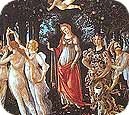
Sandro Botticelli painted "Primavera" ("Spring") circa 1478 as a huge (roughly 6' by 10') wall decoration for Villa di Castello, the elegant home of Lorenzo (Lorenzino) di Pierfrancesco, a young member of the Medici family.[6] Although it is painted in tempera on a wood panel, the design is much like that of a medieval tapestry. The painting is one of the most beloved treasures of the Uffizi Gallery in the heart of Florence, but its meaning remains a puzzle to art experts as well as to the general public.[7] It seems to depict an odd mixture of figures from ancient Greco-Roman mythology.
But "Primavera" is not the mysterious and wistful tribute to paganism it is commonly assumed to be. Instead, it is an intentional Christian allegory as orthodox and ultimately joyful as John Bunyan's Pilgrim's Progress. It is above all a depiction of Dante's sacred Garden of Eden in Purgatory, cantos 28-31. (Dante's Purgatory is a transitory region of Heaven; everyone there is already saved and is moving on into the fullness of God's peace and joy.)
Set apart in the center of the painting, like a serene but childless Madonna, Dante's beloved Beatrice (who led him to God) presides benevolently over the tableau, adorned with a cloak of red and a patterned halo of sky light. Her right hand gestures acceptance, just as Mary's does in Botticelli's "Annunciation." (Art critics identify her as an unusually circumspect Venus, goddess of love and beauty.) At Beatrice's left hand, her friend Matilda has been gathering wildflowers as in Canto 28. (Most critics identify this figure as Flora, goddess of spring, who is scattering flowers.) At Beatrice's right hand, three maidens, Faith, Hope, and Charity, dance in a circle as in Canto 30. (Critics identify them as the Three Graces, daughters of Zeus.) The luminous equanimity of Beatrice and her four companions is paradisaical. Dante's leafy canopy spreads overhead, and his carpet of grass and flowers spreads underfoot. As Matilda says, "Here spring is everlasting."[8]
Who is Matilda? Botticelli was no doubt well aware that before Dante wrote The Divine Comedy he had memorialized a young Florentine woman called Primavera. In Part XXIV of La Vita Nuova, Dante told about a specific encounter he once had with her: "I saw approaching me a gracious lady, renowned for her beauty, who for a long time had been the beloved of my closest friend (Guido Cavalcante). Her name was Giovanna (Joan, the feminine form of John), but some say that because of her beauty she was nicknamed Primavera, that is, Spring, and this is what she was usually called. And coming after her, as I looked, I saw the miraculous Beatrice. They passed by quite close to me, and Love seemed to say to me in my heart, 'The first is called Primavera, and the sole reason for this is the way you see her walking today, for I inspired him who gave her this name of Primavera, which means that she will come first [prima verra] on the day Beatrice appears after the dream of the one[9] who serves her faithfully.' "[10]
Article continues below
There can be little doubt that the historical Joan (Primavera) in La Vita Nuova appears as the allegorical Matilda (Primavera) in The Divine Comedy.[11] Charles Williams says, "It is sufficient to think of Matilda [in Purgatory] as we thought of Joan, Primavera [in Vita Nuova], who resembled the Precursor [John the Baptist]."[12] And so it is that Joan/Primavera, who appeared as Matilda in Purgatory, appears as Primavera in the painting named after her.
Like the center panel in a triptych altarpiece, Botticelli's serene portrayal of Beatrice, Matilda, and the three Theological Virtues is flanked by two related scenes. On the far right a disheveled Eve lurches vulnerably, with a broken sprig dangling from her mouth. This depicts the lines in Canto 29 where Dante deplores Eve's primordial disobedience in the Garden: "A sweet melody ran through the luminous air; and a corresponding wave of indignation caused me to condemn the recklessness of Eve, who, alone and inexperienced in this place where heaven and earth obeyed God, was unwilling to wear her veil of obedience under which, if she had been faithful, I would have enjoyed these indescribable delights far earlier and longer."[13]
Eve is being steered and perhaps propelled toward Adam by a winged Satan, who hovers in some trees with his garment curving like a large snake. Critics often identify Eve as the nymph Chloris, and Satan as Zephyr, the West Wind. Indeed, this Satan figure resembles Botticelli's West Wind in "Birth of Venus;" but in "Primavera" he is facing the opposite direction, and if he is a wind he seems to be blowing from the East. This correlates with the westward movement of the breeze in Canto 28 of Purgatory and the westward movement of the divine pageant in Canto 29. Critics all note this general sense of movement from right to left (east to west) in "Primavera." (The viewer of "Primavera" is in the same position as Dante the pageant viewer, facing north.)
On the far left a jaunty, casual, unfallen Adam gazes upward and reaches as high as fruit on a nearby orange tree. In Canto 28 Matilda deplores Adam's loss of this happy Garden full of laughter and play, which was a foretaste of eternal peace: "Through his own fault he lived here only briefly; through his own fault he exchanged spontaneous laughter and sweet play for tears and labor."[14] According to Genesis, Adam was not only the first man and the first resident of Eden, but also Eden's caretaker, the first agriculturist.
Article continues below
I suspect that Adam's martial costume is meant to suggest Mars (god of war) more than Mercury (god of commerce). Mars was originally the Roman god of agriculture and fruitfulness rather than war; thus he is a highly appropriate figure in an archetypal garden. His sword and wingless helmet are appropriate for Mars, and he strongly resembles Botticelli's Mars in "Mars and Venus." Because Mars was the unfortunately appropriate city god of Florence, he had special significance for Dante, Botticelli, and the owner of "Primavera." Furthermore, the month of Mars, March, is the time of the vernal equinox, when Dante makes his allegorical journey through Hell, Purgatory and Heaven at the beginning of earthly spring.
As a literate Christian, Botticelli was almost surely familiar with the Old Testament symbolism for war and peace. Joel 3:10 speaks of beating plowshares into swords and pruning hooks into spears. Perhaps Botticelli had the dual role of Mars in mind when he made it clear that the lower parts of some of the trees near the sword bearing figure had been trimmed by a garden caretaker. If so, he no doubt had Micah 4:3-4 in mind also: "They will beat their swords into plowshares and their spears into pruning hooks. Nation will not take up sword against nation, nor will they train for war anymore. Every man will sit under his own vine and under his own fig tree, and no one will make them afraid, for the LORD Almighty has spoken" (NIV). This famous passage expresses human longing for the Edenic state portrayed so memorably in "Primavera." On the other hand, if the figure in question primarily represents Mercury, as critics have assumed, more commentary about that aspect of the allegory would be welcome.
Like a whimsical afterthought, Cupid floats above Beatrice at the very top center of the picture with his blindfold on and his dangerous unaimed dart ready to fly, as mentioned by Dante in Canto 28.[15] But Cupid was not an afterthought; he represents the central theme of Dante's entire Comedy, which is that humans are born to be in love with God and to move ever closer to Him, but their love goes astray when they become so enamored of lesser delights that they don't find out what their deepest yearning is really for. Furthermore, in Canto 31 four maidens remind Dante that when he had first looked into the eyes of Beatrice, Cupid had aimed his arrow at Dante. (This symbolic arrow is what eventually led to Dante's salvation.)
Article continues below
Like Dante's poetry, Botticelli's art is extremely lyrical and popular, and also intellectually complex. Why should Botticelli have depicted eight of Dante's Garden of Eden figures as a random assortment of stock figures from classical mythology? This surface ambiguity is an exuberant kind of appliqu‚ that Botticelli imposed upon his tableau to reflect the fashionable Christian Neoplatonism of the owner of "Primavera" and his like-minded friends; they enjoyed relating elements of Christianity to classical mythology. (In a sense the happy patron got two paintings for the price of one.) This was done in the spirit of Dante, a master of dexterity, double meanings, and extraordinary synthesis.
This tour de force may well have been inspired by Canto 31 of Purgatory. There Dante stared into the eyes of Beatrice and was amazed to see a stationary image of Christ somehow change back and forth, back and forth, from human to divine. I suspect that the original purpose of the dual nature of "Primavera" was to create an earthly analogy to that image, in which one painting would have two natures: one human (classical mythology), and the other divine (Christian allegory).
According to Sir Kenneth Clark, Botticelli was obsessed with the study of Dante for at least twenty years, and he was commissioned to illustrate the Inferno before he was commissioned to create "Primavera." Until almost 1460, all books were handmade and very expensive, and so the very group of Florentine Neoplatonists connected with the 1478 creation of "Primavera" published a relatively inexpensive edition of The Divine Comedy on August 30, 1481. The first volume of this trilogy was illustrated with nineteen Baccio Bandini engravings based upon sketches commonly attributed to Botticelli. Clark claims that Botticelli was working on them early in the 1470s.[16] He also claims that Botticelli studied the leading Dante commentary of his day and that one of his friends was a great Dante scholar.[17]
Some fifty years after Botticelli's death, art critic Giorgio Vasari (architect of the Uffizi Gallery) not only claimed that Botticelli produced those designs, but that he also wrote his own commentary on parts of The Divine Comedy.[18] Scholars have assumed that Vasari was in error about the commentary, as he often was about other topics; but Botticelli's brother Simone, who lived with him for many years, owned an unsigned manuscript of a Divine Comedy commentary. Could it possibly be by Botticelli? That manuscript reportedly exists to this day in the National Library in Florence. Although critics assume that Botticelli did not write a commentary on Dante, many of them believe he painted the portrait of Dante (circa 1495) that resides in Switzerland.
Article continues below
About fifteen years after commissioning "Primavera," its owner commissioned Botticelli to return to The Divine Comedy and illustrate it from beginning to end without any overlay of Greco-Roman mythology. On beautiful white vellum he produced a large illustration for each of the 100 cantos and at least one extra.[19] Most of them were not completely finished, and only a handful were even partially colored. Botticelli's Divine Comedy patron was banished from Florence in 1498, which probably accounts for abandonment of the project.
Botticelli's lavish Divine Comedy drawings were much admired; but the sheepskin had been wrongly prepared, and only faint ghosts of the wonderful drawings remained on the vellum. Eight of the 92 surviving pages are in the Vatican, and the rest are in two Berlin museums. None are ordinarily available for public viewing. But in spite of their obscurity, in 1893 Dr. Ludwig Volkmann said in Iconografia Dantesca, "No other artist of the Renaissance was so well fitted for the work of illustrating the 'Divine Comedy' as Sandro Botticelli." Bernard Berenson immediately commended Dr. Voltmann's work and called for "an edition of the Commedia with illustration from the finest of fourteenth and fifteenth centuries, and from the best by Signorelli and Botticelli."[20] Ironically, neither Voltmann nor Berenson realized that "Primavera" was a Divine Comedy illustration, and another century was to pass before it would be identified as such.
The faded illustrations on vellum were finally made available to the general public in Kenneth Clark's large 1976 volume, The Drawings by Sandro Botticelli for Dante's Divine Comedy. In "Flights of Angels," Clive James's 1977 review of Clark's book in New Statesman, he remarks casually, "Nobody could look at [Botticelli's] Matilda gathering flowers in Purgatorio XXVIII[21] without thinking of the 'Primavera'." It seems not to have occurred to James that this was more than an incidental similarity.[22] Twenty more years would pass before the 500-year-old truth was discovered.
Article continues below
I suspect that Dante (1265-1321) would have been greatly pleased with Botticelli's painting, I think Botticelli (1444-1510) would be highly gratified to know that his painting is going to be understood as he intended. And I'm sure that C. S. Lewis (1898-1963), who had a keen sense of humor, would be delighted by the whole affair. If their common conception of the afterlife has proved correct, these three unusual men are no longer separated by centuries; they are together forever where nothing is ever lost or misunderstood.
Kathryn Lindskooghas published widely on C.S. Lewis and his legacy, on Dante, and other subjects.
Footnotes:
[1.] About 30 illuminated manuscripts of The Divine Comedy and some superb frescos have survived from the 1300s and 1400s, but not one of their sometimes exquisite depictions has ever been widely known and warmly loved by the general public. See Illustrations to Dante's Inferno by Eugene Paul Nassar (Associated Univ. Presses, 1994). (back to text)
[2.]All My Road Before Me: The Diary of C. S. Lewis 1922-1927 (London: Collins, 1991), p. 95. (back to text)
[3.]That Hideous Strength (London: John Lane, 1945), p. 372. (back to text)
[4.] See "C. S. Lewis and Dante's Paradise" by Kathryn Lindskoog in The Canadian C. S. Lewis Journal, Vol. 22, No. 3, Spring 1999. (back to text)
[5.] C. S. Lewis, "Dante's Statius," Studies in Medieval and Renaissance Literature (Cambridge Univ. Press, 1966). (back to text)
[6.] In his 1989 volume Sandro Botticelli: Life and Work, Ronald Lightbown contests the 1478 Villa di Castello tradition; he believes that Botticelli painted "Primavera" circa 1482 for a room in Lorenzo's town palace. (back to text)
[7.] "The Primavera. … is probably one of the best known, as well as doubtless the most puzzling and disputed, of Botticelli's paintings, and its many layers of meaning still have not been satisfactorily explained." (The Art of the Italian Renaissance, edited by Rolf Toman [Cologne, Germany: Conemann, 1995], p. 279.) (back to text)
[8.] C. S. Lewis's 14-line poem "Chanson D-Aventure" (The Oxford Magazine, February 10, 1938) is about hope for everlasting spring. It expresses our natural desire to escape human mortality and futility, the cycle of life and death, and the mutability of all earthly joys; thus it is about the longing for heaven. This theme is also suggested in "Aslan Is Nearer," chapter 11 of The Lion, the Witch and the Wardrobe. (back to text)
Article continues below
[9.] This is Dante himself, who had recently had a soul-shaking dream about Beatrice. (back to text)
[10.] Barbara Reynolds, translator, La Vita Nuova by Dante Alighieri (Penguin Books, 1969), pp. 70-1. (back to text)
[11.] From Dante's point of view, there is a kind of triple meaning in Matilda's statement "Here spring is everlasting." Primavera's life on earth was brief, but in the next life she (bearer of the nickname) and her beauty (the meaning of the nickname) and the season (the source of the nickname) are indeed everlasting. (back to text)
[12.] Charles Williams, The Figure of Beatrice: A Study in Dante (Noonday Press, 1961), p. 175. Just as John the Baptist preceded Jesus in premature death, so Joan preceded Beatrice in premature death. And just as Joan had once preceded Beatrice into Dante's presence on a real-life street in Florence, so in Canto 28 of Purgatory she precedes Beatrice into Dante's presence in his allegorical Garden of Eden. Williams continues, "The Active Life and the Contemplative are here almost like girls together; and all the learning which Matilda first [in Purgatory 28] and Beatrice [in Purgatory 29-33] after pour out on Dante cannot make them other." (back to text)
[13.] Kathryn Lindskoog, Dante's Divine Comedy, Journey to Joy: Purgatory (Mercer Univ. Press, 1997), p. 166. (back to text)
[15.] Some critics claim that Botticelli's Cupid is aiming his arrow at one of the Three Graces; but the fact that he is blindfolded presumably means that he is not aiming his arrow at any specific target. (back to text)
[16.] Kenneth Clark, The Drawings by Sandro Botticelli for Dante's Divine Comedy: After the Originals in the Berlin Museums and the Vatican (Harper & Row, 1976), pp. 8-9. (back to text)
[17.] By Botticelli's day, many Italian cities had inaugurated professorships for the study of The Divine Comedy. (back to text)
[19.] The text of each canto was on the rough side of a sheet of parchment, and its illustration faced it on the smooth side of the next sheet of parchment. (back to text)
[20.] Bernard Berenson, "Dante's Visual Images and His Early Illustrators" (The Nation, December 24, 1893). (back to text)
[21.] James is referring to the illustration on p. 143 of Clark's book. (back to text)
[22.] Clive James, From the Land of Shadows (London: Cape, 1982), p. 193. (back to text)
Lindskoog's newsletter, The Lewis Legacy, has some back issues available online.
See also Books & Culture's review of Lindskoog's recent C. S. Lewis books.You can purchase Lindskoog's retelling of Dante's Purgatory at Amazon.com and other booksellers.













 While we pray for peace, we need moral clarity about this war.
 We’ve got little information on Jesus’ appearance and personality. But that’s the way God designed it.españolFrançais
 Beyoncé’s right. Whether listening to Cowboy Carter or reading theology, diversity is a good thing.





