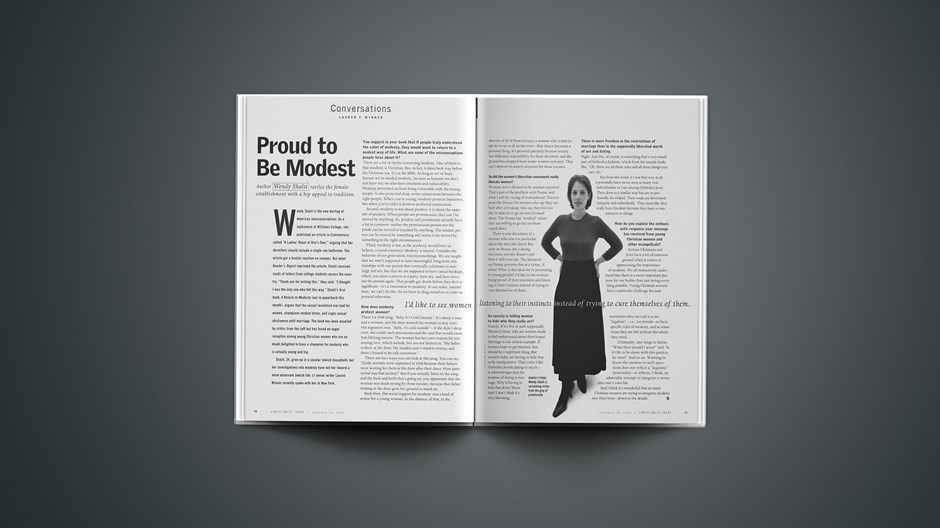
Wendy Shalit is the new darling of American neoconservatives. As a sophomore at Williams College, she published an article in Commentary called "A Ladies' Room of One's Own," arguing that her dormitory should include a single-sex bathroom. The article got a hostile reaction on campus. But when Reader's Digest reprinted the article, Shalit received scads of letters from college students across the country: "Thank you for writing this," they said. "I thought I was the only one who felt this way." Shalit's first book, A Return to Modesty (out in paperback this month), argues that the sexual revolution was bad for women, champions modest dress, and urges sexual abstinence until marriage. The book has been assailed by critics from the Left but has found an eager reception among young Christian women who are no doubt delighted to have a champion for modesty who is actually young and hip.
Shalit, 24, grew up in a secular Jewish household, but her investigations into modesty have led her toward a more observant Jewish life. CT senior writer Lauren Winner recently spoke with her in New York.
You suggest in your book that if people truly understood the value of modesty, they would want to return to a modest way of life. What are some of the misconceptions people have about it?
There are a lot of myths concerning modesty. One of them is that modesty is Victorian. But, in fact, it dates back way before the Victorian era. It's in the Bible. As long as we've been human we've needed modesty, because as humans we don't just have sex; we also have emotions and vulnerability. Modesty prevented us from being vulnerable with the wrong people. It also protected deep, erotic connections between the right people. When you're young, modesty protects innocence, but when you're older it protects profound connections.Second, modesty is not about prudery; it is about the opposite of prudery. When people are promiscuous, they can't be moved by anything. So, prudery and promiscuity actually have a lot in common: neither the promiscuous person nor the prude can be moved or touched by anything. The modest person can be moved by something and wants to be moved by something in the right circumstances.Third, modesty is not, as the academy would have us believe, a social construct. Modesty is natural. Consider the behavior of our generation, twentysomethings. We are taught that we aren't supposed to have meaningful, long-term relationships with one person that eventually culminate in marriage and sex, but that we are supposed to have casual hookups, where you meet a person at a party, have sex, and then never see the person again. That people get drunk before they do it is significant—it's a concession to modesty. In our sober, natural state, we can't do this. So we have to drug ourselves in order to pretend otherwise.
There's a 1948 song, "Baby It's Cold Outside." It's about a man and a woman, and the man wanted the woman to stay over. His argument was, "Baby, it's cold outside"—if she didn't sleep over, she could catch pneumonia and die, and that would cause him lifelong sorrow. The woman has her own reasons for not staying over, which include, but are not limited to, "My father is there at the door. My maiden aunt's mind is vicious, and there's bound to be talk tomorrow."There are two ways you can look at this song. You can say, "Gosh, women were oppressed in 1948 because their fathers were waiting for them at the door after their dates. How patriarchal was that society?" But if you actually listen to the song and the back and forth that's going on, you appreciate that the woman was made strong by those excuses, because that father waiting at the door gave her ground to stand on.Back then, this social support for modesty was a kind of armor for a young woman. In the absence of that, in the absence of all of those excuses, a woman who wants to say no to sex is all on her own—that choice becomes a personal thing. It's personal precisely because society has abdicated responsibility for these decisions, and the ground has dropped from under women and men. They can't depend on society anymore for these excuses.
So did the women's liberation movement really liberate women?
Women aren't allowed to be women anymore. That's part of the problem with Prozac and what I call the curing of womanhood. Doctors prescribe Prozac for women who say they are hurt after a breakup, who say they feel too shy or reticent to go on lots of casual dates. The Prozac has "worked" when they are willing to go out on those casual dates.There is one discussion of a woman who was too particular about the men she dated. But now on Prozac she's dating two men, and she doesn't care how it will turn out. The literature on Prozac presents this as a virtue. A virtue? What is this ideal we're presenting to young people? I'd like to see women being proud of their emotions and listening to their instincts instead of trying to cure themselves of them.
Article continues below
So society is telling women to hide who they really are?
Exactly. If we live in such supposedly liberated times, why are women made to feel embarrassed about their hopes? Marriage is one central example. If women hope to get married, that should be a legitimate thing. But women today are having to hide that or be manipulative. That's why I like Orthodox Jewish dating so much—it acknowledges that the purpose of dating is marriage.
Why is having to hide that desire liberation? I don't think it's very liberating. There is more freedom in the restrictions of marriage than in the supposedly liberated world of sex and dating.
Right. And this, of course, is something that's very much part of Orthodox Judaism, which from the outside looks like, "Oh, there are all these rules and all these things you can't do."But from the inside it's not that way at all. I personally have never seen as many true individualists as I see among Orthodox Jews. They dress in a similar way but are so profoundly developed. Their souls are developed uniquely and individually. They seem like they really have freedom because they have a commitment to things.
How do you explain the enthusiastic response your message has received from young Christian women and other evangelicals?
Serious Christians and Jews have a lot of common ground when it comes to appreciating the importance of modesty. We all instinctively understand that there is a more important purpose for our bodies than just trying everything possible. Young Christian women have a particular challenge because sometimes they are told it is too "legalistic"—i.e., too Jewish—to have specific rules of modesty, and so sometimes they are left without the advice they need.
Ultimately, one longs to know, "What then should I wear?" and "Is it OK to be alone with this particular man?" And so on.
Wanting to know the answers to such questions does not reflect a "legalistic" personality—it reflects, I think, an admirable attempt to integrate a virtue into one's own life.And I think it's wonderful that so many Christian women are trying to integrate modesty into their lives—down to the details.
Related Elsewhere
Shalit was briefly discussed in our online "Eavesdropping" department examining recent controversies about meeting with members of the opposite sex behind closed doors.Commentary, the magazine that brought national attention to Shalit, called her book "a powerful and witty book that registers the changes in our social landscape in all their starkness while also illuminating many of the steps that brought us to where we are." And though the magazine's Web site doesn't have her famous "A Ladies' Room of One's Own" article posted, they do have other articles with her byline, including Intermarriage, Inc and Daughters of the (Sexual) Revolution.In a review of A Return to Modesty for First Things, Sarah Hinlicky wrote, "Shalit has hit upon the most exciting truth to come out of the whole sexual revolution: 'Modesty is the proof that morality is sexy.' "In its somewhat critical review of A Return to Modesty, the New York Times called Shalit "a senior veteran of our culture's war on purity."Slate brought Shalit on in their "Dialogues" department to discuss female modesty with Cathy Young, author of Ceasefire: Why Men and Women Must Join Forces To Achieve True Equality.Salon gave A Return to Modesty major press when it came out, with at least three articles on the book or Shalit. Most were more positive than negative."For every statement that seems knowing," said Time of Shalit's book, "there are three that seem naive or exaggerated." George Will in Newsweek was much, much kinder: Effervescent and almost petite, Shalit—imagine Katie Couric with Edith Wharton's mind—looks younger than she is, but argues like a seasoned veteran of the culture wars."The New York Observer's article about Shalit was widely discussed in other reviews of Shalit's work because of the author's strong remarks, including a statement that her views were Victorian, not neo-Victorian.The Boston Phoenix, an alternative newspaper, criticized Shalit's book for embracing "so uncritically the virtues of an imaginary past." Shalit, the review says, "continually collapses entire spectrums of behavior: there's a lot of middle ground, for example, between not having sex with dozens of people who don't care about you and not touching a man until you're married."Here's a page of positive blurbs for Shalit's book.















 While we pray for peace, we need moral clarity about this war.
 A Christian reconciliation group in Israel and Palestine warned that war would come. Now the war threatens their relevance.العربيةFrançais
 Leader explains why the movement is seeing its biggest membership bump in 30 years and its mission for the years ahead.






