Revolutions rarely pave the way for peace. But half-way through his term as Prime Minister of the United Kingdom, Tony Blair has engineered a revolution in British politics that has secured peace in Northern Ireland—a region that has not known peace for much of the twentieth century. If completed, the reforms that Blair has initiated will stand as the most significant changes to the British system in three hundred years. The "devolution" of power from Westminster to the newly established regional governments of Scotland, Wales, and Northern Ireland is at the heart of the successful peace agreement in Northern Ireland.
The passing of power from the central government of Great Britain to the regions began with the Scottish referendum in late 1997. Tony Blair came to power in part thanks to the help of the Scottish constituencies where he promised a referendum on the establishment of a Scottish Parliament with power to make laws, collect taxes, and establish policy in the important areas of health, education, and welfare. This promise represented a compromise with the goals of the Scottish National Party, which formally advocates the complete independence of Scotland. Under the Blair-sponsored arrangement, Westminster retains policy-making power over matters of foreign policy, defense, monetary policy, and social security. In the spring of 1998 the Scottish Parliament held elections for its 129 seats and began to govern itself in earnest.
The new government in Wales was established at the same time as Scotland's, but this government has moved more slowly to assert itself. The Welsh referendum passed by only a narrow margin, and the Welsh Assembly in Cardiff lacks the power to tax or make laws; it can, however, make policy on health, education, and welfare issues.
Americans accustomed to federalism will immediately notice that this devolution has not been symmetrical—all regional governments do not have the same powers. But Lord Irvine, the Lord Chancellor and architect of the devolution plan, argues that these reforms are proportional to the degree of nationalist sentiment in each region and thus reflect "the empirical political genius of [Britain]."
Identity Crisis
These profound changes have provoked an identity crisis among those who are preoccupied with what it means to be British. Conservative politicians and columnists have reacted with near-apocalyptic acrimony in a stream of books and pamphlets on the subject. While in the United States, decentralization and greater latitude for local decision-makers has usually been the mantra of the political Right, in Britain the Conservative Party has actually been a staunch promoter of strong central government. Margaret Thatcher, usually thought of as a conservative reformer, believed so strongly in centralized authority that she even abolished the city government of London, known as the Greater London Council. Blair's reforms and his detractors' opposition point to a British identity in the midst of profound transformation and crisis.
Indeed, an identity crisis need not be catastrophic. It can often draw attention to previously obscured truths that can set one on a new road. The spring election of 1997, in which Blair's New Labour Party crushed the Conservatives (winning more than 60 percent of the seats in parliament), was the harbinger of the British identity crisis. After 18 years of Tory rule, the Conservative party had become moribund and inflexible, a government beset by sordid scandals. Moreover, the Tories had failed in their efforts to bring peace to Northern Ireland, mollify growing Scottish frustration, and achieve a common vision of Britain's relationship to the European Union. At the end of this 18-year reign, the electorate clearly viewed Blair's new, more centrist Labour Party as a legitimate contender to resolve the growing crisis at the core of Britain's identity.
The primary threats to British identity historically have been domestic. Over the past millennium English monarchs and their ministers sought to dominate the British Isles (including Scotland, Wales, and Ireland) for the sake of their own internal security. And yet the intermittent domination of the islands over the last millennium by the English has also been the source of violent civil war carried forward by the Scottish, Irish, and Welsh. Such threats from within Britain were held in balance over the past three hundred years with threats from the European continent by the attempt to construct a "British" identity that was neither English, Welsh, Scottish, nor Irish. And yet it is auspicious that at the start of a new millennium we should find Britain, as we have known her since the birth of our nation, in the midst of profound transformations propelled by these same tensions.
Americans are often highly confused by the national identities of the British because Britain is a political union of four different nations. The Union Jack is the official flag of the United Kingdom of Great Britain and Northern Ireland, and it symbolizes the union of three of the four nations [see sidebar]. The cross of St. George (for England), the cross of St. Andrew (for Scotland), and the cross of St. Patrick for Ireland are superimposed to create the Union Jack. The English have been the dominant nationality in Britain for most of the millennium. Eighty percent of those living in the United Kingdom are English, and the English have generally dominated political, economic, and cultural life in the United Kingdom.
Article continues below
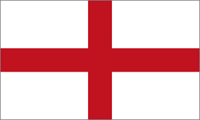
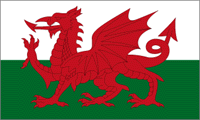
It is clear that English nationals now are the only true believers in the myth of a "British" identity. Last fall a poll funded by The Economist asked English, Scottish, and Welsh nationals which flags they identified with. A full 88 percent of English nationals identified with the Union Jack, while only 49 percent of Scots, and 55 percent of Welsh identified with the kingdom's colors. However, 75 percent of Scottish nationals identified with the Cross of St. Andrew and 85 percent of Welsh nationals identified with the Welsh Dragon. The fact that only 38 percent of English citizens identified with England's Cross of St. George suggests that the English are far more comfortable with the ideal of the United Kingdom than they are with English nationalism.
Brokering Peace in Ireland
The most momentous achievement in recent British politics is Blair's successful effort to bring peace to Northern Ireland. But how was the historic 1998 peace agreement achieved after only one year of Blair's rule when all other peace attempts had failed? The answer to this question lies in the deconstruction of Britain as a political entity. Moreover, it underscores why Christians who approach politics from the standpoint of principle must also be sensitive to the practical realities of politics, government, and institutions.
The Protestants in Northern Ireland were historically opposed to an agreement that would set up a regional governing body in Northern Ireland. Protestants feared that legitimating a regional government would be the beginning of the end of Northern Ireland's connection to Britain. Blair's genius in the resolution of this conflict lay in his recognition that with the creation of regional parliaments in Scotland and Wales, the establishment of a regional government in Northern Ireland would no longer be exceptional. Now Northern Ireland would be governed in nearly the same way that Scotland and Wales were governed—with limited sovereignty over local issues and ultimate assurance of British sovereignty. This solution also served to assuage growing nationalist sentiment in Scotland and Wales.
Article continues below
While the full effect of this historic change to Britain's constitution will not be known for decades, it does appear that Blair's devolution revolution has paved the way for peace in the United Kingdom. John Lennon once attempted to "imagine there's no countries," but as the rise of nationalism in Britain demonstrates, this has been easier to dream about than to do. If American federalism is any indication, devolution will satisfy nationalist aspirations and still ensure that Britain's "world will live as one."
England
Scotland
Wales
Slightly less than ten percent of the population is Scottish and resides primarily in the northern part of the country. Residing in the southwest of the country are the Welsh (around two percent of the population). Irish (2.5 percent of the British population) and Ulster (1.8 percent of the British population) make up the remainder.
Michael LeRoyis professor of political science at Wheaton College.
Related Elsewhere
Visit Books & Culture online at
BooksandCulture.comBooks & Culture Corner appears Mondays at ChristianityToday.com. Earlier Books & Culture Corners include:Loving the Alien, in Sickness and in Health | Too many recipients of health care today feel neither tolerated nor entitled, let alone loved
Frankenstein's Monster Returns | A discussion of recreating consciousness reminds us not to skip the footnotes. By John Wilson
The New Age Is Over | Now that Neopaganism has replaced the New Age Movement, flaws in evangelicals' criticism are obvious. By Irving Hexham
The Grove Press Bible | A former porn publisher gets in the Good Book biz. By John Wilson
Everything Old Is on TV | Antiques Roadshow asks, 'What do you want to know today?' By Elesha Coffman
Cockroaches for Jesus | America's most respected newspaper stoops to cartoon history at millennium's end. By John Wilson













 While we pray for peace, we need moral clarity about this war.
 We’ve got little information on Jesus’ appearance and personality. But that’s the way God designed it.españolFrançais
 As Haiti is uprooted by violence, church leaders treat gunshot wounds, give up homes for strangers, and rescue dignitaries.Français