You and me, baby, ain't nothin' but mammals; so let's do it like they do on the Discovery Channel.
from "The Bad Touch" by The Bloodhound Gang
If there's nothing missing in my life, then why do these tears come at night?
from "Lucky" by Britney Spears
The woman I am listening to sits slouched on my sofa. She is a lovely woman with eyes so tired and depressed I can hardly believe she is only 20 years old. She hates being in a counselor's office, but she's got to talk to somebody. It's her life that's the problem, she says. It's not going well. She wishes her boyfriend were more attentive and her father had not married this difficult woman, her stepmother. She wonders about her relationship with God. And yes, she sleeps with her boyfriend, answering my question as though I were asking something I should already know. With that fact on the table, though, she suddenly turns the pages of her life back five years. She begins to talk about the first time she had sex.
"I didn't want to have a bad experience in losing my virginity—;like some of my friends," she says. "So I found a guy I knew but didn't feel anything special for, and I had sex with him. That way I could just get it over with."
Your virginity was something you wanted to "just get over"?
"Well, sure. That way I could enjoy sex more with guys I really cared about." These words explain her logic, one alien to my own but so representative of the sexual world of her generation. Losing one's virginity, in many cases, is a girl's rite of passage into relationships and sex—;where, it seems, all the happy people live.
This picture looks a bit different at 30. Then I see women like Molly, who is married and has children, a job, and one small problem—;Molly hates sex. What can I do to help her overcome her reluctance? It's boring, distasteful, and her husband is tired, not of sex but of her disinterest. Please fix this broken part of my life, she pleads. She and her husband end up arguing a lot.
So I begin to probe her sexual history and discover that she's had sex since she was 16, with as many as 10 men, one of whom is now her husband. But that is the past, and she's in church now. She's reformed her life. She doesn't see why her past, even one with multiple partners, should have much bearing on her present sexual experience. I ask her a question:
"Can you picture what it would have felt like to be really cherished by a man, to be so special to him that he wanted to protect your innocence? Can you sense what it would mean to be that valued by a man?"
She makes no response for a while. Finally, a little trail of tears slides down her cheek, the best clue to the sense of loss she feels as she connects her early promiscuity with the boredom she now experiences.
The Lost Ones
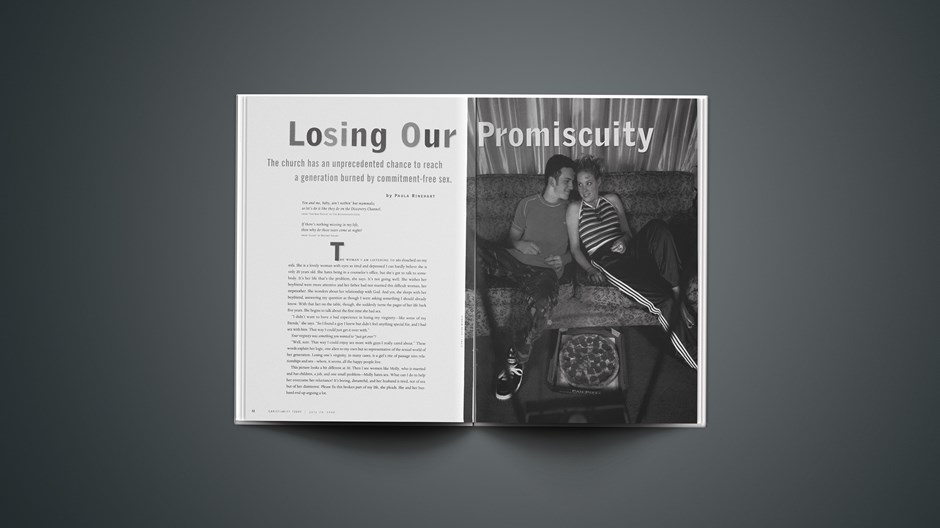
Both of these women reflect the sea change in sexual attitudes and practice of the past 20 years, a shift of epic proportions. Youth workers, counselors, singles pastors, and college ministry leaders have been long aware of the changing sexual landscape. But recently several stunning articles, books, and one in-depth TV documentary have exploded on the public scene, providing a veritable expos of the sexual practices of those under 30. The result is a widespread wake-up call that could direct the most attentive listeners to a Christian apologetic for chaste and moral relationships the church has known in many years.
Some would say this explosion began with last year's The Lost Children of Rockdale County, a PBS Frontline documentary that told the story behind a strange outbreak of syphilis in kids from the white, affluent town of Conyers, Georgia. The picture was not pretty: over 50 teenagers involved in extreme sexual behavior with between 20 to 50 partners, a secret world of sex that functioned, as one boy put it, "like an underground railroad with everybody having sex with everybody," in which the only clueless people were the adults. The documentary reported parties of 12- and 13-year-olds watching the Playboy Channel and simply copying the behaviors they saw.
Soon after PBS broadcast The Lost Children of Rockdale County, Talk magazine devoted a major article to "The Sex Lives of Your Children." Pulitzer Prize–winning journalist Lucinda Franks chronicled dozens of teenagers, mostly middle-schoolers, again affluent and well-educated, who "have created a social universe with entirely new rules." They pursue random sex that is casual, mechanical, something to escape to on weekends when, as one 14-year-old boy explained, "the games begin," while their parents avoid seeming "uncool" by interfering or asking too many questions. Gone is the timid, tentative innocence that used to come with being 13 or 14, when the world is there to be explored and one's personality takes shape. With early sexual activity, a black hole opens up, swallowing all normal routines and interests into a preoccupation with one thing: sex.
But the most startling report concerns sexuality in the campus scene. The tour guide of this cultural terrain is a recent graduate of a private liberal arts college, a savvy 24-year-old Jewish woman named Wendy Shalit. In her book A Return to Modesty (now in its sixth printing), she catalogues the fallout of a generation of young adults who exchange sex as easily as their parents shook hands. Sex on campus, Shalit explains, is often about as personal as "two airplanes refueling." Indeed, the phrase is "hooking up." That practice is defined for the uninitiated by the 1997 guide, Sex on Campus: The Naked Truth About the Real Sex Lives of College Students, as the act of "making love" but one in which both parties realize, supposedly, that the liaison is based solely on physical attraction, with no risk of attachment or commitment to either party. "You're under no obligation to date each other or call. & #133; nor should you expect to be called or dated." Hooking up is greatly aided by large quantities of alcohol that help to shed any vestiges of inhibition.
Article continues below
Shalit adds that women are less enthusiastic than men about this arrangement, and guilty of the unpardonable: wanting something more. "Our sexual landscape is already soaked in the language of betrayal before we've even begun," she says. Her book is the passionate plea of an insider to her own generation, calling for a return to sanity and the sanctity of "modesty" and moral relationships.
The story of the sexual practices and attitudes being reported in this generation is a startling one, and it is fair to ask, "Isn't it a different picture among teenagers and singles in the church?" The answer is both yes and no. Singles pastors and youth leaders agree that a strong and growing core of their flocks will commit to sexually pure lifestyles.
But even the sexually pure swim in the same cultural pool, one where their choices meet with incredulity and ridicule, though sometimes with begrudging admiration. Those who find their way out of sexual immorality into the warm confines of the church need significant repair and restoration. Anyone who works closely with teenagers and singles would admit that, when it comes to sexual purity, often there is more of the world in the church than one would hope for.
The Mourning After
That the bracing realism of this change in cultural sexual mores is being widely reported is surely a step forward. What the damage and brokenness feels like in individual lives, though, is also worth noting. Counseling these young people, for whom the doors to sexuality have been swung wide open since puberty, is like being an emergency-room physician with the survivors of a school-bus wreck. Losses that used to take four or five decades to accumulate are now packed into the short life of those who put their childhood toys in the attic just a few years back.
Article continues below
At times it feels unspeakably sad. Those who ushered in the 1960s flung open the door of sexual restraint, but those who followed walked through it more blindly—;and with devastating consequences. In just one generation, we have lost so much of our moorings. We must take the time to remember, not to retrofit the past but to mourn something beautiful being lost between the sexes, something that surely God must grieve, something every generation has had a version of until now. That we have sunk so far is, in Shalit's words, an "invisible American tragedy."
In previous generations, the dominant world upheld the standard of romance, courtship, and commitment as the precursor to sexual involvement, marriage being the entry ticket. If, for instance, I had become sexually active before I married, I would have strayed from my Christian roots. But in reality, I could not have looked the adults in my life in the face, so united was the front that protected me from entering the world of the sexually initiated. That front has all but evaporated, for many reasons. Soaring divorce rates, an epidemic of absentee parents (especially fathers), and the emergence of the latchkey-kid phenomenon in the 1970s have left an entire generation of children to more or less raise themselves.
The feminist movement, while helping bring positive changes for women in education and careers, has also hindered our ability to speak holistically about sex and gender. For the last 20 years, society has emphasized the independence and equality of young women; the notion of protecting their innocence is seen as "sexist," a confining restraint on sexual liberty and a sign of female weakness. The idea of what is "taboo" has shifted dramatically. What is considered wrong is not sex outside the bounds of marriage but interfering with the choice and pleasure of others, even one's children. Many adults, rather than playing their traditionally protective, "interfering" role, have turned mum. Many high-school students report it is often parents who are willing to vacate their house for a party, insisting only that everyone bring their own condoms and clean sheets. Franks calls this unwillingness to offer guidance and foster restraint a "mass donning of blinders" on the part of adults, and she insists it is a national phenomenon.
Article continues below
One personal barometer of this shift among many stands out for me. When I pledged a college sorority as a young Christian, some girls had sex and no one would pretend otherwise. But that behavior was discreet and accompanied by guilt and shame. When my daughter entered the same sorority 25 years later, as a committed Christian, she discovered that only five members of her entering class of 49 had not been sent to school already on birth control. The reality of being sexually active was a given, one that was planned for. (Her sorority sisters call her "Mary," as in the mother of Jesus, her virginity being so distinctive.)
This absence of social support for sexual purity means Christian teenagers and singles sometimes feel as though they are living in parallel universes with hardly a bridge between. They are strung somewhere between Dawson's Creek, so to speak, and Christian author Joshua Harris's bestselling advice to "kiss dating goodbye." The church has to create a culture that incubates purity, because the dominant one offers anything but. Teenagers and singles trying to be sexually pure can feel terribly isolated. One of the more poignant scenes in the documentary on teens in Rockdale County shows three girls, virgins by Christian conviction, who spend their weekends together shopping for clothes for dates and parties that don't exist. In a culture that lacks the social support for sexual purity, those who choose that lifestyle pay a higher price than previous generations.
Shall We Dance?
Solomon said one of the most wonderful, mysterious things on earth is "the way of a man with a maid" (Prov. 30:19). Every culture has a means of recognizing the delicate, breathtaking dance that takes place between a man and a woman—;getting to know someone, liking what you experience, falling in love.
It used to be called "courting." To be wooed and won is a beautiful, romantic process, one that fosters a lifetime of passion and commitment. Indeed, the civility and respect for boundaries that romance and courtship entail are the raw material of learning how to treat anyone well. They are foundational to culture as a whole; if this civility is not cultivated between men and women, it will not likely exist anywhere. But while a longing for romance persists, the dance is disappearing with heart-rending speed.
An atmosphere in which sex outside of marriage is the norm simply throws the dance into mayhem. Shalit refers to the weird collection of signals and nonsignals now given between partners as "guerrilla etiquette." With no framework, no plausibility for the delay of sex until marriage, the refusal by either party constitutes a personal rebuke.
Article continues below
Girls now complain that guys are boorish because they expect sex in a relationship. If either party is hurt in the process, there is no basis for redress. As social commentator Danielle Crittenden bemoans in What Our Mothers Didn't Tell Us, "Carelessly, thoughtlessly, casually, sex—;in the short space of a single generation—;went from being the culminating act of committed love to being a precondition, a tryout, for future involvement. If any." The dance is being lost.
The presence of guerrilla etiquette means that in Christian circles the dance has to be scripted because couples simply don't know what to do with each other. What does a kiss mean? How does a person express an interest in seeing a relationship become more serious? It is impossible to gain accurate bearings from the outside culture; by those standards the relationship would have been sexual long ago.
Christians talk about having "DTR's," defining the relationship talks, because it is such a challenge to read each other's cues accurately. Everything is worked out, negotiated, and agonized over in an effort to create the dance and to keep from stepping on each other's toes so badly.
When Freedom Isn't
The impact of this change in sexual attitudes and practice is felt most profoundly, though, in personal terms. God designed sex to be a powerful bonding force, one meant to help "glue" a man and a woman together for a lifetime. Outside that context, the power turns destructive. Those who work with abstinence programs for teenagers report that youths are emotionally distraught when they discover sex is not the gateway into the sustained attention and love they crave.
Early sex is especially damaging to boys, who are almost always rejected in favor of older, more mature guys, and they are left with powerful feelings they are unable to address. Some experts claim this anger goes underground and erupts later in the form of disrespecting and devaluing women.
With irresponsible, illicit sex, all the worst possibilities in human relationships take shape and form: hurt, betrayal, jealousy, rejection, a growing inability to trust. And in this generation, add one more facet: the crazy-making need to pretend it doesn't matter. You aren't allowed to feel much when a relationship is over, as that would presuppose you had hopes and expectations at the outset.
Article continues below
The combination of casual encounters and significant bonds—;made and broken, many times—;produces a measure of loss and regret that simply cannot be hidden forever. The level of brokenness rises over time. The voice of one woman in her late 20s represents many: "I wish I hadn't given so much of myself. I feel that some of my experiences thinned my soul, and such an effect takes time to undo." She recognizes something went profoundly wrong, that her sexual freedom robbed her of some essential aspects of herself. Often in the brokenness, individuals are waiting for someone to help them connect the dots, to see virginity, innocence, and the longing for an enduring relationship as something rightfully theirs, something meant to be.
The void they feel has a reason and a name. As one singles pastor explains, "They are waiting for someone to care about them and to give them permission to care about themselves."
Waking Up to Reality
As bleak as this picture appears, some encouraging trends can be seen. Many people, young and old, long for credible voices who will call this generation to form relationships grounded in love and trust, preserving sexual purity until marriage.
One such voice is Kathleen Sullivan, a Catholic with 29 grandchildren. She leads a Chicago-based organization called Project Reality, which provides abstinence-based curricula for public schools. Sullivan entered the fight for abstinence education in the 1970s as a homemaker distressed over the message her children heard at school. She persevered through years when the notion of teaching abstinence brought laughter. No one is laughing now.
Last year Project Reality hosted an abstinence rally at the University of Illinois that drew 8,000 kids in a two-hour "roar" for sexual abstinence. Five such rallies will occur this year in New York.
"We tell these kids there is no contraceptive for a broken heart," says Sullivan, "and they listen."
Voices willing to question the chaos of the current sexual scene also are emerging, increasingly from within the generation itself.
In Last Night in Paradise, Katie Roiphe writes about living in a college dorm where "toweled men" drift in and out of various rooms, spending the night with different women. Roiphe also writes about sensing, amid all the sickening anonymity, her generation's "absolute readiness for limits."
Roiphe notes her peers' fascination with movies based upon Jane Austen's 19th-century courtship novels, as though they somehow know "this is closer to the way it's supposed to be."
Article continues below
Wendy Shalit writes about the generational envy women her age feel for older women who have husbands and families. In their world, she says, "There are words that still mean things, people to depend on and steady you, real things beyond yourself to long for." She recognizes the "simple trust that comes when a spouse is also one's first and only lover." More and more, Shalit notes, young women are willing to admit a desire that would have been embarrassing in the past: the longing for one enduring love.
These words could not have been spoken until recently. These faint but hopeful talismans mark a new opportunity for Christians to offer a fresh perspective on relationships and to lead couples to the One who designed it all in the first place. How is the church taking advantage of this opportunity?
Something to Talk About
Speaking to today's young people about matters of sexuality is not for the shy and retiring. They respond to someone who will tell it to them straight up.
Chuck Milian, the singles pastor at Crossroads Fellowship in Raleigh, North Carolina, offers a six-hour dating seminar to a packed house. He believes the seminar probably would embarrass most older people.
"I cannot afford to play a game of pretend," he says. "These folks are faced with sensuality on a scale unknown to any previous generation. I have to name the elephants in the room, like pornography and living together outside of marriage, because these are options that singles are faced with now."
Milian tells the story of how God brought him out of a sexually promiscuous lifestyle and shares openly about his relationship with his wife, modeling trust, honesty, and forgiveness. He says young people are ready to hear a biblical perspective on relationships when they are sufficiently sick of the pain of being loved and left, and when they can see something better in God's way.
The need to speak in honest terms is a common refrain. Tommy Nelson, pastor of Denton Bible Church outside Dallas, uses the Song of Solomon to teach as many as 4,000 teenagers and singles at a time about the beauty of sexual passion and romance in its proper context of marriage. Nelson believes the Song of Solomon, the most "untaught book of the Bible," is about as gutsy as it gets and thus connects well with this generation. He says the Song of Solomon is to romance what the Incarnation is to doctrine—;it gives images to the abstract.
Article continues below
Although many believe today's young people think it's uncool to talk to adults about relationships and sex, recent surveys show that teens rank parents as their preferred source. A 1999 report by the Annie E. Casey Foundation reveals that 1 of 2 teenagers say they trust their parents most for reliable and complete information on sex.
This generation has a mammoth longing for connection and relationships. Barak and Rachel Dretzin Goodman, the husband-and-wife team who documented the story on teenage sex in Conyers, were interviewed themselves recently on The Oprah Winfrey Show. The Goodmans said that during the year they spent talking with teens, they were repeatedly struck with the widespread loneliness present in teenagers—;the longing for meaning and connection, especially from parents. Baby-boomer parents, it seems, are often too extended to know what's happening, to lay down restraints, or to be there to talk. While kids in previous generations longed for more freedom, Shalit writes that even college students are now "pining for interference."
The Soul of Sex
Ironically, secular sex therapy now focuses on the spiritual aspect of sex. On some level, this generation is searching for the meaning behind the act, as though it senses instinctively that sex is more than moving body parts.
Now is the time to recapture the discussion of sex and restore it to its most meaningful, soulish context. As the apostle Paul explained, this one-flesh union between man and woman is a mystery, one in which every aspect of the human bespeaks truth that is also between God and us (Eph. 5:31–33). Any discussion of sexual purity, set in its true context, takes us straight to the heart of God, because the necessary components of trust and faithfulness and passion belong, first and foremost, to him. Our grandparents understood this. That's why their marriage vows included words that sound strange to our modern ears: "With my body, I thee worship."
We must recapture for this generation an understanding of sex as a physical drama that mirrors the passionate, sacrificial love of God—;a spiritual reality so beautiful, so profound, it will take our whole lives to comprehend. Immorality, then, in any form is the trampling of that mystery, a desecration of the holy.
The longing for meaning is also creating a new openness to discussing the meaning and expectations associated with being male or female. Saying young adults are sick of the androgyny drone, Shalit says, "Not only do we think there are differences between the sexes, but we think these differences can have a beautiful meaning."
Article continues below
Pastors and youth workers note a hunger among singles and teens for someone to "create a level playing field," as Milian calls it, so that single men and women know what to expect, and what's expected of them. Honoring a woman makes it impossible to "take what you can get," and respecting a man makes it unthinkable to seduce him to win his affection.
This generation seems willing to be taught the biblical truth that might have been labeled "sexist" only a few years ago.
A Compelling Alternative
In discussing sexual purity, no tactic is more important than celebrating marriage. The average median age in which couples marry has been steadily rising for years, and the longer marriage is postponed, the greater the challenge to sexual purity.
The overt message to many single Christians is that singleness is not second-class citizenship in the kingdom of God, along with the admonition to wait for God's best in a life partner (even though the implicit message in many churches is that you're not complete until you're married). We may well have reached a time when that message needs to be amended and the benefits of marriage extolled.
"Two are better than one" for many reasons, and this generation could profit by story after story of couples who met, fell in love, and then took the risk to follow God by carving out a life together. Many single Christians hear this in their churches. But in the larger culture, Danielle Crittenden says, "What we rarely hear is how liberating marriage can actually be. The negative, that we are no longer able to live entirely for ourselves, is also the positive: We no longer have to live entirely for ourselves." Marriage is the opportunity to grow beyond the borders of the self.
Ultimately the greatest apologetic for sexual purity is the living example of a man and woman, still married and still in love. "Modeling is still the number-one influencer," says Josh McDowell, whose Right From Wrong campaign has reached thousands of high-school students with the message of sexual purity. Indeed, healthy marriages speak volumes; they are the best motivator to save sex for its rightful context. The camera in The Lost Children of Rockdale County shifts frequently from conversations with teenagers to a local Christian rock band performing at a church. Many of these kids turn out for the music on Thursday evenings. But it's clear they are also searching for a compelling alternative to their lifestyles. The inference is that only something as strong as religious faith can bring these kids out of their sexual morass.
Article continues below
Against this dark backdrop of moral chaos, the radical hope of experiencing the transforming work of Christ shines like a diamond on black velvet. For Christians, this could be our best opportunity to speak life boldly to this generation.
As one pastor in Rockdale County said, "These kids have so many things—;cell phones, pagers, and cars—;but what they are looking for is a path in life."
Paula Rinehart is a writer and Christian counselor in Raleigh, North Carolina. She and her husband, Stacy, are the coauthors of Choices: Finding God's Way in Dating, Sex, Marriage, and Singleness (NavPress, 1996).
Reprints of this article are available by writing to CT Reprints, Attn: Becky Custer, 465 Gundersen Drive, Carol Stream, IL 60188, or by sending e-mail to CTeditor@ChristianityToday.com and requesting "Losing Our Promiscuity." The cost (including postage and handling) is $8 for 10 copies, $18 for 25 copies, $32 for 50 copies, $57 for 100 copies, $105 for 500 copies, $165 for 1,000 copies. Prices are good until July 10, 2001.
Frontline's Web site has reams of information related to its documentary The Lost Children of Rockdale County. The site includes reactions from experts, extended interviews with community leaders, health officials, and parents, statistics on teen sexuality, reaction to the documentary from Rockdale County, links to other Web sites, and video clips both from the documentary and about its creation. There's even a transcript of the show, or you can purchase the video.
Christianity Today recently interviewed Wendy Shalit about her book, A Return to Modesty.
Christianity Today sister publication Campus Life, a magazine targeted at high school students, addresses issues of sexuality in every issue. See also its recent issue on "How Far is Too Far?"
Oprah Winfrey is also alarmed. See the summary of her February 7 show, which included segments on The Lost Children of Rockdale County, Talk magazine's "The Sex Lives of Your Children," quotes from teens, and advice from psychologist William Pollack.
Newswatch, a now-defunct media watchdog Web site, questioned the news value of Talk's "The Sex Lives of Your Children."
Good Morning America's site offers advice on how to talk to your teens about sex. (There's also a chat transcript with GMA's parenting contributor on the topic.)















 While we pray for peace, we need moral clarity about this war.
 As my doubts about his teachings grew, so did a secret fascination with Jesus.
 C.S. Lewis recommended discernment over diatribes in exactly the moments we’re most eager to indulge in critique.






