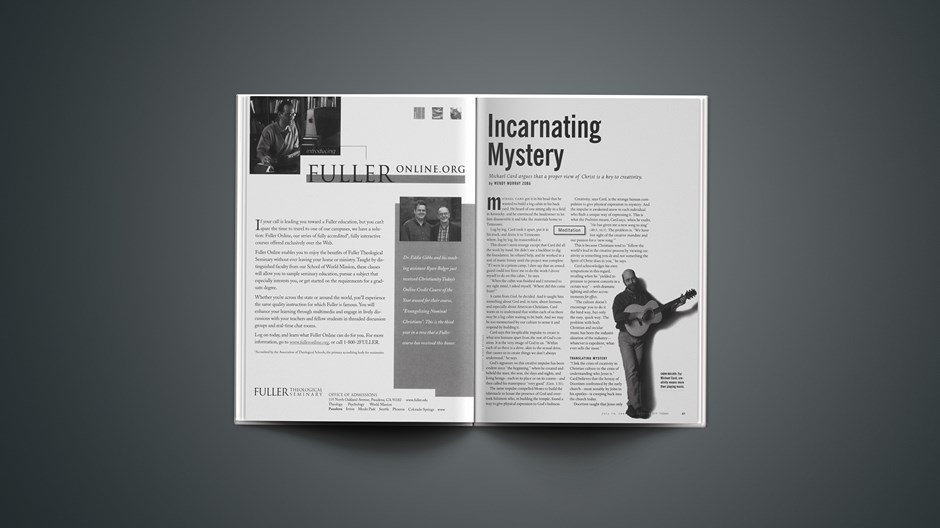
Michael Card got it in his head that he wanted to build a log cabin in his back yard. He heard of one sitting idly in a field in Kentucky, and he convinced the landowner to let him disassemble it and take the materials home to Tennessee.Log by log, Card took it apart, put it in his truck, and drove it to Tennessee where, log by log, he reassembled it.This doesn't seem strange except that Card did all the work by hand. He didn't use a backhoe to dig the foundation, he refused help, and he worked in a sort of manic frenzy until the project was complete. "If I were in a prison camp, I dare say that an armed guard could not force me to do the work I drove myself to do on this cabin," he says."When the cabin was finished and I returned to my right mind, I asked myself, 'Where did this come from?'"It came from God, he decided. And it taught him something about God and, in turn, about humans, and especially about American Christians. Card wants us to understand that within each of us there may be a log cabin waiting to be built. And we may be too mesmerized by our culture to sense it and respond by building it.Card says this inexplicable impulse to create is what sets humans apart from the rest of God's creation. It is the very image of God in us. "Within each of us there is a drive, akin to the sexual drive, that causes us to create things we don't always understand," he says.God's signature on this creative impulse has been evident since "the beginning," when he created and beheld the stars, the seas, the days and nights, and living beings—each in its place or on its course—and then called his masterpiece "very good" (Genesis 1:31).The same impulse compelled Moses to build the tabernacle to house the presence of God and overtook Solomon who, in building the temple, found a way to give physical expression to God's holiness.Creativity, says Card, is the strange human compulsion to give physical expression to mystery. And the impulse is awakened anew in each individual who finds a unique way of expressing it. This is what the Psalmist means, Card says, when he exalts, "He has given me a new song to sing" (40:3, NLT). The problem is, "We have lost sight of the creative mandate and our passion for a 'new song.'"This is because Christians tend to "follow the world's lead in the creative process by viewing creativity as something you do and not something the Spirit of Christ does in you," he says.Card acknowledges his own temptations in this regard, recalling when he "yielded to pressure to present concerts in a certain way"—with dramatic lighting and other accoutrements for effect."The culture doesn't encourage you to do it the hard way, but only the easy, quick way. The problem with both Christian and secular music has been the industrialization of the industry—whatever is expedient, whatever sells the most."
"I link the crisis of creativity in Christian culture to the crisis of understanding who Jesus is." Card believes that the heresy of Docetism confronted by the early church—most notably by John in his epistles—is creeping back into the church today.Docetism taught that Jesus only seemed to appear in the flesh, which is why John went to such great lengths to establish that "the one who existed from the beginning" is the same one "we saw with our own eyes and touched with our own hands" (1 John 1:1). The Gospels (in story, history, and creative force) prevent the church from reducing Jesus to an abstraction, a dogma, a doctrine, a system—as if he only "seemed" to have truly come in the flesh. They show that he indeed lived. He touched people. He got hungry. He wept. He told stories. He died. And he lived again.He is how God translated mystery in physicality. The Incarnation is the model for how the Christian can take hold of the true creative self: dying begets living."The artist must give up everything for Christ's sake, even her art. Creating is not indulging the self; it is denying the self. Self will be seen to be the greatest block to true artistic expression."The world says art is a matter of self-indulgence, self-expression," Card says. "Secular artists have nothing to point to higher than themselves. Their art is subservient. It may seem that 'art for art's sake' might be a purer form of artistic expression, but by faith we see this to be a lie."Our words, colors, notes, the threads that we weave together, are simply the elements. There is something more that gives meaning and significance, and holds them all together." Paul used a hymn to articulate the concept of the self-emptying of Christ (Philippians 2:5–11), Card says, noting that many times theology was sung before it was systematized.
Hearing Begets Creating
"Jesus says a man or woman speaks out of the overflow of the heart," explains Card. Creative expression is that "overflow," and if there is no overflow, there's not much to work with in the way of creative output. We need to put ourselves in a receiving posture instead of a doing posture, he says. "The best way we can show God we love him is to listen to him. That means listening to his Word and listening in prayer."This is another place where we're fighting the value system of our culture, because our culture is not a listening culture. Listening is countercultural. If Christians were known as the people who listened—not the people who only talk—it could change, in days and weeks, the place of Christians in this post-Christian era of American culture."By listening, Card says, we will hear the new song. And hearing begets creating; creating begets dying to self; dying begets living as participants in God's creative activity. In turn, we take hold of our true humanness, recover beauty, and give expression to mystery. We live in the fullness of God."God speaks through the Word of Scripture, through the silence of prayer, but also through the parable of your life"—your mystery. As it were, your log cabin.















 While we pray for peace, we need moral clarity about this war.
 We’ve got little information on Jesus’ appearance and personality. But that’s the way God designed it.españolFrançais
 Christian artists work at the intersection of music and climate change.






