Wherever true Christianity spreads, it must cause diligence and frugality, which, in the natural course of things, must beget riches! And riches naturally beget pride, love of the world, and every temper that is destructive of Christianity. Now, if there be no way to prevent this, Christianity is inconsistent with itself and, of consequence, cannot stand, cannot continue long among any people; since, wherever it generally prevails, it saps its own foundation.
—John Wesley, in the sermon Causes of the Inefficacy of Christianity.
John Wesley preached this sermon in Dublin in 1789. Transport him forward through time to the parking lot of a gleaming glass and steel megachurch, amidst the BMWs and SUVs, and it's not hard to imagine him standing on the bed of a rusty pickup truck, preaching the same sermon. Is Wesley, then, a prophet for our times? Does this sermon encapsulate the story of North American evangelicalism?
At the beginning of the 20th century, evangelicalism gave up much of its wealth and social status so that it could be more faithful to the gospel. A century later, North American evangelicalism has recouped its lost wealth, and then some. In most American neighborhoods today, nearly all the new large church buildings have been built by evangelicals. The new wealth of evangelicalism is even more pronounced in the parachurch world. The largest charitable organization in the nation—with an annual budget of over $2 billion—is the Salvation Army, a unique combination of holiness denomination and parachurch agency devoted to human services. Of the nine largest parachurch organizations in the U.S. devoted to spreading the gospel, eight are evangelical, with combined 1998 budgets of $729 million. Of the seven largest communications media agencies, six are evangelical, with total budgets of $625 million. In foreign ministry and missions, evangelical parachurch agencies raise $1.5 billion per year, while evangelical denominations raise another $1 billion. Mainline denominations and the independent agencies associated with them together raise less than $500 million.
How did this dramatic change come about, and how has it affected evangelicals?
LEAVING THE PROPERTY BEHIND
At the close of the Civil War, most northern white evangelicals were full members of the major Protestant denominations. These denominations enjoyed unprecedented wealth, social standing, and respect ability. Episcopalians, Congregationalists, Presbyterians, Christians (Disciples), and especially the Methodists all had growing central bureaucracies, fine new church buildings, networks of colleges and seminaries, and better-educated clergy than ever before. Baptists, who in their early years were a "poor and illiterate sect" composed of "contemptible class of the people," would soon count the wealthiest man on earth—John D. Rockefeller—as one of their Sunday-school teachers. The story was different, of course, for southern evangelicals, many of whom attended poor rural churches. And the story was far different for African-American Christians, whose churches were poorer yet, and who had little social status outside their own communities.
Then between 1870 and 1930, the worldly fortunes of northern white evangelicals drifted downward. When the evangelicals of the holiness movement left Methodism, they sacrificed much property and wealth. In the Protestant Episcopal Church and the Disciples of Christ, evangelicals were forced to leave and start new, poorer denominations from scratch.
Theological liberals gradually assumed control of Congregationalism, leaving evangelicals with only the smaller churches and schools. And growing numbers of Baptist and Presbyterian evangelicals drifted into the newer and poorer institutions of the Keswick holiness movement and the dispensational prophecy movement. Dwight L. Moody helped fuse these two movements, and together they formed the backbone of the fundamentalism that would emerge in the 1920s.
In retrospect it is clear that, after the turn of the century, wealth and cultural respectability followed the theological liberals and their allies. Alarmed by this, evangelicals formed coalitions in the 1920s to try to expel the liberals from several northern denominations. But by this time they were politically too weak to succeed.
In the end, most northern evangelicals chose one of two options. Some abandoned the well-established denominations for fledgling new denominations. Others remained in the old denominations but focused their energies on building a separate network of independent Bible institutes, missionary agencies, and evangelistic organizations. Either move required giving up paid-for buildings, established fundraising networks, and access to most of America's wealthy businessmen and large foundations.
BAD TIMING
Their timing could not have been worse. Just as evangelicals took up the task of building new denominations and new independent institutions, the Great Depression struck down the economy. Evangelicals of all kinds—independent, fundamentalist, holiness, Pentecostal, and African-American—had very little old wealth to fall back on. So they scraped by on small donations and perseverance. Wheaton College, for example, relied on small donations for 30 percent of its annual budget, as compared to 5 percent for other colleges in the Midwest. Over 80 percent of Wheaton's students worked their way through school, compared to the national average of 50 percent.
Article continues below
Evangelical poverty changed its social patterns. Northern evangelicals from the middle classes, the working classes, and the farms began going to church with each other. In its earliest years, Pentecostalism even managed to break down the color barrier, as blacks and whites worshiped together. The theological commitments of evangelicalism tended to repel the wealthy, but they were strong enough to weaken the class divisions that had separated other churchgoers in the 19th century. In giving up much of its wealth, evangelicalism found itself drawing together a broader range of social classes than did the established denominations.
By the late 1930s, all northern sectors of white evangelicalism that had formerly shared in the Protestant prosperity—the holiness movement, restorationists, Pentecostals, and finally fundamentalists—moved down the prosperity ladder. They became poor for the sake of the gospel as they understood it. Class divisions softened, and northern white evangelicals now stood closer to their southern and African-American brothers and sisters. All sectors of evangelicalism were, compared to mainline Protestants, financially pinched and culturally despised. In the words of the Apostle Paul, not many were "wise by human standards; not many were influential; not many were of noble birth."
BEING DILIGENT FOR THE GOSPEL
There's a curious thing about the way most historians describe evangelicalism in the 20th century. They usually talk about evangelicals' opposition to modernism. Or their attempts to re-establish America as a "Christian nation." Or their efforts to regain cultural influence and respect. Or their propagation of distinctive doctrines like entire sanctification, speaking in tongues, dispensationalism, inerrancy, creationism, pacifism, or primitivism. And all of this is true—as far as it goes.
But if you were able to ask ordinary evangelicals from the 1930s what their faith was about, most of them would talk about spreading the gospel. By this they meant both evangelism and discipleship. As historian Joel Carpenter once wrote of fundamentalist churches, the altar call was the "high holy moment" of worship. African-American, holiness, and Pentecostal churches poured equal effort into converting the unsaved and sanctifying the converted.
Article continues below
Outside the churches, new interdenominational coalitions of evangelicals labored to build networks of independent organizations—Bible institutes, missionary agencies, and evangelistic associations. Most of these concentrated primarily on evangelism and training for evangelism, as opposed to providing services for the already-converted. Evangelicals had assembled the first cohort of these "parachurch" organizations before the Civil War, and called it the Evangelical United Front. These included at least one organization that is still with us, the American Bible Society. At the same time, evangelicals also organized a number of independent missionary agencies related to particular denominations. But after the war, most of the interdenominational agencies faded away, while the denominations' growing bureaucracies gobbled up the missionary groups.
George Meuller and Dwight L. Moody launched the second cohort of parachurch organizations. This had a more direct impact on 20th-century evangelicalism and the way it financed itself. Meuller's famous orphanage, founded in England in 1835, pioneered the "faith" method of meeting financial needs. Meuller was less interested in caring for orphans than in demonstrating God's power:
"The chief end for which the institution was established is that the church would see the hand of God stretched out on our behalf in answer to prayer."
Meuller never borrowed money, nor would he ever mention the orphanage's current needs to anyone. He was, nevertheless, a tireless and relentless publicist. For 50 years, he wrote copiously and traveled widely, telling dramatic, nail-biting stories about the orphanage's desperate needs, its fervent prayers, and God's never-failing last-minute rescue from disaster.
Moody, by contrast, was bold as the winter wind in asking for money. He used personal appeals to people's religious sentiments, buttonholing industrial tycoons and sending out thousands of what he cheerfully called "begging letters" every year. Between 1858 and 1899 he founded or inspired several institutions—Moody Memorial Church, Moody Bible Institute, the Northfield Summer Conferences, the Student Volunteer Movement, and others. In all cases, they drew together revivalists, dispensationalists, and Keswick holiness types who were willing to work alongside people from a variety of denominations.
Article continues below
After 1890, as more and more evangelicals found themselves without voice in the major denominations, they turned to the patterns Moody and Meuller had laid down. Evangelicals became religious entrepreneurs, conceiving new ideas for spreading the gospel and constructing new parachurch organizations to carry out that work. From Moody they learned the possibilities of independent, interdenominational organizations. From Meuller they adopted the practice of praying for money instead of asking for it, trusting God to provide the necessary resources. These two principles were the original lodestars for many of today's most important evangelical parachurch agencies.
By contrast, the bureaucrats who were gaining authority in the mainline denominations placed more and more faith in the secular business methods of the day. In the 1920s, this meant rational planning, organizational efficiency, and impersonal appeals. Often the denominations hired secular ad agencies to design their campaigns. As the Secretary of the Congregationalists' Laymen's Advisory Committee boasted of his well-planned, multi-year fundraising program," Nothing has been left to chance. At no point have we trusted that the Lord will provide. He won't."
These were words that no evangelical could have spoken. Nearly all of the parachurch agencies evangelicals created before the Second World War were founded on big dreams, hard work, and spare change. The North American arm of the China Inland Mission began in 1889 with sufficient funds for only one month's rent on its building in Toronto. On one memorable occasion, completely out of money, CIM members set the table for breakfast with no food in the pantry. They gave thanks for the invisible breakfast, then a knock at the door brought a box of food from an anonymous donor. CIM named its first six missionaries before it had a single dollar to send them to China.
Evangelical entrepreneurs still followed this pattern a half-century later. Wycliffe Bible Translators in 1934 debated whether to hold its first training program in a rent-free barn or lavish $5 a month on a vacant farmhouse. Students and faculty sat on nail kegs, slept on boards covered with straw, and kept themselves fed by speaking in local churches for small offerings.
Article continues below
Similar stories could be told of the evangelical pastors of countless poor churches who, through long hours, low pay, and old drafty parsonages, labored to build the faith during the Depression. The pastors and the parachurch entrepreneurs prayed for money to come in, and it did—slowly enough to keep them constantly in prayer for more money, but steadily enough for them to keep their churches and ministries going. While they waited for funds, they worked, and worked hard. Young, idealistic, and totally committed, they offered up an ascetic self-sacrifice the equal of any medieval saint.
WORLD WAR WINDFALL
What happened next was astonishing. Mainline Protestantism—with its silk-stocking social connections, elaborate denominational apparatus, well-endowed colleges and universities, and rational economic planning—declined. Meanwhile, evangelicalism—with its lower-class constituencies, sectlike denominations, loosely connected network of parachurch agencies, hand-to-mouth Bible institutes, and penchant for trusting God to provide money and workers—flourished.
Beginning in the 1920s, mainline Protestantism started losing market share to evangelicals. Though the number of American churchgoers has remained about constant, more and more of them attend evangelical churches and support evangelical parachurch ministries. Now evangelical churches have more members than do mainline churches, and many of the most vibrant mainline congregations are evangelical in character.
In the process, as John Wesley predicted, evangelicalism became wealthy. With uncounted thousands of organizations—one informed estimate puts the number at over 30,000—it is impossible to calculate the financial size of the evangelical parachurch world. My own systematic but unscientific estimate is that the combined budgets of all categories of parachurch groups—evangelistic, international, human services, communication media, educational, and political action—come to perhaps $22 billion.
The end of World War II marked the beginning of evangelical prosperity. In fact, several of today's most well-financed organizations did not exist before the war. The five largest overseas ministry organizations are World Vision, Larry Jones/ Feed the Children, Food for the Poor, map International, and Wycliffe Bible Translators/Summer Institute of Linguistics. All but Wycliffe were founded after 1945. Of the four largest domestic evangelistic organizations—Campus Crusade for Christ, the Billy Graham Evangelistic Association, Young Life, and Navigators—only Navigators was active before the war. All of the largest media organizations—Christian Broadcasting Network, Trinity Broadcasting Network, and Focus on the Family—were founded after 1960.
Article continues below
Evangelicalism became wealthy after the war for several reasons. To begin with, the general postwar prosperity made available more money than ever before. Annual per-person disposable income in the U.S., adjusted for inflation, climbed from $8,281 to $14,569 between 1945 and 1993. In response, activists with visions of a better world dancing in their heads scrambled to lay claim to as much of the new American wealth as they could. The result was a flurry of nonprofit institution-building—religious and secular—that persuaded Americans to devote ever-larger portions of the national treasure to charitable activities. Between 1950 and 1990 the total number of nonprofit corporations increased eightyfold, while the number of for-profit corporations increased but sevenfold. Since 1970, the amounts Americans have donated to nonprofits have outstripped the increases in Gross Domestic Product, personal income, and personal consumption expenditures.
OPENHANDED EVANGELICALS
Evangelical institution-builders benefited from this general trend, but also from evangelicals' generosity. To begin with, church members donate more to charity than do nonmembers. Among churchgoers, Protestants are more generous than Catholics. Among Protestants, evangelicals are more generous than nonevangelicals. (This is true both when comparing evangelical and mainline denominations, and when comparing evangelical with nonevangelical individuals who belong to the same denomination.)
One study found that 80 percent of all Americans who give away 10 percent of their income are evangelicals—a group that makes up no more than a third of the American population. Within evangelicalism, Pentecostals are more generous than non-Pentecostals. According to a new study sponsored by the Lilly Endowment, the same pattern seems to hold in African-American churches. Pentecostals give at the highest levels, while those who are theologically liberal give at the lowest levels. And whether they are Pentecostal, conservative, or liberal, African-American churches appear to be sharing in the general prosperity, just like white evangelical churches.
Article continues below
Generosity, however, is a relative thing. Evangelicals are more generous than most Americans, but are not generous by Old Testament norms. Nor are we generous when compared to Wesley, who once said that if he died with ten pounds to his name then he had "lived and died a thief and a robber." There have been 20th-century examples of evangelicals who, like Wesley, gave away more than they kept—the industrialist R. G. LeTourneau and Chicago's Jesus People U.S.A. come to mind. On average, however, we prefer to spend well over 90 percent of our money on ourselves. We report giving away, on average, from 4 to 8 percent of our income. The actual number is even smaller, for self-reported estimates are always too high.
If most of us won't part with 10 percent of our income, it's not because we are not being asked to give. As evangelical entrepreneurs joined the postwar rush for resources, Moody's method of fundraising prevailed over Meuller's. After 1945, evangelicalism gradually abandoned its old faith principle of praying rather than asking. This freed evangelical organizers to dream up new ways of raising funds that produced more money than simply praying.
HANDCUFFED BY FAITH
It is important to remember that evangelicals first adopted faith principles as a way to demonstrate God's power, not because faith principles were an especially efficient way to raise money. In the years since World War II, evangelical entrepreneurs have showed less interest in demonstrating God's providential care and more in growing their ministries. Ministry leaders came to feel handcuffed by faith principles, which seemed to place arbitrary limits on the money they could raise.
Wycliffe Bible Translators/ Summer Institute of Linguistics illustrates how this change came about. William "Cam" Townsend founded the organization in 1934 in order to translate the Bible into every language. He was a born promoter who energetically publicized the organization and its work. In deference to faith principles, Townsend's board encouraged him to refrain from asking directly for money, and he did—well, more or less. But he chafed under the bonds of these restrictions, and when Wycliffe created JAARS, its aviation subsidiary, in 1949, Townsend dropped all pretense and began asking directly for airplanes and equipment. At this time, a few evangelicals were pioneering the "faith promise " method of raising support, where fundraisers would challenge church members to make pledges of future giving to missions above and beyond their normal tithe.
Article continues below
Townsend eagerly adopted this more aggressive method in raising funds for airplanes. Also in the 1950s, Wycliffe began to require individual missionaries to raise their own support, allowing it to take on new personnel at a much faster rate by making every North American church a potential donor. It also created much more room for direct solicitation. At least one board member resigned over the new methods of asking for money, but that did not slow down the change at Wycliffe and elsewhere.
Faith principles never precluded publicity, but they did keep something like a Christian speed limit on fundraising activity.
That's gone now. Today parachurch organizations employ the full complement of fundraising activities used by any nonprofit charity. These range from direct mail—envelopes carefully packed so that their many pieces of pretend personalization, pretend hand-underlining, pretend postscripts, and pretend confidential memos will spill all over your desk when opened—to Web sites that encourage online credit-card donations.
Thus parachurch organizations have, along with other nonprofits, professionalized their fundraising activities. A nonprofit service agency—the Christian Stewardship Association—sponsors workshops, study projects, literature, electronic media, and an annual conference to advise evangelical organizations about how to raise more money, more efficiently.
Why, then, did evangelicalism grow rich? In part because the rising tide of postwar prosperity floated all boats. In part because Americans continued to support churches while at the same time increasing support for nonprofit charities—including evangelical ministries. In part because evangelicals' diligence in preaching the gospel has drawn together more and more people who identify with the ideals and institutions of evangelicalism, thus concentrating resources as never before. And in part because evangelical entrepreneurs and administrators have grown more savvy about how to snag our attention and persuade us to dig into our pockets.
HOW WEALTH CHANGED EVANGELICALS
Evangelicalism has changed in at least seven ways since the 1930s. Some changes are the direct result of our new wealth. Others stem from lessons learned in the past and new situations in the present. Even for those changes, money is often an excellent barometer of the trajectory and implications of change.
Article continues below
1. Evangelicalism reverted to the old social patterns of American Protestantism.
As in the mainline churches, social class once again segments the evangelical churches. Pentecostalism failed to sustain its early black-white integration, just as the Methodists had failed to do a century earlier. Fundamentalism had numerous chances to integrate racially in the period between 1925 and 1945, but without exception its key figures quailed whenever they came face to face with opportunities to do the right thing.
Evangelicalism swung back toward class divisions, in part because it had never breached them deliberately. The easing of boundaries had been an unintended byproduct of poverty. Though the classes had been thrown together, they never really learned to like living together. Thomas Howard, son of a prominent evangelical leader, remembers that after his family left its mainline denomination,
We went to a small church whose congregation did not represent the local Blue Book. &#hellip; Some of the church members were from farms, and some were from poor neighborhoods, and I was not successful in bridging this gap. I was not able to resolve the difficulty arising in my mind over the juxtaposition of godliness and body odor. &#hellip; I gagged over the green tartar on my Sunday school classmates' teeth, and over their black and bitten half-moon fingernails, and ears filled with dark orange wax.
Once evangelicals became wealthy again, the social classes were no longer forced to worship together, and churches became more homogeneous. When the Church Growth movement arrived onstage in the early 1960s, advocating churches composed of homogeneous people groups, it merely tended to sanctify the changes already taking place.
2. There is a new emphasis on fundraising technique.
There is no denying that the earlier practitioners of faith principles developed effective publicity methods that helped increase donations. And there is no denying that their disavowal of technique was, to a degree, disingenuous.
But their emphasis on prayer, and their poverty, did keep the early faith missions sharply focused upon God. This was one of evangelicalism's richest spiritual resources at the time, but much of that capital has been spent.
One can still find the language of dependence on God in evangelicalism's fundraising literature, but it has become perfunctory. Like the mainline denominational bureaucrats of the 1920s, we now place much of our faith in professional fundraising techniques.
Article continues below
3. We show deep concern over the organization's public image.
Projecting a positive image is crucial to contemporary fundraising, and parachurch agencies devote much effort to making themselves look as good as possible. Concern over image has quickened our reflex to make decisions based on perceptions—fears, really—of how our organization's constituency might react, rather than on what is right by biblical standards. The raw truth is that parachurch leaders make decisions based on public image concerns far more often than anyone admits.
Two examples:
In 1953, when professors at Fuller Seminary publicly defended the new Revised Standard Version of the Bible, Charles Fuller had them stop. He claimed that 100,000 people stopped donating to his radio ministry in protest, and if that continued his ministry would be endangered.
In 1980 Wycliffe administrators (who have struggled through more than their share of unfair criticism) were so worried about unflattering material in a book manuscript that they persuaded Fleming H. Revell to buy its way out of the publishing contract. (The authors were James and Marti Hefley, popular evangelical writers who had previously published a glowing biography of Wycliffe's founder.)
In the 1930s, most evangelical parachurch organizations devoted themselves mainly to evangelism. But since that time, evangelical wealth has permitted the growth of a large new parachurch segment designed to deliver services to the already-converted. This has provoked sharp debate in some areas, most notably in contemporary Christian music. Those who launched the genre intended it to be evangelistic, with an audience of non-Christians. But it has since evolved into entertainment for Christians, and we now spend over $800 million on gospel music every year.
4. Christian personal finance counseling has blossomed.
The best-known counselor is Larry Burkett, who dispenses sound advice to middle-class professionals (see "When Burkett Speaks Evangelicals Listen"). Sensible as it seems now, the Burkett phenomenon would have scandalized evangelicals of the 1930s. The very idea that a Christian should devote much time and thought to maximizing personal financial assets would have been as foreign as the idea that people don't need to hear the gospel in order to be saved.
Article continues below
5. Evangelicals now spend vast amounts of money on social welfare and human-service activities at home and abroad.
In the 1930s, most missionary agencies emphasized evangelism, church-planting, and discipleship. In 1998, however, four of the five largest overseas ministries specialized in relief, development, and education work. For many of these agencies, evangelism is a secondary concern.
Evangelicals have also built an extensive network of domestic human-service agencies since the 1940s, including summer camps, women's centers, urban rescue missions, drug and alcohol treatment centers, daycare facilities, senior centers, homes for the disabled, prison ministries, youth programs, counseling services, and urban development initiatives. Total spending here is at least $3 billion, and may be as much as $4 billion. This number does not include the enormous value of our volunteer time. Nor does it include the stacks of money evangelicals give to nonreligious human-services organizations. One study found that two-thirds of all such donations in the U.S. come from churches and church members.
6. We give more to private elementary and secondary education.
In 1965 private Protestant schools constituted 1 percent of all schools. Today they constitute nearly 14 percent, with total budgets exceeding $5 billion. Since every parent paying private school tuition is also paying taxes to support public schools, this represents an enormous commitment on the part of a substantial minority of the evangelical population. Add in the estimated 1.5 million children—mostly evangelicals—who are being homeschooled, and together this adds up to the most significant restructuring of American education in over a century.
7. We've created evangelical political action organizations.
Here, too, money is a good barometer of their significance. But in this case, it turns out that the barometer registers surprisingly little activity. Contrary to the near-hysterical belief of those who have access to the press, the Religious Right is way down at the very bottom of evangelical priorities. Total 1998 expenditures of all organizations was less than $160 million. This is less than 1 percent of the total that evangelicals spent on parachurch organizations.
For every dollar we spend on political agencies, we spend nearly $10 on international ministries, almost $13 in Christian book and music stores, nearly $25 on evangelical higher education, and almost $31 on evangelical elementary and secondary schools. We spend more on summer camps than politics, more on urban rescue missions than politics, more on youth programs than on politics. The budget of just one evangelistic organization—Campus Crusade for Christ, at $241 million—is more than all the budgets of all Religious Right agencies combined.
Article continues below
WAS WESLEY RIGHT?
This brings us back to Wesley's unsettling question: Is evangelicalism's wealth undermining its Christian foundations? It's a simple question, but it doesn't afford a simple answer. Without a doubt, evangelicalism's wealth has catalyzed some major changes. Depending on one's priorities, some of these changes will appear troubling, others heartening. Many will greet with hosannas the resurrection of evangelicalism's social conscience; others will put on sackcloth and ashes over the apparent diminishment of evangelistic outreach. Some will fret over contemporary fundraising techniques; for others, they are neutral means to worthy ends.
Given the enormous temptations to sin that always accompany wealth, it is a bit surprising that we have displayed so little ambivalence at the wealth that is now in our hands. I suspect this is so because we believe in the marrow of our bones that our ministry organizations are doing God's work in the world. So any decision that might lead to a decrease in an organization's activities will hinder God's work (not to mention threatening the livelihood of its employees).
Once this conviction is in place, the very act of preserving and defending the ministry becomes a self-evident, self-sustaining virtue. And it nurses the common idea that when an evangelical organization prospers, the prosperity is a sign of God's approval. Such thinking is not biblical, of course. The Bible makes it clear that God often gives good gifts to those who do evil. It is equally clear that when Christians do as God asks they will sometimes lose money, respect, freedom—and even life itself.
This particular Christian truth only rarely works its way into the decision-making process of our ministry organizations. The engine that drives us is a compelling vision for ministry, and who can say that the vision was not vouchsafed by God? So we pursue the vision by building and growing the organizations that embody the vision. Growth means more money; more money means more ministry. In the worst cases, means and ends become reversed, and growth and influence become goals unto themselves.
In the best cases, more ministry means more people who become newly aware of the great gift God has given them in Jesus Christ—and who then, in gratitude, reach into their own pockets and give, so that others might also know.
Article continues below
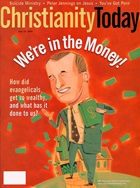
Michael S. Hamilton is assistant professor of history at Seattle Pacific University. Illustration by Amanda Duffy
"The Rich & Poor in Paul's Theology" discusses how Paul's teachings about wealth and poverty might apply to Evangelicals today. The Action Institute also discusses Evangelicals and economics. Roman Catholic scholar Michael Novak argues at Beliefnet that capitalism isn't hostile to religious faith. Also at Beliefnet, authors Gregg Easterbrook and Tom Bethell have recently debated the spiritual impact of money.
Money at Crosswalk.com features articles and information on personal finance, including advice from financial planning guru Larry Burkett. CCNfn reported last year on Burkett and the trend of using biblical wisdom in financial planning.
















 While we pray for peace, we need moral clarity about this war.
 We’ve got little information on Jesus’ appearance and personality. But that’s the way God designed it.españolFrançais
 After lobbying from fellow Southern Baptists and Christians affected by the war, the House speaker moves a package forward.






