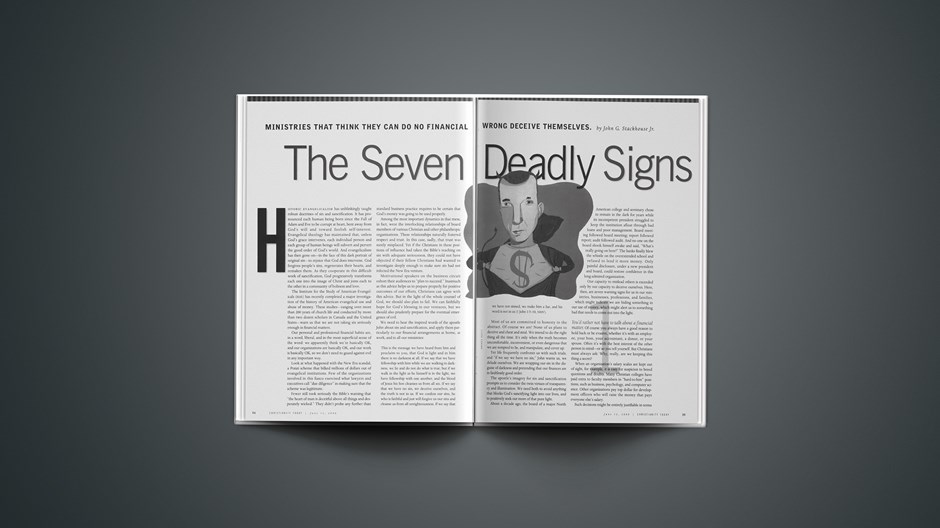
Historic evangelicalism has unblinkingly taught robust doctrines of sin and sanctification. It has pronounced each human being born since the Fall of Adam and Eve to be corrupt at heart, bent away from God's will and toward foolish self-interest. Evangelical theology has maintained that, unless God's grace intervenes, each individual person and each group of human beings will subvert and pervert the good order of God's world. And evangelicalism has then gone on—in the face of this dark portrait of original sin—to rejoice that God does intervene. God forgives people's sins, regenerates their hearts, and remakes them. As they cooperate in this difficult work of sanctification, God progressively transforms each one into the image of Christ and joins each to the other in a community of holiness and love.The Institute for the Study of American Evangelicals (ISAE) has recently completed a major investigation of the history of American evangelical use and abuse of money. These studies—ranging over more than 200 years of church life and conducted by more than two dozen scholars in Canada and the United States—warn us that we are not taking sin seriously enough in financial matters.Our personal and professional financial habits are, in a word, liberal, and in the most superficial sense of the word: we apparently think we're basically OK, and our organizations are basically OK, and our work is basically OK, so we don't need to guard against evil in any important way.Look at what happened with the New Era scandal, a Ponzi scheme that bilked millions of dollars out of evangelical institutions. Few of the organizations involved in this fiasco exercised what lawyers and executives call "due diligence" in making sure that the scheme was legitimate.Fewer still took seriously the Bible's warning that "the heart of man is deceitful above all things and desperately wicked." They didn't probe any further than standard business practice requires to be certain that God's money was going to be used properly.Among the most important dynamics in that mess, in fact, were the interlocking relationships of board members of various Christian and other philanthropic organizations. These relationships naturally fostered respect and trust. In this case, sadly, that trust was sorely misplaced. Yet if the Christians in these positions of influence had taken the Bible's teaching on sin with adequate seriousness, they could not have objected if their fellow Christians had wanted to investigate deeply enough to make sure sin had not infected the New Era venture.Motivational speakers on the business circuit exhort their audiences to "plan to succeed." Inasmuch as this advice helps us to prepare properly for positive outcomes of our efforts, Christians can agree with this advice. But in the light of the whole counsel of God, we should also plan to fail. We can faithfully hope for God's blessing in our ventures, but we should also prudently prepare for the eventual emergence of evil.We need to hear the inspired words of the apostle John about sin and sanctification, and apply them particularly to our financial arrangements at home, at work, and in all our ministries:
This is the message we have heard from him and proclaim to you, that God is light and in him there is no darkness at all. If we say that we have fellowship with him while we are walking in darkness, we lie and do not do what is true; but if we walk in the light as he himself is in the light, we have fellowship with one another, and the blood of Jesus his Son cleanses us from all sin. If we say that we have no sin, we deceive ourselves, and the truth is not in us. If we confess our sins, he who is faithful and just will forgive us our sins and cleanse us from all unrighteousness. If we say that we have not sinned, we make him a liar, and his word is not in us (1 John 1:5–10, NRSV).
Most of us are committed to honesty in the abstract. Of course we are! None of us plans to deceive and cheat and steal. We intend to do the right thing all the time. It's only when the truth becomes uncomfortable, inconvenient, or even dangerous that we are tempted to lie, and manipulate, and cover up.Yet life frequently confronts us with such trials, and "if we say we have no sin," John warns us, we delude ourselves. We are wrapping our sin in the disguise of darkness and pretending that our finances are in faultlessly good order.The apostle's imagery for sin and sanctification prompts us to consider the twin virtues of transparency and illumination. We need both to avoid anything that blocks God's sanctifying light into our lives, and to positively seek out more of that pure light.About a decade ago, the board of a major North American college and seminary chose to remain in the dark for years while its incompetent president struggled to keep the institution afloat through bad loans and poor management. Board meeting followed board meeting; report followed report; audit followed audit. And no one on the board shook himself awake and said, "What's really going on here?" The banks finally blew the whistle on the overextended school and refused to lend it more money. Only painful disclosure, under a new president and board, could restore confidence in this long-admired organization.Our capacity to mislead others is exceeded only by our capacity to deceive ourselves. Here, then, are seven warning signs for us in our ministries, businesses, professions, and families, which might indicate we are hiding something in our use of money, which might alert us to something bad that needs to come out into the light.
Article continues below
1. You'd rather not have to talk about a financial matter. Of course you always have a good reason to hold back or be evasive, whether it's with an employee, your boss, your accountant, a donor, or your spouse. Often it's with the best interest of the other person in mind—or so you tell yourself. But Christians must always ask: Why, really, are we keeping this thing a secret?When an organization's salary scales are kept out of sight, for example, it is easy for suspicion to breed questions and doubts. Many Christian colleges have paid extra to faculty members in "hard-to-hire" positions, such as business, psychology, and computer science. Other organizations pay top dollar for development officers who will raise the money that pays everyone else's salary.Such decisions might be entirely justifiable in terms of the institution's own values. But if the administration won't come clean (an interesting expression) on its practices and motives, it is easy for others to worry that the organization is sacrificing community spirit and egalitarianism for pragmatism and efficiency.On the domestic front, there are sometimes sound reasons for husbands and wives to maintain separate credit card and checking accounts—each can develop a personal credit rating, for instance. But too much separation of finances keeps spouses from sharing together in perhaps the most contentious issue in a household: money. So, too, if children at home have too much financial independence: it's a short step from privacy to secrecy, and secrecy shuts out the light of another's loving counsel.
2. It's been awhile since someone has said no to you or told you that your idea is bad. Now, unless you are always right, or unless your associates are too obtuse to recognize your shortcomings, then you have established a dark environment in which no illumination can reach you from those who are closest to you. That means you can manipulate money without anyone else raising an alarm until it's too late.Repeatedly, the ISAE research shows evangelical churches and other ministries dominated by a charismatic leader whose unquestionable authority closes off the possibility of checks and balances on the use and abuse of finances. It is to prevent such a leader from stocking leadership positions with uncritical family members that the Evangelical Council on Financial Accountability (founded in 1979) has strict rules about nepotism. But in many Christian organizations, the dynamic is as obvious as it is unhealthy: we all need Mr. Big, for without him, we have no ministry. So who wants to put her job on the line by questioning his judgment? Healthy organizations—from families to churches to corporations—must instead be structured in such a way that dissent can be heard without the dissenter risking disastrous reprisal from the thin-skinned.
Article continues below
3. You find yourself paying unhealthy attention to "competition.
" You have to wrestle inwardly with envy of others' successes—individuals or organizations—and you are tempted to relish their setbacks. You tend toward "zero-sum" thinking regarding donations ("if it's going to them, it could have gone to us") and ministry opportunities ("if they get to do that instead of us, then our work is truncated"). If you pause to reflect, you can notice a pattern of criticism in your conversation about others, and especially about those in the same line of service as yours. The Bible calls such delicious chattering "gossip"--no matter how refined and pseudospiritual our phrasing of it may be.Executives and pastors in particular are notoriously lonely people. Few of them—in our day or in the past—have sustained close friendships with those who could offer spiritual direction and comfort. Who counseled Jonathan Edwards? Who privately exhorted Charles Finney? Some biographers have suggested that Billy Graham has stayed on the straight and narrow so long and so well precisely because some of the good ol' boys from his youth, who remember when he was nobody special, have stayed his friends and confidants through the years. We all have needy egos, and we are prone to sin in order to satisfy the demands of those egos. We each need someone in our lives who will help us admit to the evil strategies we follow in order to advance our own interests at the expense of others. Or will we go it alone, making excuses to ourselves and others for our lack of accountability, and assuring ourselves that no one else could really see things as clearly as we do?
Article continues below
4. There's no one on your leadership team who can provide expert advice on thorny issues. The board instead is stocked with business people and professionals who can contribute marketplace expertise, and wealthy friends of the ministry who can contribute money, but no theologians or ethicists. In many cases surveyed in the ISAE research, leaders have justified decisions with half-remembered snatches of Scripture ("The worker is worthy of his wages," or "Him who honors me I will honor") or, worse, with secular proverbs invoked as Proverbs ("Each generation should pay its own way
"). No one is equipped to put the question into a broad and deep theological context that keeps various Scriptures and Christian principles in proper balance. In such an environment, as historian David Paul Nord puts it, economic necessity too easily gets baptized as evangelical virtue.
5. You have an uneasy feeling about a recent financial matter or decision. Sitting alone at your desk, or trying to fall asleep in your bed at night, you have a sour feeling in your stomach about a recent purchase or fundraising letter, your debt load, or your annual report. You don't feel single-minded and pure, but instead sense a nagging inner conflict that grabs at your insides and costs you sleep. Headaches, back pain, obesity, drowsiness, insomnia: alarms are flashing!Psychologists call this phenomenon "somaticizing" (from soma, the Greek word for body). We humans are physical and spiritual beings, and we do well to pay attention to our bodies signaling to us with distress that something is spiritually wrong.Organizations and homes can somaticize too. Fraying carpets, dirty windows, broken window blinds, and poor lighting all point to a household or ministry under too much stress. At the same time, however, we must beware that elegant furnishings, state-of-the-art equipment, and a high-end dress code can be the organizational equivalent of self-indulgent obesity, rather than trim fitness.
6. Your organization is under financial stress and you are finding it hard to pay your bills. You may be doing all you can—praying, fundraising, cutting costs, increasing efficiency—but you still can't turn things around. Are you considering the prospect that institutions tend never to consider: that the time of useful service is over and the organization should disband?Financial struggles are often tests of faith and shapers of character. As Dwight Moody once testified, "God has always given me money when I needed it. But often I have asked him when I thought I needed it, and he has said: 'No, Moody, you just shin along the best way you can. It'll do you good to be hard up awhile.' " But unless we believe our organizations should go on forever, there must come a terminus sooner or later. The decline of financial support may be one way in which the Body of Christ is communicating God's will for your ministry: scale down, or even stop work. Are you transparent to this possibility and seeking more light on the matter?
Article continues below
7. You have apprehensions about someone else's financial decision, but you cannot obtain reliable information to evaluate this decision. Maybe it's a decision your superiors are making, or the church leaders are making, or your fellow board members. Sometimes, of course, it isn't one's responsibility to know such things. But when people on legitimate levels of decision-making are kept uninformed, or underinformed, something evil may be lurking nearby. Many institutions studied by the ISAE project have been officially governed by people—trustees, presidents, elders—who were kept in the dark by defensive, and sometimes even deliberately deceptive, executives or pastors. So, too, sometimes donors are misled—contributors who also have a trust from the Lord to be wise stewards of their donations.We must beware the tactic of appeals to "trust," as in "Don't you trust me?" The biblical principles of transparency and illumination ought to inspire leaders to a sincere willingness to cooperate in any genuine investigation, a humble openness to correction from another, and a fervent desire above all to avoid sin and pursue holiness.To enable this essential give-and-take to happen, there must be more than one channel of reliable information up and down the line. Yet most organizations, including evangelical ones, follow the typical organizational pattern of a single flow of information that passes through a crucial gateway managed by a single individual—whether the senior pastor of the church or the head of the department or the CEO of the organization. Again, ISAE research shows board after board having no more information to decide upon the health of the organization under its care than what the president or pastor decides to offer. Donors, too, are presented either with glossy brochures or photocopied newsletters from an organization's public-relations office, neither of which presents adequately accurate and extensive information.In short, some evangelical homes are run as if Mom and Dad are never wrong and can never properly be challenged by the children. Even worse, some are run as if only one parent is infallible and cannot be corrected even by the spouse. Some churches are run as if the senior pastor or board chair alone should have all the facts and therefore make all the final decisions. Some Christian businesses and nonprofit ministries are run as if the leaders are omnicompetent and could never make a mistake—innocent or otherwise—and they are entirely sanctified and thus would never sin against anyone. So structurally there is little accountability for those leaders, even less protection of employees, and no real openness to dissent.Commendably, some organizations have responded to this challenge. One seminary recently appointed a full-time ombudsman to take up the cause of any concerned employee. Many evangelical organizations make sure that employees are represented at the highest levels of decision-making. In each case, these ministries are attempting to live and work in God's light.Who are we kidding about money in our lives and work? The apostle John reminds us that many of us are deceiving ourselves, as well as others. We are stumbling in darkness, and we need to repent right now. All of us need to take sin as seriously as the Bible does in every area of our life, including our finances. Especially our finances.
Article continues below
John G. Stackhouse Jr. is Sangwoo Youtong Chee Professor of Theology at Regent College in Vancouver and author of Can God Be Trusted? Faith and the Challenge of Evil (Oxford).
Related Elsewhere
The Institute for the Study of American Evangelicals has not yet posted the results of their historical investigation of evangelicals and money, but an
overview of the project and list of
contributors is available.The
Evangelical Council for Financial Accountability is a nonprofit ministry that helps Christian ministries develop and maintain "standards of accountability that convey God-honoring ethical practices." (Christianity Today, Inc. is a
member of ECFA.)The National Association of Evangelicals has posted resolutions on
stewardship and
fiscal accountability to serve as guidelines for individuals, churches, and Christian ministries.In 1997, as John G. Bennett, Jr., the head of the bankrupt Foundation for New Era Philanthropy, went to prison, Christianity Today asked why many evangelical institutions
failed to investigate the organization before they gave money.
GuideStar, a searchable database of more than 640,000 nonprofit organizations, offers financial information, tax forms, and other resources to (among other reasons) help "donors seek out and compare charities, monitor their performances, and give with greater confidence." (See Christianity Today's story on Guidestar
here.)At Crosswalk.com,
Larry Burkett provides sound advice to those who'd like to give money to Christian ministries.
Christian Development Ministries offers free training for Christian ministries looking for biblical ways to raise money.
Church Leaders Online at Christianity Online presents news, articles, and other resources for church and ministry leaders.See our other recent essays on evangelicals and money:We're in the Money! | How did evangelicals get so wealthy, and what has it done to us? By Michael S. Hamilton (June 9, 2000)
When Burkett Speaks, Evangelicals Listen | How this former unbelieving electrical engineer became evangelicalism's financial answer man—and a look at the advice he gives. By Larry Eskridge (June 16, 2000)
Forgive Us Our Debts | Rich Christians in an age of easy credit. By Larry Eskridge (June 16, 2000)Past Christianity Today articles by John G Stackhouse Jr. include:An Elder Statesman's Plea | John Stott's 'little statement on evangelical faith' reveals the strengths and limitations of the movement he helped create. (Feb. 14, 2000)
The Battle for the Inclusive Bible | Conflicts over "gender-neutral" versions are not really about translation issues. (Nov. 5, 1999)
Finding a Home for Eve | We are right to criticize radical feminist scholars—and wrong to ignore them. (Mar. 1, 1999)
The Jesus I'd Prefer to Know | Searching for the historical Jesus and finding oneself instead. (Dec. 7, 1998)
The Perils of Left and Right | Evangelical theology is much bigger and richer than our two-party labels. (Aug. 10, 1998)
Bad Things Still Happen | A concise, clear argument for how God can be both good and omnipotent. (July 13, 1998)
Fighting the Good Fight | A plea for healthy disagreements. (Oct. 6, 1997)















 While we pray for peace, we need moral clarity about this war.
 As my doubts about his teachings grew, so did a secret fascination with Jesus.
 After lobbying from fellow Southern Baptists and Christians affected by the war, the House speaker moves a package forward.






