We tend not to think about religious freedom as an issue with a special connection to the black community and the black church. However, the connection is very close and crucial. In fact, the black church's interaction with the subject offers lessons to the wider Christian community.
Along with many African-American theologians, I believe in the tremendous importance of preserving religious communities not only as centers of difference—that is, places where one grasps the meaning of the world as different from what you find in the dominant culture—but even more so as centers of resistance. These centers of resistance do not simply proclaim
"We don't believe what the rest of you believe," but say, "We are willing and ready to sacrifice, to lose something material for the sake of that difference in which we believe."
One of the tragedies of American history has been that whatever part of the culture has been dominant has always worked hard to domesticate or to destroy religions that seem to be turning into communities of resistance. The black churches have always faced this problem and face it today. Even though sometimes the destruction is through inadvertence or ignorance, it is also sometimes a matter of will.
LOSING ONE'S RELIGION
A few years ago, I was on a panel with a gentleman who had for many years pastored one of the largest inner-city black churches in Connecticut. He described to me a meeting of ministers of several large urban black churches at which they discussed the continuous litigation attempting to strip Roman Catholic bishops of their tax-exempt status. The plaintiffs in the suit claimed that the bishops were violating the tax code by engaging in either lobbying or, more importantly, favoring or opposing political candidates. Most people do not know about such litigation. Furthermore, no one seriously believes that any court will try to take away the tax-exempt status of the Roman Catholic bishops. The ministers had this meeting because they were terrified. They said: If, because of their political advocacy, the Roman Catholic bishops were to lose their tax-exempt status, what ramifications would this have for the various black denominations and their political involvement?
These black ministers believed that the people suing the Roman Catholic bishops did not appreciate a crucial difference between political activity in black communities and political activity in white communities. Moreover, these black clergy believed white people think civil society works through many diverse institutions with different functions. Consequently, it is not that important if one says churches cannot engage in politics. Many other institutions perform such activity in civil society. The problem, argued the ministers, is that in the inner city, the only institution of civil society able to enable political activity is the church. There, if one does not do political organizing in the churches, one does not do political organizing at all.
This anecdote points to a larger concern regarding the law of religious freedom. The law of religious freedom, in America, often falls on the religions of the black community and other people of color with a harshness, with a force, and with an edge that often does not strike communities of other kinds.
In 1988 the U.S. Supreme Court decided a legal matter called the Lyng case (Lyng v. Northwest Indian Cemetery Protective Association). In this instance, the U.S. Forest Service decided to allow someone to cut down a national forest. The party granted this permission planned to cut down the forest and, in addition, to build a road through the area in order to transport the trees down to a mill. This would have been fine, I suppose, depending on how one feels about trees, except that this was sacred ground for three Indian tribes. When I say "sacred ground," I do not mean sacred in the sense in which Christians tend to think of sacred spaces—that is, something that has been consecrated and, if destroyed, something else can be consecrated in its place. What I mean by sacred is that the Indians' religious traditions were tied to keeping this land in its pristine form. Indeed, as some of them claimed in their later lawsuit, their religious traditions were the land, in the sense that if the trees were cut and the road were built, their religion would cease to exist.
Therefore, the tribes had the quaint idea that the federal government could not cause a religion to cease to exist. So they challenged the Forest Service's decision. And when they failed to get relief, they, in the great American tradition, brought a lawsuit, claiming violation of their First Amendment rights. The lawsuit reached the Supreme Court and, in due course, they lost. The court informed the tribes that this decision by the Forest Service had to be challenged, if at all, through the democratic process and not through the judicial process. Of course, the tribes' whole point was that they had tried the democratic process, and it did not work. Furthermore, the court went on to say, in a version of language it would repeat again and again in other cases, that the government simply could not exist if it had to meet the religious needs of all of its citizens. Now this, of course, had the tribes' argument backwards.
Article continues below
The tribes, in the great conservative tradition, wanted government to get out of their way and let them meet their own religious needs. But the court almost willfully misunderstood this. The court's point, I think, pursued the following logic: It is perfectly all right for the government to make it hard or impossible for you to practice your religion, as long as you cannot prove governmental hostility to your religion. As long as government officials can rationalize their actions based on inadvertence, carelessness, ignorance, or a studied indifference, they can proceed. There are a vast number of similar cases. In most of them, the plaintiff loses; and disproportionately in those cases, the plaintiffs, like the Indian tribes, are members of "outsider" religions, not part of the American mainstream.
In 1993 Congress adopted the Religious Freedom Restoration Act. There was much debate over whether this act would actually change the course of these cases. Interestingly enough, Congress expressly mentioned the Lyng case, about the Indian tribes and deforestation, as one of the cases it did not want to overturn. Nevertheless, the act was adopted with great to-do and was heralded as the fixer of problems involving religious freedom. But in 1997 the Supreme Court held that statute unconstitutional.
The point of the example is not about a statute. It is about an attitude: If your way of being religious is recognizably like the way in which the larger culture views religion, you can have a robust religious freedom. If, however, your way of practicing your religion is very different and especially very threatening to the way in which the larger culture practices religion, you will have a much harder time.
THE NEED TO MARCH
Religious freedom is important to our community because of our need to constitute ourselves as a community of resistance. One of the great powers of African-American theology is precisely that it calls on us to understand the connection between the actual day-to-day experience of our lives and the history of our people on the one hand, and the work God wants to do in the world on the other. That is a powerful connection—a connection that is different for different people, different for different groups of people, and even different for different groups of black people. But the power of that connection is what is important. The power of that connection and the power of religion working in the human imagination provide the potential resister, the member of this community of resistance, with the strength to stand up and be different. It is easy to stand up and be different when nothing is at stake. Anyone can do that. But the power of resistance is on display when one has to stand up and be different because something is at stake.
Article continues below
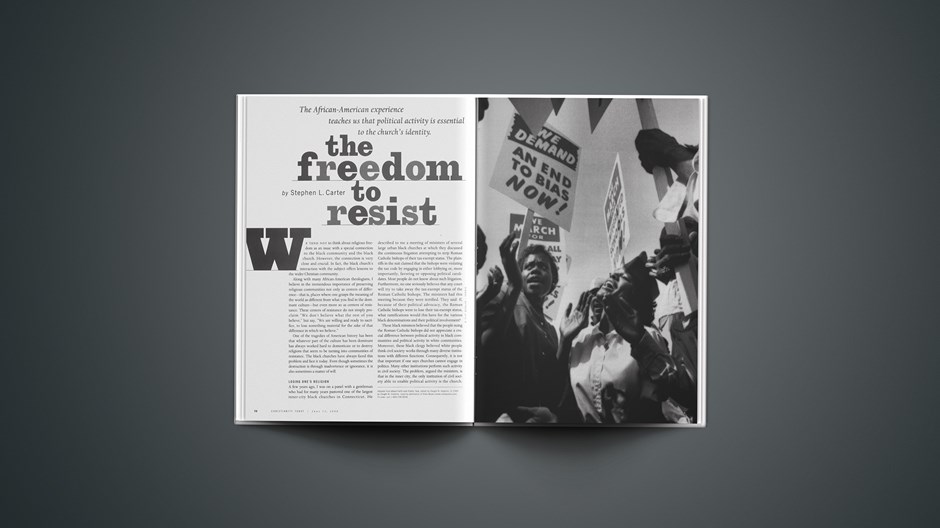
One of the wonderful things about the ministry of Martin Luther King Jr. was his ability to articulate, with some force, a vision that would lead people to say:
"All right, I'm going to stand up as an act of resistance, grounded in my religious understanding of the world, and stand up against the police dogs, against the bombs, against the assassins' bullets."
The resistance is the power of the faith, but the faith is interpreted through the concrete experience of the people. Faith provides strength to stand up for something that is at stake. The power of the faith-and-resistance dynamic fosters inspiration that can sometimes move a nation, even when the nation neither shares nor understands the underlying theology. But one can only do that if religious freedom is robustly protected.
One of the places it was not robustly protected was Birmingham, Alabama. When King wrote his landmark "Letter From Birmingham City Jail," he was not in jail for violating a city ordinance that banned parading without a permit, as the popular histories recall. He was in jail for contempt of court. More specifically, the Southern Christian Leadership Conference (SCLC) had applied for a permit to march in Birmingham on Good Friday and Easter Sunday. Already from the choice of dates and the name of the organization, there was a hint that there might be a religious aspect to these date selections. But the permit was denied. The SCLC held a meeting to decide whether to march anyway. When the city authorities learned of the meeting, they obtained an order from a judge prohibiting the march. SCLC members defied the court order twice—once by marching on Good Friday and once by marching on Easter Sunday. On Monday morning, they were hauled into court for contempt and were sentenced to a specified number of days in jail.
As a legal matter, there is a difference between the charges of parading without a permit and violating a specific court order and then being in contempt of court. The difference is that if you think that an unconstitutional law is being applied to you, you can violate the law and then claim that the law is unconstitutional once you are in court. If it is a court order, however, you cannot do this. If it is a court order, you have to obey it and then claim it is unconstitutional. But SCLC members could not obey it if they wanted to march on Good Friday. They could not obey it because they received the order on Thursday night. When they were held in contempt of court, they claimed the unconstitutionality of the order. The court rejected this notion. As a result, the case went all the way to the U.S. Supreme Court, where King lost. He did not win because the court claimed that one cannot violate a court order, no matter what one's cause is. The court made no mention of the religious dimension of the need to march on Good Friday. The court's position was:
Article continues below
"You can march next week. If you want to challenge it, you can march some other weekend. What is so important about this weekend?"
This is the willful overlooking of the religious dimension of activism. When one overlooks that, one loses a comprehension of the profound relationship between daily life and the sacred understanding of that life. It is remarkable how many otherwise very smart scholars or politicians or journalistic commentators believe that it is possible to make sense of the black community in America while giving no thought to its religiosity.
THE GIFT OF BEING DIFFERENT
America has a long way to go before it can claim to be close to racial justice. We have made important strides in the past, yet these strides have occurred in a discontinuous fashion. In the history of American race relationships, there have been long periods of inactivity and then a great upswing of energy, followed by a long period of lethargy.
In fact, there have only been two important periods of progress. One encompassed the abolitionist movement, the Civil War, and the end of legalized slavery. The other took place during the civil rights movement. What these periods held in common was the display of enormous religious activity sparking people to action. Yet very often, history books record these movements without giving a clear sense of how deeply religious they were. Both the abolitionist preachers and the Southern Christian Leadership Conference clergy who led massive protests exemplify the idea of a community of resistance. These clear examples indicate people trying to develop and build a community of resistance in part through helping the community to a greater self-understanding and furthermore to an understanding of the community's and the world's place in God's plan.
Article continues below
God's presence has been drained out of so much of American religion. The idea of God as someone, something, a being who is present, who is here among us, has always been an important part of the black church's belief and experience of the world.
This matters to the community of resistance because people behave differently if they believe God to be before them and within them and around them. That idea of behaving differently is one of the gifts that the church must spread. We must spread it because we cannot wait a hundred years for the next great upsurge of activity or the next great radical transformation of society. We need one now. And the churches must, once more, envision themselves in the vanguard of that movement. I am not talking about preaching on Sunday or volunteering in the soup kitchen once a week, though these are important. I am thinking of genuine sacrifice, about letting something be at stake.
RADICAL SACRIFICE
In a sense, both liberals and conservatives have correct ideas about radically transforming society. The liberal idea is correct in that the radical transformation is going to cost money. Part of the radical transformation that we need, if we are not going to overthrow our present economic system, requires some people to be willing to spend what is needed to alter the deleterious situation. This necessitates a great deal of spending to improve dramatically the conditions in which many poor Americans, black and white, find themselves. Such an awful lot of money challenges citizens because they do not wish to pay more taxes.
But, in a radical transformation, the spending of monies requires great sacrifice. Such a fundamental effort flows from the idea that love of neighbor actually demands that we give up something, rather than simply saying,
"I will give up what I can afford to give up, what I feel comfortable giving up."
Unfortunately, it is a scary thing today to ask people to sacrifice. No politician would now run on a platform challenging American citizens with this:
"I'm going to ask you to do hard things. I'm going to ask you to sacrifice for your fellow human beings whom you are instructed by your God to love."
Nobody would argue such a principle today, and that is a great loss. In this sense, we are worse off than we were just 30 or 40 years ago.
Article continues below
Indeed, radical transformation will demand a sacrifice. But a fundamental demand for sacrifice will not arise in politics. It will have to arise from the church, which is really the only contemporary, genuine source of resistance to the existing order. Nobody else can do it. Nobody was ever persuaded to go out and risk life and limb be cause of reading a smart article on philosophy and public affairs. No people ever said they were going to organize a march and be beaten by the police because of something they read in The New York Times op-ed page. It is only religion that still has the power, at its best, to encourage sacrifice and resistance.
Yet, one should have no illusions. All too many pastors today, black and white, are so worried about filling the seats. Clergy deliver brilliant sermons that preach up to the edge of asking people to do something, and then they will pull back. Some pastors display prophetic leadership and call for sacrifice, but their numbers are small.
In contrast to the liberal idea of spending money sacrificially to better the conditions of the poor, conservatives also have a correct idea that demands a change in behavior. Unfortunately the conservative position remains too limited because it always instructs the poor to change their behavior. Of course, conservatives are partly right at this point. We cannot have kids shooting each other over a pair of $150 sneakers. But the reason poor kids kill each other over a pair of $150 sneakers is because a market exists for such a commodity. Most of the people buying those sneakers are neither poor nor black. When well-to-do white parents are willing to send children to school wearing $500 or $600 worth of clothes, they are modeling behavior for all children in the society.
Further, we all talk correctly about the crisis of illegitimacy. Most people know that the strongest predictor of whether a child is going to be poor is whether the child has one parent in the home or two. Everyone agrees: We have to intervene in the cycle of babies having babies. But such intergenerational repetition is also learned behavior. In a society sanctioning illegitimacy, why should black kids have less access to that "privilege," if you will, than other kids? People could undertake a different path and state:
"I will change my behavior by not pursuing all the desires I may have, because I have a concern about how I am going to model behavior. I have a concern for what kind of moral world all kids grow up in."
Article continues below
These two sacrifices of economics and behavior represent two enormous sacrifices in a world valuing the material and the satisfaction of desire; and more and more we value those things.
One of the great contributions of the black church, at its best, is the ability to point beyond those things. Any theology pointing beyond the material world to the spirit can be of service in this effort to transform. But a transforming effort is only going to succeed if the world honors religion enough to perceive communities of resistance as having value to the larger society rather than manifesting a threat to it.
We are so caught up in worries about the threat this or that religious group seems to pose to our society that we are destroying the ability of communities to build themselves around their religious understanding. If we continue down such a path, we will make the black community—and many others—worse off. The denial of religious freedom takes away our ability to form a community of resistance and to act on that resistance, even in the realm of politics.
PROTECTING THE GARDEN
Widespread sentiment exists today condemning religious activism in politics. From this perspective we somehow would suffer from the lack of separation of church and state. As one who believes deeply in the ideas of the communities of resistance and particularly in my own black community, I find this notion terrifying. As a legal scholar, I think it is a misunderstanding of the separation of church and state. The separation of church and state, properly understood, comes from the work not of Thomas Jefferson, as is widely perceived, but from the insights of Roger Williams.
Williams, a Baptist and champion of religious liberty, developed the metaphor of the garden and the wilderness. The garden was the place where the people of faith would gather to struggle to understand God's Word. The wilderness was the rest of the world; the world where the light had not yet been received. Between the garden and the wilderness stood a wall. The wall existed for one purpose only. It was not there to protect the wilderness from the garden; it was there to protect the garden from the wilderness.
The wall of separation between church and state is not there to protect the state from the church; rather, it is there to protect the church from the state. It stands as a divide to preserve religious freedom. And one needs to protect the church from the state because the latter will utilize its enormous powers to do what the state has always done—either subvert the religion or destroy it. If we continue our slide toward a state that breaches the wall of separation whenever it is convenient, then I worry about the great risk to religious freedom. In the end, such a breach could destroy our ability to form the communities of resistance that are crucial if we are going to have a chance to transform the nation.
CT's coverage of Martin Luther King, Jr. and his legacy includes:
Martin Luther King, Jr.: A History | No Christian played a more prominent role in the century's most significant social justice movement than Martin Luther King, Jr. (Jan. 17, 2000)
Confessions of a Racist | It wasn't until after Martin Luther King, Jr.'s death that I was struck by the truth of what he lived and preached (Jan. 15, 1990, republished online Jan 17, 2000)
Article continues below
The March to Montgomery | Christianity Today's coverage of King's historic voting rights march, from our April 9, 1965 issue (republished online Jan 17, 2000)
Catching Up With a Dream | Evangelicals and Race 30 Years After the Death of Martin Luther King, Jr. (Mar. 2, 1998 / Jan. 17, 2000)
Yahoo!'s Full Coverage of
Martin Luther King Day includes links to news stories, audio and video archives, opinion pieces, and the best Martin Luther King Web sites.















 While we pray for peace, we need moral clarity about this war.
 A Christian reconciliation group in Israel and Palestine warned that war would come. Now the war threatens their relevance.españolالعربيةFrançaisрусскийУкраїнська
 NIL deals in college athletics present new challenges—and opportunities—for colleges and students.






