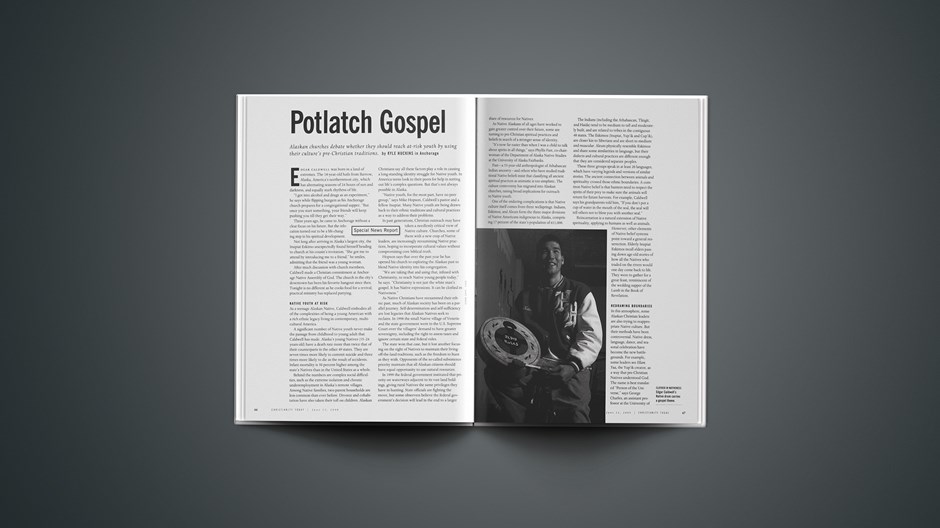
Edgar Caldwell was born in a land of extremes. The 18-year-old hails from Barrow, Alaska, America's northernmost city, which has alternating seasons of 24 hours of sun and darkness, and equally stark rhythms of life.
"I got into alcohol and drugs as an experiment," he says while flipping burgers as his Anchorage church prepares for a congregational supper. "But once you start something, your friends will keep pushing you till they get their way."
Three years ago, he came to Anchorage without a clear focus on his future. But the relocation turned out to be a life-changing step in his spiritual development. Not long after arriving in Alaska's largest city, the Inupiat Eskimo unexpectedly found himself heading to church at his cousin's invitation.
"She got me to attend by introducing me to a friend,"
he smiles, admitting that the friend was a young woman. After much discussion with church members, Caldwell made a Christian commitment at Anchorage Native Assembly of God. The church in the city's downtown has been his favorite hangout since then. Tonight is no different as he cooks food for a revival; practical ministry has replaced partying.
NATIVE YOUTH AT RISK
As a teenage Alaskan Native, Caldwell embodies all of the complexities of being a young American with a rich ethnic legacy living in contemporary, multicultural America.A significant number of Native youth never make the passage from childhood to young adult that Caldwell has made. Alaska's young Natives (15–24 years old) have a death rate more than twice that of their counterparts in the other 49 states. They are seven times more likely to commit suicide and three times more likely to die as the result of accidents. Infant mortality is 50 percent higher among the state's Natives than in the United States as a whole.Behind the numbers are complex social difficulties, such as the extreme isolation and chronic underemployment in Alaska's remote villages. Among Native families, two-parent households are less common than ever before. Divorce and cohabitation have also taken their toll on children. Alaskan Christians say all these factors play a role in causing a long-standing identity struggle for Native youth. In America teens look to their peers for help in sorting out life's complex questions. But that's not always possible in Alaska.
"Native youth, for the most part, have no peer group," says Mike Hopson, Caldwell's pastor and a fellow Inupiat. Many Native youth are being drawn back to their ethnic traditions and cultural practices as a way to address their problems. In past generations, Christian outreach may have taken a needlessly critical view of Native culture. Churches, some of them with a new crop of Native leaders, are increasingly reexamining Native practices, hoping to incorporate cultural values without compromising core biblical truth. Hopson says that over the past year he has opened his church to exploring the Alaskan past to blend Native identity into his congregation.
"We are taking that and using that, infused with Christianity, to reach Native young people today," he says. "Christianity is not just the white man's gospel. It has Native expressions. It can be clothed in Nativeness.
"
As Native Christians have reexamined their ethnic past, much of Alaskan society has been on a parallel journey. Self-determination and self-sufficiency are lost legacies that Alaskan Natives seek to reclaim. In 1998 the small Native village of Venetie and the state government went to the U.S. Supreme Court over the villagers' demand to have greater sovereignty, including the right to assess taxes and ignore certain state and federal rules.The state won that case, but it lost another focusing on the right of Natives to maintain their living-off-the-land traditions, such as the freedom to hunt as they wish. Opponents of the so-called subsistence priority maintain that all Alaskan citizens should have equal opportunity to use natural resources.In 1999 the federal government instituted that priority on waterways adjacent to its vast land holdings, giving rural Natives the same privileges they have in hunting. State officials are fighting the move, but some observers believe the federal government's decision will lead in the end to a larger share of resources for Natives.As Native Alaskans of all ages have worked to gain greater control over their future, some are turning to pre-Christian spiritual practices and beliefs in search of a stronger sense of identity.
"It's now far easier than when I was a child to talk about spirits in all things," says Phyllis Fast, co-chairwoman of the Department of Alaska Native Studies at the University of Alaska Fairbanks.—a 53-year-old anthropologist of Athabascan Indian ancestry—and others who have studied traditional Native beliefs insist that classifying all ancient spiritual practices as animistic is too simplistic. The culture controversy has migrated into Alaskan churches, raising broad implications for outreach to Native youth.One of the enduring complications is that Native culture itself comes from three wellsprings. Indians, Eskimos, and Aleuts form the three major divisions of Native Americans indigenous to Alaska, comprising 17 percent of the state's population of 611,000.The Indians (including the Athabascan, Tlingit, and Haida) tend to be medium to tall and moderately built, and are related to tribes in the contiguous 48 states. The Eskimos (Inupiat, Yup'ik and Cup'ik), are closer kin to Siberians and are short to medium and muscular. Aleuts physically resemble Eskimos and share some similarities in language, but their dialects and cultural practices are different enough that they are considered separate peoples.These three groups speak in at least 20 languages, which have varying legends and versions of similar stories. The ancient connection between animals and spirituality crossed those ethnic boundaries. A common Native belief is that hunters need to respect the spirits of their prey to make sure the animals will return for future harvests. For example, Caldwell says his grandparents told him, " If you don't put a cup of water in the mouth of the seal, the seal will tell others not to bless you with another seal."
Article continues below
Reincarnation is a natural extension of Native spirituality, applying to humans as well as animals. However, other elements of Native belief systems point toward a general resurrection. Elderly Inupiat Eskimos recall elders passing down age-old stories of how all the Natives who traded on the rivers would one day come back to life. They were to gather for a great feast, reminiscent of the wedding supper of the Lamb in the Book of Revelation.
REDRAWING BOUNDARIES
In this atmosphere, some Alaskan Christian leaders are also trying to reappropriate Native culture. But their methods have been controversial. Native dress, language, dance, and seasonal celebration have become the new battlegrounds. For example, some leaders see Ellam Yua, the Yup'ik creator, as a way that pre-Christian Natives understood God. The name is best translated "Person of the Universe," says George Charles, an assistant professor at the University of Alaska Fairbanks who specializes in studying Native religion. He adds there is a sense of the masculine about Ellam Yua as well, allowing some comparison to God the Father.But other Christian leaders say such comparisons work against a clearer understanding of orthodox Christian doctrine, especially the Trinity.Traditional dance and movement in worship, however, have become common in Native congregations. Dances may often include rhythmic drumbeats and chanting, encompassing family histories, community stories, ancient legends, and sacred teachings.Caldwell enjoys performing steps from traditional Native dances during worship at Anchorage Native Assembly. He says such dancing, learned from his family and elementary-school classes, brings him peace and calm.Hopson, Caldwell's pastor, says he permits performances in the church if they are of the right spiritual tenor.Still, some church leaders argue that dancing can be problematic and unscriptural. August Alexie, a Yup'ik from southwestern Alaska and pastor of the Ancho rage Moravian Church, says that Native dancing dates from before the Bible's introduction to Alaska, so those steps should not be part of Christian worship. Dance advocates may say it's just for fun, Alexie says,
Article continues below
"But anything that has nothing to do with the Bible, I'm against."
Some other churches use Native regalia in worship. The colorful costumes may include patterns symbolizing hunting and fishing routes and seasons, while masks resemble walruses, seals, deer, and other species. (At least one mask of Jesus has also been used.)Other congregations promote ancient legends, such as how the crane's eyes became blue. Still others encourage festivals like potlatch, a feast in which clans host each other in a spirit of community as well as competition.
"Syncretism has to be watched very carefully," warns Mike Curtis, head of the Native American Fellowship of Alaska. Curtis encourages Natives to be proud of their history, but he believes some practices are not redeemable under Christianity—like communication with good and evil spirits by the shaman, or medicine man.Deciding which pre-Christian practices to allow in the modern church should be a careful process, says Paul Hiebert, professor of missions at Trinity International University, Deer field, Ill.Hiebert says Christian leaders should ask: Does the traditional practice move the center of worship away from Christ? If not, then it can be embraced.
"We cannot force on people a totally foreign language, foreign dress, and foreign music because the foreignness then is culture, not the gospel."
For instance, if a seal dance can be reworked to give glory to God for creating the seal, that seems appropriate for Christian use, Hiebert says. If that dance leads to worship of the seal, then the dance distorts the gospel message.
Article continues below
WHITE-LEADERSHIP PROBLEMS
Alaskan churches are also concerned about training of Native leaders and pastors. Their aim is to strengthen their congregations as well as provide solid role models for Native youth, especially those coming out of broken homes. Curtis, of Athabascan and Inupiat ancestry, says the church's long history of predominantly white leadership remains an unresolved issue.
"To many the gospel of Jesus Christ is white man's religion," he says.
Christianity first came to Alaska with Russian Orthodox missionaries nearly 200 years ago. In the last third of the 19th century, Catholic and Protestant missionaries planted new congregations. But a powerful Presbyterian, Sheldon Jackson, had the greatest effect on Christianizing Alaskan Natives. In 1877, Jackson saw the need for education and systematic missionary activity and decided to combine the two. Appointed U.S. general agent for education in Alaska, Jackson created a missionary-teacher force across the territory. His charges put the gospel into schools but also followed federal mandates in punishing students for speaking Native languages and practicing local customs.Jackson also partitioned Alaska for different Protestant groups, leading to patterns of belief that still persist. For example, Quakers dominate northwestern Alaska and Presbyterians hold sway on the North Slope.While Roman Catholic and Russian Orthodox priests sometimes surrounded local practices with Christian liturgy, Protestants forbade ancient dances, discouraged Native legends, and stopped totem-pole creation in southeastern Alaska. Nevertheless, great numbers of Alaska Natives converted to Protestant Christianity, as well as the Catholic and Orthodox faiths.Persecution of missionaries was rare. Some parts of Alaska saw entire villages convert in days. Historians agree, however, that Protestant converts preserved some of their traditional beliefs.Natives eventually attained positions of leadership in some churches. Quakers quickly put Eskimos in charge of their churches and moved missionaries to new ministries. On the other hand, the Assemblies of God fills only 7 percent of its pastorates with Natives, although nearly one-third of its members are Native.
"There was a real paternalism and a reluctance to turn control over to Native ministers," Curtis says about Alaskan church history.
'VERY BIG ON DREAMS'
Both white and Native Christian leaders agree on the goal of building strong congregations. But sometimes subtle cultural differences interfere. Nathan Toots, a Cup'ik from Nunivak Island in the Bering Sea and associate pastor of Anchorage's First Evangelical Covenant Church, asserts that whites unschooled in Native ways can be jarring.
Article continues below
"We're quiet and we're reflective. We don't talk a lot," he says. "then we'll come across someone on the other side of the aisle, and yap, yap, yap. People say, 'The white man talks too much.' "
Natives put pauses between questions and answers so that each person can think, listen, and respond respectfully, Toots says. The pause grows longer when elders are involved. Whites may also fail to understand the communal nature of Native life, he says. He cites a missionary couple who always asked their Eskimo guests to leave when it was dinner time. The couple thought of dinner as family time. So did their Native guests, who believed they were members of the couple's extended family. The Natives were offended at having to leave.Belief in an active realm of demons and angels unites Alaska Native Christians regardless of their individual church's doctrines. Inupiat Elizabeth Fleagle is Episcopalian and Catholic in background and now attends an independent charismatic church. She believes Natives, many of whom have lived off the land for generations, have a sharper awareness of the environment than city-dwellers. That awareness also has an influence on their spirituality.In such a context, the question of how God communicates with people may trigger disagreements.
"Natives are very big on dreams. Sometimes they have meaning and sometimes not," says Terry Watkins, pastor of Fairbanks Intercultural Assembly of God, in which about 30 percent of the congregation is Native.
Watkins, veteran of several pastorates in the 49th state, encourages Natives to seek God's voice but emphasizes they must be discerning.
"I'm Pentecostal, and I believe in the power of God. But you can't put meaning to every leaf falling, to every bird flying," he says.
BRINGING CULTURES TOGETHER
Despite lingering tensions, the gospel message is spanning Alaska's cultural diversity, and that message is drawing Native youth to churches—even those without indigenous leadership or customs.Shannon Derenoff, a 16-year-old of Tlingit-Haida descent, is one of the 20 faithful members of Sitka Bible Baptist Church. The only other Native who attends that church is Derenoff's 7-year-old sister, who holds her hand as they walk to church on Sunday. Derenoff relates that her parents were separated for most of her life, and her father abused alcohol and drugs, but he's changed, and her folks are back together.The diminutive teenager is now leading the family back to church. Why choose to be in the minority at a white-run church?
Article continues below
"It's the basics and not real loud," she says, expressing her appreciation for the simple, straightforward preaching of her pastor, Jim Carter. Carter started the church in the southeastern Alaska town last summer, the fifth try in recent years for a fundamentalist Baptist church in Sitka. Derenoff started attending because of an invitation from Carter's daughter Nila.As Derenoff begins to learn about being a Baptist, Carter says he's adapting to the relaxed ways of the islands and inlets of this corner of Alaska.
"Most independent Baptists have to dress a certain way, listen to a certain kind of music, which may or may not be important," he says. "I'm trying to focus not on what's wrong with the people, like whether they have long hair or dress right. I don't care what they come to church looking like. I want them saved."
While the Sitka church's doctrines adhere to those of its parent Baptist Bible Fellowship International of Springfield, Mo., its service style may be unique.
"I try to keep it informal," the pastor says. While attendees sing hymns, there's no piano player or song leader, just Carter doing his best homespun a cappella to bring out the spirit of the melody. Sunday school and services have noticeably less structure than similar churches, with more give-and-take between the pulpit and people. Carter is not opposed to Native church leadership.
"My mouth waters at the opportunity to lead a Native man to Christ and have God call him to preach."
He adds that the Scriptures preach an integrated church, one that brings cultures together rather than separating them.The Sitka church seems to be on what Edgar Caldwell believes is the right track. The teenager says the key to reaching young Natives is to give them positive attention and be flexible in worship and ministry. Indigenous leadership is good but doesn't make or break a church.Back in Anchorage and getting ready for college in September, Caldwell says he may become a Native church leader himself.
"It'd be a challenge, and also a real fun time, leading a bunch of people," he says, "every week being there to help them, day in and day out."
Caldwell will attend Concordia University in Portland, Ore., to study for a career in both medicine and church ministry—back in Alaska, he hopes. His improving grades at Anchorage's Heritage Christian High School encourage him. Caldwell credits his spiritual turnaround to God, Christian friends, and open, honest church leaders who understood his problems.
Article continues below
"In Barrow, I was at the point where my life was on the downfall," he recalls, shaking his head. "if I'd stayed up there any longer, I probably wouldn't have gotten saved."
For this young Native man, a painful past will not give birth to a bleak future.
















 While we pray for peace, we need moral clarity about this war.
 A Christian reconciliation group in Israel and Palestine warned that war would come. Now the war threatens their relevance.العربيةFrançais
 The Grammy-winning artist was found dead at her home in Nashville at age 47.






