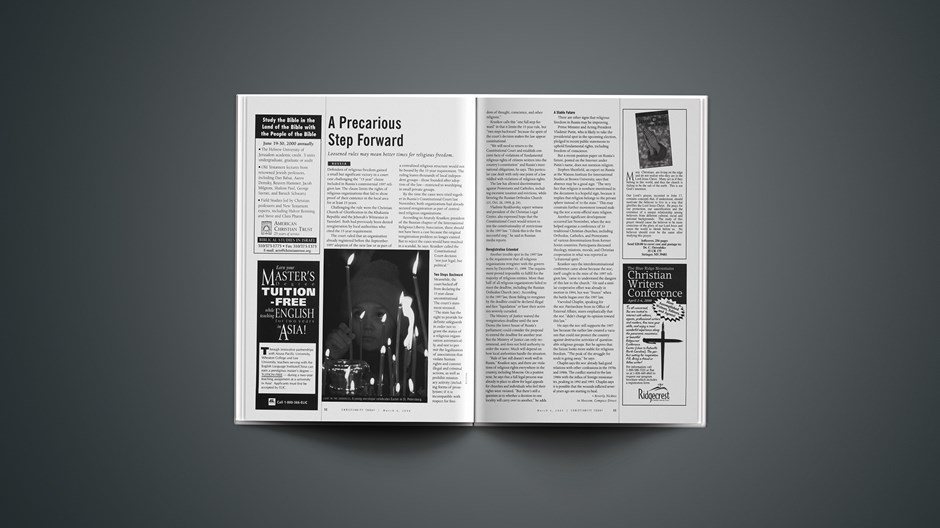
Defenders of religious freedom gained a small but significant victory in a court case challenging the '15-year' clause included Russia's country's controversial 1997 religion law.The clause limits the rights of religious organizations that fail to show proof of their existence in the local area for at least 15 years.Challenging the rule were the Christian Church of Glorification in the Khakasiia Republic and the Jehovah's Witnesses in Yaroslavl. Both had previously been denied reregistration by local authorities who cited the 15-year requirement.The court ruled that an organization already registered before the September 1997 adoption of the new law or as part of a centralized religious structure would not be bound by the 15-year requirement. The ruling leaves thousands of local independent groups—those founded after adoption of the law—restricted to worshiping in small private groups.By the time the cases were tried together in Russia's Constitutional Court last November, both organizations had already secured reregistration as part of centralized religious organizations.According to Anatoly Krasikov, president of the Russian chapter of the International Religious Liberty Association, there should not have been a case because the original reregistration problem no longer existed. But to reject the cases would have resulted in a scandal, he says. Krasikov called the Constitutional Court decision "not just legal, but political."
Two Steps Backward
Meanwhile, the court backed off from declaring the 15-year clause unconstitutional.The court's statement stressed: "The state has the right to provide for definite safeguards in order not to grant the status of a religious organization automatically, and not to permit the legalization of associations that violate human rights and commit illegal and criminal actions, as well as prohibit missionary activity (including forms of proselytism) if it is incompatible with respect for freedom of thought, conscience, and other religions."Krasikov calls this "one full step forward" in that it limits the 15-year rule, but "two steps backward" because the spirit of the court's decision makes the law appear constitutional. "We will need to return to the Constitutional Court and establish concrete facts of violations of fundamental religious rights of citizens written into the country's constitution" and Russia's international obligations, he says. This particular case dealt with only one point of a law riddled with violations of religious rights.The law has allowed discrimination agaisnt Protestants and Catholics, including excessive taxation and evictions, while favoring the Russian Orthodox Church.Vladimir Ryakovski, expert witness and president of the Christian Legal Center, also expressed hope that the Constitutional Court would return to test the constitutionality of restrictions in the 1997 law. "I think this is the first successful step," he said in Russian media reports.
Another trouble spot in the 1997 law is the requirement that all religious organizations reregister with the government by December 31, 1999. The requirement proved impossible to fulfill for the majority of religious entities. According to the 1997 law, those failing to reregister by the deadline could be declared illegal and face "liquidation" or have their activities severely curtailed.The Ministry of Justice waived the reregistration deadline until the new Duma (the lower house of Russia's parliament) could consider the proposal to extend the deadline for another year. But the Ministry of Justice can only recommend, and does not hold authority to order the waiver. Much will depend on how local authorities handle the situation."Rule of law still doesn't work well in Russia," Krasikov says, and there are violations of religious rights everywhere in the country, including Moscow. On a positive note, he says that a full legal process was already in place to allow for legal appeals for churches and individuals who feel their rights were violated. "But there's still a question as to whether a decision in one locality will carry over to another," he adds.
A stable future
There are other signs that religious freedom in Russia may be improving.Prime Minister and Acting President Vladimir Putin, who is likely to take the presidential spot in the upcoming election, pledged in recent public statements to uphold fundamental rights, including freedom of conscience.But a recent position paper on Russia's future, posted on the Internet under Putin's name, does not mention religion.Stephen Shenfield, an expert on Russia at the Watson Institute for International Studies at Brown University, says that absence may be a good sign: "The very fact that religion is nowhere mentioned in the document is a hopeful sign, because it implies that religion belongs to the private sphere instead of to the state." This may constrain further movement toward making the Russian Orthodox Church (ROC) a semi-official state religion.Another significant development occurred last November, when the Russian Orthodox Church helped organize a conference of 33 traditional Christian churches, including Orthodox, Catholics, and Protestants of various denominations from former Soviet countries. Participants discussed theology, missions, morals, and Christian cooperation in what was reported as "a fraternal spirit."Krasikov says the interdenominational conference came about because the ROC, itself caught in the mire of the 1997 religion law, "came to understand the dangers of this law to the church." He said a similar cooperative effort was already in motion in 1994, but was "frozen" when the battle began over the 1997 law.Vsevolod Chaplin, speaking for the ROC Patriarchate from its Office of External Affairs, states emphatically that the ROC "didn't change its opinion toward this law."He says the ROC still supports the 1997 law because the earlier law created a vacuum that could not protect the country against destructive activities of questionable religious groups. But he agrees that the future looks more stable for religious freedom. "The peak of the struggle for souls is going away," he says.Chaplin says the ROC already had good relations with other confessions in the 1970s and 1980s. The conflict started in the late 1980s with the influx of foreign missionaries, peaking in 1992 and 1993. Chaplin says it is possible that the wounds inflicted several years ago are starting to heal.
Article continues below
Related Elsewhere
See our past coverage of this issue:Turning Back the Clock | Non-Orthodox Christians have less religious freedom than a year ago (Oct. 26, 1998)Russia's minority churches welcome liberal ruling on religion law | 1997 ruling against 'sects' upheld, but religious groups claim victory (Nov. 30, 1999)Stepping Back from Freedom | The new law restricting religion is part of Russia'sstruggle to redefine itself. By Anita Deyneka (Nov. 17, 1997)New Religion Law Fraught with Potential for Abuses | By Beverly Nickles (Nov. 17, 1997)Jehovah's Witness Verdict Stalled | By Beverly Nickles (April 26, 1999)The U.S. Department of State Annual Report on International Religious Freedom examines Russia's religious freedom from political and societal perspectives, and remarks on what the U.S. government has done in response to human rights infringements in the country.















 While we pray for peace, we need moral clarity about this war.
 As my doubts about his teachings grew, so did a secret fascination with Jesus.
 Christian artists work at the intersection of music and climate change.






