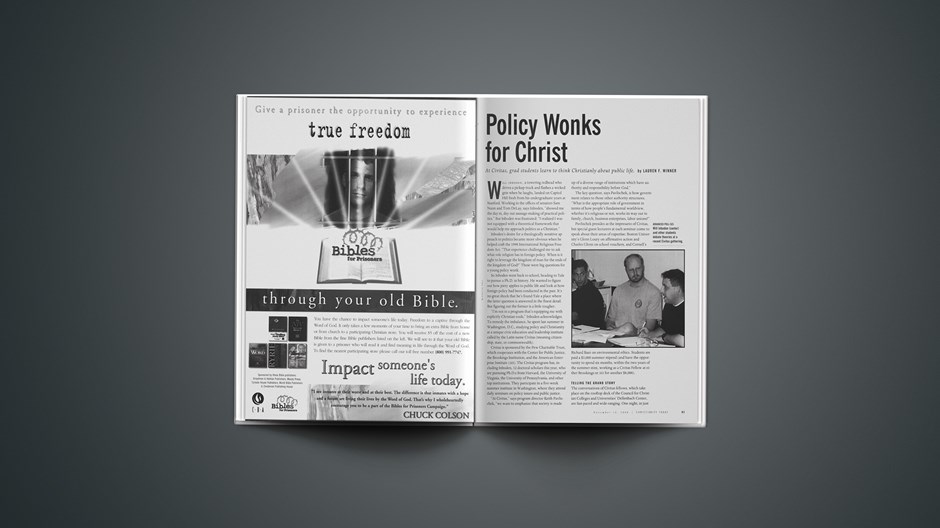
Will Inboden, a towering redhead who drives a pickup truck and flashes a wicked grin when he laughs, landed on Capitol Hill fresh from his undergraduate years at Stanford. Working in the offices of senators Sam Nunn and Tom DeLay, says Inboden, "showed me the day in, day out sausage-making of practical politics." But Inboden was frustrated: "I realized I was not equipped with a theoretical framework that would help me approach politics as a Christian."
Inboden's desire for a theologically sensitive approach to politics became more obvious when he helped craft the 1998 International Religious Freedom Act. "That experience challenged me to ask what role religion has in foreign policy. When is it right to leverage the kingdom of man for the ends of the kingdom of God?" These were big questions for a young policy wonk.
So Inboden went back to school, heading to Yale to pursue a Ph.D. in history. He wanted to figure out how piety applies to public life and look at how foreign policy had been conducted in the past. It's no great shock that he's found Yale a place where the latter question is answered in the finest detail. But figuring out the former is a little tougher.
"I'm not in a program that's equipping me with explicitly Christian tools," Inboden acknowledges. To remedy the imbalance, he spent last summer in Washington, D.C., studying policy and Christianity at a unique civic-education and leadership institute called by the Latin name Civitas (meaning citizenship, state, or commonwealth).
Civitas is sponsored by the Pew Charitable Trust, which cooperates with the Center for Public Justice, the Brookings Institution, and the American Enterprise Institute (AEI). The Civitas program has, including Inboden, 12 doctoral scholars this year, who are pursuing Ph.D.s from Harvard, the University of Virginia, the University of Pennsylvania, and other top institutions. They participate in a five-week sum mer institute in Washington, where they attend daily seminars on policy issues and public justice.
"At Civitas," says program director Keith Pavlischek, "we want to emphasize that society is made up of a diverse range of institutions which have authority and responsibility before God."
The key question, says Pavlischek, is how government relates to those other authority structures. "What is the appropriate role of government in terms of how people's fundamental worldview, whether it's religious or not, works its way out in family, church, business enterprises, labor unions?"
Pavlischek presides as the impresario of Civitas, but special guest lecturers at each seminar come to speak about their areas of expertise: Boston University's Glenn Loury on affirmative action and Charles Glenn on school vouchers, and Cornell's Richard Baer on environmental ethics. Students are paid a $3,000 summer stipend (and have the opportunity to spend six months, within the two years of the summer stint, working as a Civitas Fellow at either Brookings or AEI for another $8,000).
Telling the grand story
The conversations of Civitas fellows, which take place on the rooftop deck of the Council for Christian Colleges and Universities' Dellenbach Center, are fast-paced and wide-ranging. One night, in just two hours, talk turned to personalism, school vouchers, gay marriage, and, finally, how to write a dissertation.
Civitas students also talk Scripture. The Bible must inform how Christians think about government, Pavlischek explains.
"The grand narrative of Scripture is one of Creation, Fall, Redemption," Pavlischek says. "We need to introduce people to that grand story of Scripture, and we need to help them overcome the simplistic proof texting that one finds in a great deal of American evangelical Christianity, on both the so-called Christian left and the Christian right. Civitas gives these doctoral students a hermeneutical framework by which they can begin to ask questions about government and the Bible in the right way."
The Kuyperian mandate
The theological vision behind Civitas, say the program's leaders, is decidedly "Kuyperian"—the philosophical school of thought inspired by Abraham Kuyper. Kuyper (1837-1920) was an influential Dutch Reformed theologian and political leader whose tireless efforts to combine religious orthodoxy and social reform have emboldened generations of Christian intellectuals. In addition to pastoral ministry, he founded the Free University of Amsterdam and served as a prime minister in the Dutch government. For Kuyper, intellectual inquiry and social activism were Christian imperatives.
The Kuyperian model pervades the summer institutes. According to Jim Skillen of the Center for Pub lic Justice, Civitas is designed to foster leaders who will engage with policy debates, from either inside the academy or from posts in government and think tanks. You won't find many Stanley Hauerwas-inspired "resident aliens" at Civitas, offering a radical witness to the world but not engaging it directly; nor will you meet academics who pooh-pooh the world outside the ivory tower.
Article continues below
The Civitas program reflects the Pew Charitable Trust's new emphasis on religion and the public square. Under the leadership of Luis Lugo, who became the program director for religion in January 1997, Pew has broadened its interest in religion and scholarship to include making connections with the public square. Civitas, Lugo says, aims to help doctoral students build a bridge between their faith and their studies, and connect their calling as Christian intellectuals to the real world.
"I want to turn them all into Jean Bethke Elshtains," Lugo says, referring to the prolific writer and University of Chicago professor of social and political ethics. "I want them to be Christian public intellectuals who can speak meaningfully and intelligently to the broader public, not simply academics."
Lugo confesses that "if Civitas had existed when I was a grad student studying politics at the University of Chicago, I would have jumped all over it."
Filling a hole
The core of Civitas, now entering its third year, is the students, who come because something is missing from their graduate programs.
Heather McMillen, a doctoral candidate in psychology at Harvard University's Graduate School of Education, says she especially appreciated hearing Charles Glenn's take on vouchers. "These things don't always come up in the classrooms at Harvard," she says, and if they do come up, professors are likely to take a decidedly liberal stance.
Other Civitas scholars say the most important part of the program is meeting other Christian grad students. Leah Seppanen, a doctoral student in political science at the University of North Carolina at Chapel Hill and a Wheaton College alumna, says that while she has learned a lot from her classmates at UNC, sometimes it's tough to find conversation partners who don't automatically condemn, say, opposition to gay marriage as politically incorrect bigotry.
During Seppanen's time in Chapel Hill, the City Council and unc alike have debated what recognition to give same-sex couples, and Jimmy Creech, the Methodist minister who was eventually defrocked for performing gay marriage ceremonies, married two men at a Chapel Hill Baptist church in 1999.
As a budding political scientist, Seppanen also appreciates the opportunity to think through political questions in explicitly Christian terms. Coming from a Christian college, she admits, she had perhaps taken a Christian perspective on political theory for granted. But that perspective is missing from most political-science seminars at UNC. "It is refreshing," she says, "to be able to spend the summer thinking some of these policy questions through in an atmosphere that actually encourages bringing our faith to bear on topics like school choice and gay marriage."
Article continues below
As for Inboden, he's thankful for his Civitas experience, even if he's not totally sold on the Kuyperian model as the best framework for his consideration of faith and public policy. There are other worthy theological paradigms to consider, he explains. Still, Inboden says he is certain of at least two things: "First, there is a lot that's compelling in the Kuyperian model's notion that Christ is the Lord over all creation, everything comes under his lordship, and there's no more or less spiritual activity. Everything can be kingdom work." Second, he adds, you don't hear a lot about kingdom work in the hallowed halls at Yale.
Lauren Winner is a staff writer for Christianity Today. The application deadline for the Civitas Summer Institute 2001 is December 1. For more information, call (410) 571-6300 or send e-mail to civitas@cpjustice.org.















 While we pray for peace, we need moral clarity about this war.
 We’ve got little information on Jesus’ appearance and personality. But that’s the way God designed it.españolFrançais
 C.S. Lewis recommended discernment over diatribes in exactly the moments we’re most eager to indulge in critique.






