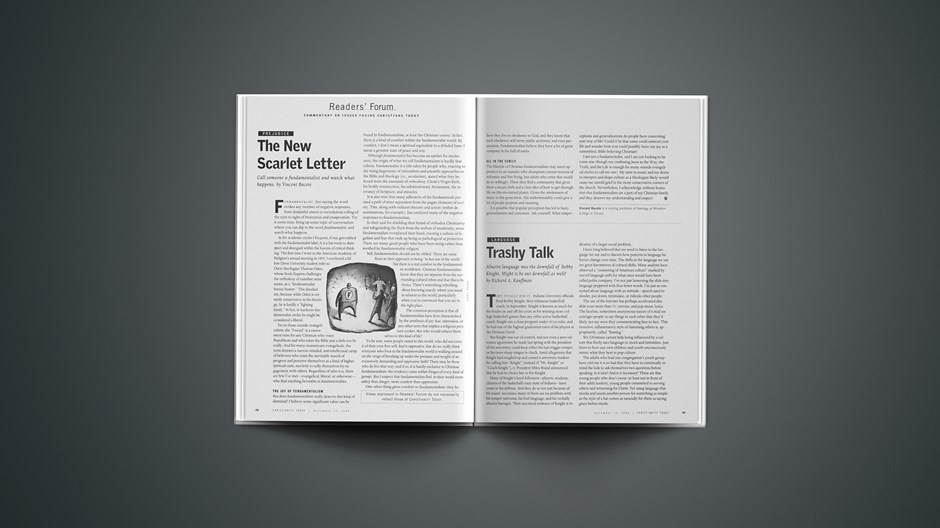
Fundamentalist. Just saying the word evokes any number of negative responses, from disdainful sneers to incredulous rolling of the eyes to sighs of frustration and exasperation. Try it some time: bring up some topic of conversation where you can slip in the word fundamentalist, and watch what happens.
In the academic circles I frequent, if one gets tabbed with the fundamentalist label, it is a fast track to disrespect and disregard within the havens of critical thinking. The first time I went to the American Academy of Religion's annual meeting in 1995, I overheard a fellow Drew University student refer to Drew theologian Thomas Oden, whose book Requiem challenges the orthodoxy of mainline seminaries, as a "fundamentalist heresy-hunter." This shocked me, because while Oden is certainly conservative in his theology, he is hardly a "fighting fundy." In fact, in hardcore fundamentalist circles he might be considered a liberal.
Yet to those outside evangelicalism, the "f-word" is a convenient term for any Christian who votes Republican and who takes the Bible just a little too literally. And for many mainstream evangelicals, the term denotes a narrow-minded, anti-intellectual camp of believers who resist the inevitable march of progress and perceive themselves as a kind of higher spiritual caste, too holy to sully themselves by engagement with others. Regardless of who it is, there are few I've met—evangelical, liberal, or otherwise—who find anything favorable in fundamentalists.
The joy of fundamentalism
But does fundamentalism really deserve this kind of dismissal? I believe some significant value can be found in fundamentalism, at least the Christian variety. In fact, there is a kind of comfort within the fundamentalist world. By comfort, I don't mean a spiritual equivalent to a deluded haze; I mean a genuine state of peace and rest.
Although fundamentalist has become an epithet for intolerance, the origin of what we call fundamentalism is hardly that odious. Fundamentalist is a title taken by people who, reacting to the rising hegemony of rationalism and scientific approaches to the Bible and theology (i.e., secularism), stated what they believed were the essentials of orthodoxy: Christ's Virgin Birth, his bodily resurrection, his substitutionary Atonement, the inerrancy of Scripture, and miracles.
It is also true that many adherents of the fundamentals pursued a path of strict separation from the pagan elements of society. This, along with militant rhetoric and action (within denominations, for example), has catalyzed many of the negative responses to fundamentalism.
In their zeal for shielding their brand of orthodox Christianity and safeguarding the flock from the wolves of modernity, some fundamentalists overplayed their hand, creating a culture of legalism and fear that ends up being as pathological as protective. There are many good people who have been stung rather than soothed by fundamentalist religion.
Still, fundamentalists should not be vilified. There are some flaws in their approach to being "in but not of the world," but there is a real comfort in the fundamentalist worldview. Christian fundamentalists know that they are separate from the surrounding cultural ethos and that this is by choice. There's something refreshing about knowing exactly where you stand in relation to the world, particularly when you're convinced that you are in the right place.
The common perception is that all fundamentalists have lives characterized by the antithesis of joy: fear, repression, or any other term that implies a religious pressure cooker. But who would subject themselves to this kind of life?
To be sure, some people raised in this world, who did not enter it of their own free will, find it oppressive. But do we really think everyone who lives in the fundamentalist world is walking around on the verge of breaking up under the pressure and weight of an excessively demanding and oppressive faith? There may be those who do live that way (and if so, it is hardly exclusive to Christian fundamentalism: the tendency exists within fringes of every kind of group). But I suspect that fundamentalists find in their world more safety than danger, more comfort than oppression.
One other thing gives comfort to fundamentalists: they believe they live in obedience to God, and they know that such obedience will invite public acrimony and even persecution. Fundamentalists believe they have a lot of great company in the hall of saints.
All in the family
The lifestyle of Christian fundamentalism may seem oppressive to an outsider who champions current notions of tolerance and free living, but adults who enter that world do so willingly. There they find a community that gives them a secure faith and a clear idea of how to get through life on this sin-stained planet. Given the aimlessness of many in this generation, this understandably could give a lot of people purpose and meaning.
It is possible that popular perception has led to hasty generalization and caricature. Ask yourself: What misperceptions and generalizations do people have concerning your way of life? Could it be that some could misread your life and wonder how you could possibly have any joy as a committed, Bible-believing Christian?
Article continues below
I am not a fundamentalist, and I am not looking to become one (though my confessing Jesus as the Way, the Truth, and the Life is enough for many outside evangelical circles to call me one). My taste in music and my desire to interpret and shape culture as a theologian likely would cause me untold grief in the more conservative corners of the church. Nevertheless, I acknowledge without hesitation that fundamentalists are a part of my Christian family and they deserve my understanding and respect.
Vincent Bacote is a visiting professor of theology at Wheaton College in Illinois.
Related Elsewhere
Don't miss today's related book excerpt, "Fundamentalism Revisited," by Fuller Seminary President Richard J. Mouw.
Read The Atlantic Monthly's take on some of the differences and similarities between evangelicalism and fundamentalism in "The Opening of the Evangelical Mind."
For a candid breakdown of the denotative and connotative definitions of fundamentalism, click here.















 While we pray for peace, we need moral clarity about this war.
 As my doubts about his teachings grew, so did a secret fascination with Jesus.
 After lobbying from fellow Southern Baptists and Christians affected by the war, the House speaker moves a package forward.






