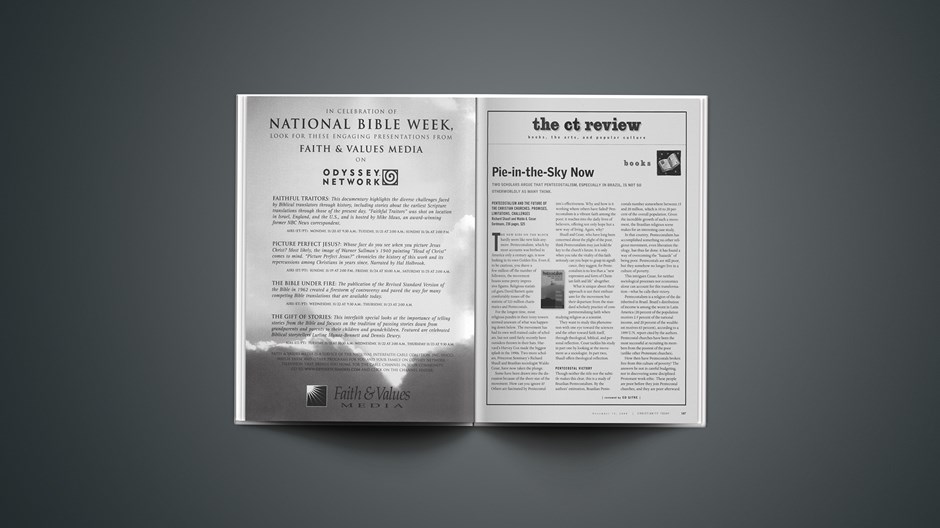
Pentecostalism and the Future of the Christian Churches: Promises, Limitations, Challenges Richard Shaull and Waldo A. Cesar Eerdmans, 236 pages, $25
The new kids on the block hardly seem like new kids anymore. Pentecostalism, which by most accounts was birthed in America only a century ago, is now basking in its own Golden Era. Even if, to be cautious, you shave a few million off the number of followers, the movement boasts some pretty impressive figures. Religious statistical guru David Barrett quite comfortably tosses off the statistic of 523 million charismatics and Pentecostals.
For the longest time, most religious pundits in their ivory towers seemed unaware of what was happening down below. The movement has had its own well-trained cadre of scholars, but not until fairly recently have outsiders thrown in their hats. Harvard's Harvey Cox made the biggest splash in the 1990s. Two more scholars, Princeton Seminary's Richard Shaull and Brazilian sociologist Waldo Cesar, have now taken the plunge.
Some have been drawn into the discussion because of the sheer size of the movement. How can you ignore it? Others are fascinated by Pentecostalism's effectiveness. Why and how is it working where others have failed? Pentecostalism is a vibrant faith among the poor; it reaches into the daily lives of believers, offering not only hope but a new way of living. Again, why?
Shaull and Cesar, who have long been concerned about the plight of the poor, think Pentecostalism may just hold the key to the church's future. It is only when you take the vitality of this faith seriously can you hope to grasp its significance, they suggest, for Pentecostalism is no less than a "new expression and form of Christian faith and life" altogether.
What is unique about their approach is not their enthusiasm for the movement but their departure from the standard scholarly practice of compartmentalizing faith when studying religion as a scientist.
They want to study this phenomenon with one eye toward the sciences and the other toward faith itself, through theological, biblical, and personal reflection. Cesar tackles his study in part one by looking at the movement as a sociologist. In part two, Shaull offers theological reflection.
Pentecostal victory
Though neither the title nor the subtitle makes this clear, this is a study of Brazilian Pentecostalism. By the authors' estimation, Brazilian Pentecostals number somewhere between 15 and 20 million, which is 10 to 20 percent of the overall population. Given the incredible growth of such a movement, the Brazilian religious scene makes for an interesting case study.
In that country, Pentecostalism has accomplished something no other religious movement, even liberation theology, has thus far done: it has found a way of overcoming the "hazards" of being poor. Pentecostals are still poor, but they somehow no longer live in a culture of poverty.
This intrigues Cesar, for neither sociological processes nor economics alone can account for this transformation—what he calls their victory.
Pentecostalism is a religion of the disinherited in Brazil. Brazil's distribution of income is among the worst in Latin America (20 percent of the population receives 2.5 percent of the national income, and 20 percent of the wealthiest receives 63 percent), according to a 1999 U.N. report cited by the authors. Pentecostal churches have been the most successful at recruiting its members from the poorest of the poor (unlike other Protestant churches).
How then have Pentecostals broken free from this culture of poverty? The answers lie not in careful budgeting, nor in discovering some disciplined Protestant work ethic. These people are poor before they join Pentecostal churches, and they are poor afterward. In fact, the church's activities almost seem counterproductive. Preachers constantly ask parishioners to give what seem like laughable sums of money; these people tithe 20, 30, and sometimes as much as 50 percent of their income.
Scholars have long branded Pentecostalism an eminently "otherworldly" religion, focused more on things above than the mundane below. To many that seems like a foregone conclusion, given the movement's emphasis on charismatic experiences, intense religiosity, and ascetic tendencies. Even highly respected Pentecostal scholars argue this point. This judgment misses part of the genius of Pentecostalism, and this book illustrates that point well.
New social actors
Joining Cox, Shaull and Cesar make the argument that Pentecostalism is in fact very "this-worldly." What surprised these two was the way Brazilian Pentecostals talked about Jesus. Jesus is someone real and close; he does amazing things in the vicissitudes of daily life. He delivers people from demons, yet also provides the most practical assistance, like food and shelter. Even language, which is so fundamental to human existence, is transformed and infused with the divine through the phenomenon of speaking in tongues.
The result of such "this-worldliness" is the transformation of these individuals into new social actors. One lives not only in the world, but in it more fully, with a new purpose. Everything is used to spread the message that God is intimately active (and not only active but at war against Satan).
Article continues below
Cesar lists several examples of this. If the task of evangelizing requires buying a multimillion-dollar TV station to promote the cause, so be it. Nothing, not even the political arena, is off-limits.
Cesdar quotes statistics from the 1995 election: of the 30 elected senators and representatives, 19 were Pentecostal. This is a populist, activist religion, which attempts to apply the transformation experienced by the individual to the broader society.
Not only is the individual changed by the message, Shaull the theologian suggests, but the message itself is to some extent changed by the Pentecostal experience among the poor.
"In Pentecostalism," he argues, "poor and broken people discover that what they read in the Gospels is happening now in their midst" (Shaull's emphasis). The kingdom of God breaks into the here and now—and changes it.
One will find little emphasis on premillennial theology among these Brazilian Pentecostals.
Heaven here and now
Look for a lot of repetition in this book; the authors spend considerable time saying some of the same things in different ways, and sometimes not even in different ways. Anyone familiar with other works on the sociology of religion will be frustrated with Cesar's analysis. Cesar says little about methodology, and he supports too many conclusions with only anecdotal testimonies. He quotes other sociologists selectively and without a sustained dialogue. Most of what is taking place here is a description of the religious life of Brazilian Pentecostals and not rigorous, comparative analysis.
These shortcomings are especially problematic because of the study's thesis that there is something fundamentally different about Brazilian Pentecostalism, with global implications.
Shaull and Cesar are certainly on to something. Without a doubt, Pentecostalism resonates with the Brazilian poor in a unique way.
But as a North American Pentecostal, I couldn't help comparing the Brazilian situation to the scene in the United States, where the movement is far more diverse and attracts many who are not of the "disinherited."
Part of the genius of any new religious movement is the fostering of a pragmatic spirit of doing whatever is necessary to achieve the goal, particularly in spreading God's Word and winning converts. New movements lack the bureaucracies and traditions that hinder creativity and adaptability and that stymie older denominations. Sociologists know well that in the end as movements grow and age, the entrepreneurial, pragmatic spirit gives way to systemization and bureaucratization.
Article continues below
There is little evidence in this work that the Brazilian Pentecostal movement will somehow avert this very human tendency. In fact, their work suggests just the opposite.
For instance, Brazilian Pentecostals are entering politics not because they identify with a particular ideological stand but simply to get elected.
Brazilian Pentecostals are successfully reaching the poor because they are the poor; it is not the result of some particularly thought-out initiative, ideology, or agenda.
I think the key is Pentecostal spirituality itself. This book lays bare the myth that Pentecostals have their heads stuck in the clouds. At its best, Pentecostalism is invigorated by a spirit that says God is active in this world and will show you he is. And you don't have to wait until you get to heaven to see that reality. That's what the healings, miracles, and speaking in tongues reinforce and give evidence of.
In terms of attracting adherents overseas, the most successful Pentecostals have been "healing evangelists." The "disinherited," those who cannot afford doctors, are attracted to a gospel that not only promises health but also apparently delivers. This is something that neither Shaull nor Cesar takes full account of, but it is central to Pentecostal theology and experience.
Despite this oversight, perhaps their work will stimulate others to come down from ivory towers to see and explore what is happening below.
Ed Gitre is on the staff of Chi Alpha, an Assembly of God ministry, at the University of Chicago.
Related Elsewhere
Christianity Today's sister magazine, Books & Culture, ran an article on Pentecostalism, power shifts, and competition in Latin American religion in 1999.
Do you know the difference between neo-Pentecostals and Holiness Charismatics? This Web site attempts to clarify some movements within Pentecostalism and trace its history. For more Pentecostal history, see our sister publication, Christian History, which devoted an issue to the subject.
Shaull and Cesar's book, Pentecostalism and the Future of the Christian Churches: Promises, Limitations, Challenges, is available from Amazon.com and Eerdmans.com.
Previous Christianity Today coverage of Pentecostalism includes:
Grow With God | World Assembly of God Fellowship aims to triple its size. (Aug. 23, 2000)
Should We All Speak in Tongues? | Some say speaking in tongues is proof of 'baptism in the Holy Spirit.' Are those who haven't spoken in tongues without the Holy Spirit? (March 21, 2000)
Conversation or Competition | Pentecostals, Roman Catholics in long-standing talks to resolve conflicts, discover some commonalities. (Sept. 7, 1998)
Romancing Pentecostalism | Clark Pinnock's theology of the Holy Spirit builds a bridge between divided communities within evangelicalism. (Nov. 11, 1996)















 While we pray for peace, we need moral clarity about this war.
 As my doubts about his teachings grew, so did a secret fascination with Jesus.
 NIL deals in college athletics present new challenges—and opportunities—for colleges and students.






