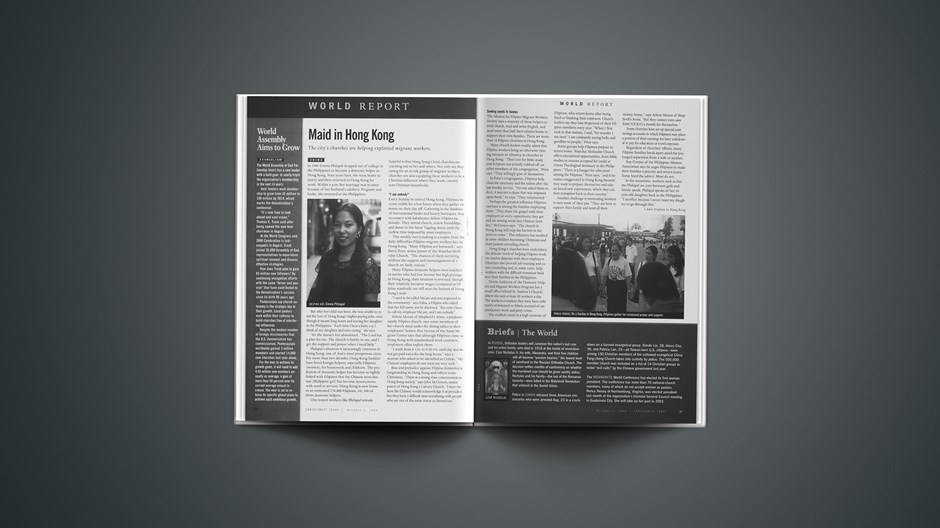
In 1985 Emma Philapal dropped out of college in the Philippines to become a domestic helper in Hong Kong. Four years later, she went home to marry and then returned to Hong Kong for work. Within a year, her marriage was in ruins because of her husband's adultery. Pregnant and broke, she returned to the Philippines. But after her child was born, she was unable to resist the lure of Hong Kong's higher-paying jobs, even though it meant long hours and leaving her daughter in the Philippines. "Each time I hear a baby cry, I think of my daughter and start crying," she says. Yet she doesn't feel abandoned. "The Lord has a plan for me. The church is family to me, and I get the support and prayer when I need help."Philapal's situation is increasingly common in Hong Kong, one of Asia's most prosperous cities. For more than two decades, Hong Kong families have hired foreign helpers, especially Filipinas (women), for housework and childcare. The profession of domestic helper has become so tightly linked with Filipinos that the Chinese term banmui (Philippine girl) has become synonymous with maid or servant. Hong Kong is now home to an estimated 170,000 Filipinos, 141,500 of them domestic helpers.One reason workers like Philapal remain hopeful is that Hong Kong's local churches are reaching out to her and others. Not only are they caring for an at-risk group of migrant workers; churches are also equipping these workers to be a Christian influence where they work—mostly non-Christian households.
"I am nobody"
Every Sunday in central Hong Kong, Filipinos become visible for a few hours when they gather en masse on their day off. Gathering in the shadows of international banks and luxury boutiques, they reconnect with kababayans (fellow Filipino nationals). They attend church, renew friendships, and dance to the latest Tagalog music until the curfew time imposed by most employers. This weekly merrymaking is a respite from the daily difficulties Filipino migrant workers face in Hong Kong. "Many Filipinas are homesick," says Barry Prior, senior pastor of the Wanchai Meth odist Church. "The chances of them surviving without the support and encouragement of a church are fairly remote."Many Filipino domestic helpers were teachers or nurses who had low income but high prestige. In Hong Kong, their situation is reversed, though their relatively lucrative wages (compared to Filipino standards) are still near the bottom of Hong Kong's scale."I used to be called Ma'am and was respected in the community," says Edna, a Filipina who asked that her full name not be disclosed. "But now I have to call my employer Ma'am, and I am nobody."Arlene Moran of Shepherd's Arms, a predominantly Filipino church, says some members of her church sleep under the dining tables in their employers' homes. Rex Verona of the Asian Migrant Center says that although Filipinos come to Hong Kong with standardized work contracts, employers often exploit them."I work from 6 a.m. to 9:30 p.m. each day and do not get paid extra for the long hours," says a woman who asked to be identified as Connie. "My Chinese employers do not treat me very well."Bias and prejudice against Filipina domestics is longstanding in Hong Kong and infects some Christians. "There is a strong class consciousness in Hong Kong society," says John McGovern, senior pastor of Hong Kong's Calvary Church. "I don't believe the Chinese would acknowledge it as prejudice, but they have a difficult time socializing with people who are not of the same status as themselves."
The Mission for Filipino Migrant Workers Society says a majority of these helpers attend church, read and write English, and send more than half their salaries home to support their own families. There are more than 10 Filipino churches in Hong Kong.Many church leaders readily admit that Filipino workers bring an otherwise missing measure of vibrancy to churches in Hong Kong. "Their love for Bible study and Scripture has actually rubbed off on other members of the congregation," Prior says. "They willingly give of themselves."In Prior's congregation, Filipinos help clean the sanctuary and the toilets after the last Sunday service. "No one asked them to do it, it was not a chore that was imposed upon them," he says. "They volunteered."Perhaps the greatest influence Filipinos can have is among the families employing them. "They share the gospel with their employers at every opportunity they get and are sowing seeds into Chinese families," McGovern says. "The church in Hong Kong will reap the harvest in the years to come." This influence has resulted in some children becoming Christians and their parents attending church.Hong Kong's churches have undertaken the delicate work of helping Filipino workers resolve disputes with their employers. Churches also provide job training and career counseling and, in some cases, help workers with the difficult transition back into their families in the Philippines.Nicola Anderson of the Domestic Helpers and Migrant Workers Program has a small office behind St. Andrew's Church, where she sees at least 20 workers a day. The workers complain they have been arbitrarily terminated or falsely accused of unsatisfactory work and petty crime.The conflicts result in a high turnover of Filipinos, who return home after being fired or finishing their contracts. Church leaders say they lose 50 percent of their Filipino members every year. "When I first took in that statistic, I said, 'No wonder I am tired.' I am constantly saying hello and goodbye to people," Prior says.Some groups help Filipinos prepare to return home. Wanchai Methodist Church offers educational opportunities, from Bible studies to courses accepted for credit at Union Theological Seminary in the Philippines. "There is a hunger for education among the Filipinas," Prior says, "and it becomes exaggerated in Hong Kong because they want to prepare themselves and take on board new experiences, which they can then transplant back in their country."Another challenge is motivating workers to save some of their pay. "They are here to support their family and send all their money home," says Arlene Moran of Shepherd's Arms. "But they cannot even save $200 [US $25] a month for themselves."Some churches have set up special joint savings accounts in which Filipinos may place a portion of their earnings for later withdrawal to pay for education or travel expenses. Regardless of churches' efforts, many Filipino families break apart amid the prolonged separation from a wife or mother. Ray Corpus of the Philippine Mission Association says he urges Filipinos to make their families a priority and return home. Some heed the advice. Most do not.In the meantime, workers such as Emma Philapal are torn between guilt and family needs. Philapal speaks of her 10-year-old daughter back in the Philippines: "I sacrifice because I never want my daughter to go through this."















 While we pray for peace, we need moral clarity about this war.
 We’ve got little information on Jesus’ appearance and personality. But that’s the way God designed it.españolFrançais
 As Haiti is uprooted by violence, church leaders treat gunshot wounds, give up homes for strangers, and rescue dignitaries.Français






