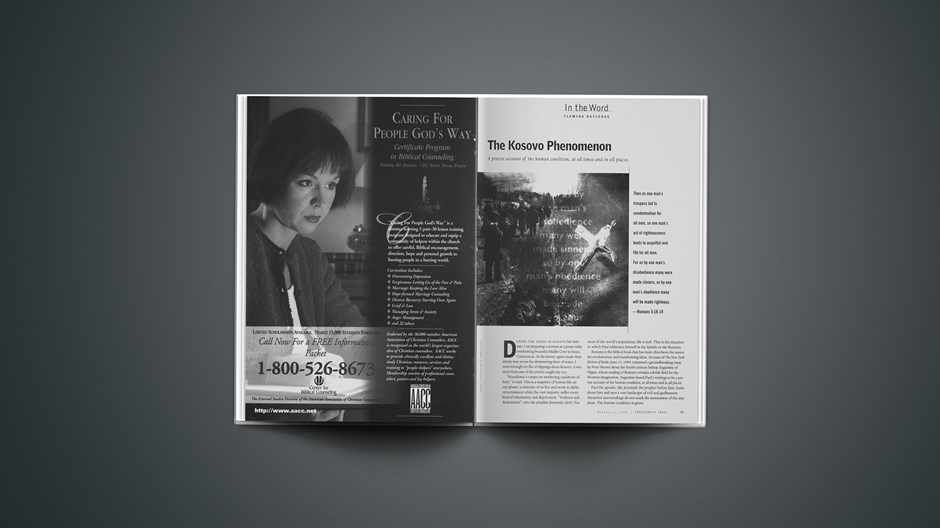
Then as one man's
trespass led to
condemnation for
all men, so one man's
act of righteousness
leads to acquittal and
life for all men.
For as by one man's
disobedience many were
made sinners, so by one
man's obedience many
will be made righteous.
—Romans 5:18-19
During the crisis in Kosovo last summer, I sat preparing a sermon at a picnic table overlooking beautiful Middle Cove in Essex, Connecticut. As the snowy egrets made their stately way across the shimmering sheet of water, I went through my file of clippings about Kosovo. A sentence from one of the articles caught my eye.
"Macedonia's camps are sweltering cauldrons of hate," it read. This is a snapshot of human life on our planet; a minority of us live and work in idyllic circumstances while the vast majority suffer every kind of inhumanity and deprivation. "Violence and destruction!" cries the prophet Jeremiah (20:8). For most of the world's population, life is hell. That is the situation to which Paul addresses himself in the Epistle to the Romans.
Romans is the biblical book that has most often been the source for revolutionary and transforming ideas. An issue of The New York Review of Books (June 15, 1999) contained a groundbreaking essay by Peter Brown about the fourth-century bishop Augustine of Hippo, whose reading of Romans remains a fertile field for the Western imagination. Augustine found Paul's writings to be a precise account of the human condition, at all times and in all places.
Paul the apostle, like Jeremiah the prophet before him, looks about him and sees a vast landscape of evil and godlessness. Attractive surroundings do not mask the seriousness of the situation. The human condition is grave.
The Kosovar refugees of whom I read that day presented a case in point. I think it is fair to say that most of us had enormously sympathetic reactions to the plight of the million ethnic Albanians who were treated with such ferocious inhumanity. Every night we looked at televised scenes of heartbroken refugees returning to their destroyed homes where relatives were murdered, and we considered how awful that would be. With a typical human tendency to sentimentalize, we viewed the Kosovar refugees as entirely innocent victims and did not care to think further than that.
The Bible, however, teaches us something quite different about human nature; Jeremiah says, "The heart is deceitful above all things, and desperately corrupt. Who can understand it?" (17:9). In other words, human nature is never innocent.
My clipping about the Macedonian refugee camp tells a shocking tale. The June 7, 1999, story by David Rhode in The New York Times reports how a Gypsy family had been in the camp for several weeks, along with the Albanians who were arriving every hour. Gypsies, a despised minority to begin with, were suspected of collaborating with the Serbs. A group of 15 or 20 Albanian men assaulted two Gypsy men and beat them savagely. The Gypsies were rescued by aid workers and taken to the Catholic Relief building for safety. The mob of Albanians, growing in numbers by the minute, tore down a chain-link fence, ripped bars from the windows, and burst through the front door using a metal gutter as a battering ram. The terrified relief workers tried desperately to stop the attack but failed, and the Gypsy men were beaten again, almost to the point of death.
The mob, screaming for blood, had grown to several thousand by this time. When they discovered a 7-year-old Gypsy boy whom the aid workers were attempting to protect, they seized him and attempted to tear him limb from limb. Ed Joseph of Catholic Relief Service, who days later was still shaken, said that they had attempted to rip the boy's arms off—literally. Several aid workers, including Joseph, were somehow able to snatch the boy from the mob, and by a miracle the Red Sea parted. The arrival of several hundred Macedonian riot police and the American ambassador finally put a stop to the nightmare, but it had lasted for four hours.
As an unnerved Joseph said later, "Any Serb still left in Kosovo when the refugees return had better be packing his bags."
What we see illustrated here is that victims can become victimizers in a blink. Thus it has been throughout the millennia. In the refugee camps, there are gatherings in the evening where adults respond enthusiastically as children recite poems they have memorized about Serbian atrocities. Thus one generation after another teaches the children whom to despise.
But this is just ancient Balkan hatred, isn't it? We Americans wouldn't do anything like that, would we? Imagine, however, that an armed horde came into a beautiful American village and burned down the houses, made a special point of defacing the churches, rounded up the young men and shot them, and then rampaged through the streets trashing everything in sight. What if they then gave us and our grandparents and young children 10 minutes to get out, taking away all our personal documents, birth certificates, and family photos, and sent us off with no medicine, food, or water, through mountains more rugged than the Adirondacks with nothing on the other side except towns inhabited by people several notches down the socioeconomic scale? What attitude would you and I have then?
Article continues below
Suppose further that we were sitting around in refugee camps which had become "sweltering caldrons of hate," where there is nothing useful to do except commiserate about what the enemy has perpetrated upon us. Can any of us be sure that, in such a context, we would step forward, risking our own lives, to save a collaborator from our own countrymen? A lot depends on circumstances. We have never been in a situation like that, so how do we know what we would do?
Paul, in Romans, paints one of the most comprehensive pictures of human wickedness in the Bible. No one is excluded. "All human beings, both Jews and Greeks, are under the power of sin, as it is written, 'None is righteous, no, not one'" (3:9–10).
The Adam phenomenon
All of us are part of the human mob. This is a phenomenon to which Paul assigns the name of the first man, "Ad am." Somehow God's good creation has gone terribly wrong, and the entire human race is implicated.
Paul wants to make sure we understand this; he says it in five different ways. "Many died through one man's [Adam' s] trespass. … The judgment following one trespass brought condemnation. … Because of one man's trespass, death reigned through that one man. … One man's trespass led to condemnation for all men. … By one man's disobedience many were made sinners" (5:15–19).
Thus "Adam" is the name Paul gives to a development in human existence whereby we have all been taken captive by a power greater than we are, the power of sin and death. It is this power that motivates us, generation after generation, to hate black people or Serbs or Yankees or Tutsis or Jews or homosexuals. As one exhausted refugee said, "When will it ever end?"
The biblical answer is that it can never end unless there is an intervention from beyond this world order altogether. The psalmist understands the desperate predicament he is in; he cries out to God, "Rescue me from sinking in the mire; let me be delivered from my enemies and from the deep waters. Let not the flood sweep over me, or the deep swallow me up, or the pit close its mouth over me" (Psalm 69:14–15). The trespass of Adam, Paul writes, has made captives of us all and the result is condemnation for all human beings. There is no hope of our race improving itself in any definitive way, except by the mercy of God. We all hope for good things to happen in the new millennium; some of these things are genuinely possible, like a cure for cancer, but human nature being what it is, it is also possible that our grandchildren will contract smallpox in a bioterrorist attack. Such is our world as Paul describes it for us.
Article continues below
In 40 years of teaching the Bible, I have made a discovery about my fellow Americans. The American answer to every theological and ethical dilemma is "freedom of the will." By making right choices, we believe, we can move out of the dominion of sin. The implication of this is, I have moved out of the grip of sin; why haven't you?
Hmmm. Looking ahead in Romans to chapter 7, we move from the universal to the particular. Speaking no longer of the human race as a whole but of the individual human being, Paul writes, "I do not understand my own actions. For I do not do what I want, but I do the very thing I hate. … So then it is no longer I that do it but sin which dwells within me. … I can will what is right, but I cannot do it. For I do not do the good I want, but the evil I do not want is what I do. Now if I do what I do not want, it is no longer I that do it but sin which dwells within me" (15–20).
Christ died for the perpetrators
This is one of the passages that sheds light on Augustine's struggle to control his own unwelcome desires. It describes the conflict within the human heart that should be familiar to us all. Paul continues, "When I want to do right, evil lies close at hand. For I delight in the law of God, in my inmost self, but I see in my members another law at war with the law of my mind and making me captive to the law of sin."
When William Faulkner won the Nobel Prize, he said in his acceptance speech that the central human drama was "the human heart in conflict with itself." Paul's urgent message to us in Romans is that the law of sin is much stronger than we are. Even with the best will in the world, we still make the same bad choices over and over, even if we have gotten as far as the White House. All of us are captive to sin in some form.
More pernicious still is the form of sin that goes unacknowledged. The man who is clearly an alcoholic refuses to face up to it; the couple whose marriage has broken down doesn't admit it even to themselves; the woman who has been involved with one unsuitable man after another refuses to get counseling. Most pathetic of all, we relish every opportunity to cluck our tongues and roll our eyes at somebody else's behavior, giving not a thought to our own. We spend our lives trying to deny the existence of the strife that goes on within our own souls.
Article continues below
Mark Edmundson, a scholar who specializes in Gothic themes in popular culture, recently explained what is still important about the work of Sigmund Freud: "Despite outward appearances and despite our wishes to the contrary, we are not unified beings. … Because we both wish and oppose our own desires, our inner lives are in a constant state of civil war." The great danger, Edmundson believes, is that we will not acknowledge "the push and pull of our desires," thereby becoming intolerably self-righteous.
This is precisely what Paul is talking about. There is nothing as unbearable as a self-righteous religious person. Such a person will not acknowledge "the war that rages inside," and seems unattractive and unreal to other people, who feel themselves put down in some way. Self-righteous religiosity separates the spiritual from the unspiritual in a way that Paul says is the opposite of the gospel.
The Epistle to the Romans is addressed to suffering humankind as a whole. "Adam" is our collective name. We do terrible things to each other, and half the time we do not even realize that we are doing it. The Kosovars who are trying to dismember a child, the president who can't control his impulses, the addict who gambles away his family's livelihood, the grown man who has no patience with his senile father, the enraged mother whom I saw yesterday dragging her screaming tot across the supermarket parking lot by one tiny arm—all of us are born into Adam, and our case is terminal. But now listen to Paul in 5:15–17:
The free gift [of God] is not like the trespass [of Adam]. For if many died through one man's trespass, much more have the grace of God and the free gift in the grace of that one man Jesus Christ abounded for many. … If, because of one man's trespass, death reigned through that one man, much more will those who receive the abundance of grace and the free gift of righteousness reign in life through the one man Jesus Christ.
This is electrifying, world-transforming news. God's action in the death and resurrection of our Lord Jesus Christ has reversed the sin of Adam, undone the reign of sin, loosed the grip of death, broken through our prison walls with righteousness and life.
"Christ died for the ungodly" (5:6)—the victims and the victimizers, the sufferers and the perpetrators, the penitent sinners and the smugly self-righteous alike. "For as by one man's disobedience many were made sinners, so by one man's obedience many will be made righteous."
Article continues below
In November 1983 an all-white jury in Clayton County, Georgia, took 40 minutes to convict an African-American man named Calvin Johnson of raping a white woman. The jury ignored the testimony of four black witnesses who supported his alibi, choosing instead to believe the ambivalent testimony of the white victim. Standing before the judge who had just sentenced him to life in prison, Johnson said, "With God as my witness, I have been falsely accused. … I just pray in the name of Jesus Christ that the truth will eventually be brought out."
On June 15, 1999—16 years later—holding a small New Testament in his hand, Johnson stood before another judge who signed an order to set him free. DNA tests had shown conclusively that he could not have committed the crime.
Sixteen years as a lifer in a Georgia prison! The mind reels. What was Johnson's attitude about those who had done him wrong? His faith in Christ had gotten him through each day of those 16 years, he said, never allowing him to despair. He said he held no lasting enmity toward the prosecutor, the victim, the jury, or the legal system. He said, "Bitterness will destroy you. Now I just need a job."
One story about Adam, one story about Christ. We do not belong to Adam. We belong to the Lord.
As the trespass of one person led to condemnation for all people, so one person's act of righteousness leads to acquittal and life for all people. For as by one man's disobedience we were made sinners, so by one man's obedience we will be made righteous (Romans 5:18–19).
Fleming Rutledge was active in parish ministry for more than 22 years. She is now an evangelist, speaker, and author of Help My Unbelief and The Bible and The New York Times.
Rutledge's book The Bible and The New York Times, is available from the ChristianityToday.com Bookstore and other book retailers.
Help My Unbelief
, her latest, is available from Amazon.com and other book retailers.
Article continues below
More on Rutledge's books, including excerpts and tables of contents, is available from
Eerdmans.com
.
Previous Christianity Today stories about Kosovo include:
Does Kosovo Pass the Just-War Test?
| The military intervention introduces moral questions that the church ought to raise now, not waiting until the body bags start coming home. (May 24, 1999)
Bridging Kosovo's Deep Divisions
| A tiny evangelical minority has a vision for how to overcome the explosive mix of religion and nationalism. (Feb. 8, 1999)
Can God Be Trusted?
| He will cover you with his pinions, and under his wings you will find refuge. (June 15, 1998)
The Day We Were Left Behind
| When Jesus had said this, as they were watching, he was lifted up, and a cloud took him out of their sight. (May 18, 1998)















 While we pray for peace, we need moral clarity about this war.
 A Christian reconciliation group in Israel and Palestine warned that war would come. Now the war threatens their relevance.العربيةFrançais
 We must always be people of the Word, but we’ll have to reimagine deep engagement with Scripture.






