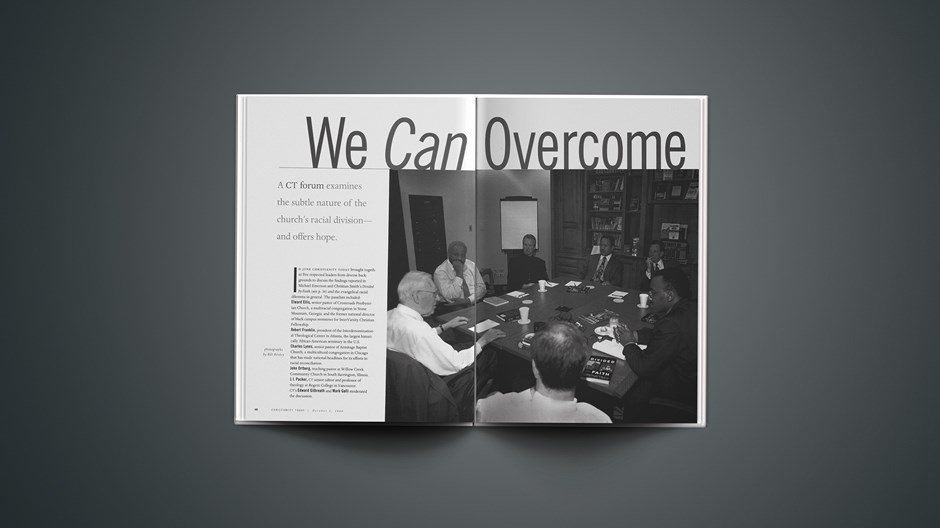
In June Christianity Today brought together five respected leaders from diverse backgrounds to discuss the findings reported in Michael Emerson and Christian Smith's Divided by Faith and the evangelical racial dilemma in general. The panelists included: Elward Ellis, senior pastor of Crossroads Presbyterian Church, a multiracial congregation in Stone Mountain, Georgia, and the former national director of black campus ministries for InterVarsity Christian Fellowship. Robert Franklin, president of the Interdenominational Theological Center in Atlanta, the largest historically African-American seminary in the U.S. Charles Lyons, senior pastor of Armitage Baptist Church, a multicultural congregation in Chicago that has made national headlines for its efforts in racial reconciliation. John Ortberg, teaching pastor at Willow Creek Community Church in South Barrington, Illinois. J. I. Packer, CT senior editor and professor of theology at Regent College in Vancouver. CT's Edward Gilbreath and Mark Galli moderated the discussion.
"I'm no racist"
Gilbreath: Emerson and Smith say that many white evangelicals are not so much racist as they are immersed in a "racialized society" in which race reflects a huge cultural chasm between people. They write, "A racialized society is a society wherein race matters profoundly for differences and life experiences. … It can also be said to be a society that allocates differential economic, political, social, and even psychological rewards to groups along racial lines."
Is this a helpful distinction?
Ortberg: I think we need language like this. As racial problems become more subtle, talking about them in this way will be helpful.
Franklin: This book is a report card for church leaders and, I hope, the larger society. The authors show how racial valuations are basically built into the structures of society, and so we are, in a sense, failing by design. Insofar as the term "racialized" helps leaders pay more attention to that systemic dimension of the sin out there, it makes an important contribution.
Ellis: We come to this discussion exhausted over issues of nomenclature. Assigning new names and labels is a little tiring, because at the end of the day we live in the same world. It behaves the same way. And I think that the "racialized society" concept would only be refreshing if it could serve the purpose of getting someone off the dime who has entrenched himself and won't talk honestly or more broadly about the race problem. But the term doesn't excite me. There are as many concepts of racial alienation as perhaps there are groups of people alive. We have to come to terms with why we have a propensity to be hostile to some and preferential to others.
Galli: The term racialized struck me as a good one. If I'm told I'm a "racist," I have no way of processing that because I don't hold racist views. But if someone tells me I've been "racialized"—that I live in a world that divides itself by race—I'm able to listen because that accords with my experience and helps me see society in a different way.
Lyons: Most of what Emerson and Smith address, I think, is cultural, not racial. The isolation, the ignorance, is cultural. The fear is cultural. The language used is important, because words mean things. So the term racialization may be helpful. Mark, you touched on an important point. The term racist has so much baggage with it. You're not going to get your normal, drive-down-the-street white guy to admit he has racist attitudes. And so the discussion will stall right there. The idea of racialization is softer and, in that way, may be helpful to stimulate discussion. But again, we're dealing with cultural issues here. Across the board in America, the majority does not dislike, much less hate, somebody else for the color of their skin.
Ellis: Mark, you don't think Johnny Whiteguy is going to stay in the dialogue if he's called a racist. What I see there is what I call a convenient reaction: "I'm not going to deal with it if they're going to call me a racist." I think for the Christian leader, that's not an option. The option is to listen to what's really being said and then ask questions with the goal of understanding. We need to find out what people are describing, as opposed to taking offense at their language, because in leadership it comes with the territory.
Franklin: The old labels—bigot, racist—don't help this conversation move anywhere. But can the Emerson/Smith way of talking about a "racialized society" help the average white person admit that society assigns certain privileges and benefits, certain doors of access, on the basis of possessing white skin? For many in the black community, having whites acknowledge this is a kind of litmus test as to whether or not we can have an honest dialogue.
Ortberg: It's strange that Christians today would say, "I'm not a racist." That strikes me as odd for a people who generally acknowledge some form of human depravity. Somebody once asked Dallas Willard, "Do you believe in total depravity?" He said, "I believe in sufficient depravity." That is, when we get to heaven we are sufficiently depraved and nobody will be able to say, "I merited this on my own."Well, if depravity touches me as a sexual being and in my ways of dealing with anger and so on, it would be remarkable if the one area in my life in which sin did not touch me was racially. So everyone in our society, particularly those of us who are in positions of privilege, is fallen in terms of racial issues. But when the problem isn't obvious, and there are no laws on the books, we lack language to talk about it.
Article continues below
Warped theology
Gilbreath: Emerson and Smith's main conclusion is that evangelical theology, with its emphasis on individualism and personal relationships, makes it extremely difficult, perhaps impossible, to deal with systemic issues of racial injustice. Is that an accurate assessment?
Packer: I think the substance is right. Evangelical Christianity starts with the individual person: the Lord gets hold of the individual; the individual comes to appreciate certain circles—the smaller circle of the small group, the larger circle of the congregation. These circles are where the person is nurtured and fed and expanded as a Christian. So, we evangelicals are conditioned to think of social structures in terms of what they do for us as individuals.That's all right, but it does lead us to settle too soon for certain self-serving social structures. And we are slow to pick up the fact that some of the social units that we appreciate for that reason can have unhappy spinoff effects on other groups.
Lyons: I don't believe evangelical theology is inherently predisposed to racism. I think the American cultural adaptation and interpretation of evangelical theology overlooks all kinds of stuff. And therein lies the malady. Good theology and the message of the Cross is adequate. What we have done to the Cross is another story. We've made La-Z-Boy versions of it, instead of just picking up the cross and following Jesus. So, while there is a definite tendency towards individualism among evangelicals, to say that it stems from our theology is a stretch. I don't make that leap. Biblical theology is adequate, but our cultural adaptations and interpretations are twisted and warped.
Article continues below
Gilbreath: What is it specifically about Western culture that has polluted our theology?
Ortberg: One problem is that American evangelicals have understood the gospel to mean "the minimal stuff I've got to do to get into heaven when I die." And that's very individualistic, so it's not at all connected to issues of reconciliation.
Ellis: In evangelical Christianity, a lot of attention is given to getting doctrine right. And so it has ignored the effects that the economic expansion of America has had on our theology. I believe the distortions in our theology are being created by the American experience itself.Historically, as we grew the nation, we had to come to terms with the economic opportunity presented by the New World and slavery. It created a moral or theological conflict, so we went to the Reverend and had him fix his preaching and doctrine so we could be both Christians and slave owners. It's at this point, where America has wrestled with how to be both profitable and ethical, that racism has taken its deepest roots. We have mixed a civil religion and pragmatism into our practice of evangelical theology.
Homogeneous unit problem
Gilbreath: Emerson and Smith argue that "in the face of social and religious pluralism, the organization of American religion drives religious groups toward internal similarity." They highlight the church-growth "homogeneous unit principle" as an example of a strategy that exploits the tendency of congregations to segregate themselves racially.Willow Creek, being the most prominent seeker-sensitive church in America, has been accused of using the homogeneous unit principle. John, how has this issue played itself out in your church?
Ortberg: I wasn't on staff when Willow Creek began, but I know there was never a discussion about using the homogeneous unit principle as a strategy for growth. Rather there was an emphasis on becoming a New Testament community that transcended barriers. But because the church is located in an upper-middle-class suburb, it naturally reached people who are all quite similar socially.One of the things that gets talked about a lot around here is that we cannot have New Testament–style community unless barriers between people, and especially people who are different, are removed. The church must be a place where people who are from different cultural backgrounds are embraced. So we have been talking a lot about becoming the kind of community that is more effective at removing the barriers.
Article continues below
Gilbreath: What kinds of things are you doing?
Ortberg: We have developed extension ministries that are designed to connect us with those who are not like us. For instance, our Urban Plunge takes volunteers into the inner city to help with ministry projects with the intention of building long-term relationships.Robert Putnam in his book Bowling Alone talks about the difference between bonding activities and bridging activities. Bonding activities connect you to people who are like you. Bridging activities connect you to those who are different from you. Probably the single greatest area of growth for us over the last couple of years has been in those areas of ministry where people are beginning to build bridges.
Galli: I was pastor of a small Presbyterian church in Sacramento, and you could have preached to us endlessly that we should have a multiracial congregation. But we lived in a white suburb, and blacks in Sacramento tended to live some five to ten miles across town. On a practical level, do people want to travel outside their neighborhood to go to a church that's different racially?
Lyons: Again, I think it all goes back to culture. I'm white and I wouldn't have come to your church. I don't get into Presbyterian worship styles. It's about more than just mixing races. I wince every time I hear that line, "11 o'clock Sunday morning is the most segregated hour in America." Give me a break! You couldn't drag black people to most white churches. You couldn't drag me to most white churches. It's a cultural issue.
Franklin: But, Charles, it sounds like you've found a comfort zone and you're not willing to step beyond it.
Lyons: Well, you'd have to follow me around for a while to see if that's true. I don't know. But the reality is, people relate culturally. I personally have more in common with black and Latino worship than with many of those found within the white evangelical subculture. I drove out here from the 'hood. And the reason I know the power of the gospel is because I see it in my pew. I see it on my street corner.It amuses me that white churches will have a black choir come out for that one Sunday a year. And maybe, maybe they'll let the preacher come—if they think he's safe—
Galli: As long as he doesn't speak too long [group laughter].
Lyons: My point is, there's a big difference between a little exposure here and there and getting down to the nitty-gritty of relationships. In my experience, we've bridged in order to bond. We didn't just do a weekend Urban Plunge; we moved in.Christ did not commute. There was not an ascension after supper every night. Jesus moved into the neighborhood. And at the heart of all of this—and it was not in Emerson and Smith's book—is the need for an incarnational theology. If we are more willing to be incarnational and multicultural in our understanding, in our thinking, in our worship styles, in our embracing, then we will have a more credible witness. Five miles is not that far to drive.
Article continues below
Ellis: I think the issue is, What is leadership telling the church about the environment where God has called us to be his people? We're not here to become stakeholders in the American Dream. We're here to be transformational presences. And those two things are not one and the same. I know it's difficult. It's no more easy for me as a black person to sit here and wrestle with those issues than it is for a white person.Charles, you talk about moving into the 'hood. I was born in the 'hood, and my question has sometimes been, Will I ever be perceived as anything more than the stereotype of a black man from the 'hood?
Preaching the American dream
Galli: A couple of you have said one problem with evangelicals is that we spend more time preaching the American Dream than preaching the gospel. What, in concrete terms, does that mean?
Ortberg: I've never heard anybody in the evangelical church get up and say, "I'm going to tell you how to fulfill the American Dream." In fact, we use the language of antimaterialism quite a lot. But I think how it gets expressed is not just in what gets said but in what doesn't get said.I recall hearing a prominent evangelical preacher speak on Nebuchadnezzar and the story of his recovery from insanity. When you go back through the story, you see part of God's prophetic judgment against Nebuchadnezzar was due to his oppression of the poor. This pastor preached a whole sermon on the subject and that dimension never got mentioned; he only talked about Nebuchadnezzar's pride and arrogance—individualistic issues. And that's how it often is in our churches—certain issues get preached, other ones don't.
Ellis: The American Dream is expressed in more than sermons. I'm also talking about the conversations we have. For example, two Christians are working in an office in a suburban Atlanta company. One of them is my neighbor, a white woman who's married to a black man. But since she is relatively new at the company, her coworkers do not know that her husband is black. So she says to her Christian girlfriend, "Steve and I are looking for a house in the Stone Mountain area."Her friend replies, "Stone Mountain? Don't you know that's going black?"In that conversation is a revelation of the drivers of the culture. In this culture, it is not expected that a person would intentionally move into a neighborhood perceived to be "going black." The normal understanding is, if blacks are going to be there, crime is going up, property values are going down, schools are declining, and your investment is going to be lost. In that context, even among Christians, that reasoning is understood and possibly affirmed. That is an uncritical embrace of the American Dream.
Article continues below
Franklin: Karl Barth once said that responsible theology is done with the Bible in one hand and a newspaper in the other. The great sin in the pulpit today is one of omission and not commission on the issues of race and justice. As people preach the kingdom of God today, the assumption often is that America—the American way of life—has more or less fulfilled those expectations. We rarely hold America accountable or critique what our government is up to. I'd love to hear more preachers—black, white, Latino, and Asian—holding up those two images, the American Dream and the kingdom of God, and critically examining them alongside one another.
Packer: There are not many sermons that speak directly about "success" using that word, just as there are not many sermons that speak about "the American Dream" using those words. But my impression is that the reality of success—understood as being able to manage one's interests, do well at it, and so maintain a certain level of comfort—is the agenda of an enormous amount of American evangelical preaching.Of course I'm being slightly cynical, but it needs to be said loud and clear that in the kingdom of God there "ain't" no comfort zone and never will be. Being in the kingdom of God has to do with self-denial and cross-bearing and living a life in which instability and problems and relational headaches of one sort or another are par for the course. You read the New Testament and that's actually what you've got. That's what you've got when Paul talks about how he's getting on. That's what you've got when John talks about the need to love each other, and that means laying down our lives for each other as the Lord laid down his life for us. This isn't comfort-zone stuff. It's the negation of comfort-zone stuff.
Article continues below
White efforts, Black suspicions
Gilbreath: Last decade, racial reconciliation was on white evangelicals' radar screen in a major way. Emerson and Smith highlight many positive examples of this, including Promise Keepers. But they argue that the white "popularized version" of reconciliation emphasizes individual-level sins and neglects questions about the larger "racialized social structures." In your view, how effective has the movement been?
Lyons: I stopped going to white-run meetings that had reconciliation on the agenda because it's usually just talk. It's well-intentioned talk, but it's a dead end just the same. The white guys want to run the show, not because they don't want to let anybody else run it but because they're used to running it. This is what we do, we run things.For example, in 1996 we put together the plan for "Say Yes, Chicago," the Luis Palau crusade. It was supposed to be a huge evangelistic campaign throughout the city. So I'm sitting at the table, listening to what these guys are describing—how they want to invite the blacks and browns and yellows—and I said, "Brothers, you don't have the relationships to pull this off. You're talking about driving tanks over footbridges. You've got to take the time to build a strong bridge." But they already had their plan.So what happened? They got minimal support from the ethnic communities. An event designed to draw tens of thousands nightly ended up pulling maybe a couple thousand church people each night. Racial reconciliation involves long-term relationships—it's a marriage. But how do we typically deal with the cities? We blitz them and then go back home. That's why white evangelicals have failed in the cities. We need to find out what the urban communities are doing and go join them.
Franklin: I agree, Charles; that old model for urban missions does not work. But I hear a new pastor coming on the scene who represents a more liberated white Christian church—pastors like yourself who are saying, "We've got to learn from black folks and Latinos and Asians and Native Americans who are in the trenches. We may have to change; we may have to negotiate."
Article continues below
Galli: But could this be a two-way problem? For instance, as a journalist, I've taken the initiative many times to reach out to black pastors and leaders. I leave messages on their answering machines or with their secretaries, saying, "We're trying to figure this thing out, can you help us?" And I can't get my calls returned. No response. What am I missing?
Franklin: In all honesty, a lot of black folks have been burned in the past by what Charles just described. A lot of us are, as Elward said, exhausted. And while those are legitimate reasons, they easily turn into excuses for never returning phone calls or responding to someone who is earnestly reaching out. So, I challenge my black sisters and brothers to at least give folks another chance. Yes, we're going to have suspicions, but we should never close the door.
"Amazing Grace" six different ways
Gilbreath: So, what does real racial reconciliation look like? Is it enough to have regular bridge-building activities between racially different churches? Or should all churches, to some extent, be multiracial?
Ortberg: There need to be churches in the suburbs, like Willow Creek. It's not a bad thing in and of itself. But we live in a society in which opportunities for education, career, and mobility depend on race; and almost everybody who lives in a middle-class area like Willow Creek is going to be of one racial group—and a lot of people who live in much more difficult positions are going to be in other racial groups, and that's wrong. The gos pel has something to say about it.
Ellis: I don't have a problem with all-white churches or all-black churches. What I do have a problem with is there being no authentic fellowship between them. That isolation is horrific, and so we lack credibility in the eyes of the wider culture that we want to reach for Christ.At Crossroads Presbyterian, we have 136 members. And people are wondering whether we should take the multiracial emphasis out of our expectations, because our pool of white people in the surrounding area is drying up. The church was founded 25 years ago and was a homogeneous, Euro-American suburban church. But 15 years ago, the neighborhood began to change—blacks moved in and whites started moving out. The church went through a lot of agony. It dropped from about 375 members to 90, and it was a core of about 60 who decided that they weren't going to move the church, that they were going to find a way to reach out to the community. For me, that kind of countercultural commitment is where true reconciliation must begin.
Article continues below
Franklin: One of the practical issues in Emerson and Smith's book, and unfortunately one that they don't really deal with, is how to move towards a transformational ministry. One key for me is to have a diagnostic conversation in our congregations in which we address issues of reconciliation and justice.When I taught at the Colgate–Rochester Divinity School in New York, we used the Lenten season as a time to bring black, white, Latino, and Asian church congregations together for worship and a potluck fellowship on Wednesday nights. I admit, the worship was always a bit clunky, because creating a cross-cultural service that really works is frankly difficult. We did agree that "Amazing Grace" was a hymn we could all sing. We sang it six different ways. Though it was a bit awkward at times, we did worship. We listened to each others' stories of how we first discovered ethnic and cultural differences. We broke bread together. We laughed with each other. And we learned.
Gilbreath: Emerson and Smith's conclusion is not optimistic. "If white evangelicals continue to travel the same road," they write, "the future does indeed look bleak." What do you think is the next step?
Ortberg: I'm a little more hopeful than the authors, but one thing I like about the book is that it frames the relationship in terms of the local church. At Willow Creek, we said a long time ago that we want evangelism to be accomplished primarily through the local church rather than outside organizations. The racial challenge is another issue that raises the question, Is it good for parachurch organizations to do all the work? I don't think so. The local church has to wrestle with it. And a lot of it starts with leadership.The reality is, at a place like Willow Creek, the only way you can move people is developmentally—one step at a time. So we encourage people to take the next step, and then provide them with opportunities to serve—from weekend plunges to long-term missions commitments. A combination of teaching and experience is the best way I know how to do it.
Franklin: The task of prophetic leadership involves stretching people beyond where they feel comfortable. One challenge is how to move forward in a way that is whole and congruent with what the gospel commands. Part of this nagging question in American race relations is, How do we reckon with the tragedies of the past? I've heard many white Christians say that blacks need to get over slavery, get over the past. I have some appreciation for that kind of impatience, because I'm worried about African Americans who don't want to move forward and heal. There's so much pain and suffering that we can replay, analyze, and even begin to celebrate.But the gospel hasn't fully worked in us if we refuse to let go of the past. It hasn't liberated. So we must move forward, but in a way that reckons with our past and periodically reminds us that it is a part of our national journey. The church in America has this ugly history, but we've grown beyond that. And if we can find a way to acknowledge that as we move forward, it would help people enter the discussion with integrity.Above all, Christians must show love and civility towards one another in this process. Even if public-policy questions about affirmative action or reparations or apologies for slavery create tension, we must continue to think of ourselves as one body of Christ.
The Lord in Black Skin | As a white pastor of a black church, I found the main reason prejudice and racism hurt so much: because we are so much alike. (Sept. 25, 2000)
Divided by Faith? | A recent study argues that American evangelicals cannot foster genuine racial reconciliation. Is our theology to blame? (Sept. 22, 2000)
Color-Blinded | Why 11 o'clock Sunday morning is still a mostly segregated hour. An excerpt from Divided by Faith. (Sept. 22, 2000)
Other Christianity Today stories about social justice include:
Mighty to Save | The gospel is holistic, serving as a change agent for social justice and penetrating the realm of body, mind, and soul or spirit. (Feb. 11, 2000)
Confessions of a Racist | It wasn't until after Martin Luther King, Jr.'s death that I was struck by the truth of what he lived and preached. By Philip Yancey. (Jan. 17, 2000/Jan. 15, 1990)
Martin Luther King, Jr.: A History | No Christian played a more prominent role in the century's most significant social justice movement than Martin Luther King, Jr. (Jan. 17, 2000)
Catching Up With a Dream | Evangelicals and Race 30 Years After the Death of Martin Luther King, Jr." (Jan. 17, 2000/ Mar. 2, 1998)















 While we pray for peace, we need moral clarity about this war.
 As my doubts about his teachings grew, so did a secret fascination with Jesus.
 After lobbying from fellow Southern Baptists and Christians affected by the war, the House speaker moves a package forward.






