Sometimes there is hardly time to listen before God says, "It's time to act!" Just a few weeks after I began pastoring Messiah Presbyterian Church in Lubbock, Texas, I received a letter from nearby Iles Elementary School inviting community leaders to discuss how they and their constituencies could be more involved with the school.
The principal opened by announcing the goal of the session: to try to figure out how to protect the school population from encroaching drugs and gang leaders. Then the teachers spoke, one by one. A sixth-grade teacher told how one of his students was running drugs. The child was making $1,000 a week. He had just bought his mother a car and paid cash, and he told his teacher that in a year or two he would be able to buy her a house.
"No," his teacher told him, "I am afraid you won't live that long." The boy looked at his teacher as if he knew it were true—all the more reason to accumulate as much as possible now.
The story that haunted my memory most, though, was told by a mild-mannered white teacher who taught second grade. He had a boy in his class who was a lookout for a drug dealer. The child was from a poor family, but now he was wearing expensive athletic shoes. The kids in his classroom were suddenly impressed. The teacher was concerned.
"What can I do with this kid?" he said, half to himself and half to the rest of us. "He's only seven years old. He doesn't even completely understand what he's doing. He thinks he's making a good choice when he's really making a bad one."
That afternoon I went home and could not get out of my mind this story: a second-grader with the shoes every kid dreams of, running into a life of gangs and drugs and crime with no awareness of any other way to live. At the time, I was the white pastor of this black Presbyterian church in Lubbock. If you know anything at all about Texas, you know that it is big, while black churches are often small. Still, our God is never small. So, naturally, my tiny church saw God do big things there.
Two different worlds
Messiah Presbyterian Church (U.S.A.) of Lubbock has 21 adult members, eight children, and a constituency of 43 in an essentially segregated city of 200,000 people. Blacks make up less than 9 percent (about 17,000 people) of the population of Lubbock. The city lies in a region so rugged it could not be settled until the development of windmills, barbed wire, and the six-shooter.
West Texas is characteristically a place that is hard on women, the weak, and minorities. I had been living on the white side of town for five years when I began to serve Messiah (my husband was the pastor of the largest Presbyterian church in the city). It is no exaggeration to say that Messiah Church and I were from two different worlds, and even in the best of circumstances, merging these worlds can be complicated for both blacks and whites.
In January 1994, members of Messiah asked me to help provide worship leadership. Their black pastor had left, they needed support during Lent, and I became their part-time pastor a few months later, serving a congregation of 17 adults. I could remember times in my ministry when I was not sure a class was worth teaching if it had fewer than 24 people in it. But now I was the only white woman pastoring an African-American congregation in the PCUSA.
Immediately I came to grips with two issues. First, I had to face the fact that my life and experience had been very different from my congregation's. This was more than a matter of race. It was also a matter of education, socioeconomic class, regional upbringing, and even experiences of faith. Second, how would I be at Messiah—and who would I be?
To address the first issue I adopted the rule of a good pastor; namely, to remember my congregation's life experience. I began to try to relate my own life to theirs. Some experiences are common to almost all people, with some variations: falling in love, getting married, having and rearing children, finding and making a home, burying one's parents, paying taxes. So I began my pastorate by emphasizing what we had in common as brothers and sisters in Christ and in life.
As I did that, a surprising thing happened to me. I began to identify with their struggles as African Americans, which were not really my struggles. I began to hear my white counterparts and colleagues differently as they talked about racial issues. I began to develop and become conscious, somewhere deep inside of me, of the nuances of racism. I worked on remembering how alike we were, and I discovered that is the key reason prejudice and racism hurt so much. Because we are so much alike, racism is so profoundly unjust.
The second issue had to do with how "careful" I should be. Should I watch what I say? Should I say I "understand" what I can never really understand? Should I try to put on "black skin"?
The only sensible answer was to be myself, which meant remembering who I was. I had to remember that I was the person who had put on my first dossier years earlier that I was willing to serve a congregation of another race. I had to remember that I was the person who had been the only friend of a 5-year-old black boy in my kindergarten class because my mother had lectured me on racism when this little boy entered our class in 1950. I remembered that in 1968 my husband and I were the only whites who stopped on an Alabama road to help a black family who had been in a head-on collision with a "white" car, and that two ambulances left empty because they did not carry blacks. Things I had never thought much about now became memories that provided me with an identity in my pastorate.
Article continues below
Of course, I also remembered that I was a middle-aged Yankee woman in a mainline denomination who had enjoyed a life of privilege compared to most people, especially compared to the Messiah congregation. My willingness to be real in my relationship with the congregation opened the door for the congregation to be the same with me.
Shoes for the righteous
In an adult Sunday-school class early in my pastorate, I had the benefit of listening to members of my congregation as they explored the sensitive issues of racism in their own experience. I sat back and took notes. It was a gift beyond all gifts for my ministry. I heard stories that I had never heard or imagined before. I saw tears in the eyes of some of the most dignified and decent people I have ever known.
As a result, I learned something about what hatred and injustice and racism can do to the human heart. These were lessons that I have valued and kept carefully within me. To hear these stories so early in the pastorate was a great advantage to me because it helped me grow in understanding. It also reinforced my belief in the importance of listening carefully to people before daring to think you might understand them.
The week after the school meeting at which I became aware of drugs and shoes, Messiah's Session of six elders met at a long table stretched down the center aisle of the sanctuary.
Three of the elders were women, among them 86-year-old Bettie Iles, a widow for 20 years. She had not completely recovered from a serious fall occasioned by a stroke. Her dad had been a preacher and had helped to plant Messiah Church with the Cumberland Presbyterians, and in the late 1950s Bettie had been one of the first women ordained as an elder in the Presbyterian Church. Now she used a walker and no longer could speak plainly. But her eyes were telling. The Holy Spirit was real for Bettie.
Article continues below
I brought to the meeting—my first one at Messiah—a mission proposal for the local elementary school. I told them about the meeting at Iles Elementary School, and that I had felt led to make a proposal: that we help the school by supplying an incentive for kids to make right choices instead of wrong ones.
My proposal was that Messiah Church offer three kids in each classroom each semester a pair of the best athletic shoes money could buy, if they made right choices by excelling in school. We could reward children for being outstanding in their classrooms, be it for scholastics or citizenship or athletics. Iles had 17 classrooms, so that would come to 51 pairs of shoes a semester or 102 pairs of shoes a year. It could cost us as much as $10,000.
They were silent. I knew very well that we did not have the money. "We will raise the money," I said. Ten thousand dollars.
I knew what they were thinking. Messiah had a tiny budget, and there were times when the utility bills could hardly be paid. My salary was paid by the presbytery. The "extra" funds for the church came from my husband's congregation, which sent Messiah its fifth-Sunday loose-change offering, usually between $60 and $80 a month.
More silence. Don Jones, an elder everyone deferred to, said, "Do you think we can raise this money?"
"I think so," I said. "But I've never raised that much money before." I had to be honest. More silence.
"We should pray," Bettie struggled to say. We understood what she was saying. After praying, we looked up and saw Bettie's eyes were bright.
"I think the Lord means for us to do this," Don said. The others agreed. It was moved and seconded. (Presbyterians follow Robert's Rules of Order even in the midst of the movement of the Holy Spirit!) The vote was affirmative. Messiah, a tiny church on Martin Luther King Jr. Boulevard, had just caught a glimpse of God's vision for his kingdom—and voted to go with it.
There was not an elder there who could have come up with that kind of money. It would have to come strictly by faith. We contacted the school's officials, shared the plan, and asked if they were interested. "Are you kidding?" they said. "Of course we're interested, but how can you do it?"
"Only with God's help," we said. We were not kidding!
This is not one of those stories in which we immediately went to the mailbox and found a check for $10,000. Still, when I would mention it to various friends and community contacts, they often wrote checks for $100 or $300.
When I telephoned denominational leaders in Louisville, Kentucky, they thought it was a fabulous idea and encouraged us tremendously. We called FootLocker and Kids FootLocker (owned by Kinney Shoes), and they thought it was such a wonderful idea they promised an initial discount of 15 percent and 25 percent at the respective stores.
Article continues below
At the church we called it the Presbyterian Shoes Ministry. For the public, it was p.s., for Presbyterian Shoes. The motto was "P.S.—Go for It!"
We announced the honors during a school assembly at the end of the first semester. "Everybody around here knows that you can make a lot of money doing the wrong thing," I said to the children at the assembly. They looked surprised that I would speak the truth.
"But these shoes are for kids who are choosing to do the right thing. In the end, more good will come to you for making right choices. And we are here to show you that is true. When you go into FootLocker or Kids FootLocker, you pick out any pair of shoes you want—any pair—because you have done the right thing. Everyone who does the right thing is a winner!"
The names were called out: Shamika Jones, Steve Wells, Soli Ramirez, Tameka Eddington, Aashuantis Johnson, Amber Fair, Nyquisha McConic, Hillary Hutchinson, and so on. The children came down from the bleachers to receive their certificates, handed to them with congratulations by the elders of Messiah. Then each child stood before the whole assembly, publicly identified as a winner.
A week later, one of the sixth-grade teachers told me that after the assembly, the other kids in her classroom said to the winners: "You just wait. When you get into that shoe store, you won't be able to get whatever you want. There'll be some cheap, junky shoe."
That afternoon and evening, 40 of the 50 winners went to the mall to get their shoes. The FootLocker managers told me each child who came in had the same question: "Can I get anything I want? Anything?" The managers replied as we had asked them to reply: "Yes, you can, because you are a winner."
That next day in school, the principal said her office was nearly overrun with kids who wanted to show her their wonderful new shoes. She said the whole school was in celebration.
A short time later, we received a letter from a mother of twin boys who had won shoes from different classrooms. It read, "I have 11 children. You cannot imagine what a blessing it is to have my two boys have new shoes. God bless you, Messiah." Although those kids may have received shoes, and their harried, worried parents got a financial break, the people who were really blessed were the folks of Messiah.
Article continues below
When the Associated Press picked up the story of the little church that was doing so much for schoolchildren, articles appeared in newspapers all over the world. Then money did start pouring in. Two dollar bills crumpled up in an envelope came with a note written by an apparently arthritic hand that read, "Keep up the ministry for the kids!" A check for $750 from a colonel in the Air Force in Italy arrived with the note, "I read about your ministry in the Stars and Stripes newspaper. Keep up the ministry for the kids!"
Since then, the Messiah elders have stood before several school assemblies to award certificates for shoes. In addition, the session adopted another elementary school. We began to be known in the city as the little church that has a heart for kids on the east side. We bought hundreds of pairs of top-quality shoes. Two years after that first session meeting, we did receive a check for $10,000—from P.W., the national Presbyterian Women's organization. We had written them, "We don't believe we have to be big to do big things for the Kingdom of God." Enclosing the check, they wrote back, "Neither do we!" I asked myself, Why am I so surprised? Didn't I always believe that God could do amazing things? Yes. But I was never more certain than I was after I had "met Messiah."
Theology from below
In fact, I learned much about theology while at Messiah. For instance, in regard to "historic slavery as a metaphor for discipleship," I learned that it is a lot easier to call yourself a slave for Christ when there is no memory of slavery in your family. How I admire those who are able to embrace this concept without being glib or false but who know that being a slave for Christ is to be sold out to the one Master who will always redeem us.
In regard to "heaven as a survival resource" in the black community, I have been enriched immeasurably by the real hope that exists among black Christians for that great and glorious day.
As for "social pain and the Exodus story," I nod toward the stories that have been shared by the women in my church. I have never been told that I could not try on a dress in a store or been escorted by the clerk to the very last dressing room. I do not know what it means to be constantly watched when I am shopping.
Social pain cuts deep into the lives of Messiah's people, and it interferes with trust and interaction among the races in ways that I am only beginning to understand. Once in a while I get a glimpse of understanding, and then I realize it is no wonder that there exists a desire to get away—to "exodus." The black community is a "community of the diaspora," according to Cornel West.
Article continues below
Society's Rodricks
The cycle of poverty and injustice was at least dented on one occasion. One of the children in my church, a sixth-grader whom I will call Rodrick, got into trouble at school. A Hispanic boy in his class called Rodrick a "nigger." He responded by pushing the boy off his chair. Both boys were sent to the principal's office. The principal was new and white. She had the school police give Rodrick a ticket.
When his grandmother called me, I drove over to see what he had been given, which turned out to be exactly like a traffic ticket. We called juvenile court and found out Rodrick had to appear in court. We were told that the lowest fine was $200. At the request of Rodrick's grandmother, I spoke to the principal. She informed me that Rodrick had been getting into "scuffles" at school. I asked to see the reports about previous punishments for his supposed scuffles. She and I both knew that Rodrick had to be expelled before a police ticket could be issued. But when the principal began to go through the papers, she could not find a report saying he had been expelled. In fact he had never been expelled or even been sent to daylong, school-based detention. She realized she had mistakenly labeled Rodrick a troublemaker.
Nevertheless, she said, he was going to have to pay the price. I explained to the principal that if Rodrick got a $200 fine, the family would be in a financial crisis. Rodrick's grandmother seldom used her clothes dryer, which she had bought with insurance money after the death of one of her children, because she could not afford to pay the power bill.
Would the principal rescind the ticket on the basis of her own error? No. She told me she could not do that. I later discovered that she could. Would the principal consider coming to court to speak to the judge on Rodrick's behalf? Yes. But she had many meetings, and it would have to be convenient.
As it turned out, it was not convenient. Rodrick made not one but two trips to the courthouse. One judge, however, was impressed enough that Rodrick had so many church members at the courthouse to support him that she declined to impose any monetary fine. Rodrick's punishment was to do 20 good deeds in his neighborhood within one month.
Rodrick suffered through this situation, however, in a way that a 12-year-old child who had been provoked into a foolish scuffle should not have had to endure. If Rodrick had come from a powerful family, if Rodrick had been influential, and most likely if Rodrick had not been black, he never would have been in court at all for such a childish offense.
Article continues below
An impoverished grandmother rearing four grandchildren, and trying against all odds to provide a decent home so that these children "won't be poor like I was," is banking everything on them having a chance in life. My guess is that there are Rodricks everywhere in our society. They need the church's prayers and support.
It is eye-opening to be with people who are not using their clothes dryer because it is too expensive to run.
It is eye-opening to be with families who have loved ones in prison due to crimes related to their poverty; to witness grandmothers' and mothers' hand-wringing concern over whether their young boys will stay alive; to realize that many of the families in my church have been touched by murder; to discover that poverty has its own rules and its own world.
One of ours
People in the community sometimes visited Messiah. The city symphony's conductor and his American-Dutch family attended regularly for over a year, but he never told the congregation about his work. Because I was in line to become president of the board for one of the city's ballet companies, I was able to obtain free tickets to The Nutcracker Suite that Christmas, and I distributed them to the church. One of the elders, jazz piano-playing Ed Higgins, recognized the symphony conductor and said to me at the ballet's intermission, "Did you see? That's George down there in front conducting the orchestra!" Ed smiled, lowered his voice to a confidential tone and whispered to me, "I said to myself, Now, there's one of ours!"
In the most profound sense, being able to tell each other There's one of ours, whatever their color or socioeconomic class, is a tremendous testimony to the power of Jesus Christ to bring us together in his body, the church.
The reality of this spiritual family hit me in another way in a crowded general store near the church. There was so much merchandise that things were piled from floor to ceiling. As I approached the counter and waited to be helped, I looked down at my feet, and there was a large framed picture of a powerful, fierce-looking black man. His long hair was braided in multistrands, and he was sitting, surrounded by children. Black children were all around him—on his lap and at his feet and side.
Article continues below
The toes of my shoes were almost touching the picture, so I stepped back. I was startled when I saw it, and my first thought was Who is that supposed to be?
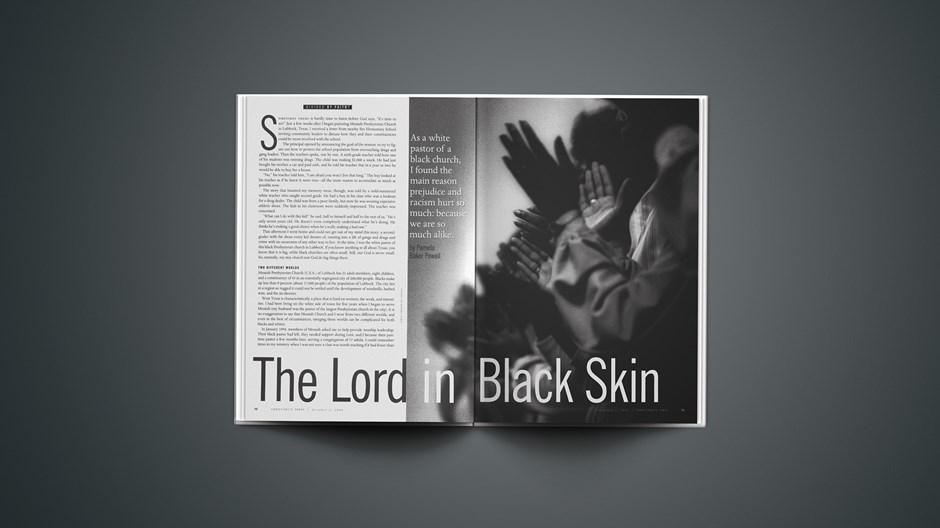
Something deep inside me caused me to look again—to look again and to see. There I saw my Lord differently. For the first time in my life, I saw my Lord in black skin, and in my heart I praised him.
When I first came to Messiah, I drove to another part of town and found people who were strange and different from me. But after meeting and knowing Messiah, I find something has happened—and I am at home in a new way in God's world.
Christianity Today's series on evangelicals and racial reconciliation began Friday and will continue all week. Our earlier stories include:
Divided by Faith?
| A recent study argues that American evangelicals cannot foster genuine racial reconciliation. Is our theology to blame? (Sept. 22, 2000)
Color-Blinded
| Why 11 o'clock Sunday morning is still a mostly segregated hour. An excerpt from Divided by Faith. (Sept. 22, 2000)















 While we pray for peace, we need moral clarity about this war.
 We’ve got little information on Jesus’ appearance and personality. But that’s the way God designed it.españolFrançais
 But experts say it can offer opportunities for leaders and congregations to grow.






