Fairfield, Iowa, of all places, is now a major world center for Transcendental Meditation, and local Christians are figuring out how to best evangelize the Maharishi's devotees.
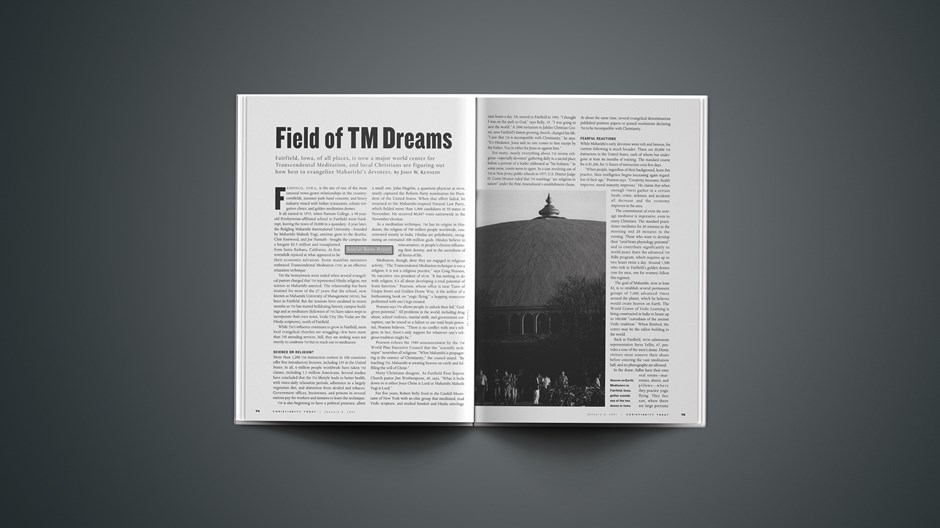
Fairfield, Iowa, is the site of one of the most unusual town-gown relationships in the country: cornfields, summer park band concerts, and heavy industry mixed with Indian restaurants, colonic-irrigation clinics, and golden meditation domes.
It all started in 1973, when Parsons College, a 98-year-old Presbyterian-affiliated school in Fairfield went bankrupt, leaving the town of 10,000 in a quandary. A year later, the fledgling Maharishi International University—founded by Maharishi Mahesh Yogi, onetime guru to the Beatles, Clint Eastwood, and Joe Namath—bought the campus for a bargain $2.5 million and transplanted from Santa Barbara, California. At first townsfolk rejoiced at what appeared to be their economic salvation. Some mainline ministers embraced Transcendental Meditation (TM) as an effective relaxation technique.
Yet the honeymoon soon ended when several evangelical pastors charged that TM represented Hindu religion, not science as Maharishi asserted. The relationship has been strained for most of the 27 years that the school, now known as Maharishi University of Management (MUM), has been in Fairfield. But the tensions have escalated in recent months as TM has started bulldozing historic campus buildings and as meditators (followers of TM) have taken steps to incorporate their own town, Vedic City (the Vedas are the Hindu scriptures), north of Fairfield.
While TM's influence continues to grow in Fairfield, most local evangelical churches are struggling—few have more than 150 attending services. Still, they are seeking ways not merely to condemn TM but to reach out to meditators.
Science or religion?
More than 1,200 TM instruction centers in 108 countries offer free introductory lectures, including 135 in the United States. In all, 6 million people worldwide have taken TM classes, including 1.5 million Americans. Several studies have concluded that the TM lifestyle leads to better health, with twice-daily relaxation periods, adherence to a largely vegetarian diet, and abstention from alcohol and tobacco. Government offices, businesses, and prisons in several nations pay for workers and inmates to learn the technique.
TM is also beginning to have a political presence, albeit a small one. John Hagelin, a quantum physicist at mum, nearly captured the Reform Party nomination for President of the United States. When that effort failed, he returned to the Maharishi-inspired Natural Law Party, which fielded more than 1,000 candidates in 50 states in November. He received 80,847 votes nationwide in the November election.
As a meditation technique, TM has its origins in Hinduism, the religion of 700 million people worldwide, concentrated mostly in India. Hindus are polytheistic, recognizing an estimated 300 million gods. Hindus believe in reincarnation, in people's choices influencing their destiny, and in the sacredness of all forms of life.
Meditators, though, deny they are engaged in religious activity. "The Transcendental Meditation technique is not a religion; it is not a religious practice," says Craig Pearson, 50, executive vice president of mum. "It has nothing to do with religion; it's all about developing a total potential of brain function." Pearson, whose office is near Taste of Utopia Street and Golden Dome Way, is the author of a forthcoming book on "yogic flying," a hopping maneuver performed with one's legs crossed.
Pearson says TM allows people to unlock their full "God-given potential." All problems in the world, including drug abuse, school violence, marital strife, and government corruption, can be traced to a failure to use total brain potential, Pearson believes. "There is no conflict with one's religion; in fact, there's only support for whatever one's religious tradition might be."
Pearson echoes the 1989 announcement by the TM World Plan Executive Council that the "scientific technique" nourishes all religions. "What Maharishi is propagating is the essence of Christianity," the council stated. "By teaching TM, Maharishi is creating heaven on earth and fulfilling the will of Christ."
Many Christians disagree. As Fairfield First Baptist Church pastor Jim Wotherspoon, 49, says, "What it boils down to is either Jesus Christ is Lord or Maharishi Mahesh Yogi is Lord."
For five years, Robert Relly lived in the Catskill Mountains of New York with an elite group that meditated, read Vedic scripture, and studied Sanskrit and Hindu astrology nine hours a day. He moved to Fairfield in 1993. "I thought I was on the path to God," says Relly, 35. "I was going to save the world." A 1996 invitation to Jubilee Christian Center, now Fairfield's fastest-growing church, changed his life. "I saw that TM is incompatible with Christianity," he says. "It's Hinduism. Jesus said no one comes to him except by the Father. You're either for Jesus or against him."
For many, nearly everything about TM seems religious—especially devotees' gathering daily in a sacred place before a portrait of a leader addressed as "his holiness." In some areas, courts seem to agree. In a case involving use of TM in New Jersey public schools in 1977, U.S. District Judge H. Curtis Meanor ruled that TM teachings "are religious in nature" under the First Amendment's establishment clause. At about the same time, several evangelical denominations published position papers or passed resolutions declaring TM to be incompatible with Christianity.
Article continues below
Fearful reactions
While Maharishi's early devotees were rich and famous, his current following is much broader. There are 20,000 TM instructors in the United States, each of whom has undergone at least six months of training. The standard course fee is $1,200, for 11 hours of instruction over five days.
"When people, regardless of their background, learn this practice, their intelligence begins increasing again regardless of their age," Pearson says. "Creativity increases, health improves, moral maturity improves." He claims that when enough TMers gather in a certain locale, crime, sickness, and accidents all decrease and the economy improves in the area.
The commitment of even the average meditator is impressive, even to many Christians. The standard practitioner meditates for 20 minutes in the morning and 20 minutes in the evening. Those who want to develop their "total brain physiology potential" and to contribute significantly to world peace learn the advanced TM Sidhi program, which requires up to two hours twice a day. Around 1,500 who trek to Fairfield's golden domes (one for men, one for women) follow this regimen.
The goal of Maharishi, now at least 82, is to establish several permanent groups of 7,000 advanced TMers around the planet, which he believes would create heaven on Earth. The World Center of Vedic Learning is being constructed in India to house up to 100,000 "custodians of the ancient Vedic tradition." When finished, the center may be the tallest building in the world.
Back in Fairfield, mum admissions representative Steve Yellin, 47, provides a tour of the men's dome. Dome visitors must remove their shoes before entering the vast meditation hall, and no photographs are allowed.
In the dome, Sidhis have their own real estate—mattresses, sheets, and pillows—where they practice yogic flying. They face east, where there are large portraits of Maharishi and his mentor, Guru Dev. "Seven million hours of transcending have occurred in here," Yellin says. "There's almost a church-like quality."
Meditators are a difficult group to reach with the gospel. Robert Relly has evangelized numerous TMers, but only a few have become Christians. "Theological arguments don't work because they are already dedicated to a cause," Relly says. "I don't know many people who pray four hours a day." Telling meditators they are worshiping the devil is ineffective, Relly believes: "They don't think they need a Savior. They aren't feeling the conviction of sin."
Article continues below
Many early evangelistic efforts were counterproductive, says Jim Cecil, 59, pastor of Fairfield's Foursquare Gospel Church since 1983. "No one had a real mission strategy other than to treat them as cultic," Cecil says. "There were prayer marches around the university, but it really was misdirected energy, spun out of fearfulness rather than a desire to reach people who needed Christ. It came off as an attack against meditators."
When pastor Stephen Higdon arrived to plant an Assemblies of God congregation in 1981, he zealously wanted to evangelize meditators. Yet his efforts were largely unproductive, he admits. "I became convicted that I was spending so much time reading books on TM, trying to figure out where they were coming from, that I neglected God's Word," Higdon says.
Still, some Christians in Fairfield say that studying the meditators carries benefits that go beyond evangelism. "We can learn dedication and commitment from the TM community," says Greg Crawford, pastor of Jubilee Christian Center. "One of the arguments I hear is, 'Why would I want to be a part of what you're doing? You have no commitment.' They don't see Christians taking their faith as seriously as they take their meditation."
Both Higdon and Cecil have had meditators become Christians in their churches. But most of those disillusioned with TM eventually move out of town, having no reason to stay once they have left the close-knit meditating community.
"They have a cause they will give everything for, and we can't even agree on what our cause is," Crawford says. "They view meditation as bigger than Christianity."
Wotherspoon says Christians could learn lessons in harmonious living from the TM community. When Wotherspoon arrived in 1995 to lead an American Baptist congregation, he swiftly heard warnings from townspeople to be wary of the "roos," the disparaging nickname attributed to followers of "guru" Maharishi. He also heard that all meditators are selfish and self-absorbed.
"That's not a fair characterization," Wotherspoon says. He also found Christians leery of participating in Habitat for Humanity, a distinctly Christian organization, because meditators served on the local board. "They are doing this to benefit others," he says. "Yet churches haven't been responsive because meditators are a part of the local leadership."
Article continues below
Evangelicals realize they have a mission field at their doorstep. "Meditators are spiritually seeking and have given up things to pursue this," Wotherspoon says. "They're looking for meaning and purpose. God is the answer to their quest."
Longtime Fairfield pastors Cecil and Higdon concede it may be time for strategies used by relative newcomers such as Crawford and Clint Freeman.
Freeman moved to Fairfield a year ago after living in Tokyo for 15 years. With knowledge of Eastern culture and a Japanese wife, Keiko, Freeman believes he can be relevant to the diverse community in Fairfield. He is focusing on establishing relationships before planting a Christian and Missionary Alliance church. He recently sponsored a "Jesus I Never Knew" seminar in a downtown hotel frequented by meditators, and an international food-and-games festival in a city park that drew 130 people.
Crawford opened the tri-level, 24,000-square-foot Jubilee Christian Center in October at the most-traveled intersection of Fairfield, the junction of state Highway 1 and U.S. 34, one block west of the square. The five-year-old congregation had been meeting in a factory-district warehouse. Jubilee has a Bible school with 15 students, which Crawford says may expand to 70 students in time. The move to the downtown location has helped the congregation grow to 300, including 20 former meditators. The new building was purchased for $75,000 from a "hard-core" meditator, according to Crawford. It had an appraised value of $500,000.
Crawford credits much of Jubilee's success to 20 members who meet for prayer on Friday nights. "There is a time to confront, but there's also a time to love people and let God deal with their hearts," says Crawford, 41. "We need to show we are more concerned with them as people, and not so concerned with their behavior. Nevertheless, Crawford has rankled some mum officials because of the numbers of meditators he has prompted to leave TM, the acquisition of a new building, and by Crawford's sponsoring TM book burnings by former followers.
A glimpse of the future?
MUM continues to expand its campus, finishing the first phase of a three-phase $50 million rebuilding program on the 280-acre campus. Three years from now, a building currently under construction is projected to have 1,000 students enrolled solely for a computer-science program. By the time construction is complete, enrollment is projected to increase dramatically.
Article continues below
MUM is fully accredited, offering master's and doctoral programs. University courses have such modest titles as "Self-Pulse Reading for Perfect Health" and "Yogic Flying: Creating Happiness, Health, Enlightenment, and Heaven on Earth." mum has 650 full-time students, up 50 percent from 1999. Half the mum student body is from outside the United States, representing 50 nations.
But students are not what keeps Fairfield humming. The number of meditators is around 2,750, people who have settled in Fairfield to be part of the movement. About 400 businesses in and around Fairfield are run by meditators, including 50 in the telecommunications and software industries (the area is sometimes dubbed "Silicorn Valley"). Two multinational telecommunications companies, Telegroup Inc. and USA Global Link, have world headquarters in Fairfield.
Rather than spend millions to renovate deteriorating Parsons College buildings, mum has opted to rebuild. So far, three buildings on the National Register of Historic Places have been bulldozed.
The unoccupied chapel may be torn down soon, which could further strain tensions between the community and university.
"It has serious structural problems," Pearson says. However, mum has offered to give the building to any community group able to raise the estimated $1 million needed to move it.
The main challenge for Fairfield Christians is evangelistic, and that has required a new attitude. "I've quit looking at them as weird people," Cecil says. "They're just a bunch of good people who need Christ."
Dave Elmore, 43-year-old Friends Church pastor in Fairfield since 1999, says, "God has shown us that the only way anything is going to happen is if we pray and rely on God's power. We have failed to call on God's power to be active in us. Compared to God's power, they are very small. It's going to take all of us, not just two or three churches, to have an impact on the city."
"Fairfield, Iowa, is just a taste of where we're headed in the U.S. if Christians don't evangelize in the next 30 years," Freeman says. "People need spiritual nourishment. If it's not from Christianity, it will be from some other source."
Related Elsewhere
Be sure to read Christianity Today's related stories "Mere Transcendental Meditation | The basic concepts of neo-Vedanta philosophy" and "Sometimes It Takes a Miracle | Jim Sieber found Christ more sufficient than self-realization."
Article continues below
Maharishi University of Management's claim to "develop the total potential of the brain, the cosmic creativity latent within every student" is reminiscent of Scientology rhetoric about actualizing personal potential.
















 While we pray for peace, we need moral clarity about this war.
 As my doubts about his teachings grew, so did a secret fascination with Jesus.
 NIL deals in college athletics present new challenges—and opportunities—for colleges and students.






