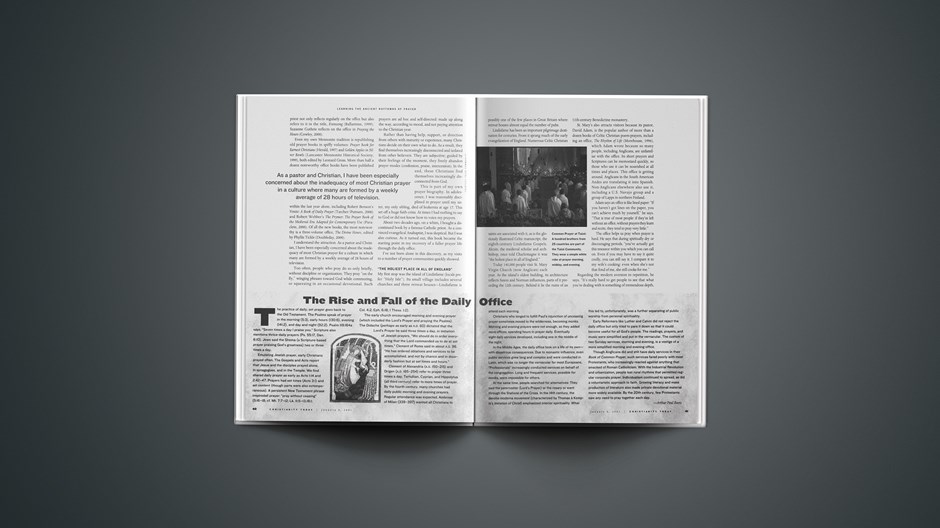
The practice of daily, set prayer goes back to the Old Testament. The Psalms speak of prayer in the morning (5:3), early hours (130:6), evening (141:2), and day and night (92:2). Psalm 119:164a says, "Seven times a day I praise you." Scripture also mentions thrice-daily prayers (Ps. 55:17, Dan. 6:10). Jews said the Shema (a Scripture-based prayer praising God's greatness) two or three times a day.
Emulating Jewish prayer, early Christians prayed often. The Gospels and Acts report that Jesus and the disciples prayed alone, in synagogues, and in the Temple. We find shared daily prayer as early as Acts 1:14 and 2:42-47. Prayers had set times (Acts 3:1) and set content (though parts were also extemporaneous). A persistent New Testament phrase inspired all prayer: "pray without ceasing" (5:16-18; cf. Mt. 7:7-12; Lk. 11:5-13,18:1; Col. 4:2; Eph. 6:18; 1 Thess. 1:2).
The early church encouraged morning and evening prayer (which included the Lord's Prayer and praying the Psalms). The Didache (perhaps as early as A.D. 60) dictated that the Lord's Prayer be said three times a day, in imitation of Jewish prayers. "We should do in order everything that the Lord commanded us to do at set times," Clement of Rome said in about A.D. 96. "He has ordered oblations and services to be accomplished, and not by chance and in disorderly fashion but at set times and hours."
Clement of Alexandria (A.D. 150-215) and Origen (A.D. 185-254) refer to prayer three times a day. Tertullian, Cyprian, and Hippolytus (all third century) refer to more times of prayer. By the fourth century, many churches had daily public morning and evening prayers. Regular attendance was expected. Ambrose of Milan (339-397) wanted all Christians to attend each morning.
Christians who longed to fulfill Paul's injunction of unceasing prayer sometimes moved to the wilderness, becoming monks. Morning and evening prayers were not enough, so they added more offices, spending hours in prayer daily. Eventually eight daily services developed, including one in the middle of the night.
In the Middle Ages, the daily office took on a life of its own—with disastrous consequences. Due to monastic influence, even public services grew long and complex and were conducted in Latin, which was no longer the vernacular for most Europeans. "Professionals" increasingly conducted services on behalf of the congregation. Long and frequent services, possible for monks, were impossible for others.
At the same time, people searched for alternatives: They said the paternoster (Lord's Prayer) or the rosary or went through the Stations of the Cross. In the 14th century, the devotio moderna movement (characterized by Thomas à Kempis's Imitation of Christ) emphasized interior spirituality. What this led to, unfortunately, was a further separating of public worship from personal spirituality.
Early Reformers like Luther and Calvin did not reject the daily office but only tried to pare it down so that it could become useful for all God's people. The readings, prayers, and music were simplified and put in the vernacular. The custom of two Sunday services, morning and evening, is a vestige of a more simplified morning and evening office.
Though Anglicans did and still have daily services in their Book of Common Prayer, such services fared poorly with most Protestants, who increasingly reacted against anything that smacked of Roman Catholicism. With the Industrial Revolution and urbanization, people lost rural rhythms that permitted regular corporate prayer. Individualism continued to spread, as did a voluntaristic approach to faith. Growing literacy and mass production of literature also made private devotional material more widely available. By the 20th century, few Protestants saw any need to pray together each day.
Arthur Paul Boers is pastor of the Bloomingdale (Ontario) Mennonite Church. His latest book is Never Call Them Jerks: Healthy Responses to Difficult Behavior (Alban). His research was made possible in part by a grant from the Louisville Institute (a Lilly Endowment program)
















 While we pray for peace, we need moral clarity about this war.
 A Christian reconciliation group in Israel and Palestine warned that war would come. Now the war threatens their relevance.españolالعربيةFrançais
 C.S. Lewis recommended discernment over diatribes in exactly the moments we’re most eager to indulge in critique.






