Not long ago a friend of mine, an affluent businessman and active churchman, shared with me his growing disillusionment with modern Protestantism, especially with its worship. After regularly attending various churches in his area—mainly evangelical and conservative—he confessed that this uneasiness had accelerated rather than abated.
He went on to say that he was now seriously considering turning to the Catholic Church—mainly to be spiritually fed, but also out of a desire to be intellectually challenged. I told him that he was likely to be leaving one set of problems for another. Yet I could empathize with him, for I too have been troubled by the increasing vacuity of much Protestant preaching and worship.
Evangelical Protestantism is in trouble today as an increasing number of business and professional people are searching for a new church. The complaint I hear most often is that people can no longer sense the sacred either in the preaching or in the liturgy. The atmosphere in most of our services is clubby and convivial rather than adoring and expectant. What is missing is the fear of God, the experience of God as the Wholly Other.
Sentimental appeal
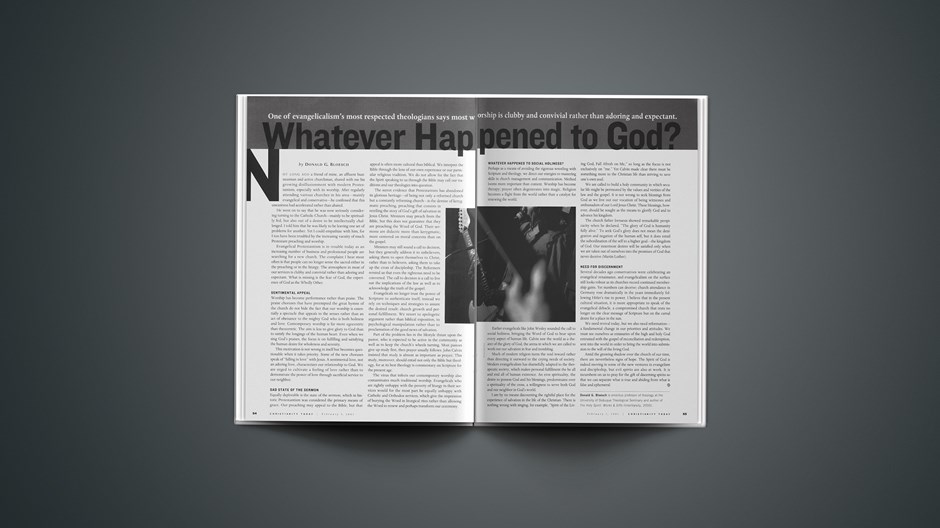
Worship has become performance rather than praise. The praise choruses that have preempted the great hymns of the church do not hide the fact that our worship is essentially a spectacle that appeals to the senses rather than an act of obeisance to the mighty God who is both holiness and love. Contemporary worship is far more egocentric than theocentric. The aim is less to give glory to God than to satisfy the longings of the human heart. Even when we sing God's praises, the focus is on fulfilling and satisfying the human desire for wholeness and serenity.
This motivation is not wrong in itself but becomes questionable when it takes priority. Some of the new choruses speak of "falling in love" with Jesus. A sentimental love, not an adoring love, characterizes our relationship to God. We are urged to cultivate a feeling of love rather than to demonstrate the power of love through sacrificial service to our neighbor.
Equally deplorable is the state of the sermon, which in historic Protestantism was considered the primary means of grace. Our preaching may appeal to the Bible, but that appeal is often more cultural than biblical. We interpret the Bible through the lens of our own experience or our particular religious tradition. We do not allow for the fact that the Spirit speaking to us through the Bible may call our traditions and our theologies into question.
The surest evidence that Protestantism has abandoned its glorious heritage—of being not only a reformed church but a constantly reforming church—is the demise of kerygmatic preaching, preaching that consists in retelling the story of God's gift of salvation in Jesus Christ. Ministers may preach from the Bible, but this does not guarantee that they are preaching the Word of God. Their sermons are didactic more than kerygmatic, more centered on moral concerns than on the gospel.
Ministers may still sound a call to decision, but they generally address it to unbelievers, asking them to open themselves to Christ, rather than to believers, asking them to take up the cross of discipleship. The Reformers remind us that even the righteous need to be converted. The call to decision is a call to live out the implications of the law as well as to acknowledge the truth of the gospel.
Evangelicals no longer trust the power of Scripture to authenticate itself; instead we rely on techniques and strategies to assure the desired result: church growth and personal fulfillment. We resort to apologetic argument rather than biblical exposition, to psychological manipulation rather than to proclamation of the good news of salvation.
Part of the problem lies in the lifestyle thrust upon the pastor, who is expected to be active in the community as well as to keep the church's wheels turning. Most pastors give up study first, then prayer usually follows. John Calvin insisted that study is almost as important as prayer. This study, moreover, should entail not only the Bible but theology, for at its best theology is commentary on Scripture for the present age.
The virus that infects our contemporary worship also contaminates much traditional worship. Evangelicals who are rightly unhappy with the poverty of liturgy in their services would for the most part be equally unhappy with Catholic and Orthodox services, which give the impression of burying the Word in liturgical rites rather than allowing the Word to renew and perhaps transform our ceremony.
Article continues below
Whatever happened to social holiness?
Perhaps as a means of avoiding the rigorous wrestling with Scripture and theology, we direct our energies to mastering skills in church management and communication. Method looms more important than content. Worship has become therapy; prayer often degenerates into magic. Religion becomes a flight from the world rather than a catalyst for renewing the world.
Earlier evangelicals like John Wesley sounded the call to social holiness, bringing the Word of God to bear upon every aspect of human life. Calvin saw the world as a theater of the glory of God, the arena in which we are called to work out our salvation in fear and trembling.
Much of modern religion turns the soul inward rather than directing it outward to the crying needs of society. Modern evangelicalism has shamefully adapted to the therapeutic society, which makes personal fulfillment the be all and end all of human existence. An eros spirituality, the desire to possess God and his blessings, predominates over a spirituality of the cross, a willingness to serve both God and our neighbor in God's world.
I am by no means discounting the rightful place for the experience of salvation in the life of the Christian. There is nothing wrong with singing, for example, "Spirit of the Living God, Fall Afresh on Me," so long as the focus is not exclusively on "me." Yet Calvin made clear there must be something more to the Christian life than striving to save one's own soul.
We are called to build a holy community in which secular life might be permeated by the values and verities of the law and the gospel. It is not wrong to seek blessings from God as we live out our vocation of being witnesses and ambassadors of our Lord Jesus Christ. These blessings, however, should be sought as the means to glorify God and to advance his kingdom.
The church father Irenaeus showed remarkable perspicacity when he declared, "The glory of God is humanity fully alive." To seek God's glory does not mean the denigration and negation of the human self, but it does entail the subordination of the self to a higher goal—the kingdom of God. Our innermost desires will be satisfied only when we are taken out of ourselves into the promises of God that never deceive (Martin Luther).
Need for discernment
Several decades ago conservatives were celebrating an evangelical renaissance, and evangelicalism on the surface still looks robust as its churches record continued membership gains. Yet numbers can deceive: church attendance in Germany rose dramatically in the years immediately following Hitler's rise to power. I believe that in the present cultural situation, it is more appropriate to speak of the evangelical debacle, a compromised church that rests no longer on the clear message of Scripture but on the carnal desire for a place in the sun.
We need revival today, but we also need reformation—a fundamental change in our priorities and attitudes. We must see ourselves as emissaries of the high and holy God entrusted with the gospel of reconciliation and redemption, sent into the world in order to bring the world into submission to the will of the living God.
Article continues below
Amid the growing shadow over the church of our time, there are nevertheless signs of hope. The Spirit of God is indeed moving in some of the new ventures in evangelism and discipleship, but evil spirits are also at work. It is incumbent on us to pray for the gift of discerning spirits so that we can separate what is true and abiding from what is false and ephemeral.
Donald G. Bloesch is emeritus professor of theology at the University of Dubuque Theological Seminary and author of The Holy Spirit: Works & Gifts (InterVarsity, 2000).
Visit Christianity Today's Worship area for more articles about praise and worship.
Mark Noll's "We Are What We Sing | Our classic hymns reveal evangelicalism at its best" and Michael S. Hamilton's "The Triumph of the Praise Songs | How guitars beat out the organ in the worship wars" (both from our July 12, 1999 issue) offer historical perspectives on the worship tensions. Other stories from that issue include:
The Profits of Praise |The praise and worship music industry has changed the way the church sings.(July 12, 1999)















 While we pray for peace, we need moral clarity about this war.
 As my doubts about his teachings grew, so did a secret fascination with Jesus.
 Leader explains why the movement is seeing its biggest membership bump in 30 years and its mission for the years ahead.






