The utopian visions of 1960s America affected more than the devotees of Flower Power. The theological world became similarly captivated by revolutionary notions about God and his dealings with the world. Royce Gordon Gruenler remembers those turbulent days. He was an inquisitive young scholar teaching religion and philosophy at Hiram College in Ohio when a colleague introduced him to the writings of Alfred North Whitehead and Charles Hartshorne. Both men had pioneered the liberal movement in theology known as process theism at a time when, according to biographer Alan Gragg in his book Charles Hartshorne, it stood "forth in the theological sunlight as one of the most creative and viable options on the American scene." Gruenler was hooked.
His detour into process theism began a spiritual pilgrimage that would lead him to near-despair. In time, he returned to his evangelical roots and gathered a small cadre of InterVarsity Christian Fellowship-types whom he discipled. In 1979 Gruenler left Hiram to become professor of New Testament at Gordon-Conwell Theological Seminary in South Hamilton, Massachusetts, where he remains today. He has written many articles and books, including The Inexhaustible God: Biblical Faith and the Challenge of Process Theism (Baker, 1983). Senior writer Wendy Murray Zoba recently visited her former professor in Massachusetts, where he weighed in on the current theological debate about the openness of God and its relationship to process theology.
What exactly is process theology?
Process thought is the idea that God is engaged in the time sequence. He doesn't know the future. He has ideals for the future, and he tries to lure us to actualize those ideals, but he does not control each individual or occasion on the atomic scale. God needs us because without us he's not concrete. He sets the ideals, but then we create the content and God expands his actuality through us. We add to him.
How did you become attracted to process theism?
So God is constantly advancing in what Hartshorne, in his book Creative Synthesis and Philosophic Method, calls a "creative advance." God is advancing at every moment in time, synthesizing all the data from every occasion throughout the universe. That happens again and again, multiple times per second, as we move on in time. God is in "process" and is, of necessity, limited to time.
A colleague came to the Hiram campus in the early 1960s fresh out of the University of Chicago Divinity School, where he had studied with Hartshorne. He got me interested in Whitehead, and I spent a summer reading Process and Reality, Whitehead's magnum opus. I thought it was wonderful and opened new vistas. This was the early 1960s, and we were taken in with the view that through political and economic idealism we could bring in Utopia.
When did you first begin to have your doubts about process theology?
I taught a course on Romans in the late '50s and early '60s using Karl Barth. He sees Christ enveloping everybody in the yes, and there's not an ultimate no. It was a first step toward liberalism. At the same time, I was working on the social nature of the Trinity and had been concerned about the role of God the Father. Process theology helped because it spoke of a God active in time with us. This made God much more personal.
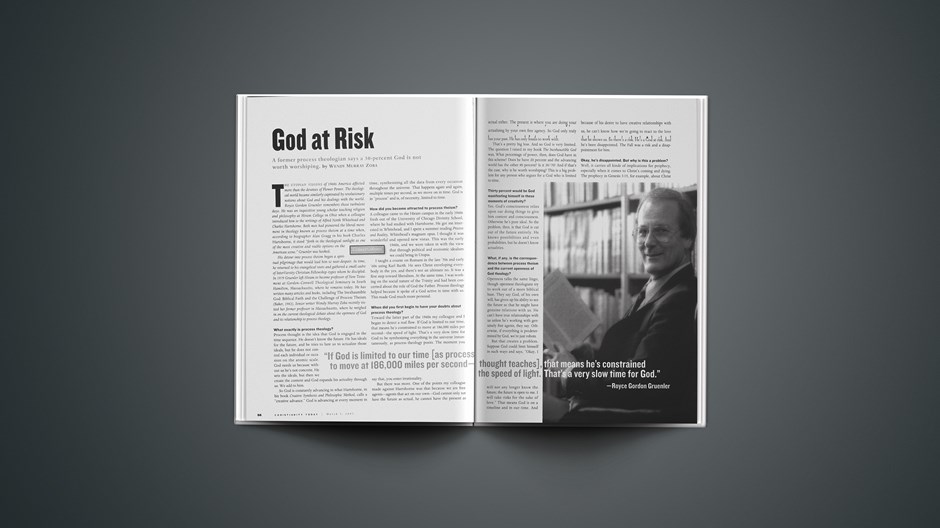
Toward the latter part of the 1960s my colleague and I began to detect a real flaw. If God is limited to our time, that means he's constrained to move at 186,000 miles per second—the speed of light. That's a very slow time for God to be synthesizing everything in the universe instantaneously, as process theology posits. The moment you say that, you enter irrationality.
But there was more. One of the points my colleague made against Hartshorne was that because we are free agents—agents that act on our own—God cannot only not have the future as actual, he cannot have the present as actual either. The present is where you are doing your actualizing by your own free agency. So God only truly has your past. He has only fossils to work with.
Thirty percent would be God manifesting himself in these moments of creativity?
That's a pretty big loss. And so God is very limited. The question I raised in my book The Inexhaustible God was, What percentage of power, then, does God have in this scheme? Does he have 20 percent and the advancing world has the other 80 percent? Is it 30/70? And if that's the case, why is he worth worshiping? This is a big problem for any person who argues for a God who is limited to time.
Yes. God's consciousness relies upon our doing things to give him content and consciousness. Otherwise he's pure ideal. So the problem, then, is that God is cut out of the future entirely. He knows possibilities and even probabilities, but he doesn't know actualities.
What, if any, is the correspondence between process theism and the current openness of God theology?
Openness talks the same lingo, though openness theologians try to work out of a more biblical base. They say God, of his own will, has given up his ability to see the future so that he might have genuine relations with us. He can't have true relationships with us unless he's working with genuinely free agents, they say. Otherwise, if everything is predetermined by God, we're just robots.
Article continues below
Okay, he's disappointed. But why is this a problem?
But that creates a problem. Suppose God could limit himself in such ways and says, "Okay, I will not any longer know the future; the future is open to me. I will take risks for the sake of love." That means God is on a timeline and in our time. And because of his desire to have creative relationships with us, he can't know how we're going to react to the love that he shows us. So there's a risk. He's a God at risk. And he's been disappointed. The Fall was a risk and a disappointment for him.
Well, it carries all kinds of implications for prophecy, especially when it comes to Christ's coming and dying. The prophecy in Genesis 3:15, for example, about Christ being bruised on his heel and bruising Satan's head, would not be possible because God did not know at that point in time how the Garden of Eden thing was going to work out. By denying that there can be prophecy, you're eliminating a lot of the Scripture.
Some openness theists realize a problem here and argue that God doesn't foreclose all future knowledge and control. For example, God chooses to act as God in the Incarnation, so he knows that particular future as actual before it occurs; it is only the future responses of his creatures that he chooses not to determine. But now we're back in the percentage game if God acts as God only selectively. This is logically difficult, since historical events are interlocked. If you don't have the proper sequence of persons and their choices from Genesis 3:15 through Noah, Abraham and Israel, and a host of others, you don't get to Christ and the fulfillment of prophecy. Besides, if God can pop in and out with sovereign control selectively, he could also do it to eliminate evil if he wanted to. This is the logic of having your cake and eating it too.
Since God, in openness theology, does not know how we will act, is he absolved from the problem of evil?
It's really Pelagian [a heresy that claims people can take the initial steps toward their own salvation by their own efforts]. What did Christ come for? In openness theology, he has to be seen more as an aesthetic Christ who lures us to aesthetic and loving deeds, instead of the Christ who was preordained to reconcile all things to himself through his blood, as Paul says in Colossians 1.
Article continues below
Theodicy—reconciling the goodness of God to the existence of evil—is one of the secondary interests of the openness school. They want to protect God from evil, but it doesn't take God off the hook.
They say God is all-powerful to begin with. He created the world and the universe. But he creates it on the condition that he will remove his sovereignty from the scene and blank out the future. So, supposedly, that gives culpability to humans when it comes to the problem of evil. But the ultimate culpability still rests with God because, if he was all-powerful in creating the world, he could have created it as a place where the creature wouldn't have the freedom to commit evil.
How did you come back to orthodox Christian faith?
It becomes a percentage thing again. Let's say God retains 30 percent and gives us 70 percent when it comes to human decision. He's still got 30 percent responsibility for keeping the universe going on these terms. Openness does not absolve him from the problem of evil. At any time he could pull back and say, "The heck with it. There's too much evil in the world—Auschwitz and aids in Africa and all the rest. I'll just call it off here." But he doesn't. He keeps it going.
The whole experience precipitated an intellectual and spiritual crisis for me. I was in the church preaching lousy, liberal sermons, and the church was dying. We'd had uproars on the campus, the Kent State killings had stirred us, and everything was a mess. I was bottoming out in every direction. But through the gracious leading of God, a small prayer and Bible-study group in our church formed. I went back to my knees, and I went back to the Word and haven't been off it since. You've got to have a high view of Scripture and of the sovereignty of God.
Some would argue, however, that if God knows the future, there is no human freedom and history is a farce.
It all hinges on your understanding of human freedom. God is in control, and he is working out his purposes. Our freedom comes as something given to us as a gift of grace. We are responsible for working out its implications, but it's still a gift. It is not freedom in an autonomous sense, however. I'm free only in Christ. I'm a slave of Christ. Servanthood for God's sake, and thus for one another, is the highest kind of freedom.
In openness thought, you have a God who is 100 percent powerful but who gives up some of that freedom in order to give us free will. In my reading of the Scriptures, God never talks about freedom in terms of inherent autonomy. Paul explains this in Romans 6. The biblical interpretation of freedom is in the form of bond service to God. The openness school completely bypasses that biblical definition of freedom, assuming an autonomous freedom apart from God. But we're either slaves of sin or slaves of righteousness.
Article continues below
What practical difference does all this make?
Our worship has to do with our honoring God but also feeling the presence of God in our daily needs. If God is limited to the degree in which he can help us and is so limited that he doesn't know what's going to happen to us, then we're kind of on our own. He's not a very helpful God.
Royce Gordon Gruenler's page at Gordon-Conwell Theological Seminary gives some more biographical information about the theologian.
Though CT's past articles on process theology are not yet available online, several articles on openness theology are. They include:
Did Open Debate Help The Openness Debate? | It's been centuries since Luther nailed his theses to a church door, but the Internet is reintroducing theological debate to the public square. (Feb. 16, 2001)
God vs. God | Two competing theologies vie for the future of evangelicalism (Feb. 7, 2000).
Do Good Fences Make Good Baptists? | The SBC's new Faith and Message brings needed clarity—but maybe at the cost of honest diversity. (Aug. 8, 2000)
The Perils of Left and Right | Evangelical theology is much bigger and richer than our two-party labels. (Aug. 10, 1998)
The Future of Evangelical Theology | Roger Olson argues that a division between traditionalists and reformists threatens to end our theological consensus. (Feb. 9, 1998)
A Pilgrim on the Way | For me, theology is like a rich feast, with many dishes to enjoy and delicacies to taste. (Feb. 9, 1998)
A Theology to Die For | Theologians are not freelance scholars of religion, but trustees of the deposit of faith. (Feb. 9, 1998)
The Real Reformers are Traditionalists | If there is no immune system to resist heresy, there will soon be nothing but the teeming infestation of heresy. (Feb. 9, 1998)
Have something to add about this? See something we missed? Share your feedback here.
Our digital archives are a work in progress. Let us know if corrections need to be made.















 While we pray for peace, we need moral clarity about this war.
 As my doubts about his teachings grew, so did a secret fascination with Jesus.
 After lobbying from fellow Southern Baptists and Christians affected by the war, the House speaker moves a package forward.






