"The Jubilee movement convinced the world to write down the debt of impoverished nations, but the strings attached provoke fresh debate on economic justice"
A movement that won the support of both U2's Bono and Republican Sen. Jesse Helms must have something going for it. The Jubilee 2000 campaign to cancel the debt of the poorest countries transformed a technical economic matter into a compelling moral issue—one likely to find Christians on opposing sides of an ideological firestorm.
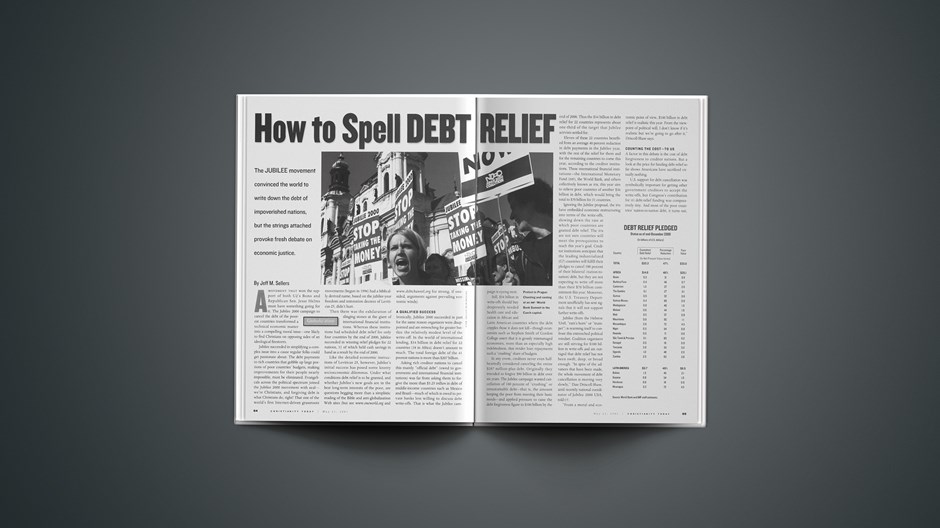
Jubilee succeeded in simplifying a complex issue into a cause regular folks could get passionate about: The debt payments to rich countries that gobble up large portions of poor countries' budgets, making improvements for their people nearly impossible, must be eliminated. Evangelicals across the political spectrum joined the Jubilee 2000 movement with zeal—we're Christians, and forgiving debt is what Christians do, right? That one of the world's first Internet-driven grassroots movements (begun in 1996) had a biblically derived name, based on the jubilee-year freedom and restoration decrees of Leviticus 25, didn't hurt.
Then there was the exhilaration of slinging stones at the giant of international financial institutions. Whereas these institutions had scheduled debt relief for only four countries by the end of 2000, Jubilee succeeded in winning relief pledges for 22 nations, 11 of which held cash savings in hand as a result by the end of 2000.
Like the detailed economic instructions of Leviticus 25, however, Jubilee's initial success has posed some knotty socioeconomic dilemmas. Under what conditions debt relief is to be granted, and whether Jubilee's new goals are in the best long-term interests of the poor, are questions begging more than a simplistic reading of the Bible and anti-globalization Web sites (but see www.oneworld.org and www.debtchannel.org for strong, if one-sided, arguments against prevailing economic winds).
A Qualified Success
Ironically, Jubilee 2000 succeeded in part for the same reason organizers were disappointed and are retrenching for greater battles: the relatively modest level of the write-off. In the world of international lending, $34 billion in debt relief for 22 countries (18 in Africa) doesn't amount to much. The total foreign debt of the 41 poorest nations is more than $207 billion.
Asking rich creditor nations to cancel this mainly "official debt" (owed to governments and international financial institutions) was far from asking them to forgive the more than $3.25 trillion in debt of middle-income countries such as Mexico and Brazil—much of which is owed to private banks less willing to discuss debt write-offs. That is what the Jubilee campaign is eyeing next.
Still, $34 billion in write-offs should buy desperately needed health care and education in African and Latin American countries where the debt cripples those it does not kill—though economists such as Stephen Smith of Gordon College assert that it is grossly mismanaged economies, more than an especially high indebtedness, that render loan repayments such a "crushing" share of budgets.
In any event, creditors never even half-heartedly considered canceling the entire $207 million-plus debt. Originally they intended to forgive $90 billion in debt over six years. The Jubilee campaign wanted cancellation of 100 percent of "crushing" or unsustainable debt—that is, the amount keeping the poor from meeting their basic needs—and applied pressure to raise the debt forgiveness figure to $100 billion by the end of 2000. Thus the $34 billion in debt relief for 22 countries represents about one-third of the target that Jubilee activists settled for.
Eleven of these 22 countries benefited from an average 40 percent reduction in debt payments in the Jubilee year, with the rest of the relief for them and for the remaining countries to come this year, according to the creditor institutions. These international financial institutions—the International Monetary Fund (IMF), the World Bank, and others collectively known as IFIs, this year aim to relieve poor countries of another $36 billion in debt, which would bring the total to $70 billion for 31 countries.
Ignoring the Jubilee proposal, the IFIs have embedded economic restructuring into terms of the write-offs, slowing down the rate at which poor countries are granted debt relief. The IFIs are not sure countries will meet the prerequisites to reach this year's goal. Creditor institutions anticipate that the leading industrialized (G7) countries will fulfill their pledges to cancel 100 percent of their bilateral (nation-to-nation) debt, but they are not expecting to write off more than their $70 billion commitment this year. Moreover, the U.S. Treasury Department unofficially has sent signals that it will not support further write-offs.
Jubilee (from the Hebrew Yôvel, "ram's horn" or "trumpet") is rearming itself to confront this entrenched political mindset. Coalition organizers are still striving for $100 billion in write-offs and are outraged that debt relief has not been swift, deep, or broad enough. "In spite of the advances that have been made, the whole movement of debt cancellation is moving very slowly," Dan Driscoll-Shaw, until recently national coordinator of Jubilee 2000 USA, told CT.
Article continues below
"From a moral and economic point of view, $100 billion in debt relief is realistic this year. From the viewpoint of political will, I don't know if it's realistic but we're going to go after it," Driscoll-Shaw says.
Counting the Cost—to Us
A factor in this debate is the cost of debt forgiveness to creditor nations. But a look at the price for funding debt relief so far shows Americans have sacrificed virtually nothing.
U.S. support for debt cancellation was symbolically important for getting other government creditors to accept the write-offs, but Congress's contribution for IFI debt-relief funding was comparatively tiny. And most of the poor countries' nation-to-nation debt, it turns out, is owed not to the United States but to Asian and European states.
The United States is the largest contributing member of the IMF at 60 percent of funds (considering exchange rate values), so one might want to argue it is bearing the brunt of the IFI's write-off. But the cost of funding the ifi debt relief came from new, not existing, funds—hence the battles in Congress and in other G7 capitals last year.
Grasping just how small the U.S. cost was requires understanding that the $70 billion in debt relief got recast into "Net Present Value" terms—a complicated discounting trick that replaces debt's face amount with its current market value. Thus, to creditors, $70 billion in debt morphed into just $28.6 billion to cancel it.
Strange as this may sound, it underscores the accounting reality that debt does not disappear when it is forgiven; someone has to cover the loss to the creditors (even if all parties realized the debt was never going to be repaid anyway). One way IFIs covered this cost was to sell IMF gold stocks—a victory for Jubilee campaigners. The main way, however, was getting member nations of the IMF and World Bank to contribute additional funds because these institutions said they couldn't afford to take the hit (a hotly disputed claim).
In response to this request for $28.6 billion, and after a herculean battle by Jubilee organizers, Congress coughed up only $360 million—and this went not to the IMF or the World Bank but to other institutions that lend to a number of different countries. Congress authorized another $75 million for reduction of the relatively small U.S. bilateral debt with poor countries, for a total of $435 million.
The average American barely blinked at this, and the relatively small amount indicates how difficult it is to crack political nuts, which is the challenge ahead as Jubilee campaigns for yet deeper debt relief.
Article continues below
Accountability: We'll See
Most Christians, whether or not they join Jubilee in opposing economic reforms, are more concerned about debt relief translating into immediate social benefits rather than the palaces and private jets that foreign financing has purchased in the past.
To ensure that savings go to social programs, the debtor governments are required to write and implement Poverty Reduction Strategy Papers (PRSPs) in consultation with local community groups and Non-Governmental Organizations (NGOS).
Uganda has used its 48 percent reduction in debt payments to double primary-school enrollment. The potential is even greater in other countries: Mozambique's 72 percent reduction in payments represents a figure twice its health budget.
Jubilee organizers helped get local civic groups and NGOS involved in the process for deciding how poor countries will spend their savings. But Jubilee now complains that getting the PRSP process into place as a debt relief precondition causes delays. Additionally, doubts linger about how effective the PRSP process will be.
"Those are still at the level of exhortation, not of implementation," Allan Meltzer, chairman of the International Financial Institution Advisory Commission, told CT. "The problem with PRSPS is making them traceable and realistic. Perhaps they will, but there's a lot of history there that makes one look on it with skepticism. We'll see."
But Jubilee's Driscoll-Shaw questions whether the creditor institutions are best suited to monitor the PRSP process, given that IFI lending itself has a long legacy of corruption. Long before Jubilee 2000, the Fund and the Bank were objects of disdain within the international financial community for either doling out geopolitical patronage or failing to help countries achieve long-term sustainable development. Charles Calomiris, professor of finance and economics at Columbia University and a member of the Meltzer Commission, says few deny that creditor institutions are due for major reform, and the buzz about doing away with them occasionally gets shrill.
"The real problem that needs to be discussed is not just the reforms needed in the debtor countries themselves, but the reforms needed in the multilateral lenders that will prevent this kind of corrupt lending," Calomiris told CT.
Article continues below
Ideological Firestorms
Most players in the international finance community join experts like Meltzer in a chorus of support for free-market policy reforms in the debtor nations, echoing Catholic theologian Michael Novak's refrain that "business is the best hope of the poor."
To the Christian left and grassroots activists who answer that years of IMF-imposed free-market reforms have hurt rather than helped the poor, Meltzer says the policies have never had a chance to take root.
"We have given a considerable amount of attention to incentives to keep the structural reforms in place—up to this point it's been a lot of lip service," Meltzer says. "Externally, you cannot get people to do things which are politically difficult for them to do. It's important to give them incentives so they'll want to do it, and debt relief is one of them."
Debt relief as a policy-change incentive is a good distance, indeed, from the call of Jubilee for economic justice. Lenders, Jubilee argues, have an ethical duty to cancel at least that portion of debt from "odious" or "criminal" loans granted for tainted cause and motives.
For example, the former military junta in Argentina incurred "odious debt" in that it used the funds to repress its people with the full knowledge of the IMF, Driscoll-Shaw says; criminal debt refers to stolen wealth, such as the estimated 30 percent of World Bank funds to Indonesia that the Suharto family banked or diverted to cronies, he says.
As a moral imperative, debt relief in general must be immediate, absolute, and free from policy directives; this is no time for economic reforms that take food and basic services from the poor, and certainly not if they are imposed by the very institutions that created the debt peonage, according to Jubilee.
"What is there in the history, the charter, or the experience of the IMF that gives them the right to talk about poverty reduction, let alone have a say in it?" Driscoll-Shaw says. "Debt relief without removing the [demand for] structural adjustment is just a tremendous contradiction, and that's what's holding things up."
Such arguments are simply not taken seriously among ifi bureaucrats and economic scholars weaned on the prevailing wisdom that without free-market reforms, poor countries will not grow economically, making debt relief ineffective.
"You want to get countries in position so that when they get debt relief, they can build more schools, they can have a sound health-care system—all those other kinds of social programs that are ultimately important for poverty reduction," IMF spokesman Bill Murray told CT.
Article continues below
To be sure, the IFIS didn't begin calling their structural adjustment prescriptions "poverty-reduction" plans until Jubilee and other grassroots activists began launching attacks the past few years, but the lending institutions say helping the poor has always been their goal.
Anthony Gaeta, a counselor in the World Bank's Heavily Indebted Poor Country section, does not deny that during the Cold War, the Bank knowingly made loans for bad projects to corrupt regimes to support the West's political goals, and that Mozambican children are hungry today as a result. But political objectives have not been foremost for an institution that since the 1960s has provided funding for education and basic health in poor, rural areas unreached by private lending, he says.
Regardless, Jubilee's new goals include reducing the IFIS' negotiating power: it is pushing for an independent body to arbitrate loan and debt-relief negotiations. Gaeta, noting that IFIS already bring together creditor and poor nations to jointly hammer out conditions for loans—or, now, debt relief—has a hard time envisioning either lenders or debtors warming to such an independent authority.
But then, before the Jubilee year, many things were hard to imagine.
Jeff M. Sellers is an associate editor of Christianity Today.
See today's related article, "Private Debt: The Final Frontier | Broadening relief to include middle-income countries with private bank debt would be tricky." We also have a chart of debt relief pledged to developing nations.
DebtChannel.org, "the global portal on international debt," links to news stories and analysis of debt relief efforts around the world. Its parent site, OneWorld.net, "dedicated to harnessing the democratic potential of the internet to promote human rights and sustainable development," has articles that you're not likely to find elsewhere on justice and peace.
The stop-imf mailing list republishes many newspaper editorials, press releases, and other information critical of the IMF and World Bank. For example, here's a press release on NGO responses to the Meltzer report and a Wall Street Journal editorial on the report.
















 While we pray for peace, we need moral clarity about this war.
 As my doubts about his teachings grew, so did a secret fascination with Jesus.
 The Grammy-winning artist was found dead at her home in Nashville at age 47.






