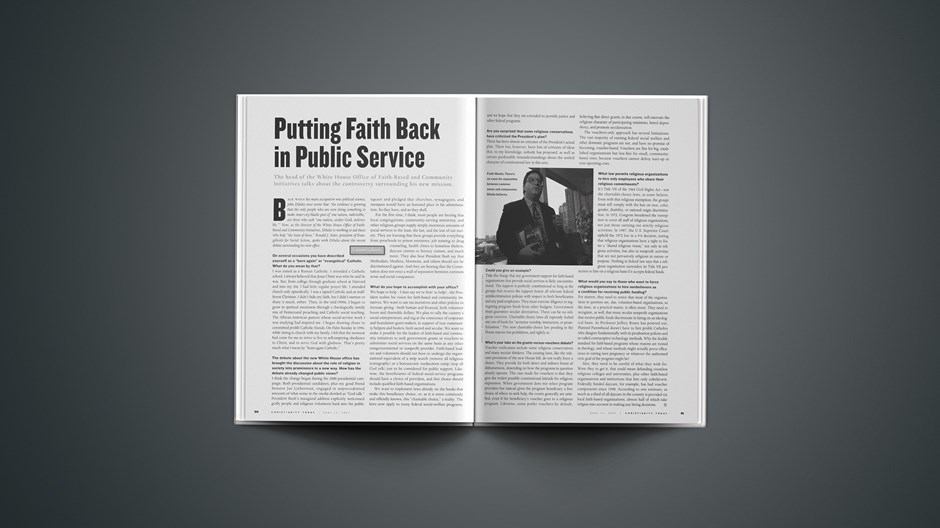
Back when his main occupation was political science, John DiIulio once wrote that "the evidence is growing that the only people who are now doing something to make inner-city blacks part of 'one nation, indivisible,' are those who seek "one nation, under God, indivisible.'" Now, as the director of the White House Office of Faith-Based and Community Initiatives, DiIulio is working to aid those who help "the least of these." Ronald J. Sider, president of Evangelicals for Social Action, spoke with DiIulio about the recent debate surrounding his new office.
On several occasions you have described yourself as a "born again" or "evangelical" Catholic. What do you mean by that?
I was raised as a Roman Catholic. I attended a Catholic school. I always believed that Jesus Christ was who he said he was. But, from college through graduate school at Harvard and into my 30s, I had little regular prayer life. I attended church only episodically. I was a lapsed Catholic and an indifferent Christian. I didn't hide my faith, but I didn't nurture or share it much, either. Then, in the mid-1990s, I began to grow in spiritual awareness through a theologically untidy mix of Pentecostal preaching and Catholic social teaching. The African-American pastors whose social-service work I was studying had inspired me. I began drawing closer to committed prolife Catholic friends. On Palm Sunday in 1996, while sitting in church with my family, I felt that the moment had come for me to strive to live in self-emptying obedience to Christ, and to serve God with gladness. That's pretty much what I mean by "born-again Catholic."
The debate about the new White House office has brought the discussion about the role of religion in society into prominence in a new way. How has the debate already changed public views?
I think the change began during the 2000 presidential campaign. Both presidential candidates, plus my good friend Senator Joe Lieberman, engaged in unprecedented amounts of what some in the media derided as "God talk." President Bush's inaugural address explicitly welcomed godly people and religious volunteers back into the public square and pledged that churches, synagogues, and mosques would have an honored place in his administration. So they have, and so they shall.
For the first time, I think, most people are hearing that local congregations, community-serving ministries, and other religious groups supply simply enormous amounts of social services to the least, the last, and the lost of our society. They are learning that these groups provide everything from preschools to prison ministries, job training to drug counseling, health clinics to homeless shelters, daycare centers to literacy centers, and much more. They also hear President Bush say that Methodists, Muslims, Mormons, and others should not be discriminated against. And they are hearing that the Constitution does not erect a wall of separation between common sense and social compassion.
We hope to help—I dare say we're fixin' to help!—the President realize his vision for faith-based and community initiatives. We want to use tax incentives and other policies to increase giving—both human and financial, both volunteer hours and charitable dollars. We plan to rally the country's social entrepreneurs, and tug at the conscience of corporate and foundation grant-makers, in support of true community helpers and healers, both sacred and secular. We want to make it possible for the leaders of faith-based and community initiatives to seek government grants or vouchers to administer social services on the same basis as any other nongovernmental or nonprofit provider. Faith-based leaders and volunteers should not have to undergo the organizational equivalent of a strip search (remove all religious iconography) or a bureaucratic reeducation camp (stop all God talk) just to be considered for public support. Likewise, the beneficiaries of federal social-service programs should have a choice of providers, and that choice should include qualified faith-based organizations.
We want to implement laws already on the books that make this beneficiary choice, or, as it is more commonly and officially known, this "charitable choice," a reality. The laws now apply to many federal social-welfare programs, and we hope that they are extended to juvenile justice and other federal programs.
Are you surprised that some religious conservatives have criticized the President's plan?
There has been almost no criticism of the President's actual plan. There has, however, been lots of criticism of ideas that, to my knowledge, nobody has proposed, as well as certain pardonable misunderstandings about the settled character of constitutional law in this area.
Could you give an example?
Take the charge that any government support for faith-based organizations that provide social services is flatly unconstitutional. The support is perfectly constitutional so long as the groups that receive the support honor all relevant federal antidiscrimination policies with respect to both beneficiaries and any paid employees. They must exercise diligence in segregating program funds from other budgets. Government must guarantee secular alternatives. There can be no religious coercion. Charitable-choice laws all expressly forbid any use of funds for "sectarian worship, instruction, or proselytization." The new charitable-choice law pending in the House repeats this prohibition, and rightly so.
Article continues below
What's your take on the grants-versus-vouchers debate?
Voucher enthusiasts include some religious conservatives and many secular thinkers. The existing laws, like the relevant provisions of the new House bill, do not really force a choice. They provide for both direct and indirect forms of disbursement, depending on how the programs in question already operate. The case made for vouchers is that they give the widest possible constitutional latitude for religious expression. When government does not select program providers but instead gives the program beneficiary a free choice of where to seek help, the courts generally are satisfied, even if the beneficiary's voucher goes to a religious program. Likewise, some prefer vouchers by default, believing that direct grants, in due course, will enervate the religious character of participating ministries, breed dependency, and promote secularization.
The vouchers-only approach has several limitations. The vast majority of existing federal social welfare and other domestic programs are not, and have no promise of becoming, voucher-based. Vouchers are fine for big, established organizations but less fine for small, community-based ones, because vouchers cannot defray start-up or core operating costs.
What law permits religious organizations to hire only employees who share their religious commitments?
It's Title VII of the 1964 Civil Rights Act—not the charitable-choice laws, as some believe. Even with that religious exemption, the groups must still comply with the ban on race, color, gender, disability, or national origin discrimination. In 1972, Congress broadened the exemption to cover all staff of religious organizations, not just those carrying out strictly religious activities. In 1987, the U.S. Supreme Court upheld the 1972 law in a 9-0 decision, stating that religious organizations have a right to foster a "shared religious vision," not only in religious activities, but also in nonprofit activities that are not pervasively religious in nature or purpose. Nothing in federal law says that a religious organization surrenders its Title VII protection to hire on a religious basis if it accepts federal funds.
Article continues below
What would you say to those who want to force religious organizations to hire nonbelievers as a condition for receiving public funding?
For starters, they need to notice that most of the organizations in question are, alas, volunteer-based organizations, so the issue, as a practical matter, is often moot. They need to recognize, as well, that many secular nonprofit organizations that receive public funds discriminate in hiring on an ideological basis. As Professor Jeffrey Rosen has pointed out, Planned Parenthood doesn't have to hire prolife Catholics who disagree fundamentally with its proabortion policies and so-called contraceptive technology methods. Why the double standard for faith-based programs whose reasons are rooted in theology, and whose methods might actually prove efficacious in cutting teen pregnancy or whatever the authorized civic goal of the program might be?
Also, they need to be careful of what they wish for. Were they to get it, that could mean defunding countless religious colleges and universities, plus other faith-based organizations and institutions that hire only cobelievers. Federally funded daycare, for example, has had voucher components since 1990. According to one estimate, as much as a third of all daycare in the country is provided via local faith-based organizations, almost half of which take religion into account in making any hiring decisions.
The Bush Agenda | Will the White House be user-friendly for religious organizations? (Jan. 8, 2001)
Bush's Call to Prayer | After Al Gore's concession, evangelical leaders unify around faith-based initiatives, morality, and prayer as the incoming Bush administration gears up. (Dec. 14, 2000)
A Presidential Hopeful's Progress | The spiritual journey of George W. Bush starts in hardscrabble west Texas. Will the White House be his next stop? (Sept. 5, 2000)















 While we pray for peace, we need moral clarity about this war.
 We’ve got little information on Jesus’ appearance and personality. But that’s the way God designed it.españolFrançais
 C.S. Lewis recommended discernment over diatribes in exactly the moments we’re most eager to indulge in critique.






