Well, I kissed dating goodbye. But it sure wasn't by choice. For the last four years, I have lived in a very conservative Midwestern town of 35,000. Jefferson City, Missouri, is a place where it's harder for a college-educated, twentysomething, professional, Christian man to find a date than it is to find a good coffeehouse or bookstore. And Starbucks and Barnes & Noble are nowhere near this town, if that tells you anything.
Joshua Harris hasn't made my life any easier. In fact, thanks to him, my future wife—wherever she is— may very well have given up the idea of ever dating. Harris's surprise 1997 bestseller, I Kissed Dating Goodbye (penned when he was only 21), has caught the attention of hordes of young women of my generation—particularly those who are evangelical Christians.
In his book, Harris encourages young Christians to look beyond our Western culture's dominant paradigm for developing serial intimate relationships (namely, the process of "dating") and instead commit to "purposeful singleness." Romantic relationships, he suggests, should exist only as a means to preparing for marriage—what's commonly called "courting." Harris avoids that quaint-sounding term in I Kissed Dating Goodbye, but the idea is implicit in his promotion of relationships that emphasize long-term commitment and the supervision of the community of believers over and against traditional dating, which he feels emphasizes self-centered emotional and physical satisfaction.
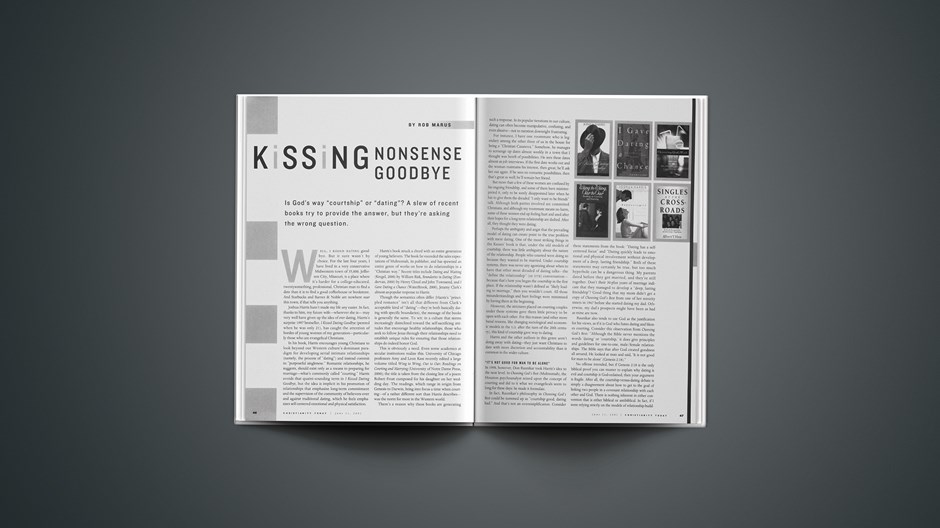
Harris's book struck a chord with an entire generation of young believers. The book far exceeded the sales expectations of Multnomah, its publisher, and has spawned an entire genre of works on how to do relationships in a "Christian way." Recent titles include Dating and Waiting (Kregel, 2000) by William Risk, Boundaries in Dating (Zondervan, 2000) by Henry Cloud and John Townsend, and I Gave Dating a Chance (WaterBrook, 2000), Jeramy Clark's almost-as-popular response to Harris.
Though the semantics often differ (Harris's "principled romance" isn't all that different from Clark's acceptable kind of "dating"—they're both basically dating with specific boundaries), the message of the books is generally the same. To wit: in a culture that seems increasingly disinclined toward the self-sacrificing attitudes that encourage healthy relationships, those who seek to follow Jesus through their relationships need to establish unique rules for ensuring that those relationships do indeed honor God.
This is obviously a need. Even some academics at secular institutions realize this. University of Chicago professors Amy and Leon Kass recently edited a large volume titled Wing to Wing, Oar to Oar: Readings on Courting and Marrying (University of Notre Dame Press, 2000); the title is taken from the closing line of a poem Robert Frost composed for his daughter on her wedding day. The readings, which range in origin from Genesis to Darwin, bring into focus a time when courting—of a rather different sort than Harris describes—was the norm for most in the Western world.
There's a reason why these books are generating such a response. In its popular iterations in our culture, dating can often become manipulative, confusing, and even abusive—not to mention downright frustrating.
For instance, I have one roommate who is legendary among the other three of us in the house for being a "Christian Casanova." Somehow, he manages to scrounge up dates almost weekly in a town that I thought was bereft of possibilities. He sees these dates almost as job interviews. If the first date works out and the woman maintains his interest, then great; he'll ask her out again. If he sees no romantic possibilities, then that's great as well; he'll remain her friend.
But more than a few of these women are confused by his ongoing friendship, and some of them have misinterpreted it, only to be sorely disappointed later when he has to give them the dreaded "I only want to be friends" talk. Although both parties involved are committed Christians, and although my roommate means no harm, some of these women end up feeling hurt and used after their hopes for a long-term relationship are dashed. After all, they thought they were dating.
Perhaps the ambiguity and angst that the prevailing model of dating can create point to the true problem with mere dating. One of the most striking things in the Kasses' book is that, under the old models of courtship, there was little ambiguity about the nature of the relationship. People who courted were doing so because they wanted to be married. Under courtship systems, there was never any agonizing about when to have that other most dreaded of dating talks—the "define the relationship" (or DTR) conversation—because that's how you began the courtship in the first place. If the relationship wasn't defined as "likely leading to marriage," then you wouldn't court. All those misunderstandings and hurt feelings were minimized by having them at the beginning.
However, the strictures placed on courting couples under these systems gave them little privacy to be open with each other. For this reason (and other more banal reasons, like changing sociological and economic models in the u.s. after the turn of the 20th century), this kind of courtship gave way to dating.
Article continues below
Harris and the other authors in this genre aren't doing away with dating—they just want Christians to date with more discretion and accountability than is common in the wider culture.
"It's Not Good for Man to Be Alone"
In 1998, however, Don Raunikar took Harris's idea to the next level. In Choosing God's Best (Multnomah), the Houston psychoanalyst seized upon the concept of courting and did to it what we evangelicals seem to long for these days: he made it formulaic.
In fact, Raunikar's philosophy in Choosing God's Best could be summed up as "courtship good, dating bad." And that's not an oversimplification. Consider these statements from the book: "Dating has a self-centered focus" and "Dating quickly leads to emotional and physical involvement without development of a deep, lasting friendship." Both of these statements may certainly be true, but too much hyperbole can be a dangerous thing. My parents dated before they got married, and they're still together. Don't their 30-plus years of marriage indicate that they managed to develop a "deep, lasting friendship"? Good thing that my mom didn't get a copy of Choosing God's Best from one of her sorority sisters in 1967 before she started dating my dad. Otherwise, my dad's prospects might have been as bad as mine are now.
Raunikar also tends to use God as the justification for his views, as if it is God who hates dating and blesses courting. Consider this observation from Choosing God's Best: "Although the Bible never mentions the words 'dating' or 'courtship,' it does give principles and guidelines for one-to-one, male/female relationships. The Bible says that after God created goodness all around, He looked at man and said, 'It is not good for man to be alone' (Genesis 2:18)."
No offense intended, but if Genesis 2:18 is the only biblical proof you can muster to explain why dating is evil and courtship is God-ordained, then your argument is fragile. After all, the courtship-versus-dating debate is simply a disagreement about how to get to the goal of linking two people in a covenant relationship with each other and God. There is nothing inherent in either convention that is either biblical or antibiblical. In fact, if I were relying strictly on the models of relationship-building I see in Scripture, I wouldn't be courting either. I would either be waiting for God to create a wife for me out of my rib or expecting my parents to select for me a comely bride from among the other families in our subdivision. The realities of modern life no longer permit us to choose our spouses this way.
Article continues below
I don't mean to dismiss the work of those who think that their ideas of courtship are an improvement on the culturally prevalent dating models. In fact, there are some people who have been so hurt in dating relationships that they may need Raunikar's rules to begin healing—not to mention the hundreds who say they've been helped by Harris's books or other works in the genre.
Harris, in his new book Boy Meets Girl (the story of the author's courtship and marriage in the wake of I Kissed Dating Goodbye), acknowledges that there are no hard and fast scriptural rules regarding dating—only general principles. And, happily, he gives a Christocentric reason (as opposed to appealing to decontextualized Pauline pronouncements or shadowy Old Testament references) for his philosophy: "Though our Lord never specifically addressed the topic of dating and courtship in his earthly ministry, He answered our questions about the right way to do relationships by answering the broader question of the right way to live life."
The Unspoken Problem
Nevertheless, for all of their merits, these works fail to address a much more basic issue related to the problem of dating and singleness: Why is it a problem?
As my friend Al Hsu notes in his excellent 1997 book, Singles at the Crossroads (IVP):
The average Christian bookstore has more than a hundred titles on marriage and another hundred about parenting, children, and family issues. In contrast, these stores stock only about a dozen books about singleness. Half of these are geared for "single-again" divorcees or widows. Of the remainder, most are about "how to find the right one." … Instead of dealing with problems that singles might face, these books seem to think singleness is the problem. They instruct the reader on how to bide one's time until the right person comes along. In other words, they imply that the solution to the problem of singleness is to get married.
Hsu goes on to argue convincingly that American evangelicals have all but made an idol out of the human concepts of marriage and family, thus marginalizing single Christians, who are just as complete in Christ as any married person.
Article continues below
The courtship books, it seems, don't begin with this premise. For instance, by stating in Choosing God's Best that "God's solution for man's aloneness is marriage, not dating," Raunikar implicitly labels singleness as something in need of a solution—in other words, a problem.
But these days it seems marriage may well be more of a problem than singleness. I have lost count of the number of friends and acquaintances near my age who either have already gone through a divorce or are in the midst of one. And the vast majority of them are committed believers who come from solidly evangelical congregations where divorce is not taken lightly.
This widespread reality doesn't jibe with the promarriage rhetoric I heard growing up in the youth group of a Southern Baptist megachurch. We were told constantly that "God has that special someone out there for you" and that "you should be preparing yourself for that person even now." My youth minister never said anything about how difficult marriage might be after we found that special someone. I can't blame him; he was too busy making sure that we would defer sex until marriage to tell us much about what came afterward.
Critics in non-Christian contexts have noted this aspect of the problem. Reflecting on the Kasses' book in The Atlantic Monthly, Peter Berkowitz articulates one of the things that has always troubled me about most Christian advice on marriage and dating: "If our anti-romantic tendencies persuade us to expect too little from marriage, our romantic tendencies seduce us into expecting too much."
In some ways, overemphasizing (and thus over-romanticizing) marriage may have created more problems among evangelicals than it has solved. Marriage is not always the solution, and singleness is not always a problem. In fact, singleness actually may be preferable to marriage in some cases. Just ask the apostle Paul.
Whatever the case, single believers should not fall prey to the world's trap of entering into dating relationships lightly or without accountability. By the same token, nobody and no book should elevate culturally bound ideas about courtship, marriage, or family over the family of God.
Rob Marus is the director of Mainstream Missouri Baptists in Jefferson City, where he serves as a coteacher of the Twentysomething Singles at First Baptist Church.
Other articles appearing on our site this week about singleness and the church include:
Solitary Refinement | The church is doing better than ever at ministering to single people. But some evangelical assumptions still need rethinking. (June 4, 2001)
A Singular Mission Field | There are more single people in America than ever—and they need the church as much as ever. (June 4, 2001)
'Surf Here Often?' | Online matchmaking is changing the Christian dating game. (June 5, 2001)
The Man Who Ignited the Dating Debate | I Kissed Dating Goodbye has generated both disgust and delight among singles. But the author says it's not about "not dating." An interview with Joshua Harris. (June 6, 2001)
The complete Robert Frost line ending with "wing to wing, oar to oar" is included in an inspirational site of Frost quotations.
InterVarsity Press has a fewexcerpts from Hsu's Singles at the Crossroads.
ChristianityToday.com's singles area has articles from many Christianity Today sister publications of interest to unmarried Christians. It also includes Camerin Courtney's "Single Minded" column, which once examined dating books.
Christianity Today's earlier coverage of Christian single life includes
















 While we pray for peace, we need moral clarity about this war.
 A Christian reconciliation group in Israel and Palestine warned that war would come. Now the war threatens their relevance.españolالعربيةFrançaisрусскийУкраїнська
 NIL deals in college athletics present new challenges—and opportunities—for colleges and students.






