On June 26, 2000, scientists Francis Collins and J. Craig Venter joined Bill Clinton at the White House for the stunning announcement that researchers had mapped 90 percent of the genes on the human genome, which contains codes for all inherited characteristics. The President declared, "Today, we are learning the language in which God created life."
Humanity will spend much of the 21st century attempting to speak that language. A fast-developing biotech vocabulary—genetic therapy, stem cells, reproductive cloning, and so on—strains the ability of even the most thoughtful to keep up. Human life may soon be changed dramatically, and Christians must participate in the international conversation about these changes before they become irreversible.
The Christian faith has the potential to serve not just the church but the world by penetrating the fog of current events to discern their deeper meaning—and to offer clear-headed analysis amid growing confusion.
Opposing Forces
Long-established forces threaten to crowd out the voice of faith:
Market forces. The sprawling biotech industry, already doing $80 billion in business in the United States alone, would not be awash in money were there not a demand for its innovations. These products and services include stem cells, gene therapies and enhancements, and, one day, perhaps soon, clones. Biotech firms promise what people want—health, pain relief, reproduction, longevity, success.
Thus far they do so with little public regulation or control, one of the most troubling features of our new era—unlike the nuclear weapons challenge posed last century, harrowing as that was. Then government policy threatened humanity; today, corporate interests do.
Moral fragmentation. A morally fragmented nation may lack the basic requisites for a conversation—a shared framework of meaning, a minimal level of trust, and an agreed-upon vocabulary. But by failing to converse and arrive at a national (much less international) decision about the biotech revolution, we default to existing powers and interests and likely stumble into disaster.
"Our society currently lives from moral fragments and community fragments only, both of which are being destroyed faster than they are being replenished," writes ethicist Larry L. Rasmussen.
Worldview dynamics. This leads us to a still deeper reality: beneath both economic practice and moral fragmentation lies the foundation of worldview. Among those who press most aggressively for unrestrained development of biotech advances —including nonscientists—worldviews and philosophies such as naturalism, atheism, utilitarianism, and scientific utopianism reign. Much of our culture's élite lives without a working hypothesis of God. Assuming we dwell alone in the universe, they believe we must simply keep improving life until the next comet hits.
Libertarian ideology—which stresses individualism, privacy, moral relativism, unlimited choice-making, and autonomy—folds neatly into these godless worldviews. It holds that no one should deny himself anything that will bring self-realization and is not immediately harmful to another.
Hence a powerful contingent argues for the largely unrestrained pursuit of biotechnology as a matter of personal (including reproductive) liberty. This quest is driven by a utopian dream: overcoming our species' limits through human power and scientific progress.
Some suggest triumphantly that our species is about to evolve right past homo sapiens to what New Republic senior editor Gregg Easterbrook calls homo geneticus. One enthusiast has said that future generations will look back on our time as "the point in history when human beings gained the power to seize control of their own evolutionary destiny."
Leaving the limits of nature and the past behind, we will remake ourselves. Still, as bioethicist Audrey Chapman has written, the nations are not sure they ought to heed this siren song. They seem to be pausing at the brink, waiting to hear from the church or any other voice on why they should not plunge into the remaking of humanity.
The Challenge to Christians
Tell us why we should not proceed to remake humanity now that we are developing the power to do so—this is the challenge presented to Christians (and other religious groups). When the U.S. National Bioethics Advisory Commission formulated guidance to the President on human cloning in 1997, for example, it sought the testimony of a variety of religious thinkers.
To offer answers, we must consider some difficult theological conundrums. After we identify a few of them, we will sketch an initial response —exhaustive neither in scope nor argument—to specific biotech challenges.
Is God responsible for these technological advances? A vibrant theology of divine sovereignty would have to answer "yes," at least in some sense. If so, then why worry? Because our affirmation of God's sovereignty comes with the equally biblical assertion that human beings have the freedom to make good or bad decisions.
God did indeed make us with the intelligence to develop these technologies, but we are responsible for what we do with that intelligence. We may stumble into areas beyond our appropriate range; this was the primordial sin, after all. But it is also possible that God is at work in some of these biotechnological advances.
Article continues below
Are suffering, finitude, and death revocable by human effort? Human sin introduced suffering and death into a previously unmarred creation. The reversal of sin's effects marked the kingdom-inaugurating ministry of Jesus Christ, but until he returns the creation will continue to "groan" (Rom. 8:18ff)—illness, death, and finitude will remain a reality.
Indeed, both Scripture and history show that utopian visions of the elimination of suffering tend toward disaster, either through tyranny or as the unforeseen consequence of well-intended schemes. One of the best things biblical faith contributes to the biotech discussion is a well-considered understanding of human weakness, finitude, and sin, and the double-edged potential of many human endeavors.
The Dominion Mandate
And yet does God not mandate human efforts to mitigate the effects of sin? Along with Christ's kingdom mandate to heal and restore, in creation God called humanity to exercise dominion over (Gen. 1:28) and preserve/protect (Gen. 2:15) the Earth. After the Fall, the dominion/protection (stewardship) mandate was not removed, but extended to more difficult conditions.
God calls us to "sustain, restore, and improve" our fallen world, according to ethicist James C. Peterson. While the term "created co-creators" overstates our status, we are called to mitigate the Fall's effects and thus improve human and planetary life. It would be disobedient to resist human progress toward these ends, but the issue becomes complex when innovations risk bringing more harm than benefit—and when they risk transgressing divinely established boundaries.
To what extent does God intend to "fix the world," as opposed to redeeming a people for eternity from within a broken world? Lutheran theologian Philip Hefner has argued that a dubious "fix-it" mentality lies behind much of the biotech revolution. And yet a healthy theology of God's sovereignty as Creator and Redeemer drives us to reclaim "every square inch" of creation, as Dutch Calvinist Abraham Kuyper (1837-1920) once famously said. Likewise, a kingdom approach emphasizes Jesus' mission as reclaiming a rebellious and suffering world for its rightful King.
More pessimistic theologies allow for much less actual transformation before Christ returns. Our bioethical dilemmas underscore both the possibilities and the limits of transformation in this world, and perhaps keeping both in tension is the best way forward.
Article continues below
Are genetic anomalies, and the diseases they cause, God's will? Some argue that interventions such as gene therapies constitute an attempt to thwart God's will. Yet, only if we think of cancer, crib death, car accidents, tornadoes, and nearsightedness as God's will in some nonbiblical, fatalistic sense, ought we also understand genetic anomalies such as cystic fibrosis or spina bifida this way. We should instead see these inherited diseases as legacies of the Fall and hence worthy subjects of our best efforts to safely mitigate them.
What is normatively human? Has God established a fixed human nature (the imago dei) that we are not permitted to alter or transcend? While humanity is made in the image of God, strikingly diverse Christian interpretations of the imago dei abound. It may be that Christians can ascribe no single meaning to it, but at minimum the imago dei means that humans were designed to resemble God in ways that other creatures do not—this includes our intelligence, moral agency, and our ability to form interdependent relationships in community.
Human life merits a special imputed respect, even sacred value, on the basis of this design as well as God's unique declaration of our status. Also, by sharing this status, all humans partake of a fundamental equality. But given that much about us is far from Godlike, in the biotech era we must find the balance between reaching our potential and respecting our limits—both of which are fundamental to human life.
To what extent does God work through the agency of government to restrain sin and prevent disaster? Reflection on the biotech challenge helps to settle the question of whether Christians should remain politically engaged despite the many disappointments we have with government. God created the State to advance the common good (Rom. 13:1-7), and at times it is the only human power capable of restraining threatening forces.
We cannot withdraw from political engagement, especially in times like these.
At least three pressing issues demand an immediate Christian response: stem-cell research, human cloning, and genetic therapy.
Article continues below
Stemming Life
The effort to use stem cells obtained from adult neural cells, bone marrow, live-birth umbilical cord and placental blood, and other sources raises no moral problems. The potential health benefits of stem cells remain unclear (despite dramatic claims in the media), but there is no reason to limit research as long as the source of such cells is morally licit. Indeed, Christians should support initiatives such as Rep. Chris Smith's (R-N.J.) proposal to establish a national stem-cell donor bank involving only these nonembryonic cell sources. Such a donor bank would make stem-cell research a public initiative with near-universal support—and would greatly expand the availability of such cells.
The use of embryonic stem cells from elective abortion, or, more importantly, from the "leftovers" from in vitro fertilization (IVF), has heated up the debate. Both concern the moral status of embryonic life, and thus this issue intertwines with the moral struggle over abortion. The biotech community and its allies have pressed hard for the right to use embryonic stem cells freely, and for an end to the ban on federal funding of such research.
In one sense, the moral issues are similar whether we are considering aborted fetuses or "surplus" IVF embryos. Both are (or were) among that class of human beings rightly called the unborn, or those in the process of being born—human beings valued by God whose lives began at conception.
Research using aborted fetuses entangles the researcher in a prior wrong. A researcher can be guilty of complicity even if he had no role in the original wrong and his own motives were beyond reproach. Complicity can be avoided. For example, the medical community rightly rejected any use of knowledge gained from the Nazis' horrific experiments on concentration camp prisoners.
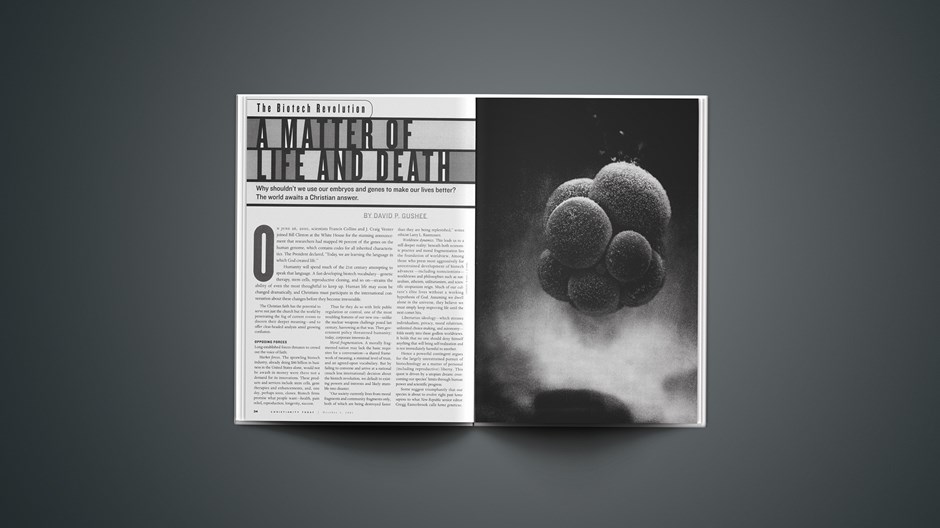
As for the more than 100,000 unused frozen embryos in the United States alone, the moral problem remains the manipulation and ultimate destruction of a human life at its earliest and most defenseless stage.
A prior problem exists, of course: the routine practice of producing excess embryos. This is a fine example of the law of unintended consequences. Twenty years ago, at the dawn of the assisted reproduction industry (today still largely unregulated), no one imagined that at the turn of the millennium, a city's worth of embryos would await an uncertain future in icy limbo.
A fresh moral evaluation of the assisted reproduction industry is past due. Before President Bush's decision in August to limit federally funded stem-cell research to existing stem-cell lines, biotech industry, political, and media voices pressed hard for the legitimation of research using IVF leftovers. "Respectable" opinion continues to assert that blocking stem-cell research using IVF leftovers is foolish and extremist. But the Roman Catholic Church and hardline prolifers aren't the only ones to raise their voices in protest.
Article continues below
Ethicist Amy Laura Hall of Duke University notes that feminist scholars such as herself believe this practice raises troubling questions about exploitative "harvesting" of the female body.
Further, due to its Nazi past, Germany is moving much more carefully in this area than the United States. If international opinion matters, we should listen to its misgivings as part of our decision-making. And, as Hall rightly notes, our suddenly deep concern about suffering people is disturbingly selective. "This is not, ultimately, about the alleviation of suffering in general; it is about the alleviation of our own fear of suffering."
Of all potential sources of stem cells, producing embryos for experimentation and research via cloning techniques—known as therapeutic cloning—is the most troubling. Yet private research firms have begun doing precisely this. Therapeutic cloning is odious because (a) it could surreptitiously lead to morally dubious reproductive cloning, and (b) it intentionally manufactures human life with the certainty of its destruction.
Many leaders here and abroad are pressing for therapeutic cloning; the Christian community must reject it. As a matter of public policy, Christians and others who value embryonic and fetal life have a right and obligation to press for the exemption of embryonic stem cells from research efforts. President Bush's stance, while demonstrating laudable respect for the value of embryonic life, in this sense did not go far enough.
This is especially true in light of the apparent promise of other sources of stem cells and other paths to the goals of regenerative medicine. Discovery of treatments for such diseases as Parkinson's and Alzheimer's would be a tremendous accomplishment, but deeper biblical values proscribe us from pursuing those ends at the expense of developing human life—especially when alternative sources are viable.
Drawing the Line at Dolly
A fascinating thing happened during the debate that broke out after Dolly the cloned sheep made her appearance—large sectors of society said, "This crosses a line; this must not happen."
This does not mean that powerful voices are not continuing to make their best case for cloning (extracting the nucleus of an adult cell and inserting it into an egg cell that has been stripped of its own nucleus, then stimulating it to begin cell division). Nor does it mean that research has halted; no one knows how many private laboratories have ignored the moral, physiological, and legal risks in attempts to clone humans. But it may mean that the human family will rouse itself to actually draw a line before cloning becomes a fait accompli.
Article continues below
University of Chicago medical ethics professor Leon Kass, whom Bush named as head of his new bioethics commission, summarizes the overwhelming case against cloning in four points: unethical experimentation; threat to human identity and individuality; turning procreation into manufacturing; and despotism over children in the perversion of parenthood.
1. Cloning is a form of experimentation on a nonconsenting subject. Attempts on animals reveal extremely high failure rates, resulting in many disabilities and deformities. No ethical scientist would attempt human cloning at current odds.
2. Cloning threatens human identity and individuality by permitting the intentional genetic replication of a person whose life is already in process. The clone, says Kass, "will not be fully a surprise to the world; people are always likely to compare his doings in life with those of his alter ego."
3. Cloning turns procreating into manufacturing by enabling the advance selection of a total genetic blueprint. Things are made, but people are begotten. In cloning, that boundary line is erased (although a form of baby manufacturing has been underway since in vitro fertilization began, Kass rightly notes).
4. Cloning is an act of despotism that perverts parenthood by turning children into genetically engineered possessions intended to fulfill parental wants. Some argue that many children are already brought into the world for reasons other than the sheer desire to welcome new life. But we must reject treating children, however they are born, as commodities or as instruments to other ends.
A number of other arguments have emerged: Cloning would mark the first instance of humans reproducing through asexual replication, radically altering the nature of procreation and eliminating dual genetic origin in the cloned. Notre Dame law professor Kathleen Kaveny has shown how dramatically cloning would confuse family lines and relations.
If made available solely by the market based on ability to pay, cloning would contribute to distributive injustice. It would weaken marriage and the relationships between men and women by further eroding the link connecting marriage, sex, and childbearing—likely extending the practice of assisted reproduction among homosexuals. Kass has made the point that it could deepen the misery of children after divorce—if, for example, Mom had to look at the clone of the now-despised Dad all day long.
Article continues below
Cloning would contribute to our epidemic narcissism by enabling self-creation without any involvement of another person. The potential for multiple self-cloning could create a household freak show. It could bring more children into the world who lack the benefit of two parents. The sly might try to clone others without their consent; or, conversely, famous people and corporate interests might market highly desired genotypes to those seeking (in vain) to guarantee successful offspring.
Finally, cloning does not meet any legitimate human need. Many kinds of reproductive technology exist for the infertile. Misguided efforts to bring back a dead child through cloning would mark a sad attempt to salve a grief that cannot be salved, and at the cost of exploiting another human being through her very creation.
Human cloning should be banned. We need both federal laws and international agreements. The United States has lagged behind irresponsibly; while anti-cloning legislation had passed the House, at press time, the United States had only a temporary ban on federal funding and threats from the Food and Drug Administration to prosecute private firms that attempt cloning.
Tinkering with Genes
Genetic therapy may be the most morally difficult of the three areas considered here. A distinction between somatic interventions (repairing a defect in the genes of a living person) and germline interventions (altering reproductive DNA inheritable by future generations) has been recognized in this field since the 1980s, with ethicists saying yes to the first and no to the second. But recently questions have been raised about this distinction's scientific accuracy and moral relevance.
An American Association for the Advancement of Science (AAAS) study group has suggested abandoning the terminology and instead distinguishing only between inheritable and nonheritable genetic modifications.
In Genetic Turning Points: The Ethics of Human Genetic Intervention, geneticist/ethicist Peterson argues that all genetic intervention should be evaluated based on four criteria: safety; improvement for the recipient; maintaining an open, and not foreclosed, future for the recipient; and just resource allocation. While the stakes of germline intervention (or inheritable modifications) are certainly higher than for somatic intervention, Peterson argues that either could meet these criteria if the science develops adequately. He further asserts that we might have a moral obligation to pass on to progeny the healthiest possible genetic legacy.
Article continues below
Several points argue in favor of germline therapy: some maladies might be cured, it may be the only way to attack some diseases, and prevention costs less than cures. If, for example, the gene for Tay-Sachs or Huntington's disease could be eliminated from the reproductive DNA of all those who carry it, the disease itself could presumably be wiped out. Why just offer somatic interventions to millions of sufferers if we can eliminate the disease altogether?
Among concerns, one is simply scientific. If, as Francis Collins (director of the National Human Genome Research Institute) argues, the role of genes is complicated and undeterministic—genes interact unpredictably with each other, with other cellular actors, environment, and free will—then the supposed promise of some germline interventions may be vastly overstated. At present, at least, we may simply be in over our heads and end up doing more harm than good.
The AAAS report states flatly that inheritable modifications cannot now be carried out safely on human beings.
Furthermore, germline intervention would affect not just one person but all offspring; more broadly, it would affect the gene pool of the human race. Another concern is distributive justice—unless everyone gets access to germline therapies, such exclusivity could worsen our already unjust allocation of health-care resources.
Some fear, further, that the effort to eradicate genetic diseases will contribute to the social stigmatization of those who have them.
Finally, we will not be able to draw a firm line against morally odious genetic enhancements if we permit germline therapy. Genetic enhancement suggests outrageous possibilities. We rightly scorn the prospect of a society in which people with means purchase prepackaged genetic endowments of athletic, artistic, intellectual, or physical prowess for themselves or their children (if this ever really proves possible).
It is easy to envision a split between what Princeton University molecular biologist Lee M. Silver creatively labels the GenRich and the Naturals—those who would be able to buy genetic excellence and those who would not.
Article continues below
A tragically ironic misunderstanding of human satisfaction lies behind such a possibility; not giftedness alone, but a blend of natural endowment, discovery, and hard work makes excellence satisfying. Undoubtedly, however, a market would grow instead for engineered excellence, even if it were a black market. Recently Sports Illustrated suggested the drive for athletic success will make genetically engineered athletes inevitable.
The implications of genetic enhancement for human reproduction, family life, childhood, and society as a whole are indeed chilling. Ethicists address this issue in various ways. In From Chance to Choice: Genetics and Justice (Cambridge, 2000), by Allen Buchanan, et al., the authors flatly propose that the purchase of what I am calling "excellence enhancements" should be prohibited by law.
They argue, however, for a consensus on a small core of very basic human capabilities, and for access by all citizens in all health plans to the genetic therapies that could help obtain them. In a sense, this is the model that already prevails in health care (though it is deeply corrupted by unequal access). It would simply be extended to genetic medicine.
At a theological level, John Feinberg argues for drawing a distinction between conditions traceable to the Fall of humanity and its consequences, and those that are not; genetic interventions would be permissible for the former, and only for the latter if motives were morally correct. But who will decide that?
While the current state of science on inheritable modifications demands at least a moratorium on any application of them, research should continue. Making fundamental distinctions between narcissistic excellence enhancements and genuine health care, perhaps one day we will be able to eliminate genetic maladies through rigorously tested therapies available to all.
A Bioethical Decalogue
I have argued that the world, especially the biotech industry, presents this challenge to the church: Tell us why we should not proceed to remake humanity now that we are developing the power to do so.
Our answer should be this: You rightly perceive a mandate to understand and alleviate illness and the suffering it brings. We will support this effort, but within the boundaries of human well-being under the sovereignty of God. These boundaries include limits on the means we may use to achieve the goals.
Human beings may not be manufactured, engineered, or destroyed; we may not experiment on or otherwise use the vulnerable without their consent; we may not set aside the essential structures of the created physical and social order; we may not casually alter or enhance the nature of the person (and other forms of life); we may not restrict the legitimate benefits of innovations to the privileged but instead must serve the common good; and the biotech community may not make decisions without the participation and consent of society.
Article continues below
In turn, we will pledge to protect biotech efforts from the attacks of those who do not understand them, and will do everything we can to nurture a culture in which innovations will honor human dignity.
Bioethicist Chapman asks, "Will society have the wisdom, the powers of discernment, and the appropriate commitments to apply its new knowledge and capabilities for ethical ends?" May God graciously guide our steps, that the answer to that question will reflect wise exercise of our dominion.
David P. Gushee is Graves Associate Professor of Moral Philosophy and Senior Fellow of the Center for Christian Leadership, Union University, Jackson, Tennessee.
A ready-to-download Bible Study on this article is available at ChristianBibleStudies.com. These unique Bible studies use articles from current issues of Christianity Today to prompt thought-provoking discussions in adult Sunday school classes or small groups.
Also appearing on our site today:
Wanna Buy a Bioethicist? (Editorial) | Some corporations have discovered that bioethics makes good public relations. (Sep. 28, 2001)
Do No Harm, the Coalition of Americans for Research Ethics, is a national coalition of researchers, bioethicists, and others dedicated to the promotion of scientific research and health care which does no harm to human life.
The U.S. Human Genome Project (HGP) is the national coordinated effort to characterize human genetic material by determining the complete sequence of the DNA in the human genome. View timeline and history for background information on the project.
See the transcript of President Bush's Aug. 9 speech on embryo stem cell funding (video). He took a middle ground position by offering federal funds for embryonic stem-cell research—but only where the "life and death decision has already been made."
A CNN-USA Today-Gallup found that 60 percent of Americans approved of the president's decision.
David Gushee's previous articles for Christianity Today include:
Forgive and Remember | A year after the Clinton impeachment, can we get some perspective? (Jan. 10, 2000)
How Immortality Almost Killed Me | My quest for immortality and lasting significance reflects the fact that God has put eternity in the human heart. (March 3, 1997)
















 While we pray for peace, we need moral clarity about this war.
 We’ve got little information on Jesus’ appearance and personality. But that’s the way God designed it.españolFrançais
 When I married into a Jewish family, antisemitism hit home. Now, the holy day reminds me of our future hope.






