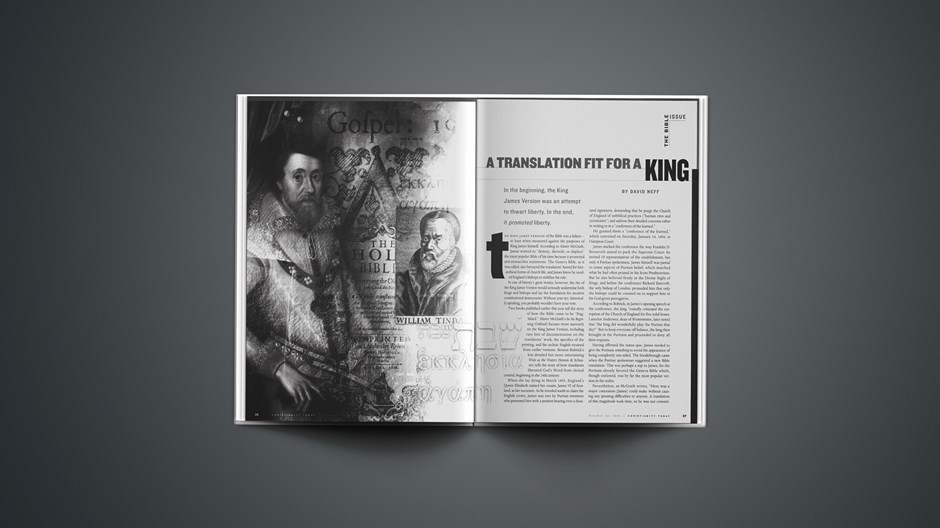
The King James version of the Bible was a failure—at least when measured against the purposes of King James himself. According to Alister McGrath, James wanted to "destroy, discredit, or displace" the most popular Bible of his time because it promoted anti-monarchist sentiments. The Geneva Bible, as it was called, also betrayed the translators' hatred for hierarchical forms of church life, and James knew he needed England's bishops to stabilize his rule.
In one of history's great ironies, however, the rise of the King James Version would seriously undermine both kings and bishops and lay the foundation for modern constitutional democracies. Without your KJV, historically speaking, you probably wouldn't have your vote.
Two books published earlier this year tell the story of how the Bible came to be "Englished." Alister McGrath's In the Beginning (Oxford) focuses more narrowly on the King James Version, including rare bits of documentation on the translators' work, the specifics of the printing, and the archaic English retained from earlier versions. Benson Bobrick's less detailed but more entertaining Wide as the Waters (Simon & Schuster) tells the story of how translators liberated God's Word from clerical control, beginning in the 14th century.
When she lay dying in March 1603, England's Queen Elizabeth named her cousin, James VI of Scotland, as her successor. As he traveled south to claim the English crown, James was met by Puritan ministers who presented him with a petition bearing over a thousand signatures, demanding that he purge the Church of England of unbiblical practices ("human rites and ceremonies") and address their detailed concerns either in writing or in a "conference of the learned."
He granted them a "conference of the learned," which convened on Saturday, January 14, 1604, at Hampton Court.
James stacked the conference the way Franklin D. Roosevelt aimed to pack the Supreme Court: he invited 19 representatives of the establishment, but only 4 Puritan spokesmen. James himself was partial to some aspects of Puritan belief, which matched what he had often praised in his Scots Presbyterians. But he also believed firmly in the Divine Right of Kings, and before the conference Richard Bancroft, the wily bishop of London, persuaded him that only the bishops could be counted on to support him in his God-given prerogative.
According to Bobrick, in James's opening speech at the conference, the king "roundly criticized the corruption of the Church of England for five solid hours. Lancelot Andrewes, dean of Westminster, later noted that 'the king did wonderfully play the Puritan that day!'" But to keep everyone off balance, the king then brought in the Puritans and proceeded to deny all their requests.
Having affirmed the status quo, James needed to give the Puritans something to avoid the appearance of being completely one-sided. The breakthrough came when the Puritan spokesman suggested a new Bible translation. This was perhaps a sop to James, for the Puritans already favored the Geneva Bible which, though outlawed, was by far the most popular version in the realm.
Nevertheless, as McGrath writes, "Here was a major concession [James] could make without causing any pressing difficulties to anyone. A translation of this magnitude took time, so he was not committing himself to anything with major short-term implications." This decision bought him time.
Subversive Scriptures
Why should James need to defend himself against the existing English Bibles? The first English translations did not stop at trying to bring the Scriptures to the common people: they also offered translations and commentary that called in question both absolute monarchy and the hierarchical church establishment.
John Wycliffe (c. 1330-80) was the first to upset the establishment by making the Bible available in English. The learned Wycliffe regarded the preaching of Scripture as "an act more solemn than the making of any sacrament." While others before him had claimed that Scripture was the norm for all truth, Wycliffe argued that every man had a right to examine the Bible for himself. Thus he not only challenged such medieval practices as Masses for the dead, indulgences, and a church organized along feudal lines, but he also encouraged all Christians to read the Bible and form their own opinions on these matters.
McGrath quotes one contemporary who complained that Wycliffe had translated the Bible "from Latin into the English [Latin: anglica], not the angelic [Latin: angelica], language." The critic went on to complain that what had been reserved for the learned clergy was now available to the laity—"in fact, even to women who can read. As a result, the pearls of the gospel have been scattered and spread before swine." Many in the establishment shared his scorn. The English nobility preferred French and Latin, and rarely used English except when communicating with their social inferiors.
Wycliffe's followers sharply criticized the clerical establishment, with its wealth and privilege. For example, shortly after Wycliffe's death, Nicholas Hereford ended one sermon by declaring it God's will for the Christian population to rise up and seize the church's wealth. The establishment panicked, and, as McGrath writes, "The mere possession of a vernacular Bible [became] presumptive evidence of heresy in fifteenth-century England."
Article continues below
William Tyndale (1494?-1536) made the next major effort at vernacular Bible translation into English. One day, in an argument with an ignorant priest, he lost his temper. "I defy the pope and all his laws," Tyndale said, "and if God spare my life, ere many years I will cause a boy that driveth the plough shall know more of the Scriptures than thou doest."
Tyndale had to translate on the lam. The 1408 Constitutions of Oxford were still in force, making it technically illegal for a scholar even to possess an English vernacular Bible or to raise many of the questions he was eager to debate. And so in May 1524, Tyndale left England and sailed to Germany.
Because vernacular Bible-reading had been associated with the peasant uprisings in Europe during the very years Tyndale was doing his work, the fruits of his labors were outlawed in England. But the network of weavers and wool merchants who had financed his translation work helped also to smuggle more than 18,000 copies of his New Testament into England between 1525 and 1528. We may think of them as prototypes of Brother Andrew, "God's Smuggler." The English authorities, however, viewed them they way we regard Colombian cocaine smugglers. Many of those copies were seized and burned, but many got through to believers who loved God's Word.
Bobrick calls Tyndale's translation a "tour de force." Tyndale's contemporaries had other words for it. Sir Thomas More, for example, included Tyndale's New Testament among the heretical writings he tried to refute. Though he damned it as a whole, he had difficulty specifying its errors, complaining mainly about Tyndale's anti-ecclesiastical word choices: congregation rather than church, senior or elder rather than priest, favor rather than grace, repentance rather than penance, and love rather than charity. These terms were not heretical, but were rather an opportunity to read the text afresh without being mentally hampered by the baggage of medieval church life.
Tyndale's New Testament was consigned to the flames, as was Tyndale himself. But Tyndale's words live on. His translations of the Beatitudes and the prologue to John's Gospel, for example, were almost entirely appropriated by the KJV: "Blessed are the poor in spirit: for theirs is the kingdom of heaven" and "In the beginning was the word, and the word was with God: and the word was God." He brought into English the "noun + of + noun" construction of Hebrew (e.g., the law of Moses rather than Moses' law or the holy of holies rather than the holiest place). And he gave us scapegoat, Passover, and atonement, and introduced into English beautiful and Jehovah.
Article continues below
After Tyndale, the authorities knew they had to bow to the popular demand for a vernacular translation. In 1537, Henry gave royal approval to "Matthew's Bible," which was largely Tyndale and contained aggressively Protestant marginal notes and therefore failed to gain the support of the clergy. In 1539, Grafton and Edward Whitchurch produced the Great Bible, a large Bible designed for public reading and intended to be placed in churches but not of convenient size for individual reading or family devotion.
After Henry's death, the crown passed to his son Edward and then to his daughter Mary. For Mary, Protestantism symbolized her father's disgraceful divorce of her mother, and she was committed to restoring Roman Catholic England. English Protestant leaders fled to the Continent, many of them settling in Geneva. There John Foxe began his Book of Martyrs, and there William Whittingham (who it is thought married John Calvin's sister) and other exiles produced a Bible translation under the influence of Calvin, Theodore de Besze, and John Knox.
The Geneva Bible was everything the Great Bible was not. The 1560 edition was relatively compact and inexpensive, putting it within the reach of many families. And it was user-friendly, with illustrations and maps, explanatory prefaces, annotations, and marginal notes that, according to McGrath, made it "the market leader."
Those marginal notes not only explained obscure passages and taught doctrines such as free justification by faith; they also pointed out the limits of monarchy. For example, Daniel "disobeyed the king's wicked commandment in order to obey God, and so he did no injury to the king, who ought to command nothing by which God would be dishonored." Notes on Exodus treat the Pharaoh as a tyrant and a note in 2 Chronicles criticizes King Asa for giving "place to foolish pity" when he merely removed his idol-worshiping mother as queen rather than executing her. Finally, Psalm 105:15—"Touch not mine anointed," a favorite prooftext for the Divine Right of Kings—was interpreted by the Geneva Bible to refer not to kings but to "those whom I have sanctified to be my people."
Article continues below
The English establishment did its best to supplant the Geneva Bible, with its pro-Protestant, anti-absolutist tilt, by sponsoring the Bishops' Bible (1568), but to no avail. At points, the Bishop's Bible was simply grotesque. Instead of the Geneva Bible's now familiar "Cast thy bread upon the waters," the Bishops' had "Lay thy bread upon wet faces." It is no wonder that, as McGrath notes, "between 1583 and 1603, 58 editions of the Bible were published in England—seven of the Bishops' Bible and 51 of the Geneva edition." The Geneva Bible had won the loyalty of the people.
So when it came to a new translation, Richard Bancroft, future Archbishop of Canterbury, gave the King James translators some rules. The first one insisted that they follow the Bishops' Bible "as little altered as the Truth of the original will permit." The third rule decreed that "the Old Ecclesiastical Words [were] to be kept, viz. the Word Church not to be translated Congregation &c." The sixth rule forbade all marginal notes. These rules were designed to ensure that the translations would not challenge the feudal trappings of church and state. The rest of the rules were mostly devoted to sketching out the way in which the translators would work in teams and achieve consensus. Eventually, Bancroft himself reviewed the text and introduced 14 changes just before he died. With rules like that in place, how could things go awry for the monarchy?
The KJV was published in 1611 to mixed reviews. It got some help in 1616, when authorities forbade the printing of the Geneva Bible in England, but people still bought copies, now imported from the Netherlands.
In 1625 James died and left the unresolved political tensions to his son, Charles I. More willful and less politically astute than his father, Charles married a French princess who was Roman Catholic. This alarmed the Puritans, and the nation became ever more unsettled. "High" Anglicans cast their lot with royalists and King James's Authorized Version, while the Puritan churchmen cast their lot with Parliament (as representatives of the people) and the Geneva Bible.
Puritans, Parliament, and the political pendulum
In 1642 the tensions erupted into Civil War, and soon a Puritan-dominated Parliament ruled. There was talk of a new Bible duly authorized by the people's representatives, but in one of history's great mysteries, the opponents of the kjv let their opportunity pass. The Puritans overreached in many things and lost popular support. The people began to fear chaos, and when in 1660 the monarchy was restored, the King James Version was finally triumphant in the "battle of the Bibles."
Article continues below
Says McGrath: "The most significant factor in its final triumph appears to have been the fact that it was associated with the authority of the monarch at a time when such authority was viewed positively. … The Geneva Bible was marginalized. … because it had been the preferred translation of the detested Puritan faction."
The King James Version was thus established, but the political pendulum's swinging between Parliament and the monarchy continued until the revolution of 1688. This pendulum had been set in motion by Henry VIII's top legal adviser, Thomas Cromwell. It was Cromwell's idea to have Parliament declare Henry "Protector and Supreme Head of the English Church."
Cromwell wanted England to be a sovereign national state, writes Bobrick, "rooted in the supremacy and omnipotence of statute, or. … the legislative supremacy of the king-in-Parliament." By seeking Parliament's approval for his divorce and his power over the church, Henry in fact legitimized Parliament's standing. They strengthened each other short-term, but Henry's move set the stage for the bitter struggle between the Stuart kings and Parliament, and ultimately for the Glorious Revolution.
By the time Charles II and Parliament came to their standoff, countless English Bibles were in the hands of the people, including the plowboys who had inspired Tyndale's efforts. Reading and printing were largely religious (two-thirds of the books printed in England between 1480 and 1640 were religious, notes Bobrick, and the lion's share of those were Bibles), and Bible reading was the way people became literate.
Bible stories taught that bad kings (Nebuchadnezzar, the Pharaoh of the Exodus) come to bad ends. They also displayed the possibility of righteous disobedience (Daniel, Peter, and John) and of God vindicating the downtrodden. The New Testament overflows with the language of liberty. Such ideas, when written in a language "understanded of the people," could only undermine the political and ecclesiastical remnants of feudalism.
Logically, it is a fairly short step from the biblical language of liberty to the secular politics of liberty. Bobrick, perhaps too eagerly, draws a direct line from the apostles of Christ to the apostles of natural rights, John Locke and Thomas Hobbes. Yet these secularized notions of liberty were built on biblical notions, selectively appropriated, that became foundational to constitutional democracy. Bobrick's story of the Bible is the history of liberty. For both Bobrick and McGrath, it is also the history of shaping, fixing, and elevating English. For still others, it will be the story of justice. And for others, the story of salvation. When the Bible is read and relished with hunger, it penetrates lives, reshapes cultures, and reforms institutions—often with ironic results. Hunger is the key. With our abundance of Bibles we can deceive ourselves into thinking we too hunger for the Word. But we do not dig into it like our ancestors did. What will it take to restore our appetite?
The Reluctant Romans | At Douai in Flanders, Catholic scholars translated the Bible into English as an alternative to the Bible of "the heretics." (Oct. 22, 2001)
Englishing the book | The rise and fall of the King James Bible. (Books & Culture)
Where is it written? Right here | The Bible in English, two writers maintain, shaped the language, politics and culture of Britain and America. (The New York Times)
England's good book | Two authors tell story of Bible's translation to English. (Houston Chronicle)
Authorized by God | The history of the all-time best seller (The Guardian, London)
Search or browse the King James Bible online. The Bible Gateway allows users to search and compare various translations.
Previous Christianity Today articles on Biblical translation include:
Old Wisdom for New Times | The International Bible Society is doing "spiritual archaeology" and retro-publishing to reach seekers. (April 23, 2001)
And the Word Came with Pictures | Visual Bible International (VBI), is producing a movie version of the Bible book for book, word for word. (March 1, 2001)
On the Shoulders of King James | Barclay M. Newman has kept before him a question posed by the translators of the 1611 King James Version: "What can be more [important] than to deliver God's book unto God's people in a tongue which they understand?" (Oct. 27, 1997)
Confessions of a Bible Translator | As a stylist on a new translation of the Bible, Daniel worries over the effectiveness of the language into which the text is translated. (Oct. 27, 1997)

















 While we pray for peace, we need moral clarity about this war.
 A Christian reconciliation group in Israel and Palestine warned that war would come. Now the war threatens their relevance.العربيةFrançais
 Christian artists work at the intersection of music and climate change.






