In the year 1281, the Mongol warlord Kublai Khan led a mighty armada to conquer Japan, but a fierce typhoon destroyed the flotilla. The Japanese called it the kami ("divine") kaze ("wind"). Centuries later, by a strange linguistic twist, kamikaze became the word for a suicide attack when a pilot crash-bombed a ship.
As Christians, we believe in the Divine Wind, the Holy Spirit. In Scripture, the same Hebrew and Greek words can mean breath, wind, spirit, and the Spirit (John 3:5-8). The words describe windstorms at sea, even the destruction of a fleet of ships (Ps. 48:7). At Pentecost the Spirit's coming sounded like "the blowing of a violent wind."
Sixty years ago this month, the United States was attacked at Pearl Harbor, an event that stunned America. The event has been referred to often since the September 11 suicide attacks, which also left America shocked and grieving. So it may be time to retell a remarkable story that arose from that horrific attack in 1941. It is a story of the kamikaze of God.
Prisoner of Japan
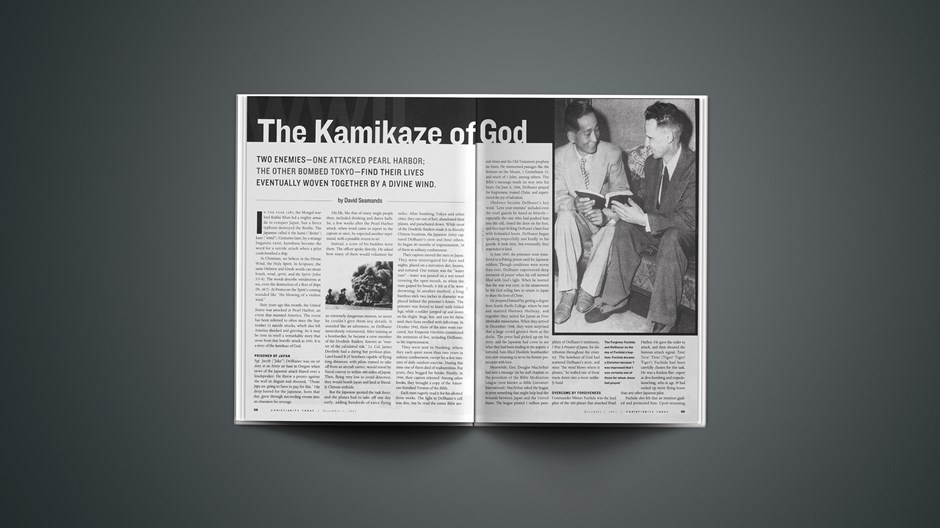
Sgt. Jacob ("Jake") DeShazer was on KP duty at an Army air base in Oregon when news of the Japanese attack blared over a loudspeaker. He threw a potato against the wall in disgust and shouted, "Those Japs are going to have to pay for this." His deep hatred for the Japanese, born that day, grew through succeeding events into an obsession for revenge.
His life, like that of many single people then, included drinking and dance halls. So, a few weeks after the Pearl Harbor attack, when word came to report to the captain at once, he expected another reprimand, with a possible return to KP.
Instead, a score of his buddies were there. The officer spoke directly. He asked how many of them would volunteer for an extremely dangerous mission, so secret he couldn't give them any details. It sounded like an adventure, so DeShazer immediately volunteered. After training as a bombardier, he became a crew member of the Doolittle Raiders. Known as "master of the calculated risk," Lt. Col. James Doolittle had a daring but perilous plan. Land-based B-25 bombers capable of flying long distances, with pilots trained to take off from an aircraft carrier, would travel by Naval convoy to within 400 miles of Japan. Then, flying very low to avoid detection, they would bomb Japan and land at friendly Chinese airfields.
But the Japanese spotted the task force, and the planes had to take off one day early, adding hundreds of extra flying miles. After bombing Tokyo and other cities, they ran out of fuel, abandoned their planes, and parachuted down. While most of the Doolittle Raiders made it to friendly Chinese locations, the Japanese Army captured DeShazer's crew and three others. So began 40 months of imprisonment, 34 of them in solitary confinement.
Their captors moved the men to Japan. They were interrogated for days and nights, placed on a starvation diet, beaten, and tortured. One torture was the "water cure"—water was poured on a wet towel covering the open mouth, so when the man gasped for breath, it felt as if he were drowning. In another method, a long bamboo stick two inches in diameter was placed behind the prisoner's knees. The prisoner was forced to kneel with folded legs, while a soldier jumped up and down on his thighs. Bugs, lice, and rats bit them until their faces swelled with infections. In October 1942, three of the men were executed, but Emperor Hirohito commuted the sentences of five, including DeShazer, to life imprisonment.
They were sent to Nanking, where they each spent more than two years in solitary confinement, except for a few minutes of daily outdoor exercise. During this time one of them died of malnutrition. For years, they begged for books. Finally, in 1944, their captors relented. Among other books, they brought a copy of the American Standard Version of the Bible.
Each man eagerly read it for his allotted three weeks. The light in DeShazer's cell was dim, but he read the entire Bible several times and the Old Testament prophets six times. He memorized passages like the Sermon on the Mount, 1 Corinthians 13, and much of 1 John, among others. The Bible's message made its way into his heart. On June 8, 1944, DeShazer prayed for forgiveness, trusted Christ, and experienced the joy of salvation.
Obedience became DeShazer's key word. "Love your enemies" included even the cruel guards he hated so bitterly—especially the one who had pushed him into the cell, closed the door on his foot, and then kept kicking DeShazer's bare foot with hobnailed boots. DeShazer began speaking respectfully and kindly to his guards. It took time, but eventually they responded in kind.
In June 1945, the prisoners were transferred to a Peking prison used for Japanese soldiers. Though conditions were worse than ever, DeShazer experienced deep moments of prayer when his cell seemed filled with God's light. When he learned that the war was over, to his amazement he felt God telling him to return to Japan to share the love of Christ.
Article continues below
He prepared himself by getting a degree from Seattle Pacific College, where he met and married Florence Matheny, and together they sailed for Japan as Free Methodist missionaries. When they arrived in December 1948, they were surprised that a large crowd greeted them at the docks. The press had picked up on his story, and the Japanese had come to see what they had been reading in the papers: a tortured, hate-filled Doolittle bombardier was now returning to serve his former persecutors with love.
Meanwhile, Gen. Douglas MacArthur had sent a message via his staff chaplain to the president of the Bible Meditation League (now known as Bible Literature International). MacArthur asked the league to print something that might help heal the wounds between Japan and the United States. The league printed 1 million pamphlets of DeShazer's testimony, I Was A Prisoner of Japan, for distribution throughout the country. The kamikaze of God had scattered DeShazer's story, and since "the wind blows where it pleases," he wafted one of those tracts down into a most unlikely hand.
Overcome by Forgiveness
Commander Mitsuo Fuchida was the lead pilot of the 360 planes that attacked Pearl Harbor. He gave the order to attack, and then shouted the famous attack signal, Tora! Tora! Tora! (Tiger! Tiger! Tiger!) Fuchida had been carefully chosen for this task. He was a fearless flier, expert at dive-bombing and torpedo-launching, who at age 39 had racked up more flying hours than any other Japanese pilot.
Fuchida also felt that an intuition guided and protected him. Upon returning from Pearl Harbor, he inspected his plane and found 20 large antiaircraft holes and the main control wire barely held together by a thread. Although he was not in any sense "religious," this was the first of a series of near-death incidents that made him believe something was watching over him. The successful attack against the United States made Fuchida a national hero, earning him an audience with Emperor Hirohito himself. This, mixed with typical Japanese military patriotism, added to his sense of destiny.
Other incidents contributed to this feeling. When the battle of Midway began in June 1942, Fuchida was in a below-deck sickbay on an aircraft carrier, suffering severe pain from an appendectomy. He disobeyed orders and crawled out of sick- bay to the flight deck. When American bombs hit the carrier, it exploded. Fuchida, thrown ten feet into the air, broke both legs as he fell. He barely missed burning to death, which happened to all who had stayed below deck.
Article continues below
In August 1945, Fuchida was on duty in Hiroshima when a telephone call summoned him to headquarters. He left the city at 5 p.m. The next day at 8 a.m., the first atom bomb destroyed the city. The next day, he was ordered back to Hiroshima. He spent three days walking amid the fatally radioactive rubble. While most officers became seriously ill and died from the exposure, Fuchida remained perfectly healthy.
Shortly after the war, Fuchida spoke to a friend who had been captured and then imprisoned in the United States. He was curious to hear how well Japanese prisoners were treated, especially by one 18-year-old volunteer, Peggy Covell. When the prisoners asked her why she had been so helpful, she replied, "Because Japanese soldiers killed my parents." She explained that her parents were missionary teachers in Japan at the beginning of the war. They fled, only to be captured later in the Philippines. They were judged to be spies and, while kneeling in prayer, they were beheaded. When Peggy heard about this three years later in the States (she had been evacuated), she was filled with hate. But she concluded that her parents must have forgiven their killers. Now God asked her to forgive—and show it.
This story astounded Fuchida. He had long been pondering a phrase from the Emperor's surrender broadcast—"To pave the way for a grand peace for all generations to come"—and now he began to think that such peace could come only from a supernatural source.
One day in October 1948, while waiting at a rail station in Tokyo, Fuchida was handed DeShazer's leaflet, I Was a Prisoner of Japan. He was ready to throw it away, but he noticed that it was written by a courageous Doolittle flier, so he read it with keen interest. This prompted him to buy a Bible immediately, though he didn't get around to reading it for months. When he did, he found that the Bible's message gripped him, and Christ's prayer from the cross captured him: "Father, forgive them, for they know not what they do" (Luke 23:24). He wept as he realized Jesus had prayed and died for him. In September 1949, he accepted Christ as his Savior, and he was baptized on Easter Sunday in 1951.
Over the next years, Fuchida and De-Shazer spoke to large crowds, both together and individually, and their ministries brought thousands more to Christ.
Fuchida died in 1976 at age 74. De-Shazer, now 88, and his wife live near Salem, Oregon.
While God may not be the author of every situation, he is certainly master of them all. Through his inspired (divine, wind-breathed) Word, two enemies, who through war and the subsequent peace had good reason not to trust Christ or one another, did both.
Article continues below
David Seamands, author of the classic Healing for Damaged Emotions, is a contributing editor to Christianity Today.
















 While we pray for peace, we need moral clarity about this war.
 We’ve got little information on Jesus’ appearance and personality. But that’s the way God designed it.españolFrançais
 The Grammy-winning artist was found dead at her home in Nashville at age 47.






