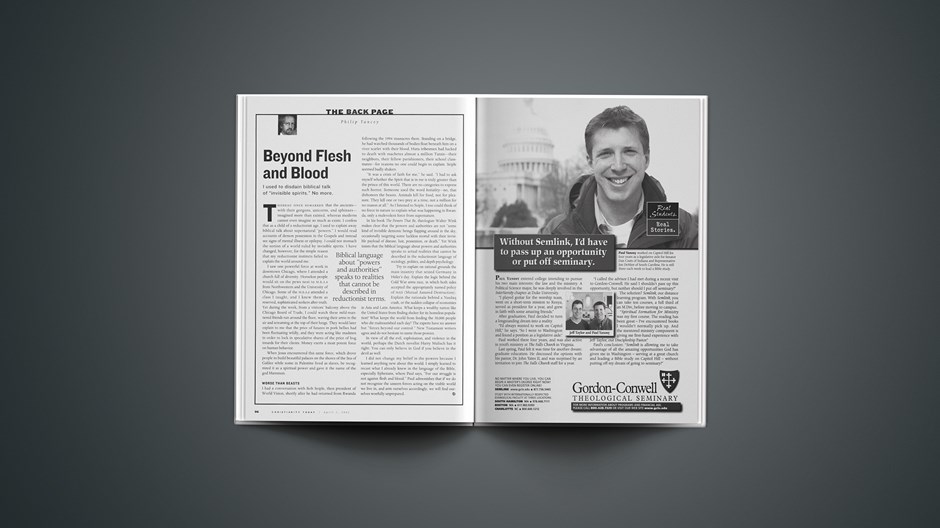
Thoreau once remarked that the ancients—with their gorgons, unicorns, and sphinxes—imagined more than existed, whereas moderns cannot even imagine so much as exists. I confess that as a child of a reductionist age, I used to explain away biblical talk about supernatural "powers." I would read accounts of demon possession in the Gospels and instead see signs of mental illness or epilepsy. I could not stomach the notion of a world ruled by invisible spirits. I have changed, however, for the simple reason that my reductionist instincts failed to explain the world around me.
I saw one powerful force at work in downtown Chicago, where I attended a church full of diversity. Homeless people would sit on the pews next to M.B.A.s from Northwestern and the University of Chicago. Some of the M.B.A.s attended a class I taught, and I knew them as reserved, sophisticated seekers after truth. Yet during the week, from a visitors' balcony above the Chicago Board of Trade, I could watch these mild-mannered friends run around the floor, waving their arms in the air and screaming at the top of their lungs. They would later explain to me that the price of futures in pork bellies had been fluctuating wildly, and they were acting like madmen in order to lock in speculative shares of the price of hog innards for their clients. Money exerts a most potent force on human behavior.
When Jesus encountered this same force, which drove people to build beautiful palaces on the shores of the Sea of Galilee while some in Palestine lived as slaves, he recognized it as a spiritual power and gave it the name of the god Mammon.
Worse Than Beasts
I had a conversation with Bob Seiple, then president of World Vision, shortly after he had returned from Rwanda following the 1994 massacres there. Standing on a bridge, he had watched thousands of bodies float beneath him on a river scarlet with their blood. Hutu tribesmen had hacked to death with machetes almost a million Tutsis—their neighbors, their fellow parishioners, their school classmates—for reasons no one could begin to explain. Seiple seemed badly shaken.
"It was a crisis of faith for me," he said. "I had to ask myself whether the Spirit that is in me is truly greater than the prince of this world. There are no categories to express such horror. Someone used the word bestiality—no, that dishonors the beasts. Animals kill for food, not for pleasure. They kill one or two prey at a time, not a million for no reason at all." As I listened to Seiple, I too could think of no force in nature to explain what was happening in Rwanda, only a malevolent force from supernature.
In his book The Powers That Be, theologian Walter Wink makes clear that the powers and authorities are not "some kind of invisible demonic beings flapping around in the sky, occasionally targeting some luckless mortal with their invisible payload of disease, lust, possession, or death." Yet Wink insists that the biblical language about powers and authorities speaks to actual realities that cannot be described in the reductionist language of sociology, politics, and depth psychology.
Try to explain on rational grounds the mass insanity that seized Germany in Hitler's day. Explain the logic behind the Cold War arms race, in which both sides accepted the appropriately named policy of mad (Mutual Assured Destruction). Explain the rationale behind a Nasdaq crash, or the sudden collapse of economies in Asia and Latin America. What keeps a wealthy nation like the United States from finding shelter for its homeless population? What keeps the world from feeding the 30,000 people who die malnourished each day? The experts have no answer but "forces beyond our control." New Testament writers agree and do not hesitate to name those powers.
In view of all the evil, exploitation, and violence in the world, perhaps the Dutch novelist Harry Mulisch has it right: You can only believe in God if you believe in the devil as well.
I did not change my belief in the powers because I learned anything new about this world. I simply learned to recast what I already knew in the language of the Bible, especially Ephesians, where Paul says, "For our struggle is not against flesh and blood." Paul admonishes that if we do not recognize the unseen forces acting on the visible world we live in, and arm ourselves accordingly, we will find ourselves woefully unprepared.
Philip Yancey is editor at large of Christianity Today and cochair of the editorial board for Books and Culture. Yancey's most recent book is What Good Is God?: In Search of a Faith That Matters. His other books include Prayer (2006), Rumors of Another World (2003), Reaching for the Invisible God (2000), The Bible Jesus Read (1999), What's So Amazing About Grace? (1998), The Jesus I Never Knew (1995), Where is God When It Hurts (1990), and many others. His Christianity Today column ran from 1985 to 2009.















 While we pray for peace, we need moral clarity about this war.
 A Christian reconciliation group in Israel and Palestine warned that war would come. Now the war threatens their relevance.العربيةFrançais
 The Grammy-winning artist was found dead at her home in Nashville at age 47.






