The Talmud and the Internet: A Journey Between Worlds Jonathan Rosen
Farrar, Straus, and Giroux, 132 pages, $16
thelordismyshepherd.com: Seeking God in Cyberspace Joshua Hammerman
Simcha Press, 261 pages, $10.95
For both Jonathan Rosen and Joshua Hammerman, the Internet poses something of a problem. They are not Luddites, worried about the disastrous impact the new technology will have on social relations. They are simply religiously engaged Jews, of some not-so-easily-pigeonholed non-Orthodox variety. And they are intuitively sure that the Internet has some religious meaning—they're just not so sure what it is.
To describe that elusive religious meaning, both Hammerman and Rosen reach for analogies: the only way, it seems, to make the World Wide Web intelligible. Rosen, a former columnist for the leftish Jewish newspaper the Forward, likens the Web to the Talmud, and Hammerman likens it to God. That both feel compelled to resort to metaphor is where the similarities end. Hammerman's musings are silly and self-absorbed. Rosen's spare reflections are reflective, measured—and even Christians can learn from them.
Hammerman, a Connecticut rabbi, says it is all but impossible to find God in traditional religious vocabulary and sources. He is particularly upset with the metaphors offered by the 23rd Psalm. Thinking of God as a shepherd, he baldly asserts, does not comfort or resonate after "six million of my fellow Jews were led like sheep to the slaughter. … As a human being, I cannot trust a God who, on his shepherd's watch, would allow his sheep to die." Add to that Hammerman's discomfort "as a pastor" (a term that Hammerman really shouldn't keep using if he thinks the psalm's imagery outdated) with the "stifling" model of shepherd ministry leadership, and the shepherd image doesn't have a fighting chance. Hammerman drops the psalmist's metaphors—the metaphors that, according to Jewish teaching, God himself spoke to Moses on Sinai—and looks for "much more appealing metaphors" online.
What follows is a shallow tour of spiritual sites on the Internet, an online pilgrimage. First, Hammerman clicks to the Western Wall in Jerusalem, then to the al-Haram al-Sharif mosque, Madurai in southern India, and Chartres. In between these stops, readers are subjected to Hammerman's ramblings about faith, kabala, and the Gospel of John. He also surfs sites designed to live "in God's image." He goes to worldhungeryear.org, and checks out sites on homelessness, nonviolence, disabilities, and euthanasia (which he somehow considers prolife).
Hammerman's starting point—the Web can have religious meaning for religious folks—is useful. But his superficial discussion is not adequate to the task of exploring that religious meaning.
Eavesdropping on the rabbis
Jonathan Rosen's analogy of choice is not that the Web is like God but that the Web is like a page of Talmud. The Talmud, is, with the Hebrew Bible, the central text of Jewish Scripture. Compiled after the destruction of the Temple, the Talmud is the written version of instructions that God, according to Jewish teaching, revealed to Moses at the same time he revealed the Bible.
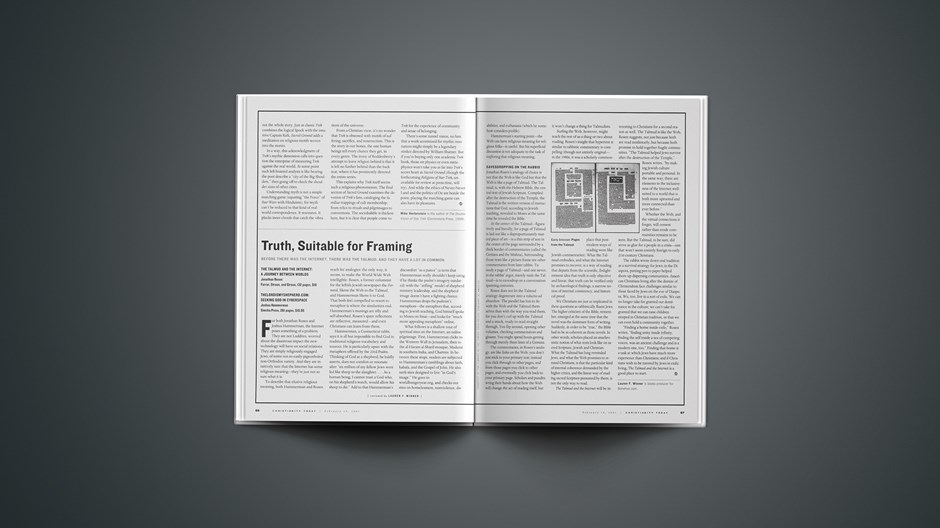
At the center of the Talmud—figuratively and literally, for a page of Talmud is laid out like a disproportionately matted piece of art—is a thin strip of text in the center of the page surrounded by a thick border of commentaries (called the Gemara and the Mishna). Surrounding those texts like a picture frame are other commentaries from later rabbis. To study a page of Talmud—and one never, in the rabbis' argot, merely reads the Talmud—is to eavesdrop on a conversation spanning centuries.
Rosen does not let the Talmud analogy degenerate into a reductio ad absurdum. The parallel has less to do with the Web and the Talmud themselves than with the way you read them, for you don't curl up with the Talmud and a snack, ready to read straight through. You flip around, opening other volumes, checking commentators and glosses. You might spend hours getting through merely three lines of a Gemara.
The commentaries, in Rosen's analogy, are like links on the Web: you don't just stick to your primary text; instead you click through to other pages, and from those pages you click to other pages, and eventually you click back to your primary page. Scholars and pundits wring their hands about how the Web will change the act of reading itself, but it won't change a thing for Talmudists.
Surfing the Web, however, might teach the rest of us a thing or two about reading. Rosen's insight that hypertext is similar to rabbinic commentary is compelling (though not entirely original— in the 1980s, it was a scholarly commonplace that postmodern ways of reading were like Jewish commentaries). What the Talmud embodies, and what the Internet promises to recover, is a way of reading that departs from the scientific, Enlightenment idea that truth is only objective and linear, that truth can be verified only by archaeological findings, a narrow notion of internal consistency, and historical proof.
Article continues below
We Christians are just as implicated in these questions as rabbinically fluent Jews. The higher criticism of the Bible, remember, emerged at the same time that the novel was the dominant form of writing. Suddenly, in order to be "true," the Bible had to be as coherent as those novels. In other words, scholars placed an anachronistic notion of what texts look like on sacred Scripture, Jewish and Christian. What the Talmud has long reminded Jews, and what the Web promises to remind Christians, is that the particular kind of internal coherence demanded by the higher critics, and the linear way of reading sacred Scripture presumed by them, is not the only way to read.
The Talmud and the Internet will be interesting to Christians for a second reason as well. The Talmud is like the Web, Rosen suggests, not just because both are read nonlinearly, but because both promise to hold together fragile communities. "The Talmud helped Jews survive after the destruction of the Temple," Rosen writes, "by making Jewish culture portable and personal. In the same way, there are elements in the inclusiveness of the Internet well-suited to a world that is both more uprooted and more connected than ever before."
Whether the Web, and the virtual connections it forges, will cement rather than erode communities remains to be seen. But the Talmud, to be sure, did serve as glue for a people in a crisis—one that won't seem entirely foreign to early 21st-century Christians.
The rabbis wrote down oral tradition as a survival strategy for Jews; in the Diaspora, putting pen to paper helped shore up dispersing communities. American Christians living after the demise of Christendom face challenges similar to those faced by Jews on the eve of Diaspora. We, too, live in a sort of exile. We can no longer take for granted our dominance in the culture; we can't take for granted that we can raise children steeped in Christian tradition, or that we can even hold a community together.
"Finding a home inside exile," Rosen writes, "finding unity inside infinity, finding the self inside a sea of competing voices, was an ancient challenge and is a modern one, too." Finding that home is a task at which Jews have much more experience than Christians; and if Christians wish to be tutored by Jews in exilic living, The Talmud and the Internet is a good place to start.
Lauren F. Winner is books producer for Beliefnet.com.
Image courtesy of The Library of the Jewish Theological Seminary of America.
Lauren Winner's "Living by Law, Looking for Intimacy | What Christians can learn from the debates that divide American Jews" is available from Books and Culture magazine.
Read about the history of the Talmud from its handwritten format to its first typesetting, or learn about the 20 volumes of scholarly discussion that have been incorporated into the Talmudic text over the past two thousand years.
Daf Yomi is a system of Talmud study founded in 1927 by Rabbi Meir Shapiro to unite Jews all over the world by having them study the same page of Talmud each day. The Daf Yomi Advancement Forum is an organization dedicated to promote this study. By following a seven-year calendar of readings, the Daf Yomi program allows Jews to read the entire Talmud in seven years.
Maqom is a cyber-school for adult Talmud study founded and directed by Rabbi Judith Abrams. Abrams is also creating "Talmud: The Musical," a play to illustrate the relevance of the Talmud to daily modern experience.
Have something to add about this? See something we missed? Share your feedback here.
Our digital archives are a work in progress. Let us know if corrections need to be made.















 While we pray for peace, we need moral clarity about this war.
 We’ve got little information on Jesus’ appearance and personality. But that’s the way God designed it.españolFrançais
 We must always be people of the Word, but we’ll have to reimagine deep engagement with Scripture.






