We've always had a love affair with the printed book. We write our names on the inside flaps, loan books to friends, and read bestsellers in the bathtub. We dog-ear the pages, underline our favorite passages, and stack paperbacks on our nightstands.
So what are book lovers to make of the electronic book? In this volatile time when the latest technology claims last a nanosecond, digital content providers promise us the moon. Electronic books, they assert, will cost readers less money, save publishers warehousing and overhead costs, and allow pastors and missionaries in Third World countries to access resources more quickly via the Internet. Authors will be able to self-publish their titles; bulky textbooks will be replaced by sleek laptops or handheld devices; and those quirky little tomes we love but that don't sell well will never go out of print.
Whether all of these things are true or just hype, one major appeal of the electronic book is its instant gratification for a fast-food generation. Digital books—via online bookstores such as Amazon.com or bn.com—are accessible 24/7. If you crave the latest bestseller at 2 a.m., you can download it to your PC in seconds. There's no shipping delay, and no out-of-stock apologies.
Business is betting on electronic books. According to research by Accenture, in just five years, 28 million of us will be adopting some sort of device to read our books electronically, whether through our PCs, a handheld reading device, or even a special mobile phone. Accenture also found that more than half of consumers, regardless of their age, want to use digital media—including audio, interactive television, and e-books. If these estimates hold true, Accenture predicts the market for digital books will be $2.3 billion in five years. The Wall Street Journal also quotes Dick Brass, vice president of technology at Microsoft, as predicting that 20 to 40 percent of all online text sales will be electronic in three to five years.
In case you've missed the e-book so far, an easy way to sample the technology is to go to www.amazon.com/ebooks/ and download the Microsoft Reader program. Classic titles, such as Moby Dick, are available for free downloading to your laptop or home PC, or you can choose from more than a thousand titles for sale on the site (ebooks.bn.com is another option). In addition to reading content on your home PC or laptop, you can also read specially-formatted e-books on dedicated reading devices such as Gemstar's eBook, which retails for around $300, or Franklin's eBookMan starting at $129.95. Other specialty e-books can be read on devices such as Palm Pilots.
Most e-book content is formatted in its digital language, then encrypted for copyright protection. Once you purchase an electronic book title from a Web site, there's often a verification process to make sure you got it legally, then it's yours for life—but you can't share it with friends, unless they look at it on your reading device or PC. Once purchased, e-books are not returnable.
Digital books have been around for several years, but early dedicated reading devices were often cumbersome and expensive. The sleek NuvoMedia Rocket eBook (which merged with SoftBook in an early 2000 buyout by Gemstar) cracked open the religious market in 1999 when InterVarsity Press and Broadman & Holman Publishers both issued several titles in the format to test Christian readership interest.
But the big break came last summer when Microsoft launched its Reader—a free program used to render books on PC screens and handheld Pocket PCs rather than having to purchase a special device. Suddenly, former e-book skeptics sat up and took notice. As Michael Hyatt, executive vice president and publisher at Thomas Nelson Publishers in Nashville says, "When you bet on Microsoft, it's usually pretty safe."
Keeping up with the Joneses
Safe bet or not, how much of the e-book chatter is just about image? Keith Carlton writes in PriceWaterhouseCoopers' Global Media and Entertainment Outlook that "in order to stay in front of the pack, or to simply remain competitive, companies must remain at the cutting edge of technology." At least two large Christian publishing houses are taking this seriously. Zondervan Publishing House of Grand Rapids, Michigan, and Thomas Nelson both recently announced a major plunge into e-books—a commitment both believe is critical in maintaining their positions in the industry and vying for big-name authors. (In press releases, both companies claimed to be the first Christian publisher in the e-book pool. Both were wrong; it was Intervarsity Press.)
"It helps us communicate that we are on the cutting edge," says Hyatt. "We can tell our authors we are committed to distributing them in every format available." Nelson introduced 17 titles in e-book format on November 15, and planned another wave of digital offerings in late January.
Article continues below
Zondervan's executive vice president and book group publisher Scott Bolinder is equally clear: "We want to be a leader. Our assets are our content. And how we deliver that content is secondary." Zondervan made Philip Yancey's Reaching for the Invisible God its first print release to go to electronic format in Microsoft Reader in November, and Leonard Sweet's The Dawn Mistaken for Dusk debuted at the same time, exclusively in electronic format and eight months before the print version. Trying both prepublishing and postpublishing electronic releases is Zondervan's way of testing the market, Bolinder says. "Everything we do with e-books is speculative. We are just putting our toe in the water and starting to learn."
Nelson will attempt to drive the electronic religious book market by releasing half its catalog in e-book format one month before the printed version, beginning this summer. Hyatt, who took over the Nelson helm in July and is trying to turn around its bottom line for shareholders, says e-books are not a financial risk.
"The cost of entry is so low, we can go down some blind alleys if we have to and then back up and take another tack," Hyatt says. "The most important thing we can do is put an oar in the water, get paddling, and figure out where to go."
Maybe it's not that simple—at least for other smaller and midsize publishing houses, such as Westminster John Knox (WJK) Press in Louisville. Richard Brown (who resigned as editorial director this month to direct Georgetown University Press) says WJK sees an "urgent need" to get in the game but isn't quite sure what strategy to pursue. "Many of us are scratching our heads over this," he admits. "At some point everything goes to the Internet. But what sort of delivery system do we want? We're still trying to figure out the next step."
Gary Terashita, senior acquisitions and development editor at Nashville-based Broadman & Holman, says the publisher has released 10 titles for Gemstar's eBook and is committed to bringing its entire list out in various "secure formats." Broadman is still looking for the right partnerships and vehicles for delivery. "Our two primary concerns are security for our author's intellectual property and financial efficiency in making the digital conversions," he says. With digital music's pirated content floating around for free on the Internet, publishers are worried about protecting their assets and avoiding a Napster-like nightmare.
Article continues below
Digital technology offers other hazards for traditional print publishers: the low cost of self-publishing for new authors. Digital publishing companies like startup Xulon Press in Vienna, Virginia, launched by former Creation House executive Tom Freiling, will take an author's edited manuscript and, for $399, publish it in digital and print format within a month.
Authors submit their manuscripts to Xulon Press, which digitizes the text and stores the file in Ingram's Lightning Source digital library. The book is then available in electronic, hardcover, or paperback editions for customers to order direct from Internet sites Amazon.com and bn.com, or for retailers to order via distributors Ingram and Spring Arbor. Xulon is also talking with seminaries and universities about creating an imprint for their books in all formats in partnership with the publisher, enabling professors to publish their work quickly and inexpensively.
Some readers, such as Jamie Engle, 38, like the idea of "fresh content" that e-book publishing can provide. Engle, a mother of three, became a digital-book convert in 1998 because of the "unique cross-blend of genres" found in e-books—but rarely in print. ("E-books tend toward the subgenres of genre fiction and allow more freedom in settings, time periods, and character types," she says.) She reads digital books on an old-model Rocket eBook, her personal PC, and a Pocket PC.
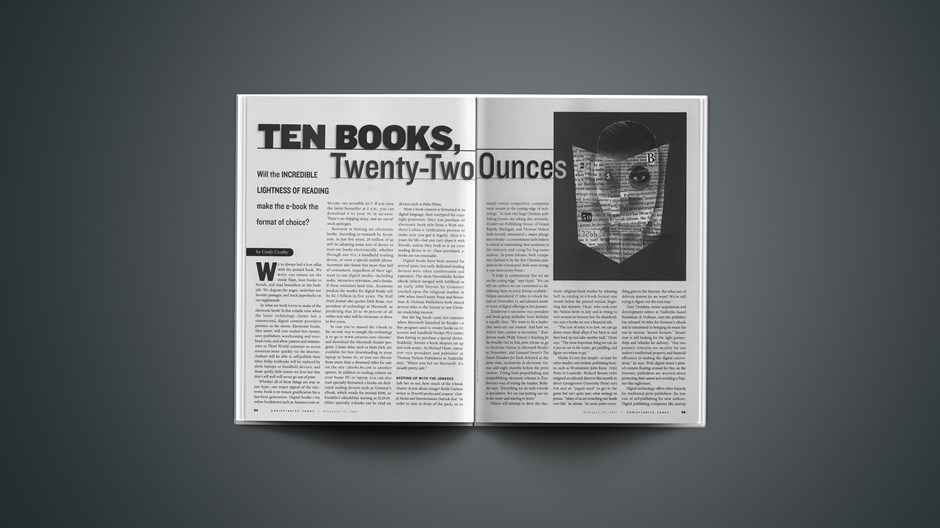
"I read a lot when I travel," Engle says. "Taking ten books with me that weigh a total of 22 ounces, instead of 10 pounds, is a lot easier!"
Engle says she finds it difficult to read on her desktop computer, but she likes it for nonfiction reference books because of the live hyperlinks.
"The new reading software has made reading on my desktop easier on my eyes," Engle says. "But it's still not as comfortable as curling up in a chair and reading a print book."
Her enthusiasm for the e-book led her to open two informational Web sites in 1999: ebookconnections.com and epublishingconnections.com. Her Web sites contain news, reviews, supplier directories, and links to other e-book information sites, as well as basic instruction on how to use e-books.
Jim Seybert, vice president of marketing at The Parable Group (an association of 333 independent Christian stores), isn't so enthusiastic about his experience trying to read an e-book on his old Palm II handheld computer: "I downloaded a Gospel of John and tried to read it, but couldn't. The main drawback was the way it advanced text one line at a time, which was extremely difficult to read. I have since given up on using Palm-like devices, returning to hard-copy paper calendars and little scraps of paper in my pocket."
Article continues below
A laptop on every pulpit
Despite all the potential dollars to be made, it's not just about business. Advocates point out that e-books offer new ways to spread the gospel. Mission organizations pay large shipping costs to send books to Third World countries, providing pastors and church leaders with material for education and training.
Digital content could change all this, says Bucky Rosenbaum, CEO of the privately-owned, for-profit Pastors.com. The site was launched last year by Rick Warren, founding pastor of Saddleback Valley Community Church in California and author of The Purpose-Driven Church. Rosenbaum, a former executive at Broadman & Holman, said Pastors.com is working with publishers to have digital content available for download in six to nine months.
Rosenbaum envisions an estimated 2.2 million evangelical pastors worldwide downloading low-cost or no-cost electronic reference works, training manuals, and sermon-preparation tools. "Only about 350,000 of these pastors and church leaders have any college or seminary training," Rosenbaum says. "Our goal is to get a laptop in the hands of every pastor in those countries—many of whom are new Christians themselves and can't attend a seminary."
Rosenbaum acknowledges that while seminary students are familiar with the latest gadgets, many pastors are less in tune with technology. Missionaries tend to be more familiar with digital content because of their frequent communication with financial supporters and their home organizations, he believes: "We found that even in countries where there may not be running water, someone has an Internet connection."
Others in ministry see e-books as an important future component of global mission work—but balanced with print resources. George Verwer, president of Operation Mobilization, recently worked with the Evangelical Christian Publishers Association to ship more than a million donated books to Christian leaders in poor countries. Although he embraces the new technology, he doesn't believe an electronic book will eliminate the need for a hardcover or paperback. "Print books will still be a vital part of ministry overseas. It won't be an either-or situation, it will be both," Verwer says.
Article continues below
Ministry values and business profitability questions aside, the bottom line is whether we really want to read the newest Philip Yancey title on our laptops. No one really knows—and probably will not know for a while. The only certainty is that we'll continue to explore how it makes the best sense to integrate the gospel with technology.
"There's a whole generation out there that is Internet savvy and carrying around their Palm Pilots," says Hyatt. We have to be willing to be in every format available to reach the world for Christ."
Cindy Crosby regularly covers the book industry for Publishers Weekly, Christian Retailing, and other publications. She is the author of Waiting for Morning, due in July from Baker Book House.
An easy way to sample e-book technology is to download Microsoft Reader at Amazon.com/ebooks/ or ebooks.bn.com, and then sample one of the free books available at either site.
Christianity Today's Wired World area has several articles about Christian using evolving technology including:
Is God.com Dead? | Investors lost faith in iBelieve.com, Lightsource.com was extinguished, and Crosswalk is being run over. What happened to the for-profit Christian Web site boom? (Feb. 9, 2001)
We've Got Porn | Online smut is taking its toll on Christians. What is the church doing about it? (July, 5, 2000)















 While we pray for peace, we need moral clarity about this war.
 A Christian reconciliation group in Israel and Palestine warned that war would come. Now the war threatens their relevance.españolالعربيةFrançaisрусскийУкраїнська
 Beyoncé’s right. Whether listening to Cowboy Carter or reading theology, diversity is a good thing.






