As a young man of 23, missionary Jim Elliot wrote in his journal, "For youth there is special wretchedness; for then the powers within conflict most bluntly with the powers without. Restraint is most galling, release most desired. To compensate for these, youth has special powers."
The so-called special "wretchedness" and "powers" of today's youth have been the subject of much of the cultural conversation recently. The string of school shootings over the past few years and other alarming trends (like anorexia and self-mutilation) have aroused national soul-searching and highlight the extremes, positive and negative, of the generation known as the Millennials.
Despite the troubling signals, there is still plenty of good news. "The unsung story of today's teenagers may be how religious they are," wrote John Leland in Newsweek (May 8, 2000). Indeed, in an earlier Newsweek poll, 78 percent of teenagers said religion is important, and many gladly identified themselves as "spiritual," though few wanted to be labeled "religious." Christian pollster George Barna notes that two out of three teens strongly desire a personal relationship with God. The downside, according to Barna, is that fewer than half are excited about church, which has left many church leaders wondering how to reach this complicated and disparate cohort.
Trends and demographics are open to interpretation. But two characteristics are emerging as defining features of many Millennials: They are activists, and they long for God. One place where they and the church are coming together in a happy collaboration is the mission trip. This experience is becoming so prevalent in youth ministry that many high school pastors see it almost as a rite of passage.
"A youth mission trip offers a great opportunity for discipling," says Seth Barnes, executive director of Adventures in Missions (www.adventures.org), a Gainesville, Georgia-based ministry that sponsors and coordinates trips for youth groups around the country. Barnes says proper screening and training are essential because some teens go simply for the adventure or to get away from home. But assuming those checks are in place, he says the trip itself is an excellent tool for training a young person in the hard work of following Christ.
"It requires discipline, reaching out to others, and personal holiness," he says, all of which appeal to the activist and spiritual inclinations of the Millennials. The exponential rise in the number of trips reflects their interest in such an enterprise. Short-term mission trips numbered around 25,000 people in 1979. By 1989 that number had jumped to 120,000, and by 1995 to 200,000.
Many youth pastors believe mission trips are one way to call youth to a higher level of accountability and, says Barnes, "They are answering that call."
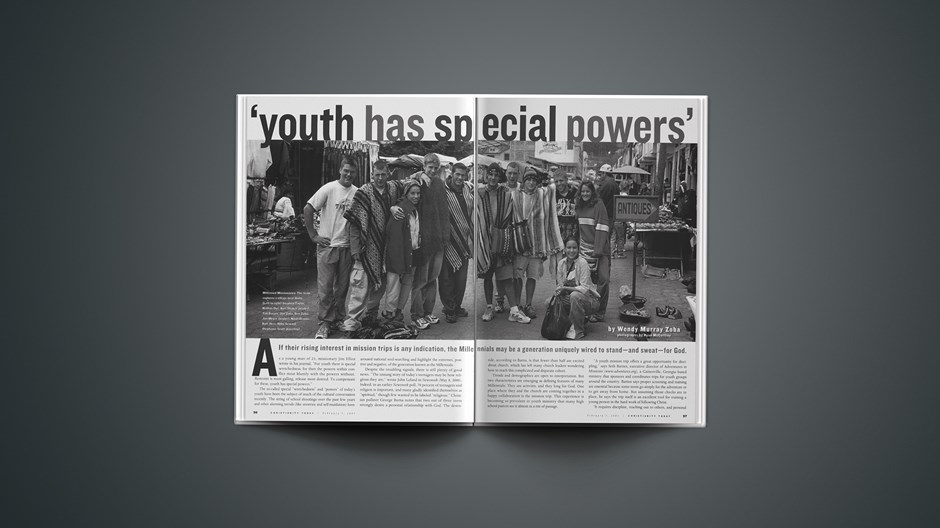
I observed the "phenomenon" up close last summer when my husband Bob and I (and three other younger leaders) led a group of 12 teens to the jungles of Ecuador. One mission trip does not denote a trend for an entire generation. But it offers a window into the kind of gritty spirituality that animates many of today's teens.
Why they went
The teens we took were suburban and white, and most had been raised in Christian homes. They were active in the senior-high youth program at College Church in Wheaton, Illinois, and each had a personal reason for making the trip.
Stephanie wanted to know she had "suffered to help someone." Rachel prayed that the trip would "restore humility" in her. Susanna didn't want to go at first but felt the Lord wanted her to do it. Nate said that God had recently shown him "the true horrors of what an eternal hell would be like" and so activated his otherwise passive faith.
Karen said she wanted the "chance to serve" because God had been showing her "how selfish and ungrateful" she was. Abby hoped for the opportunity to work with needy children. Noah wanted to "share the gospel and love with others." Stephen sensed a call to become a missionary pilot and wanted exposure to missions.
Kyle hoped it "would change how I view the way I live." Tim wanted "to see the poverty and helplessness in the world." Our sons Ben and Jon, also team members, went because Jon wanted "to bring God glory," and Ben wanted "to be a servant like [Christ] was."
The team went to work with the missionary community serving HCJB World Radio, based in Quito (HCJB stands for "Heralding Christ Jesus' Blessings"). We were to drive east of Quito, to the outskirts of the jungle to work with the missionaries who lived in a town called Shell (named by the oil company; population 5,000). They ran a hospital sponsored by HCJB that served nationals and people from the jungle tribes. The original hospital there had been built in the 1950s by Nate Saint, one of the five missionaries who died in 1956 at the hands of the Auca Indians (today known as the Huaorani; pronounced Wah-dah-nee). Saint and the others had departed from Shell when they took their fateful trip into the jungle to meet the tribe. Saint had secured land in Shell and donated a portion to HCJB for that purpose. All five martyred men worked on the crew that built that first hospital. It had since been converted to the guesthouse where we stayed. The martyrs' black-and-white photos hung in the hallway.
Article continues below
On our first full day, we traveled five hours by bus from Quito to Shell. We went through the "avenue of the volcanoes," some of which were still blowing smoke, and then over the "Shell Road," a stretch the oil company chiseled out of the mountainside decades ago. Many of us hadn't slept the night before, and fatigue was setting in. I tucked my head into a pillow to snatch some sleep. That's when Noah, our worship leader, pulled out his guitar. The kids called out requests and started to sing. I tried to ignore them. I didn't know most of the songs and it annoyed me to be with singing people when I was tired and couldn't sing along. But the girls had perfect pitch and the guys sang boldly. "I'm coming back to the heart of worship;/it's all about You, Lord, it's all about you, Jesus./I'm sorry for the things that I've made it;/it's all about you, Lord, it's all about you."
They sang many songs I didn't know. But by the time they sang "Amazing Grace," I had lifted my head out of the pillow and was singing, too.
No time for blisters to heal
Once in Shell, we reported to the maintenance area where a missionary named Alex showed Bob the list of jobs he hoped we would accomplish that week. Bob shook his head and didn't think we could do it in the time we had. But the teens were up for the challenge. Alex divided us into teams: one crew painted the school library, another poured a new concrete sidewalk, and the crew I was on removed the dingy ceiling tiles from the north wing of the hospital with the plan to repaint and replace them all.
The Hospital Vozandes del Oriente was at the center of our activity. Our hosting missionaries, Mark and Marilyn Papierski, had lived in Shell as career missionaries since 1991, and Mark served as its administrator. The hospital was small by U.S. standards, but it had a reputation for offering outstanding care at low cost. The price of seeing a doctor was $1; it was $25 to spend the night and $100 to have a baby. Even so, these sums were an elusive dream for most, so patients often paid their bills with fruit, chickens, or the side of a cow. "We don't turn people away who can't afford to pay," Mark Papierski told us. "But we do ask them to pay what they can, even if it's only a bag of yuca."
Article continues below
Roger Smalligan, a missionary doctor with HCJB, said he saw people every day who had traveled up to 12 hours to get there. But they receive more than health care. "We can do medicine anywhere in the world, but we're here to share what Jesus Christ has done in our lives," he said. The hospital chaplain, he said, sees 10 to 15 people a month come to the Lord.
In one area of the hospital, a glass case housed Huaorani artifacts. One looked like a stone hatchet with a dull edge. Mark Papierski told us the Huaorani attackers used this to break the knees of some of the martyred missionaries when they attacked, so the missionaries would fall face-down before being speared. Reminders were everywhere, it seemed, that kept us aware of the men in whose shadows we walked.
At the end of the first day, spirits were high despite the blistered hands and tired muscles. Noah launched our evening devotions. "This morning I was reading in Nehemiah, and one of his prayers was that God would be his strength. God showed me the impact the Spirit has on your physical being," he said. "Paul commands us not to complain or grumble. We should make that our goal."
"I was reading Colossians today," said Jon. "In 3:23 we're commanded to work. It's not an option. We're commanded to be happy and cheerful when we work."
When the teens prayed I heard phrases like "even the things that don't have life in them, the rocks and the mountains, glorify you" and "the trees climb upward trying to touch you, their Creator, to return your glory back to yourself."
The week wore on, and the work became more tedious, but the teenagers found creative ways to pass the time, like the mock battle they staged one day between the Smurfs and the Care Bears. But their typical means to get through the day was to sing hymns and praise songs. A teacher overheard them when they worked at the school and wrote Mark Papierski an e-mail: "Monday, as I worked in the classroom, their joyous refrains of hymns flooded through the window, as the young men energetically loaded and dumped barrels of mud."
Article continues below
The work got tougher day by day, and there was no time for blisters and muscles to heal. One crew lost half a day trying to pull one stubborn boulder from a ditch. Working around patients in stretchers or wheelchairs and hearing children cry was taking its toll on the ceiling-tile crew at the hospital. A baby with pneumonia, clinging to life, hacked with such struggle that each cough sounded like it would be her last. Sometimes nurses shushed us as we worked. A mouse ran across one ceiling tile as we pulled it out; another mouse lay dead on a different tile.
Many in our group contended with sickness; others were losing sleep from itching and burning bug bites. It rained constantly, which meant our clothes didn't dry when we hung them up. After a week's work, our "infirmities," as the apostle Paul calls them, were laid bare before one another. Noah and Tim hadn't done laundry all week, and their dirty clothes, strewn all over the floor of their room, stunk up the hallway. Some complained when we changed their work assignments; others maneuvered to be placed on a different crew. More than once I was ignored as I tried to relay pertinent instructions. We confronted tears, squabbles, jealousies, and hurt feelings—on top of fatigue, intestinal disorders, nausea, and raw nerves.
Still, we gathered every night for student-led devotions. Karen was scheduled to lead after one particularly grueling day, but first had to fight for her bag of Cheez-Its snatched by one of the guys. Then she opened with Scripture.
"This morning I was reading in Isaiah, and, well, this is what I read: 'Come, all you who are thirsty, come to the waters; and you who have no money, come, buy, and eat! … Seek the Lord while he may be found; call on him while he is near.'"
The group, sore and subdued, sat attentively while she read. After a stretch of silence, Stephen said, "I learned perseverance today. My arms hurt, and I did not feel like I could keep going. But I realized you just have to mix that next batch of cement, no matter what it takes."
"I prayed for patience with the ceiling tiles," said Tim.
"Trying to pull that boulder out made me think that it was like our sin," said Kyle. "It took a whole group of us working together to get it out and move it to where it could be forgotten."
Noah was sick but got out of bed to play guitar and lead the singing: "I lift my eyes unto the heavens; where does my help come from? My help comes from you, Maker of Heaven, Creator of the earth."
Article continues below
Sick and exhausted, the teens bobbed their heads as they sang and closed their eyes. The girls lifted their faces, and the guys folded their blistered hands. They sang past the quiet curfew at the guesthouse, but nobody complained. By the evening's end, everyone had forgiven Tim and Noah for stinking up the hallway—and Susanna ministered to them, and to us all, when she heroically did their laundry the next day.
Angels on the hills
Our last day in Shell was to be our payoff day. It was the one chance we had to journey into the jungle and visit the site of the massacre of the five missionaries—Nate Saint, Pete Fleming, Jim Elliot, Roger Youderian, and Ed McCully. We were scheduled to fly into ToÑampade, the village from which the killers launched their attack. More recently, Nate Saint's sister Rachel had lived and was buried there.
The night before, we asked God for a miracle. It would take a miracle to pull this off. Two Mission Aviation Fellowship (MAF) pilots flying two planes that carried only six had to get 17 of us out and back before dark, weather permitting. It meant shuttling four planeloads.
That morning we woke up to rain. The quiet group gathered for breakfast and I read the morning devotional: "The path of the just is like the shining sun that shines ever brighter unto the perfect day" (Prov. 4:18).
The first shift, myself included, arrived at the hangar at 7:35 a.m., the torrential downpour notwithstanding. The pilots and other MAF personnel invited us to join them for their morning prayers, and the rain came down so hard on the corrugated roof, we could barely hear the words.
Our pilot, Dan, looked at the sky at 9:30 and said, "The low clouds are breaking up. We could probably get you out. I'm just not sure we could get you back." The whole undertaking would have to be abandoned if the skies didn't clear soon. Abby, Rachel, and I stood in a circle outside and prayed. "God, you know that we would really like to go to the jungle," said Abby. "It's totally okay if it doesn't work out. But we'd just really like to go."
By 10:30 the Cessna's engines were roaring and we were buckled in. The skies were still gray and wet, but another pilot had radioed in from the east, where we were headed, and said it was clear. I thought of Nate Saint as we ascended into the clouds. His house still stood on the edge of the road across from the hangar. He had charted this course in his little yellow plane decades ago. Today these pilots could almost fly it blindfolded.
Article continues below
The clouds carried us into our dream. The jungle was so dense you couldn't see the ground except where ridges gave way to mudslides. The flight took 25 minutes. The increased humidity in the cabin signaled we were dropping in altitude and getting close. The plane banked to the left, then right. We righted ourselves to touch down on the patch of grass that looked to me more like a Popsicle stick than a landing strip. Before we knew it, we were on the ground being greeted by women and children led by Dayuma, a Huaorani woman who had been a key helper in Rachel Saint's translation work.
The heat and humidity were oppressive, but the skies were blue. Dan turned around immediately to fly back to Shell to shuttle another group. Dayuma took us down a path to the village. We passed Rachel Saint's grave and a memorial dedicated to the five fallen missionaries "who sacrificed their lives in this place on January 8, 1956, for the advancement of the gospel of our Lord Jesus Christ."
The next planeload arrived shortly thereafter. The first two groups were to canoe down the Curaray River to the site of the massacre. I was looking forward to standing on Palm Beach, where the men had been killed, to read the group a portion from Steve Saint's article published in CT (Sept. 16, 1996). In that article, he told the story of the attack as the Huaorani had told it to him. They had said that after the massacre, the attackers had seen angels on the ridge above the beach and had heard singing. I wanted our group to look up at the ridge and imagine the angels and think about these brave men who died without defending themselves.
But the pilot told our group we had to return with him. I asked if I could do a quick reading first, and he consented. Sweat poured off my face onto the paper as I read, competing with Huaorani women talking loudly and freely to my right and kids playing raucously with Ben and Jon to my left. A Huaorani woman, whose name I never learned but who came to be known to us as "The Woman with the Big Holes in Her Ears," stood behind me looking over my shoulder. Whenever I mispronounced a Huaorani word, she corrected me.
We weren't standing on Palm Beach, and there were no singing angels. Still, I sensed something transpire that day. The Woman with the Big Holes in Her Ears seemed gratified that I had learned to pronounce some tribal words correctly, and she hugged me before we boarded the plane. The Huaorani kids ran down the airstrip waving at us as the Cessna lifted us out of the dream. Abby was crying in the back of the plane, and back at the guesthouse, I found Ben on his hands and knees in prayer beside his bed.
Article continues below
40,000 pounds of cement
God answered our prayers. Every one of us made it out to the tribe and back. We spent our last night in Shell reflecting on the day and the entire week. Stephanie prayed, "Dear Lord, I just want to thank you for an awesome day. Even though in the morning it seemed like it wasn't going to happen, you are faithful and you gave us this awesome opportunity to go to the jungle tribe and see what the lives of those five men brought for your glory."
Karen burped.
"Burper!" said Tim.
Unfazed, Stephanie led the devotion. "This whole trip has been a really awesome demonstration of his love for us and it really, like, revived my spirits and stuff." She read a portion from C. S. Lewis's Mere Christianity: "[Y]our moods change. … That is why daily prayers and religious reading and churchgoing are a necessary part of the Christian life. We have to be continually reminded of what we believe."
"We've all been changed here," Stephanie said. "We can't let our friends make us normal again. We can't forget it. It's our job to go back and share this awesome experience with everybody and remind them of what we've been reminded here this week."
They also reflected on the work accomplished that week. "For the record," Stephen said, "in the last week, the cement crew has mixed about 40,000 pounds of cement." We poured sidewalks, painted the school library and basketball court, put in a basketball hoop, dug a drainage ditch, built a carport, landscaped one side of the hospital, and replaced all of the ceiling tiles in one wing of the hospital. Alex crossed almost every job off his list.
Our mandate had been to serve the missionaries through grunt work, but the teens especially rejoiced that they were able to perform a gospel skit—in Spanish—for people seated in the hospital waiting area.
The sharing of that last evening soon moved to reflections about the Huaorani visit. "We went running through la selva [the jungle] looking for snakes," said Jon. "The kids took us through the whole village, to one hut, then another hut, and then to another hut. We were waving to everybody, when 50 years earlier if we had done that, we would have been speared to death. We couldn't have done that if those five men hadn't died. It was interesting to think about the legendary story of Jim Elliot and the others and how we were so directly affected by it. It's so humbling."
Article continues below
"I enjoyed talking with Dayuma's husband," said Ben. "He was older, so he lived back in the day when the tribe was all about killing and revenge. He was so friendly and cheerful. It was incredible to think about what he would be like if they hadn't had this change of heart."
From mission trip to Power Jam
It is difficult to measure the true impact a mission trip has on the lives of young people. One layer of enthusiasm has to be peeled away by virtue of their being teens. But the "special powers" of youth, to which Elliot referred, shine bright in an experience like this. People have to die a lot of little deaths on a mission trip, forcing them to submit their individual wills to the greater purpose.
There were days that our teens did not want to work and didn't think they could lift another shovelful of dirt. But they pressed on, emboldened by their singing and a sense that the Holy Spirit was giving them new strength. The Ecuadorian foremen who oversaw their work used the Spanish words santidad and servicio to describe these youth: "holy" and "servants."
It is too soon to tell whether these virtues will play out over the long haul. But seeing the Millennials in our group using their limited Spanish to talk with people, running hut to hut with the Huaorani kids, crying and praying on their knees, and singing hymns when their flesh felt its weakest, gives me reason to hope.
After we returned from Ecuador, several youth from our town, including young people from our trip, organized a community event to reach their unchurched peers. They called it Power Jam. The young people themselves planned, prayed, and orchestrated the event with no adult input, doing everything from running the cotton-candy machine to leading the worship. Six hundred local youth showed up.
All of the youth who led the Power Jam had recently been on mission trips, observes Rod Van Solkema, who at the time was senior-high pastor at College Church. He adds, "They learned on those trips, 'If God can use me over there, why can't he use us over here?'"
Article continues below
A mission trip will not set the course for an entire generation. But, as it did with our group, it can help young people to see a God who is alive in his world—where trees climb upward to return God's glory to himself; where the Spirit builds up the physical being; where the sinful nature can be slaughtered with a song.
It's too soon to tell if the mission-trip trend is raising a generation of disciples. But it's a start.
Wendy Murray Zoba is a senior writer for CT. Her latest book, Day of Reckoning: Columbine and the Search for America's Soul (Brazos), comes out this month.
Elegy for a Jesus Freak | "These are the ultimate Jesus Freaks—the people who are willing to die for their faith."—Toby McKeehen of dc Talk (Dec. 6, 1999)
















 While we pray for peace, we need moral clarity about this war.
 A Christian reconciliation group in Israel and Palestine warned that war would come. Now the war threatens their relevance.العربيةFrançais
 The Grammy-winning artist was found dead at her home in Nashville at age 47.






