Artur Barcis, Olgierd Lukaszewicz, Olaf Lubaszenko
Theatre Release
December 10, 1989
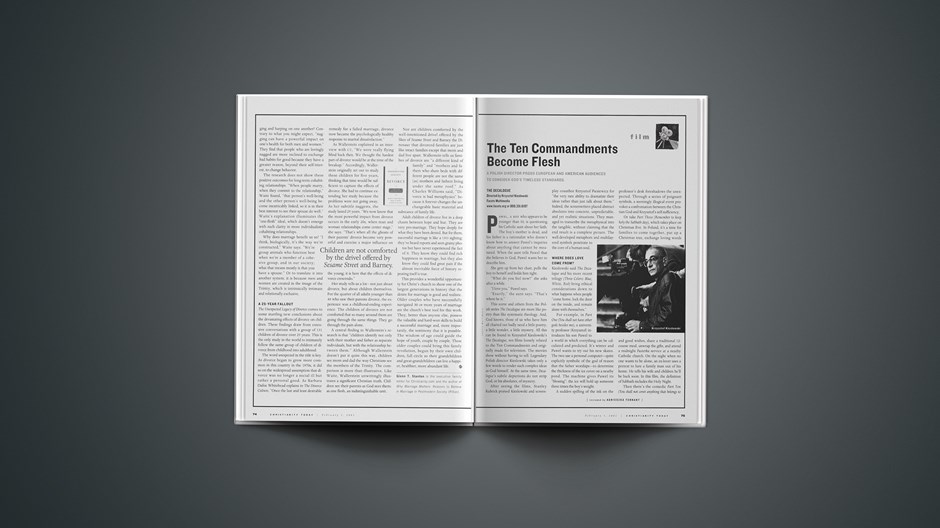
The Decalogue
Directed by Krzysztof Kieslowski
Facets Multimedia www.facets.org or 800.331.6197
Pawel, a boy who appears to be younger than 10, is questioning his Catholic aunt about her faith. The boy's mother is dead, and his father is a rationalist who doesn't know how to answer Pawel's inquiries about anything that cannot be measured. When the aunt tells Pawel that she believes in God, Pawel wants her to describe him.
She gets up from her chair, pulls the boy to herself and holds him tight.
"What do you feel now?" she asks after a while.
"I love you," Pawel says.
"Exactly," the aunt says. "That's where he is."
This scene and others from the Polish series The Decalogue are more like poetry than like systematic theology. And, God knows, those of us who have him all charted out badly need a little poetry, a little wonder, a little mystery. All this can be found in Krzysztof Kieslowski's The Decalogue, ten films loosely related to the Ten Commandments and originally made for television. The movies show without having to tell. Legendary Polish director Kieslowski takes only a few words to render such complex ideas as God himself. At the same time, Decalogue's subtle depictions do not strip God, or his absolutes, of mystery.
After seeing the films, Stanley Kubrick praised Kieslowski and screenplay coauthor Krzysztof Piesiewicz for "the very rare ability to dramatize their ideas rather than just talk about them." Indeed, the screenwriters placed abstract absolutes into concrete, unpredictable, and yet realistic situations. They managed to transcribe the metaphysical into the tangible, without claiming that the end result is a complete picture. The well-developed metaphors and multilayered symbols penetrate to the core of a human soul.
Where does love come from?
Kieslowski said The Decalogue and his more recent trilogy (Three Colors: Blue, White, Red) bring ethical considerations down to what happens when people "come home, lock the door on the inside, and remain alone with themselves."
For example, in Part One (You shall not have other gods besides me), a university professor (Krzysztof) introduces his son Pawel to a world in which everything can be calculated and predicted. It's winter and Pawel wants to try out his new skates. The two use a personal computer—quite explicitly symbolic of the god of reason that the father worships—to determine the thickness of the ice cover on a nearby pond. The machine gives Pawel its "blessing": the ice will hold up someone three times the boy's weight.
A sudden spilling of the ink on the professor's desk foreshadows the unexpected. Through a series of poignant symbols, a seemingly illogical event provokes a confrontation between the Christian God and Krzysztof's self-sufficiency.
Or take Part Three (Remember to keep holy the Sabbath day), which takes place on Christmas Eve. In Poland, it's a time for families to come together, put up a Christmas tree, exchange loving words and good wishes, share a traditional 12-course meal, unwrap the gifts, and attend a midnight Pasterka service at a nearby Catholic church. On the night when no one wants to be alone, an ex-lover uses a pretext to lure a family man out of his home. He tells his wife and children he'll be back soon. In this film, the definition of Sabbath includes the Holy Night.
Then there's the comedic Part Ten (You shall not covet anything that belongs to your neighbor), in which two brothers unexpectedly inherit a rare stamp collection that turns out to be worth millions. But they refuse to sell it and obsess about a little stamp missing from the collection.
Like Three Colors: Blue, White, Red, each part of The Decalogue is a complete dramatic picture and can be seen by itself. But seeing all ten films rewards viewers with the adventure of spotting themes that emerge throughout the series. Part Four and Part Seven jointly teach a lesson about parenthood: that it must be earned, and that it is more than just biology.
Both Part Two and Part Eight speak against taking a child's life. In my favorite of all ten films, Part Two (You shall not take the name of the Lord Your God in vain), a woman poses a hard question to the doctor in charge of her dying husband's case: "Will he live?" The physician is reluctant to give a verdict. Things could go either way—he's seen dying patients spring back to life and the healthy die unexpectedly, for no reason. The woman persists, stalking the doctor.
Eventually she tells him why she wants to know the answer: Previously unable to get pregnant, she's now expecting a baby. But the child is not her husband's. If her husband lives, she'll abort—if he dies, she'll keep the baby. Should the physician give in to this psychological blackmail? Should he swear that her husband will live, or swear that he will die, easing her decision about the baby? Initially he refuses to play God.
Part Three, Part Six, and Part Nine deal with love and lust: Love is "in the heart, not between the legs," says the heroine of Part Nine. Where does this love come from? How is it born and how is it sustained? (There is nudity in Part Six and some sensuality in Part Three and Part Nine.)
Article continues below
The Decalogue's understated, true-to-life settings—mass-produced, colorless buildings (much like the one in Szczecinek, Poland, where I lived as a child); cheerless wintry outdoors; cold flats; bad cars; impersonal stairwells; elevators and offices—do not detract from the series' charm. The shabby scenery directs the spotlight to some of Poland's best actors as they reflect the agonies of not-so-clear ethical choices.
Individual commandments influence each movie "to the same degree that the commandments influence our daily lives," the director said. Consequently, some of the films correspond with a given commandment almost incidentally, and the commandments function as excuses for bigger, more complex ethical debates.
Such is the case in Part Eight (You shall not bear false witness against your neighbor), which asks the poster question from an ethics course: "Would you lie to the Gestapo if you were hiding Jews during the war?" But this film digs even deeper: "If you believed it was wrong to lie to the Gestapo, would you refuse to hide Jews—even if you knew that your decision would send them to an almost sure death?" The questions aren't abstract. People in Poland faced these dilemmas during World War II before situation ethics debates began in American classrooms. In the film, a university professor meets the Jewish woman whom the professor refused to hide from the Gestapo when she was a girl. There's nothing predictable about their encounter.
One character poses a delightful puzzle. A lanky, blond, somber young man pops up in eight of the films, often carrying a large prop such as a kayak or a suitcase. The man often locks eyes with a main character just before that character makes a difficult ethical decision, or just before something unexpected happens. He never says anything. Who is he? I had thought I solved the riddle: the man symbolizes God's presence among us, Christian conscience, or at least—for a secular audience—fate. Then I found out what Kieslowski said about him: "I don't know who he is; just a guy who comes and watches us, our lives. He's not very pleased with us." With all other metaphors of The Decalogue being so thought out and consistent, it seems Kieslowski must have been teasing. But I'll never get a chance to ask him: the filmmaker died suddenly in 1996 at the age of 54.
Both the director and the series quickly became popular in Europe, but North American distributors held out for too long with the release in the United States. Some copies did trickle in from Europe shortly after the films were completed but only recently has a subtitled The Decalogue shown up at some urban Blockbuster stores and more ambitious cinemas. Filmed in 1988 and 1989 in Poland, the series showcases some arguably humorous remains of totalitarianism (the rudeness of the government-run hospital staff in Part Two for example), but they're not the main emphasis. Kieslowski purposely left out many facts of socialist Poland for the sake of reaching international audiences. He wanted viewers to wrestle with the truths of the Ten Commandments not out of their nationality, but out of their humanity.
Article continues below
Agnieszka Tennant is an assistant editor of Christianity Today.
















 While we pray for peace, we need moral clarity about this war.
 As my doubts about his teachings grew, so did a secret fascination with Jesus.
 Beyoncé’s right. Whether listening to Cowboy Carter or reading theology, diversity is a good thing.






