Let the president alone!" declared President Clinton's defenders in the midst of Monicagate. "Judge him by political standards, not personal ones. The private and the public are separate spheres. Mind your own business, you sexual McCarthyists!"
Many Americans, of course, disagreed as they partook in this national conversation. The President's impeachment forced us to grapple with the complicated mix of morality, governance, and faith. Whatever the overall legacy of Bill Clinton, this piece of it holds lessons for the nation but especially for the church.
1. Reject the separation of personal and public. While 1999 polls seemed to affirm that Clinton's sexual escapades were his own business, the year 2000 was less charitable. "Clinton fatigue" set in. Memories of his infidelity and duplicity kept hobbling his attempts to "move on," seriously impeding the President's political effectiveness. Former presidential adviser David Gergen gave us a behind-the-scenes glimpse of how the personal was beginning to take a political toll. In his book Eyewitness to Power, he reported that the exposure of Clinton's infidelity damaged his conjugal bonds and so depressed him that he and the first lady were unable to work together on domestic policies. In addition, Hillary Clinton decided to run for the Senate at the same time. No relation between private and public?
Furthermore, the "character issue"—the weight of one's word when a finger is wagged or public testimony given, how one treats another human being, one's faithfulness to vows taken before bar or altar, and sexual responsibility—marked both Democratic and Republican campaigns this fall. In selecting Joseph Lieberman, a high-profile critic of Clinton's behavior, my own Democratic Party acknowledged that deep down in the soul of the American electorate the personal is inseparable from the political.
And while policy questions were given priority, surely the issue of character was a subtext in the Bush campaign. As presidential historian Doris Kearns Goodwin has said on television, the Clinton scandals gave Bush the character issue, significantly influencing the voters.
One part of Clinton's legacy is that we will scrutinize his successors to make sure there is coherence between personal behavior and public professions of piety and virtue. Prediction: Future presidents will be held accountable because women reporters and a newly voiced female citizenry will no longer let male sexual adventurism pass.
In an ironic twist, the "separatists"—who insisted that government had no business mixing the personal with the political—campaigned to pass a congressional resolution declaring Clinton's personal conduct reprehensible. Of course, the congressional rebuke functioned partly as a ploy to show moral outrage while deflecting impeachment. But it was also an admission that the faithful execution of public office requires the personal virtues of trustworthiness, truth-telling, and fidelity.
2. Understand two "conversations." How often we saw President Clinton proceeding from church with Bible in hand. How pious were his prayer breakfasts, visits to congregations, and consultations with clergy. Sooner or later, he had to account for disparities between his professions of piety and his practice.
Two conversations go on with presidents about matters of personal morality. The first conversation has to do with the public's need for moral standards in public office, based on data everyone can inspect in accord with universally discernible norms. Being caught in lies and infidelity weakens a presidency. When the public was having this conversation with Clinton, it escalated into congressional scrutiny of his "high crimes and misdemeanors."
Christians conduct a second conversation with a president who professes to be a believer. This conversation draws upon biblical teachings to which both parties give allegiance, such as matters of repentance and forgiveness, the grace of God, Christian vocation and its responsibilities, the temptations that come with power, and the like.
Unfortunately, the nation confused these two conversations during the presidential crisis.
Defenders of Clinton declared the critique that came from religious quarters to be a dangerous neopuritanism. But the theological call for accountability is part of the second conversation—the back-and-forth among professed Christians about shared moral commitments. Such dialogue might well include a call for resignation as a sign of making amends for dishonoring one's stewardship of the highest office in the land.
However, Christian-specific charges in themselves do not constitute warrants for impeachment. Some critics of Clinton gave ammunition to his defenders as they deployed Christian premises as criteria for removal from office. Yet another aspect of the Clinton legacy is that we must distinguish between the two encounters in the public square, because they have different venues, criteria, and consequences.
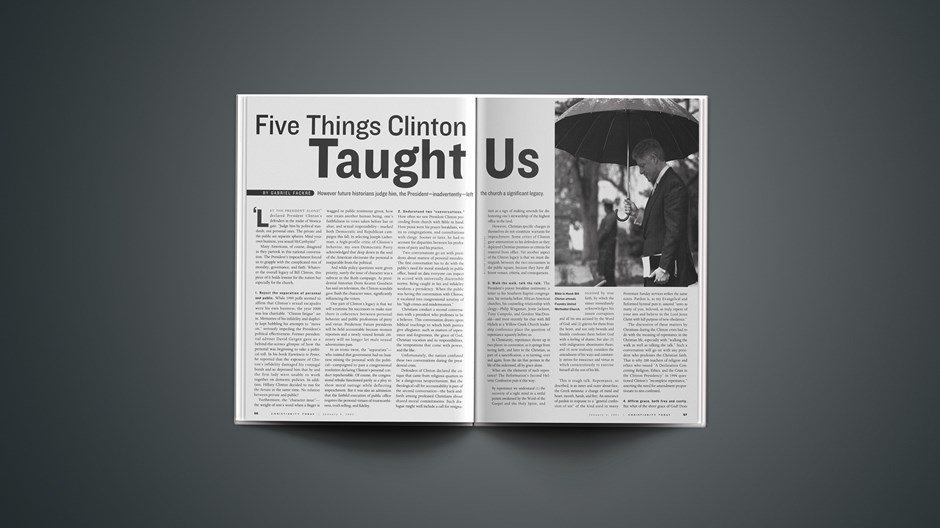
3. Walk the walk, talk the talk. The President's prayer breakfast testimony, a letter to his Southern Baptist congregation, his remarks before African-American churches, his counseling relationship with clergy—Philip Wogaman, Jessie Jackson, Tony Campolo, and Gordon MacDonald—and most recently his chat with Bill Hybels at a Willow Creek Church leadership conference place the question of repentance squarely before us.
Article continues below
In Christianity, repentance shows up in two places: in conversion, as it springs from saving faith, and later in the Christian, as part of a sanctification, a re-turning, ever and again, from the sin that persists in the life of the redeemed, all by grace alone.
What are the elements of such repentance? The Reformation's Second Helvetic Confession puts it this way:
By repentance we understand (1) the recovery of a right mind in a sinful person awakened by the Word of the Gospel and the Holy Spirit, and received by true faith, by which the sinner immediately acknowledges his innate corruption and all his sins accused by the Word of God; and (2) grieves for them from the heart, and not only bewails and frankly confesses them before God with a feeling of shame; but also (3) with indignation abominates them; and (4) now zealously considers the amendment of his ways and constantly strives for innocence and virtue in which conscientiously to exercise himself all the rest of his life.
This is tough talk. Repentance, so described, is an inner and outer about-face, the Greek metanoia: a change of mind and heart, mouth, hands, and feet. An assurance of pardon in response to a "general confession of sin" of the kind used in many Protestant Sunday services strikes the same notes. Pardon is, as my Evangelical and Reformed hymnal puts it, assured "unto as many of you, beloved, as truly repent of your sins and believe in the Lord Jesus Christ with full purpose of new obedience."
The discussion of these matters by Christians during the Clinton crisis had to do with the meaning of repentance in the Christian life, especially with "walking the walk as well as talking the talk." Such a conversation will go on with any president who professes the Christian faith. That is why 200 teachers of religion and ethics who issued "A Declaration Concerning Religion, Ethics, and the Crisis in the Clinton Presidency" in 1998 questioned Clinton's "incomplete repentance," asserting the need for amendment proportionate to sins confessed.
4. Affirm grace, both free and costly. But what of the sheer grace of God? Does God withhold mercy when repentance is incomplete? Another lesson from the Clinton legacy is that we need to struggle with the question of how God's mercy comes to the sinner.
Article continues below
Our Lord's parable of the Prodigal Son illuminates Clinton's attempt at repentance. Did the father welcome the errant home because he knew his son returned penitent? Not according to the account in Scripture. The prodigal was "yet afar off" when the father ran to embrace him. The parent had no knowledge of the son's reasons for return (could it be another plea for patrimony?), yet he put out the welcome mat. God's unmerited, unconditional grace anxiously awaits sinners.
What did it take for the Semitic parent, righteously wrathful over the son's wasted substance, to make that move? Surely it took a heart that accepted the judgment deserved by the son into itself, a portent of God's suffering love on the cross. Divine forgiveness awaits the sinners because of Christ's sacrifice, not because of their good works such as acts of penitence. Grace is free!
But it is not cheap, as Dietrich Bonhoeffer pointed out in The Cost of Discipleship. Grace is there for the taking, but you must receive it firsthand. Faith enabled the prodigal's reach for the grace-filled arms of the father. And the prodigal had to make that metanoia from old demons to get on the road home, an about-face possible only by grace. A costly repentance is not yet faith, but is inextricable from it. Paradoxically, grace costs nothing but it is priceless.
Did we forgive the prodigal? The plea of the pious as well as many politicians was the same during the crisis: "The President has repented. What more do you want?" A fair question. Do we have the right to withhold our forgiveness and show less charity than Jesus Christ? Our mercy must run in welcome like the proverbial earthly father and reach like the heavenly Father. Christian forgiveness comes without conditions, even before the word or deed of repentance. Bill Clinton does not need to earn his salvation by good works, including the words and deeds of repentance, any more than we do.
Yet, like the prodigal, he must make a turn toward home to receive the proffered forgiveness. Grace is free but not cheap. It is not ours to withhold forgiveness from the President. It is his to decide to accept it in the heart, with the mouth, and by the feet.
The Christian conversation has implications for the public conversation here. For Christians, the Clinton legacy teaches another facet of the "distinguishable but not separable" refrain in matters of morals, politics, and piety. In her comments on forgiveness during the crisis, political philosopher and theologian Jean Bethke Elshtain observed that Pope John Paul II forgave his would-be assassin, but he did not plead for removal of the assailant's jail term. In the same vein, a Boston pastor noted that Jesus forgave the thief on the cross but did not rescue him from his civil penalty. Both comments recognize the distinction Christians must make between the gospel and law, the forgiveness freely given by the grace of God and the accountability required by the norms of the state.
Article continues below
5. Beware the hand of Jehu
As Jehu drives his chariot through the Plain of Jezreel toward Samaria to kill the remaining members of the royal family, he invites the prophet Jehonadab to ride along: "Come with me and see my zeal for the Lord."
So observed biblical scholar Robert Jewett in Judgment Day at the White House, citing 2 Kings 10:16. He was drawing an analogy between the temptations of Jehonadab and the conduct of some clergy during the Clinton crisis.
The hand of Jehu is ever extended. Ah, to ride in the chariots of the mighty! The ready absolution given to Clinton by some religious leaders in response to his words of contrition made me think of the seduction of proximity to power. Among others, Clinton got endorsements from Christian Century editorials as well as from prominent evangelicals. And what do we make of Bill Hybels's recent hosting of a Clinton apologia in the country's best-known megachurch? Six hundred members of that congregation gathered soon after to ask their pastor that question.
Was Clinton's apparent contrition just the White House way of seeking to refute the President's critics? Religious leaders need to learn something about the "gee whiz" factor. To be on the list of invitees to the White House, to get a phone call from the President, to have him sit in one of your pews—is this a hand up into the chariot? God help us if we give evidence for the Marxist charge that religion exists to provide cover for the powers that be.
Of course presidents need pastoral care. Clergy should attend them, even with the temptations that come at the highest level of power. How to relate pastorally to those at the pinnacle but not capitulate politically to their agenda? The art of living in such tension doesn't come easy. In doing so, the ministers should remember the companion story to Jehu and Jehonadab, that of Nathan's response to the execrable actions of David. Not only must the prophet refuse to ride with the king; he must be ready to stand before that king and say firmly and publicly, "You are the man!" (2 Samuel 12:7).
Article continues below
Presidents hunger for a legacy that will shape generations to come. That legacy may include lessons taught by untoward circumstances and unsought recollections. Time will tell if both our nation and the church learned well from this season of soul-searching.
Gabriel Fackre is a research scholar at the Center of Theological Inquiry in Princeton. He is editor of Judgment Day at the White House (Eerdmans, 1999) and author of its sequel, The Day After (Eerdmans, 2000).
Christianity Today's most recent article on Clinton covered his visit to Willow Creek Community Church.
Read a transcript of Clinton's appearance at Willow Creek here.
More recently, Clinton gave the January 7 sermon at Foundry United Methodist Church. A transcript of his message, "Reflections and Anticipations," is available here.















 While we pray for peace, we need moral clarity about this war.
 As my doubts about his teachings grew, so did a secret fascination with Jesus.
 Helping marine biodiversity flourish is a means of participating in God’s work, says an Indonesian theologian.






