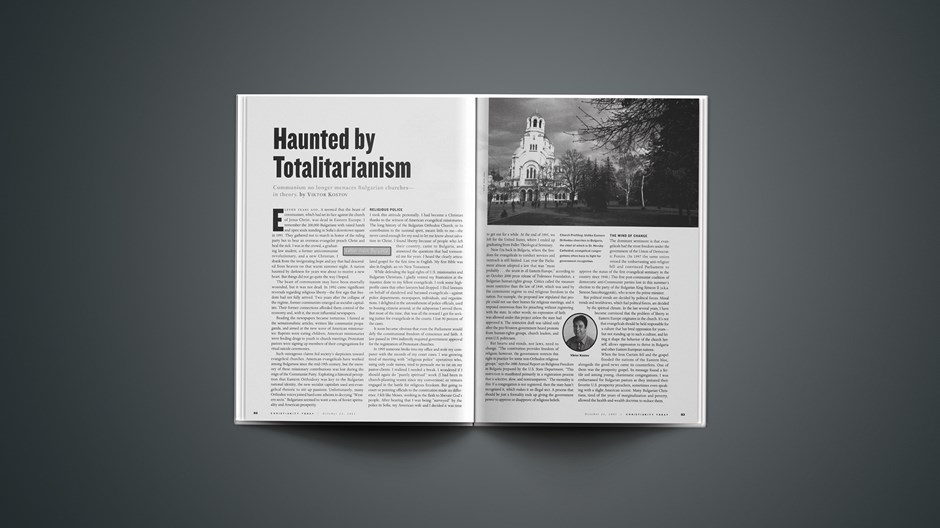
Eleven years ago, it seemed that the beast of communism, which had set its face against the church of Jesus Christ, was dead in Eastern Europe. I remember the 200,000 Bulgarians with raised hands and open souls standing in Sofia's downtown square in 1991. They gathered not to march in honor of the ruling party but to hear an overseas evangelist preach Christ and heal the sick. I was in the crowd, a graduating law student, a former anticommunist revolutionary, and a new Christian. I drank from the invigorating hope and joy that had descended from heaven on that warm summer night. A nation haunted by darkness for years was about to receive a new heart. But things did not go quite the way I hoped.
The beast of communism may have been mortally wounded, but it was not dead. In 1992 came significant reversals regarding religious liberty—the first sign that freedom had not fully arrived. Two years after the collapse of the regime, former communists emerged as socialist capitalists. Their former connections afforded them control of the economy and, with it, the most influential newspapers.
Reading the newspapers became torturous. I fumed at the sensationalistic articles, written like communist propaganda, and aimed at the new wave of American missionaries: Baptists were eating children; American missionaries were feeding drugs to youth in church meetings; Protestant pastors were signing up members of their congregations for ritual suicide ceremonies.
Such outrageous claims fed society's skepticism toward evangelical churches. American evangelicals have worked among Bulgarians since the mid-19th century, but the memory of these missionary contributions was lost during the reign of the Communist Party. Exploiting a historical perception that Eastern Orthodoxy was key to the Bulgarian national identity, the new socialist capitalists used anti-evangelical rhetoric to stir up passions. Unfortunately, many Orthodox voices joined hard-core atheists in decrying "Western sects." Bulgarians seemed to want a mix of Soviet spirituality and American prosperity.
Religious Police
I took this attitude personally. I had become a Christian thanks to the witness of American evangelical missionaries. The long history of the Bulgarian Orthodox Church, or its contribution to the national spirit, meant little to me—she never cared enough for my soul to let me know about salvation in Christ. I found liberty because of people who left their country, came to Bulgaria, and answered the questions that had tormented me for years. I heard the clearly articulated gospel for the first time in English. My first Bible was also in English: an NIV New Testament.
While defending the legal rights of U.S. missionaries and Bulgarian Christians, I gladly vented my frustration at the injustice done to my fellow evangelicals. I took some high-profile cases that other lawyers had dropped. I filed lawsuits on behalf of slandered and harassed evangelicals—against police departments, newspapers, individuals, and organizations. I delighted in the astonishment of police officials, used to bossing citizens around, at the subpoenas I served them. But most of the time, that was all the reward I got for seeking justice for evangelicals in the courts. I lost 90 percent of the cases.
It soon became obvious that even the Parliament would defy the constitutional freedom of conscience and faith. A law passed in 1994 indirectly required government approval for the registration of Protestant churches.
In 1995 someone broke into my office and stole my computer with the records of my court cases. I was growing tired of meeting with "religious police" operatives who, using only code names, tried to persuade me to rat on my pastor-clients. I realized I needed a break. I wondered if I should again do "purely spiritual" work (I had been in church-planting teams since my conversion) or remain engaged in the battle for religious freedom. But going to court or pointing officials to the constitution made no difference. I felt like Moses, working in the flesh to liberate God's people. After hearing that I was being "surveyed" by the police in Sofia, my American wife and I decided it was time to get out for a while. At the end of 1995, we left for the United States, where I ended up graduating from Fuller Theological Seminary.
Now I'm back in Bulgaria, where the freedom for evangelicals to conduct services and outreach is still limited. Last year the Parliament almost adopted a law that was "most probably. … the worst in all Eastern Europe," according to an October 2000 press release of Tolerance Foundation, a Bulgarian human-rights group. Critics called the measure more restrictive than the law of 1949, which was used by the communist regime to end religious freedom in the nation. For example, the proposed law stipulated that people could not use their homes for religious meetings, and it imposed enormous fines for preaching without registering with the state. In other words, no expression of faith was allowed under this project unless the state had approved it. The restrictive draft was tabled only after the pro-Western government heard protests from human-rights groups, church leaders, and even U.S. politicians.
Article continues below
But hearts and minds, not laws, need to change. "The constitution provides freedom of religion; however, the government restricts this right in practice for some non-Orthodox religious groups," says the 2000 Annual Report on Religious Freedom in Bulgaria prepared by the U.S. State Department. "This restriction is manifested primarily in a registration process that is selective, slow, and nontransparent." The mentality is this: If a congregation is not registered, then the state hasn't recognized it, which makes it an illegal sect. A process that should be just a formality ends up giving the government power to approve or disapprove of religious beliefs.
The Wind of Change
The dominant sentiment is that evangelicals had the most freedom under the government of the Union of Democratic Forces. (In 1997 the same union vetoed the embarrassing anti-religion bill and convinced Parliament to approve the status of the first evangelical seminary in the country since 1948.) This first post-communist coalition of democratic anti-Communist parties lost in this summer's election to the party of the Bulgarian King Simeon II (a.k.a. Simeon Saxcoburggotski), who is now the prime minister.
But political trends are decided by political forces. Moral trends and worldviews, which fuel political forces, are decided by the spiritual climate. In the last several years, I have become convinced that the problem of liberty in Eastern Europe originates in the church. It's not that evangelicals should be held responsible for a culture that has bred oppression for years—but not standing up to such a culture, and letting it shape the behavior of the church herself, allows oppression to thrive in Bulgaria and other Eastern European nations.
When the Iron Curtain fell and the gospel flooded the nations of the Eastern bloc, alongside the good news came its counterfeits. One of them was the prosperity gospel. Its message found a fertile soil among young, charismatic congregations. I was embarrassed for Bulgarian pastors as they imitated their favorite U.S. prosperity preachers, sometimes even speaking with a slight American accent. Many Bulgarian Christians, tired of the years of marginalization and poverty, allowed the health-and-wealth doctrine to seduce them.
Article continues below
Neediness, Control, and Fear
It was not just the Western prosperity preachers' fault. Evangelicals in Bulgaria were accustomed to seeking foreign help—an understandable reflex after years of being second-class citizens in their own country. The church did not err in accepting help from American Christians; but the neediness of many Bulgarian evangelicals had distorted their view of American wealth. A leader of a Christian training school in Sofia once told me that his school was reluctant to hire Bulgarian theologians and teachers because they had to be paid. If American teachers were invited to teach, they paid their own way, did not receive any salary, and even brought gifts to the school. This conversation made me realize how difficult it is to break loose from the ruts of poverty.
Bulgarian evangelical Christians are a brutalized people. Stuck in a wounded culture, church leaders tend to multiply hurt and deny liberty, as if they took lessons from communist leaders. Their harsh authoritarianism cripples Christian witness and repels young and educated Christians.
Milena Michailova, a manager of a Christian bookstore in Sofia, had trouble finding a home church. The leaders of various congregations were threatened by this avid reader who asked questions. "The pastors I know don't allow anyone or anything to challenge their authority," she told me. "They treat people as if they don't understand anything, and with an attitude of being irreplaceable."
When traveling with her mobile bookstore, a bus loaded with Christian titles, she finds a lot of rivalry among local pastors. "They also seem to be threatened by [Christian booksellers], and we just want to sell literature that will help the believers," she says.
Bulgarian evangelicals' church leadership style—a mix of control and fear—reveals the need for spiritual mentoring that would liberate leaders from their insecurities. My brother, Yavor Kostov, pastor of four small congregations in the poorest, northwestern area of the country, thinks dictatorial church leadership inhibits church growth. "Pastors don't lead people to Jesus but to themselves," he says. "This means that no gifts, talents, or freedom can blossom in the church." His primary church started after a dispute regarding leadership style.
It is hard for many new-generation believers to join churches that use methodologies reminiscent of the Communist Party. When Milena Eneva was considering attending a U.S. Bible college, her pastor bluntly told her that this was not God's will and that she would lose the presence of the Holy Spirit in her life—not exactly the blessing she wanted. She is now a graduate of a U.S. Nazarene college.
Article continues below
Totalitarian harshness among evangelicals is not only a Bulgarian phenomenon. Many evangelical churches in other post-communist countries (such as Ukraine, Romania, and Poland) practice a legalism that defeats the Christian message. A missionary to Eastern Europe told me he once took a nonbelieving relative to a Ukrainian Pentecostal church. The church members looked at her makeup and fancy clothes with such obvious disapproval that she vowed never to return to church again.
Why would anyone, beat up by a hard life to begin with, want to come to church to be subject to the will and strife of insecure individuals? Didn't Jesus say, "Come to me, all you who are weary and burdened, and I will give you rest"?
Zeal, Vision
By now you may be asking, "Is there anything right with the post-communist church?" The zeal with which Eastern European believers kept the message during the communist era is an example of the church's strength. Persecuted pastors put in hours of work, with minimal or no pay, and traveled miles to care for their brothers and sisters. Evangelicals were harassed, fired, detained, and interrogated for owning Bibles or just talking about their faith.
Haralan Popov spent 13 years in concentration camps, accused of spying for the United States and England. He was not a spy, but a pastor of the largest Pentecostal church in Bulgaria, when the communists took over in the 1940s. He not only did not renounce his faith amid torture, but he also shared the gospel and the love of Christ with his fellow prisoners. In 1972 he founded Door of Hope International, a U.S. mission agency that spread the news of the persecuted church in the West and helped underground churches behind the Iron Curtain. This past is the great spiritual inheritance of Eastern European Christians, one empowered by the freedom found only in Christ and displayed in the Book of Acts.
A new generation with a vision for change is emerging, too. Here are some of its leaders:
Michailova leads a missionary campaign with her bus, selling Christian books.
A missionary friend told me of a humble Bulgarian couple who minister to Bulgarian Turks in southern Bulgaria, with the vision of raising missionaries to go to Turkey.
My brother's primary church reaches out to institutionalized orphans, and his church's rock band seeks to win young people's souls.
Article continues below
All these hope-filled glimpses show that true freedom for a servant and visionary church is not that far away.
My wife and I have returned to Bulgaria as missionaries with Door of Hope to pursue "the Bulgarian dream," as I often joke. But the dream is not a joke. The vision from that summer night of 1991—for a whole nation, a bride of darkness and hopelessness for decades, to find a better way, a way to truth, forgiveness, and liberty in Jesus Christ—is still very much alive in me. I think the same dream made the apostles follow Christ against all odds. It made the apostle Paul travel restlessly, building up churches. And it made missionaries go to foreign nations, reminding us over and over again that "for freedom Christ has set us free."
Viktor Kostov is founder of the Balkan Center for Law and Freedom, a religious-liberty lawyer, and a missionary (Web site: kmission.homestead.com) working in Sofia, Bulgaria, with his wife and two children.
The U.S. Department of State's Annual Report on International Religious Freedom for 2000 gives more background on religious freedom in Bulgaria. International Christian Concern has more on persecution in Bulgaria.
Radio Free Europe put together an update on the progress of Eastern European countries ten years after the fall of communism. One article on Bulgaria found that "communism had stumbled, not fallen."















 While we pray for peace, we need moral clarity about this war.
 As my doubts about his teachings grew, so did a secret fascination with Jesus.
 The Grammy-winning artist was found dead at her home in Nashville at age 47.






