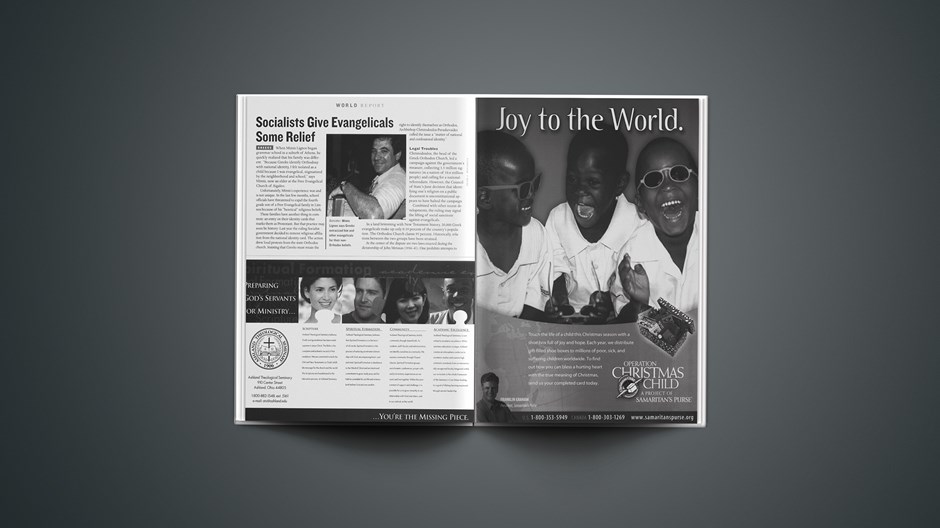
When Mimis Lignos began grammar school in a suburb of Athens, he quickly realized that his family was different. "Because Greeks identify Orthodoxy with national identity, I felt isolated as a child because I was evangelical, stigmatized by the neighborhood and school," says Mimis, now an elder at the Free Evangelical Church of Aigaleo.
Unfortunately, Mimis's experience was and is not unique. In the last few months, school officials have threatened to expel the fourth-grade son of a Free Evangelical family in Limnos because of his "heretical" religious beliefs.
These families have another thing in common: an entry on their identity cards that marks them as Protestant. But that practice may soon be history: Last year the ruling Socialist government decided to remove religious affiliation from the national identity card. The action drew loud protests from the state Orthodox church. Insisting that Greeks must retain the right to identify themselves as Orthodox, Archbishop Christodoulos Paraskevaides called the issue a "matter of national and confessional identity."
Legal Troubles
Christodoulos, the head of the Greek Orthodox Church, led a campaign against the government's measure, collecting 3.5 million signatures (in a nation of 10.6 million people) and calling for a national referendum. However, the Council of State's June decision that identifying one's religion on a public document is unconstitutional appears to have halted the campaign.
Combined with other recent developments, the ruling may signal the lifting of social sanctions against evangelicals.
In a land brimming with New Testament history, 20,000 Greek evangelicals make up only 0.19 percent of the country's population. The Orthodox Church claims 95 percent. Historically, relations between the two groups have been strained.
At the center of the dispute are two laws enacted during the dictatorship of John Metaxas (1936-41). One prohibits attempts to convert Greek Orthodox to other religions. The other requires all non-Orthodox churches to obtain licenses from local Orthodox bishops.
In 1986 authorities filed charges under the proselytism law against evangelical leader Costas Macris, but he was eventually exonerated on appeal. In 1997 a European Union court found the Greek government guilty of violating the religious rights of three Pentecostals when it sharply restricted their evangelistic outreach.
Last December, Thessaloniki police charged 11 evangelical congregations with operating without permits from Orthodox authorities, but a district court ruled in their favor.
Still, not all is well. Last spring, both Protestant radio stations in Athens were shut down by the Ministry of Press and Media. Government authorities insisted that the evangelical stations were not singled out, pointing out that many other commercial stations were shut down as well. But human-rights observers have documented discriminatory government interference with one of the evangelical stations in the past.
Johan Candelin, director of the World Evangelical Fellowship's Religious Liberty Commission, calls the station closings "disturbing" and a reason for vigilance. "More than ever, now is the time for evangelicals to be proactive," he told CT.
Still, Greek evangelicals have witnessed small signs that Greek Orthodox leaders are becoming more tolerant of other Christian traditions. John Paul II's well-publicized May visit to Athens may lead to a lessening of religious tensions between the Orthodox East and the Catholic and Protestant West. The pontiff and Archbishop Christodoulos both stated their desire to reclaim "the Christian roots of Europe and its Christian soul." Some additional Protestant-Orthodox discussion occurs through the World Council of Churches (WCC). Both the Greek Orthodox Church and the Greek Evangelical (Presbyterian) Church are WCC members, although they are not in dialogue.
Operation Rose
Fotis Romeos, general secretary of the Greek Evangelical Alliance, told CT that evangelicals share a desire to combat secular humanism and neopaganism in Greece. "Our greatest problem is that Greek society is totally secular, hedonistic, and apathetic toward all things Christian," Romeos says.
Mimis Lignos's church tries to share God's love with its Orthodox neighbors. Set in the middle of the working-class neighborhood of Lignos's childhood, the church last year launched Operation Rose, delivering a rose to each Orthodox family in the area.
And while the majority of Greek society continues to fear the recent wave of Middle Eastern refugees that have settled in Athens, the Aigaleo church has embraced this marginalized minority. It has begun an Arabic congregation and sponsors meals for the church.
Romeos says the evangelical church's linkage of worship and evangelism can deepen the spiritual life of Greece. "Part of the very essence of our worship is to witness to God's glory," Romeos says. "[Evangelism is] not focused on proselytizing other people, or fighting the Orthodox Church, but on communicating God's attributes."
Previous Christianity Today articles on Greece include:
Pope Apologizes | In Athens, Pope defuses hostility by asking God to forgive Roman Catholics for sins committed against Orthodox Christians. (June 11, 2001)















 While we pray for peace, we need moral clarity about this war.
 A Christian reconciliation group in Israel and Palestine warned that war would come. Now the war threatens their relevance.العربيةFrançais
 Helping marine biodiversity flourish is a means of participating in God’s work, says an Indonesian theologian.






