The safe return of eight Shelter Now workers closes one tortured chapter in Afghanistan's recent history. But workers providing food, shelter, and medicine in Afghanistan are not at all certain the nation's next chapter will end as happily.
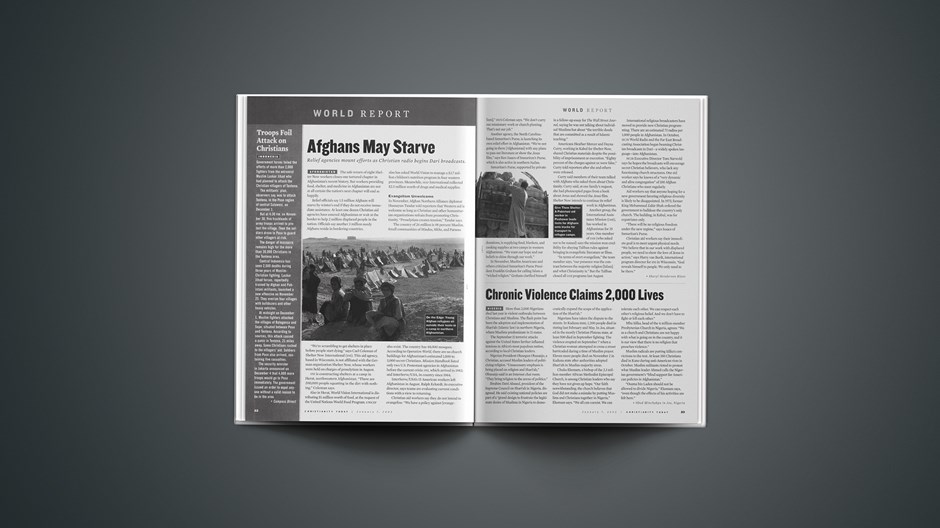
Relief officials say 1.5 million Afghans will starve by winter's end if they do not receive immediate assistance. At least one dozen Christian aid agencies have entered Afghanistan or wait at the border to help 2 million displaced people in the nation. Officials say another 3 million needy Afghans reside in bordering countries.
"We're scrambling to get shelters in place before people start dying," says Cael Coleman of Shelter Now International (SNI). This aid agency, based in Wisconsin, is not affiliated with the German organization Shelter Now, whose workers were held on charges of proselytism in August.
SNI is constructing shelters at a camp in Herat, northwestern Afghanistan. "There are 200,000 people squatting in the dirt with nothing," Coleman says.
Also in Herat, World Vision International is distributing $1 million worth of food, at the request of the United Nations World Food Program. UNICEF also has asked World Vision to manage a $3.7 million children's nutrition program in four western provinces. Meanwhile, MAP International collected $2.5 million worth of drugs and medical supplies.
Evangelism Unwelcome
In November, Afghan Northern Alliance diplomat Humayun Tandar told reporters that Western aid is welcome as long as Christian and other humanitarian organizations refrain from promoting Christianity. "Proselytism creates tension," Tandar says.
The country of 26 million is 98 percent Muslim. Small communities of Hindus, Sikhs, and Parsees also exist. The country has 48,000 mosques. According to Operation World, there are no church buildings for Afghanistan's estimated 1,000 to 3,000 secret Christians. Mission Handbook listed only two U.S. Protestant agencies in Afghanistan before the current crisis: SNI, which arrived in 1982; and InterServe/USA, in country since 1964.
InterServe/USA's 15 American workers left Afghanistan in August. Ralph Eckardt, its executive director, says teams are evaluating current conditions with a view to returning.
Christian aid workers say they do not intend to evangelize. "We have a policy against [evangelism]," SNI's Coleman says. "We don't carry out missionary work or church planting. That's not our job."
Another agency, the North Carolina-based Samaritan's Purse, is launching its own relief effort in Afghanistan. "We're not going in there [Afghanistan] with any plans to pass out literature or show the Jesus film," says Ken Isaacs of Samaritan's Purse, which is also active in southern Sudan.
Samaritan's Purse, supported by private donations, is supplying food, blankets, and cooking supplies at two camps in western Afghanistan. "We want our hope and our beliefs to shine through our work."
In November, Muslim Americans and others criticized Samaritan's Purse President Franklin Graham for calling Islam a "wicked religion." Graham clarified himself in a follow-up essay for The Wall Street Journal, saying he was not talking about individual Muslims but about "the terrible deeds that are committed as a result of Islamic teaching."
Americans Heather Mercer and Dayna Curry, working in Kabul for Shelter Now, shared Christian materials despite the possibility of imprisonment or execution. "Eighty percent of the charges against us were false," Curry told reporters after she and others were released.
Curry said members of their team talked with Afghans who asked them about Christianity. Curry said, at one family's request, she had photocopied pages from a book about Jesus and showed the Jesus film. Shelter Now intends to continue its relief work in Afghanistan.
Another group, the International Assistance Mission (IAM), has worked in Afghanistan for 35 years. One member of IAM (who asked not to be named) says the mission won credibility for obeying Taliban rules against bringing in evangelistic literature or films.
"In terms of overt evangelism," the team member says, "our presence was the contrast between the majority religion [Islam] and what Christianity is." But the Taliban closed all IAM programs last August.
International religious broadcasters have moved to provide new Christian programming. There are an estimated 73 radios per 1,000 people in Afghanistan. In October, HCJB World Radio and the Far East Broadcasting Association began beaming Christian broadcasts in Dari—a widely spoken language—into Afghanistan.
HCJB Executive Director Tom Narwold says he hopes the broadcasts will encourage secret Christian believers, who lack any functioning church structures. One aid worker says he knows of a "very dynamic and alive congregation" of 100 Afghan Christians who meet regularly.
Aid workers say that anyone hoping for a new government favoring religious diversity is likely to be disappointed. In 1973, former King Mohammed Zahir Shah ordered the government to bulldoze the country's only church. The building, in Kabul, was for expatriates only.
Article continues below
"There will be no religious freedom under the new regime," says Isaacs of Samaritan's Purse.
Christian aid workers say their immediate goal is to meet urgent physical needs. "We believe that in our work with displaced people, we need to show the love of Jesus in action," says Harry van Burik, international program director for SNI in Wisconsin. "God reveals himself to people. We only need to be there."
Afghanistan Humanitarian Update includes a look at the refugee situation at a glance, statistics, maps, and analysis. From the UN High Commissioner on Refugees.
Christianity Today's Opinion Roundup looked at the economic and political conditions that may hurt donations for relief work in Afghanistan and other countries.
Have something to add about this? See something we missed? Share your feedback here.
Our digital archives are a work in progress. Let us know if corrections need to be made.















 While we pray for peace, we need moral clarity about this war.
 As my doubts about his teachings grew, so did a secret fascination with Jesus.
 Eastern Orthodox poet Scott Cairns reflects on his new collection, his journey of faith, and poetry’s capacity to apprehend inexhaustible realities.






